A Complete Guide to Identifying and Managing Cannabis Pests Indoors and Out
-

The Silent Invaders: A Complete Guide to Identifying and Managing Cannabis Pests Indoors and Out
Every cannabis grower eventually faces the same harsh reality: you are not alone in your garden. Whether you cultivate in a climate-controlled indoor tent or a sun-drenched outdoor plot, pests will find your plants. The difference between a successful harvest and a heartbreaking loss often comes down to how quickly you spot the problem and what you do about it.
This guide covers the most common cannabis pests, how to identify them before they destroy your crop, and safe control methods that work whether you grow inside or outside.
Why Cannabis Attracts So Many Pests
Cannabis is surprisingly vulnerable to insects and mites. Recent research from Florida identified 105 different arthropod and mollusk species that can infest hemp plants, with 26 of them classified as major pests capable of causing serious economic damage . These numbers are similar for high-THC cannabis.
The plant's soft tissues, dense flowers, and nutrient-rich sap make it an ideal food source. Add to that the warm, humid conditions growers create to maximize yields, and you have an environment pests absolutely love.
The Integrated Pest Management Approach
Before diving into specific pests, you need to understand the philosophy that guides safe, effective control. It is called Integrated Pest Management, and it works the same way indoors and out.
IPM is a four-tiered approach that prioritizes prevention over chemical warfare . The first step is setting an action threshold, which is the point at which pest populations justify intervention. Seeing a single aphid does not mean you need to spray. You need to know when the problem is serious enough to act .
The second step is monitoring and identification. You cannot fix what you cannot find. Regular scouting, sticky traps, and leaf inspections catch problems early .
The third step is prevention. This means creating conditions that pests cannot tolerate through sanitation, environmental control, and plant health .
The fourth step is control. If pests cross your action threshold, you intervene using methods in this order: cultural, physical, biological, and chemical as a last resort .
Common Cannabis Pests and How to Identify Them
Aphids
Aphids are small, soft-bodied insects that come in green, black, or brown. They cluster on leaves, stems, and buds, sucking sap and causing leaf curling and stunted growth . They secrete a sticky substance called honeydew that can lead to mold.
One reliable sign of aphids is the presence of ants on your plants. Ants farm aphids for their honeydew and will protect them from predators . If you see ants marching up your stems, flip the leaves over and look for the real problem.
The cannabis aphid is particularly difficult to control due to its rapid reproduction rate. Each aphid begins extracting plant sap and secreting honeydew from the moment it is born .
Spider Mites
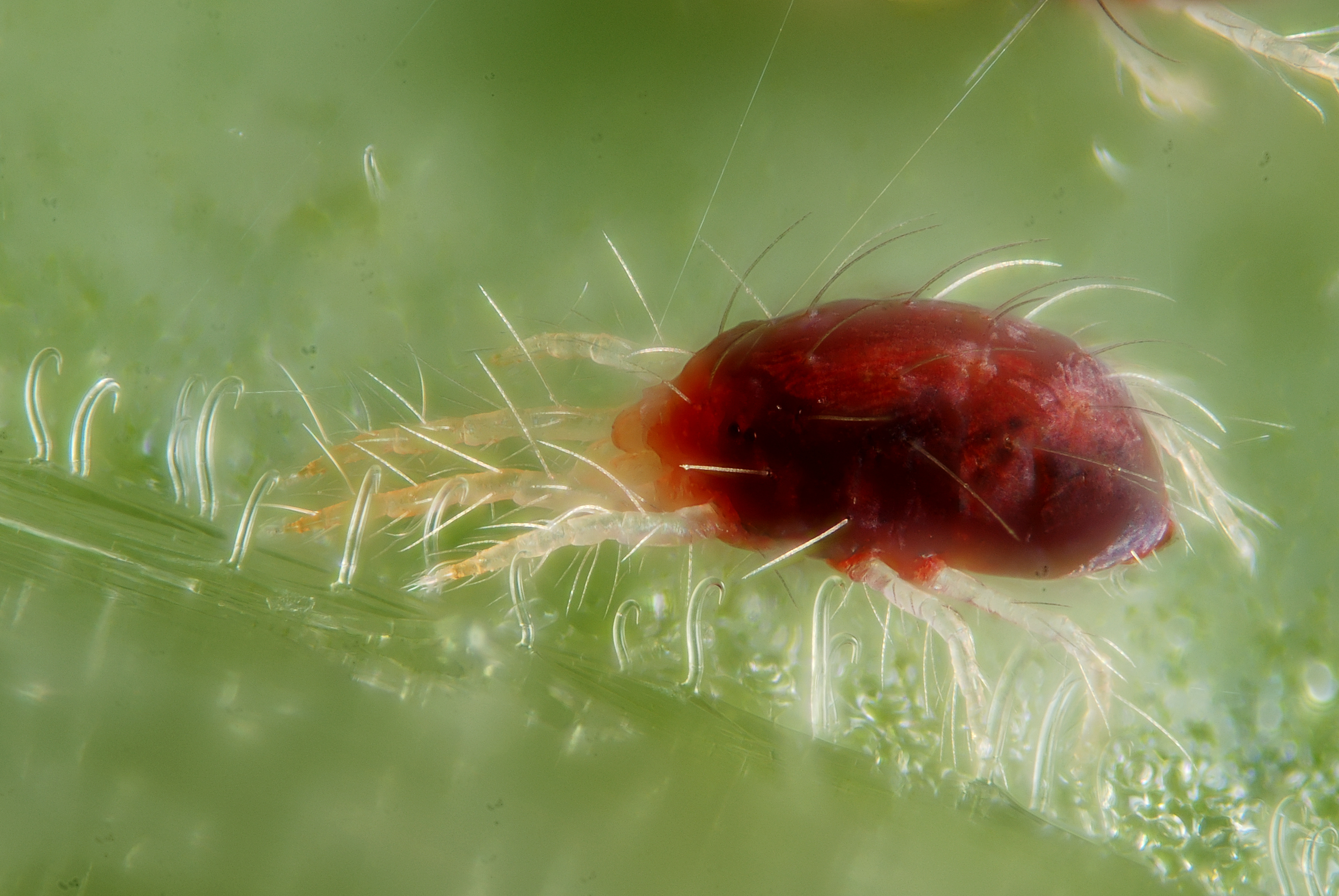
Spider mites are tiny pests that appear as small dots on leaves. They cause yellowing, stippling damage, and eventually webbing . They thrive in dry, dusty conditions and reproduce rapidly.
Infestations usually begin on plants near walls, doors, or posts. The damage starts as small yellow speckles but rapidly escalates to severely damaged leaves covered in webbing. This can quickly kill a plant by preventing photosynthesis .
The Two-Spotted Spider Mite is the most common species. During the flowering stage, a portion of the population may turn red or orange as they enter diapause, which is a hibernation state triggered by changing light cycles .
Recent research tested various products against spider mites and found that garlic oil caused 80 percent mortality within 24 hours, while citric acid caused 58 percent mortality. The predatory mite Amblyseius swirskii showed the highest predation rate against related mite species .
Thrips
Thrips are slender, winged insects that cause silver or bronze discoloration on leaves. They feed by scraping plant tissues and can transmit viral diseases . They are small, about one to two millimeters long, and are often yellow, brown, or black .
You can detect thrips by shaking plants onto a white surface and looking for tiny, fast-moving insects . Onion thrips make up about 95 percent of thrips found in cannabis crops .
Thrips damage shows up as stippling on leaf surfaces, silvering from older feeding damage, and black specks of fecal matter . The most important reason to control thrips is not the direct damage but their role as vectors that transmit diseases between plants .
Fungus Gnats
Fungus gnats are small, dark-colored flies that hover around the soil. The adults are a nuisance, but the larvae cause the real damage by feeding on root hairs, leading to weak plants and root damage .
The larvae live in the soil and can be identified by their brownish-black head capsules. They are cylindrical, milky white to opaque, and have twelve body segments .
Whiteflies
Whiteflies are small, flying insects with a white, moth-like appearance. They feed on the undersides of leaves, causing yellowing, stunted growth, and sticky honeydew residue .
Caterpillars
Caterpillars are the larvae of moths or butterflies. They can cause significant damage by feeding on leaves and buds. They vary in appearance and often blend in with the plant .
Leafhoppers
Leafhoppers are small, wedge-shaped insects that hop or fly away when disturbed. They cause yellowing, stippling, and curling of leaves .
Broad Mites and Hemp Russet Mites
These mites are microscopic and difficult to detect until damage appears. They cause distorted growth and are best prevented through regular monitoring and generalist predatory mites .
Prevention Strategies That Work
Prevention is always easier than treatment. Here is how to keep pests out of your garden regardless of where you grow.
Quarantine New Plants
The first step to a pest-free facility is quarantining plants upon arrival. All plants entering your garden should be inspected immediately. After inspection, quarantine them for a minimum of two weeks in a separate space away from your main growing area .
Start with Healthy Stock
Choose mother plants that are infection-free and buy from reputable sources . Healthy plants fight off pests better than stressed ones.
Sanitation
Maintain a clean environment by removing debris, fallen leaves, and plant material that may harbor pests . In outdoor gardens, weed control is essential because weeds can host pests that migrate to your cannabis .
Environmental Control
Indoor growers can maintain consistent conditions with proper HVAC systems. One reason powdery mildew and root rot are prevalent is environmental inconsistency when lights turn off. Plants continue transpiring for 45 to 90 minutes after the photoperiod ends, and as temperature drops in the dark, humidity spikes create conditions susceptible to pests and pathogens .
Outdoor growers should provide adequate spacing between plants to promote airflow and reduce humidity. Avoid overhead watering, as wet foliage encourages fungal diseases .
Screening and Access Control
Seal potential entry points for pests. Use sticky mats before entering grow rooms to catch hitchhikers. Install screens on vents and intakes .
Monitoring Techniques
You cannot manage what you do not measure. Here is how to stay ahead of problems.
Regular Inspections
Conduct routine inspections of leaves, stems, flowers, and soil . Pay close attention to the undersides of leaves, where most pests begin their infestations . Use a magnifying glass to spot tiny pests like spider mites .
Sticky Traps
Place yellow or blue sticky traps strategically throughout the grow area. They capture flying insects and reveal what is in your crop weeks before visible damage appears . Place yellow traps near the soil line for fungus gnats .
Record Keeping
Maintain logs of pest sightings and control measures. Track trends over time to make informed decisions . This helps you understand whether populations are increasing or decreasing .
Biological Controls
Beneficial insects are your garden's security team. They work indoors and outdoors, providing control without chemicals.
For Spider Mites
Neoseiulus californicus works best as a preventative. It comes in slow-release sachets that release predators for up to four weeks. These mites actively search for spider mites, moving from plant to plant if foliage touches .
Phytoseiulus persimilis is a specialist predator that feeds only on spider mites. It is the most important natural enemy of Two-Spotted Spider Mites and works best as a curative treatment when you already have an infestation .
For Thrips
Amblyseius swirskii works preventatively or for light curative control. These generalist predatory mites feed on first-instar thrips larvae and eggs .
Orius insidious is a predatory bug that prefers all active life stages of thrips. It reacts rapidly to movement, piercing thrips with its mouthparts and consuming them whole .
Stratiolaelaps scimitus is a soil-dwelling predatory mite that feeds on thrips pupae in the soil .
For Fungus Gnats
Stratiolaelaps scimitus also targets fungus gnat larvae in the soil. For heavy infestations, Steinernema feltiae nematodes can be added. These nematodes lie inactive in the soil until a larva passes by, then they attack. They work best when applied together with predatory mites .
For Aphids
Ladybugs and lacewings are voracious aphid predators . Lacewing larvae are nicknamed Aphid Lions because they grasp prey, inject digestive fluids, and suck out the contents .
Aphidius matricariae is a parasitic wasp that lays eggs inside live aphids. The aphid slowly dies and turns into a leathery mummy. The wasp inside hatches two to three weeks later and continues the cycle .
For Broad Mites and Russet Mites
Generalist predatory mites like Amblyseius swirskii and Neoseiulus californicus will usually take care of these pests if you are already using them for thrips and spider mites .
Organic Control Products
When biological controls are not enough, organic products offer effective options with minimal environmental impact.
Neem Oil
Neem oil is extracted from neem tree seeds. It acts as both an insect repellent and a pesticide, disrupting feeding and reproduction of mites, aphids, and caterpillars . It is also effective against fungus gnat larvae .
Insecticidal Soap
Insecticidal soap coats insects and disrupts their cellular structure. It works on aphids, thrips, whiteflies, and other soft-bodied pests .
Garlic Oil and Citric Acid
Recent research confirms that garlic oil causes rapid mortality in spider mites, with 80 percent killed within 24 hours. Citric acid achieved 58 percent mortality in the same timeframe .
Horticultural Oils
These oils smother pests and are effective against a wide range of insects .
Diatomaceous Earth
This powder damages the exoskeletons of insects and dehydrates them. It works well for soil-dwelling pests.
Potassium Bicarbonate
For powdery mildew, weekly treatments of potassium bicarbonate are effective. Some growers also use UV-C light for three to four seconds daily on leaves .
Companion Planting for Outdoor Gardens
Companion planting uses specific plants to repel pests or attract beneficial insects .
Marigolds emit a scent that repels aphids, nematodes, and whiteflies .
Basil repels flies, mosquitoes, and thrips. Some growers believe it enhances the aroma and flavor of neighboring cannabis plants .
Nasturtiums act as trap crops, attracting aphids away from cannabis. They also repel whiteflies and squash bugs .
Lavender attracts pollinators and repels mosquitoes, moths, and fleas .
Indoor-Specific Considerations
Indoor growing gives you more control but creates unique challenges.
Climate Control
High-performance HVAC systems that handle heating, cooling, air conditioning, and dehumidification allow precise control of temperature, humidity, and airflow. These factors impact microbial sporulation, pest mating cycles, and overall IPM efficacy .
No Entry Without Inspection
Indoor rooms are fortresses. Inspect everything that enters, including tools, pots, and especially new plants.
Co2 and Air Movement
Constant air movement over plants creates cooler temperatures that make it harder for spider mites to reproduce .
Outdoor-Specific Considerations
Outdoor gardens face different challenges and opportunities.
Crop Rotation
Rotate crops to disrupt pest life cycles and reduce buildup of specific pests .
Weed Control
Weeds harbor pests that migrate to cannabis. Keep the area around your garden clean .
Resistant Varieties
Some cannabis strains have genetic traits that make them less susceptible to specific pests. Research varieties known for resistance to issues in your region .
Row Covers
Physical barriers like mesh screens or row covers prevent pests from reaching plants .
Chemical Control as a Last Resort
If all else fails and you must use chemical pesticides, follow these rules.
Use chemical control only after other methods have failed . Choose products specifically labeled for use on cannabis and follow label instructions exactly . Be aware of local regulations regarding pesticide use on cannabis.
Understand that unnecessary treatments are costly and may increase pest resistance to pesticides . Synthetic pesticides should be the absolute last resort, as they may pose threats to humans and the environment .
When to Call It
Sometimes you have to accept loss. If hop latent viroid is confirmed, infected plants must be removed and destroyed . For severe root aphid infestations where biological controls do not work, wrapping plants in Reemay and using Botanigard drenches with insecticidal soap every four to seven days may be your only option .
The Bottom Line
Pests are inevitable. Crop loss is not.
The difference between a successful grower and a frustrated one is simple. Successful growers inspect plants weekly. They know what healthy looks like so they spot problems early. They use sticky traps and keep records. They introduce beneficial insects before pests explode. They create environments that favor cannabis, not invaders. And they only reach for sprays when nothing else will work.
Start with prevention. Monitor constantly. Use biology before chemistry. Your plants, your wallet, and anyone who consumes your harvest will thank you.
◆ Mentioned in this thread
Matched from the thread text
