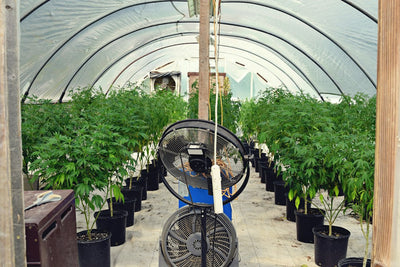
Root Zone Temperature: The Yield Lever You're Ignoring
Photo by Andrew Dawes via Unsplash.
Walk into any serious grow room and you'll find a wall of instrumentation pointed at the canopy: PAR meters, hygrometers, IR thermometers aimed at the leaf surface, maybe a CO2 monitor bolted to the tent frame. Ask the same grower what temperature their root ball or reservoir is sitting at, and you usually get a shrug. Most of us were trained to obsess over air temp and RH because that's what every grow guide talks about, and it's what our HVAC controllers report back to us on a dashboard. Root zone temperature just doesn't get the same billing, even though it's arguably doing more to determine whether that crop finishes strong or limps to harvest.
Here's the part that should change how you think about your setup: root zone temperature is not a byproduct of air temperature. It's a separate variable, decoupled by the thermal mass of your medium and reservoir, and it can be manipulated independently -- often for less money than it costs to condition a whole room of air. A reservoir holds a few gallons; a grow room holds hundreds of cubic feet of air that has to be reheated or recooled constantly as doors open, lights cycle, and exhaust fans run. That asymmetry alone is worth paying attention to.
The numbers from commercial trials make the case bluntly. Root zone temperature optimization systems have been documented producing yield swings anywhere from 30% to over 270% in controlled comparisons -- figures large enough that no grower chasing yield or potency should be ignoring this lever. This piece breaks down the actual temperature ranges that matter, what happens to your plants outside them, and how to get practical root zone control into a setup of any size, from a closet tent to a commercial greenhouse.
Why Root Zone Temperature Isn't the Same as Air Temperature

Photo by Anna Tarazevich via Pexels.
Air temperature and root zone temperature drift apart constantly, and the mechanism is simple thermal physics. A greenhouse can bake at 30°C under midday sun while the slab or reservoir underneath stays a comfortable 21°C, because water and solid growing media have far more thermal mass than air and change temperature slowly. Run the scenario in reverse and you get the opposite problem: a cold basement grow room can hold air at a perfectly reasonable 23°C while an unheated reservoir sitting on a concrete floor slowly bleeds down toward 15°C or lower, chilling every root that touches it.
This matters because roots don't respond to what your ambient thermometer says -- they respond to their own local temperature. Water uptake through root cell membranes, the ion exchange that drives nutrient absorption, and the signaling of hormones like cytokinins and gibberellins that regulate shoot growth and cell division are all temperature-dependent processes happening entirely within the root zone. A canopy sitting in ideal 25°C air with 55% RH can still stall out if the roots underneath it are sitting at 14°C, because the plant simply can't move enough water and nutrients up to support the growth that ideal air conditions would otherwise allow.
In hydroponic and coco coir systems especially, the lag between air and substrate temperature can run for hours. A reservoir heated by an aggressive lighting schedule during the day can still be climbing in temperature well after lights-out, while a coco slab exposed to a cold night-cycle drop from ambient air won't fully warm back up until well into the next light cycle. If you're only checking a wall-mounted thermometer, you have no idea what's actually happening at the root -- you're flying blind on one of the most consequential variables in the entire grow.
The upside is that fixing this is cheap relative to fixing air temperature. Conditioning a few gallons of nutrient solution with an inline chiller or heater, or insulating a root ball from a hot bench, costs a fraction of what it takes to condition an entire room's air volume around the clock. That's the real setup here: root zone temperature is a lever you can pull independently of your HVAC system, and it's one most growers have simply never touched.
The Cannabis Sweet Spot: 20-24°C, and What Happens Outside It

Photo by Remedy Pics via Unsplash.
Cannabis tolerates a fairly wide daytime root zone range, roughly 15-30°C (59-86°F), but tolerating a range and thriving in it are different things. The tight band that shows up repeatedly across grower reporting and cultivation research sits at 20-24°C (68-75°F) -- narrow enough that most growers who've never measured root zone temp directly are almost certainly outside it at some point in their cycle without realizing it.
Push past either edge of the viable range and the plant's chemistry and growth rate both suffer. Above 31°C (88°F), THC potency measurably declines and vegetative and flowering growth both slow down, even if canopy air temp and humidity look textbook on paper. Drop below 15.5°C (60°F) and you get the same slowdown from the other direction -- root metabolic activity drops off and the plant can't keep pace with what the light above it is trying to drive. Get down to 13°C (55°F) and you're no longer talking about a gradual slowdown; the plant goes into mild cold shock, root function essentially stalls, and water and nutrient uptake drop off sharply enough that you'll often see wilting or leaf curl that looks like a nutrient problem but is actually a root temperature problem.
Seedling and clone stages are even less forgiving of temperature swings than mature plants. Research from Roots Sustainable Agriculture Technologies found that holding root zone temperature in that narrow 20-24°C band is specifically necessary for uniform, high-quality seedling development -- even small swings outside that band show up later as uneven stands, with some plants noticeably behind their neighbors despite receiving identical light and nutrients. If you've ever had a tray of clones or seedlings that took off unevenly for no obvious reason, root zone temperature variance is a strong candidate you probably never checked.
The practical fix is straightforward: get an actual probe into the medium, slab, or reservoir rather than relying on an ambient air reading. A cheap substrate or submersible thermometer will tell you, in minutes, whether your root zone is actually sitting where you think it is -- and for most growers, that first real measurement is a genuine surprise.
The Commercial Proof: A 40% Yield Jump in Southern California Greenhouses

Photo by Cannafornia via Pexels.
The clearest commercial demonstration of root zone temperature control comes out of Southern California greenhouse trials using Roots Sustainable Agricultural Technologies' RZTO system. The system held root zone temperature stable at 21°C (70°F) even as greenhouse air climbed to 30°C (85°F) during the day and outside ambient air hit a brutal 43°C (120°F) -- exactly the kind of summer heat load that normally cooks root systems regardless of what shade cloth or evaporative cooling is doing to the air above the canopy.
The results weren't marginal. Dry flower yield increased 40% in the trial, with THC content rising from 18% to 21% in some of the strains grown under root zone control versus untreated controls. Two separate summer trials, run on 400 plants and 200 plants respectively, recorded yield increases of 30% and 118% -- numbers that would be considered remarkable if they came from a new nutrient line or lighting upgrade, let alone from stabilizing a single overlooked variable.
Roots' agronomist Noam Dinar has reported dry matter yield gains ranging from 40% to 270% across combined cooling and heating trials, covering both the summer heat-stress scenario and cold-season root heating. His central argument is one of simple thermodynamics and cost: the root zone is a far smaller, more contained volume than canopy air, which makes it dramatically cheaper to hold at a precise setpoint. You're not fighting convection, door openings, and exhaust cycling -- you're conditioning a slab, a bed, or a reservoir with a fraction of the energy input.
The cold side of the equation gets less attention but matters just as much. Agronomist Mark Fishman has made the point that an unheated, cold root zone can cost growers 2-3 hours of plant growth and photosynthesis per day -- the plant is metabolically capable of running longer, but the roots simply can't keep up with water and nutrient demand until they warm up, so the whole plant effectively idles for a chunk of every light cycle. Over a full flowering run, that's a meaningful percentage of total potential growth time lost to something a heat mat or heated reservoir line could have fixed for the cost of a few dollars a month in electricity.
What the Broader Crop Research Shows
Cannabis growers aren't the only ones seeing this pattern, and the fact that it shows up consistently across unrelated crops is what makes it worth trusting. A 2016 PLOS ONE study out of China Agricultural University found that warming the root zone in cucumber could actively compensate for sub-optimal air temperature stress -- plants exposed to less-than-ideal ambient conditions still grew well when researchers held their root zone at a favorable temperature, which tells you the roots aren't just a passive support system, they're an independent lever on whole-plant stress tolerance.
A 2024 Frontiers in Plant Science hydroponic lettuce study mapped out something important about the shape of this relationship: root growth rises linearly with root zone temperature right up to an optimum point, then falls off sharply once you cross it. This isn't a gentle curve where a little too warm just means a little less growth -- it's closer to a cliff edge, where crossing the optimum by even a few degrees produces a disproportionate drop in root development. A companion 2024 PMC lettuce study tested root zone temperatures of 15, 25, and 35°C over a 13-day trial and found 25°C produced the maximum shoot and root dry weight of the three -- both the cold and hot extremes underperformed the middle setpoint substantially.
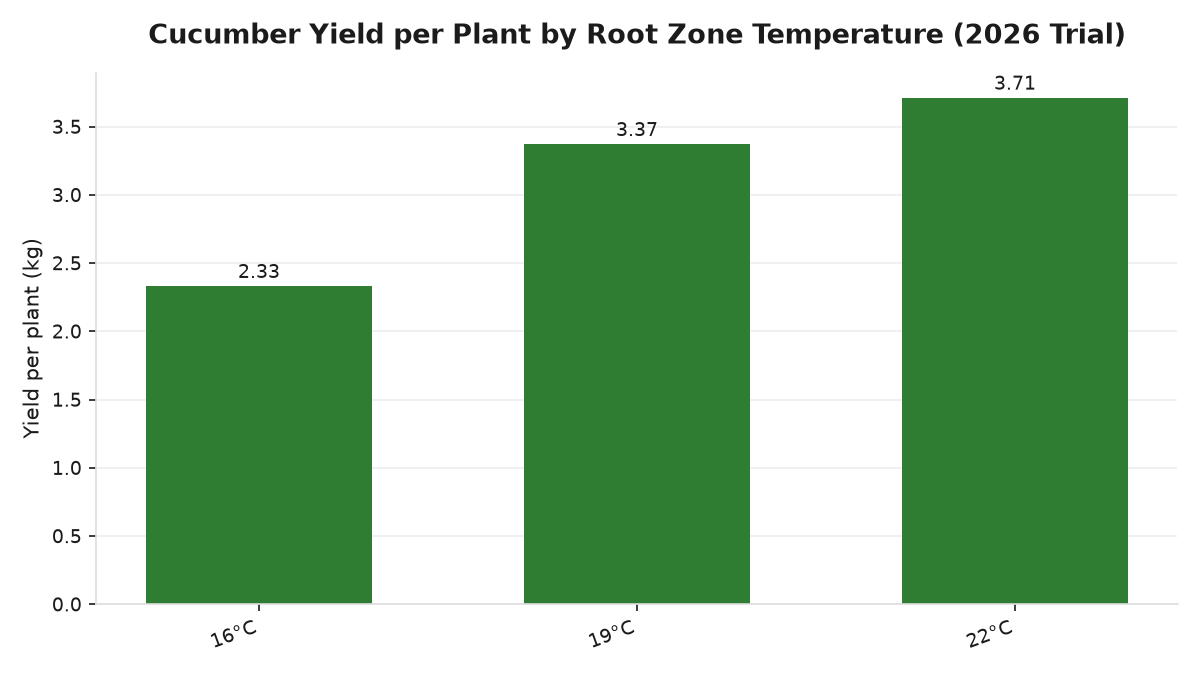
Greenhouse-scale trials back this up at commercial volume. A 2024 solar greenhouse system covered in Nature Index raised irrigation water temperature by as much as 8.6°C during winter production and saw lettuce yield per plant increase by nearly 16% compared to unheated irrigation water -- a meaningful gain from warming water alone, with no other input changed. A March 2026 Scientific Reports greenhouse cucumber trial went further, burying thermal cables 10cm into the soil and testing a range of soil temperatures from 13°C to 25°C. Plants held at 19°C and 22°C yielded 3.37kg and 3.71kg per plant respectively, while plants stuck at just 16°C managed only 2.33kg -- a difference of roughly 60% in per-plant yield driven entirely by soil temperature, with everything else held constant.
The pattern across cucumber, lettuce, and cannabis is the same: yield curves peak in a narrow mid-range band and drop off quickly on both sides. It's not a gradual slope where warmer is always better or cooler is always safer -- there's a real, findable optimum, and missing it in either direction costs you measurably.
Getting Root Zone Control Into Your Own Setup
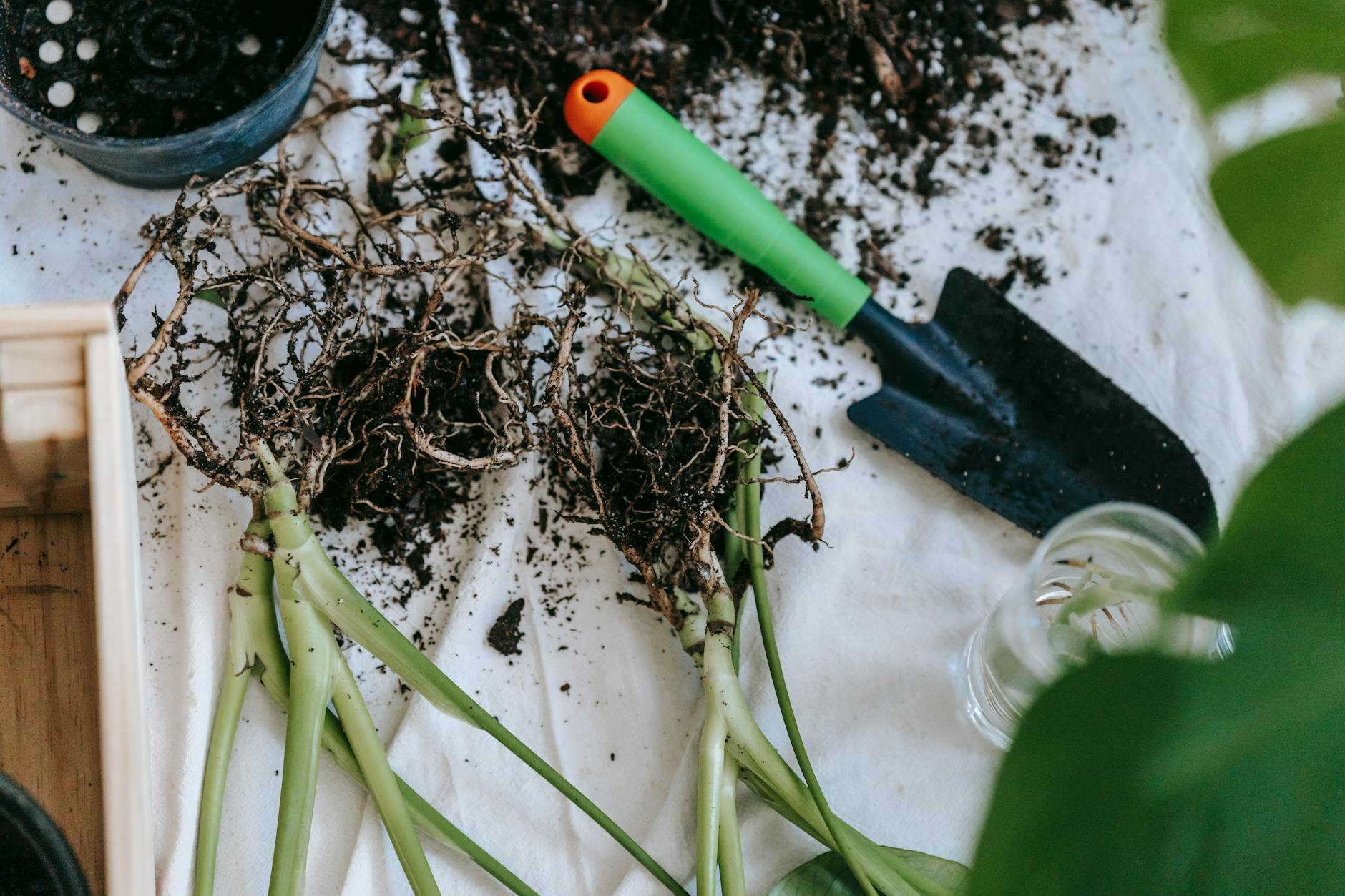
Photo by Teona Swift via Pexels.
Start with measurement, because you can't fix a variable you're not tracking. A submersible thermometer for reservoirs or a substrate probe for coco and soil costs less than a single replacement light fixture, and it will tell you within seconds whether your root zone is actually where you assume it is. Most growers who add this step for the first time find their root zone running several degrees off from what their ambient air reading suggested -- that gap is exactly the blind spot this whole topic is about.
In hydro and DWC systems, the most direct fix is a chiller or inline heater plumbed into the reservoir line, targeting that 20-24°C band discussed earlier. Resist the temptation to let a reservoir drift warm during a hot summer stretch -- once you're pushing past 28°C, dissolved oxygen in the solution drops at the same time root disease pressure from pathogens like Pythium climbs, so you're compounding a temperature problem with an oxygen and pathogen problem simultaneously.
Coco and soil growers have simpler, cheaper tools available. Get containers up off hot concrete or metal benching with a pallet, rack, or even a piece of plywood -- direct contact with a heat-absorbing surface can push root zone temps well above air temp in summer. Light-colored pots reflect more radiant heat than black nursery pots in warm climates, a small change that matters more than it looks like it should. Going the other direction, a basement or cold-climate winter grow benefits from root zone heating mats under trays or containers, holding that same 20-24°C target when ambient room temp alone won't get you there.
Outdoor growers with raised beds or large containers should lean on mulching to buffer the swing between hot daytime soil and cold overnight soil -- and this matters more, not less, as plants get bigger. A large outdoor plant with an extensive root system spread across a bigger volume of soil needs that soil staying uniform in temperature, or you get uneven uptake across the root mass even when the plant looks fine above ground.
Genetics still play a real role here. Well-bred seeds respond more predictably to environmental tuning than genetically inconsistent stock, which is part of why Seedtiva puts real effort into offering quality genetics rather than just volume -- but no genetic advantage overcomes a root zone parked at 13°C or 32°C for weeks at a time. Match your investment to your scale: a hobby grower needs a $20 probe and maybe a $60 heat mat, while the chiller-and-heater loop systems that produced those 40-270% commercial gains only make financial sense once you're running at a scale where the yield difference pays for the equipment many times over.
By the time most growers have their lighting spectrum and intensity dialed to a specific DLI target and their nutrient EC and pH locked to the growth stage, they've already spent real money and real time chasing incremental gains. Root zone temperature control is one of the few variables left on the table that's both cheap and high-leverage -- conditioning a few gallons of reservoir solution or a bed's worth of root medium takes a fraction of the energy and equipment cost of conditioning an entire room's air volume around the clock, and the yield data across cannabis, cucumber, and lettuce all point the same direction.
The mental shift that matters most here isn't technical, it's procedural: stop assuming root zone temperature follows air temperature, and start measuring it as its own setpoint. A probe in the medium or reservoir costs almost nothing and removes the guesswork entirely. Once you know your actual number, the fixes -- a heat mat, an inline chiller, better pot placement, mulch -- are simple and inexpensive relative to almost anything else you'd spend on to move yield.
None of this happens in a vacuum, and results will vary with your genetics, your medium, your climate, and how tightly you're already controlling everything else in the room. But the direction of the evidence across every crop it's been tested on is consistent enough that it stops being a marginal tweak and starts looking like an oversight. If you've optimized everything above the medium line and yield has plateaued, the roots are the next place to look.
Sources
- Root zone temperature effect on cannabis growth
- Root Zone Temperature – BESTVALED
- Root zone cooling technology provides often 40% more cannabis yield in high-tech greenhouse
- Optimizing Cannabis Root zone temperatures – key to volume and uniformity - Israel Agricultural Technology & innovations Hub
- The importance of the root zone temperature