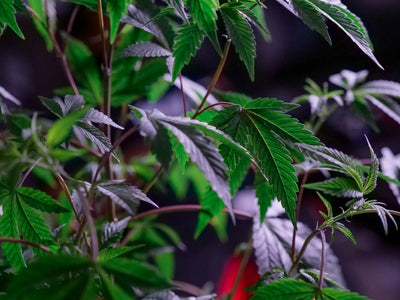
What Alcohol and Tobacco Regulation Tell Us About Cannabis's Future
Photo by KATRIN BOLOVTSOVA via Pexels.
On April 28, 2026, marijuana officially moved off Schedule I for the first time since Nixon signed the Controlled Substances Act in 1970. That sounds like the headline everyone in this industry has been waiting a decade to write. It isn't, or at least not the whole story. The DEA's final order only reschedules two narrow categories to Schedule III: FDA-approved drug products containing marijuana, and cannabis dispensed through a state medical license. Everything else — the recreational dispensary in Denver, the adult-use shop in Detroit, the entire multibillion-dollar non-medical market — stays exactly where it's been since the Nixon era, sitting on Schedule I next to heroin.
That split status has no real precedent in how America has handled its other vice industries. Alcohol wasn't half-legal after 1933. Tobacco was never scheduled at all. What cannabis has now is a substance that's simultaneously a Schedule III pharmaceutical, a Schedule I street drug, and — in 38-plus states — a fully licensed retail product, all at once, all under the same federal government. It's messy. But it's not unprecedented in the sense that matters for forecasting: America has walked two other morally-fraught substances back into ordinary commerce before, and both times it left behind a legible, well-documented playbook. Alcohol's path ran through the 21st Amendment and a state-by-state three-tier distribution system that still governs your local liquor store. Tobacco's ran through a 1998 legal settlement that traded corporate liability protection for perpetual payments and a public-health messaging campaign. Neither transition was instant, neither was clean, and both left fingerprints on the laws being drafted in Washington right now. Congress isn't guessing at how to regulate cannabis from scratch — Rep. Andy Barr's Lawful Hemp Protection Act lifts alcohol's three-tier TTB permitting structure almost wholesale. That's not an analogy. That's a bill borrowing a template line by line.
Where cannabis actually stands right now

Photo by Andrew Patrick Photo via Pexels.
Start with what actually happened, because the details determine how much weight this moment can bear. On April 23, 2026, Acting Attorney General Todd Blanche announced that the DOJ and DEA had finalized an order reclassifying marijuana under the Controlled Substances Act — but only for two carved-out categories: cannabis-derived products that clear FDA approval, and cannabis dispensed under a state medical marijuana license. That order took effect April 28, 2026. It is a real, consequential change — Schedule III unlocks federal tax deductions under IRC Section 280E for medical operators and opens research pathways that Schedule I effectively blocked for fifty-plus years. But adult-use cannabis purchased at a recreational dispensary in a state without a medical carve-out, or purchased recreationally in a state that does have one, remains Schedule I. So does any THC product that doesn't route through a state medical license. That's a genuinely novel bifurcation — alcohol was never half-Schedule-III, half-Schedule-I depending on the store you walked into.
Two carve-outs sit entirely outside this order and are worth naming explicitly: synthetic THC and hemp regulated under the 2018 Farm Bill's 0.3% delta-9 THC threshold. Both continue under their existing separate legal tracks, untouched by the April order, which is exactly why Congress keeps drafting hemp-specific bills in parallel rather than treating this as settled.
The broader question — full descheduling, not just this narrow carve-out — is moving on a separate, faster clock. Per Trump's December 18, 2025 executive order, an expedited administrative hearing on comprehensive rescheduling opened June 29, 2026, with a mandated conclusion by July 15, 2026. Buried in that process is a transitional mechanism that deserves more attention than it's getting: state-licensed operators who filed by June 29, 2026 qualify for six-month expedited review and can keep operating on their existing state license while the review is pending. That bridge — keep operating under the old regime while the new one gets sorted out — is precisely the kind of transitional device that shows up repeatedly in prior regulatory handoffs, and it's worth watching closely for how it gets used as precedent. Meanwhile, the legislative track hasn't paused to wait for DOJ: on July 16, 2026, seventeen senators led by Cory Booker, Chuck Schumer, and Ron Wyden reintroduced the Cannabis Administration and Opportunity Act, aiming to delist cannabis from the CSA entirely. Administrative and legislative fixes are running simultaneously, not sequentially — a sign nobody in Washington considers the Schedule III order the finish line.
Prohibition's repeal left a three-tier system we still live under

Photo by Danny Doneo via Pexels.
Repeal of Prohibition in 1933 gets remembered as the moment alcohol became legal again, but that's a simplification that matters here. The 21st Amendment didn't deregulate alcohol at the federal level — it handed the entire question back to the states, and most states responded by building a mandatory three-tier system: producers sell only to licensed distributors, distributors sell only to licensed retailers, retailers sell to the public. No direct producer-to-consumer sales, no vertical integration across tiers in most states even today. That structure wasn't an accident of 1933; it was a deliberate response to pre-Prohibition tied-house saloons that brewers had used to monopolize retail markets, and it's still the legal skeleton underneath every liquor store, brewery taproom law, and wine distributor contract in the country.
This is where the cannabis-legislation parallel stops being a loose comparison and becomes a documented borrowing. Rep. Andy Barr's Lawful Hemp Protection Act explicitly proposes a three-tier distribution and permitting model for hemp-derived products, administered through the Alcohol and Tobacco Tax and Trade Bureau — the same federal agency, the same tier logic, adapted wholesale from the alcohol precedent. That's not speculation about what might happen; it's a bill sitting in Congress right now that names its own ancestor.
The catch is timeline. The three-tier alcohol system didn't snap into place uniformly in 1933 — it took decades to stabilize state by state, and some states held onto full prohibition long after repeal. Mississippi didn't repeal statewide prohibition until 1966, thirty-three years after the 21st Amendment passed. If cannabis regulation follows a similar state-by-state maturation curve rather than a single federal switch-flip, the current patchwork of 38-plus divergent state cannabis regimes could persist for decades even after any federal rescheduling resolves, not smooth out within a few years the way market optimists tend to assume.
One structural limit on this analogy matters enough to flag directly: alcohol never operated under an international drug-control treaty. Cannabis does. That constraint doesn't show up anywhere in the alcohol precedent, and it means the three-tier borrowing can only take cannabis legislation so far before it runs into a wall alcohol never had.
The tobacco settlement model: regulation bought with money and health messaging

Photo by freestocks.org via Pexels.
If alcohol's precedent is about distribution structure, tobacco's is about liability. The 1998 Tobacco Master Settlement Agreement bound the major cigarette manufacturers to attorneys general in 46 states plus the District of Columbia, Puerto Rico, and other territories — 52 jurisdictions in total. The core trade was straightforward: manufacturers accepted marketing restrictions and released the states from health-claim litigation exposure, in exchange for making annual payments to those states in perpetuity, adjusted for inflation and sales volume, forever.
The consumption data behind that settlement is the strongest evidence this blog has for any single regulatory intervention actually working. According to National Association of Attorneys General tracking, cigarette consumption fell by more than 50% between 1998 and 2019. Youth smoking rates dropped from 36.4% to 6.0% over roughly that same window. That's not a modest decline — that's one of the largest voluntary behavior shifts in modern American public health history, driven by a combination of settlement-funded anti-smoking campaigns, price increases passed through from the settlement payments, and marketing restrictions that took cartoon mascots and stadium sponsorships off the table.
What's easy to forget is how alive this settlement still is. Colorado's Legislative Council Staff issued a fresh MSA revenue forecast as recently as January 30, 2026 — twenty-eight years after the agreement was signed, states are still building annual budgets around these payment streams as a live line item, not a historical footnote.
Does cannabis have an equivalent liability exposure waiting to force a similar deal? That's the honest open question, and it's speculative in a way the alcohol comparison isn't. Vaping-related lung illness claims and potency-related harm litigation exist, but nothing close to the scale of the tobacco lawsuits of the 1980s and 1990s — those cases involved decades of documented internal industry knowledge about addiction and cancer risk, evidence that doesn't have a clean cannabis analog yet. Cannabis's industry structure is also more fragmented and more state-embedded than tobacco's handful of major manufacturers were, which may make a single unified MSA-style deal structurally harder to negotiate even if the liability materializes. This is reasoned extrapolation from an incomplete data set, not a prediction with a date attached.
Congress is drafting the next law from two different templates at once

Photo by Ramaz Bluashvili via Pexels.
Here's a fact that should reset expectations for how fast a single federal cannabis law arrives: Congress currently has at least three cannabis-adjacent bills moving in parallel, and each one borrows from a different regulatory ancestor. That's not chaos for its own sake — it reflects real disagreement about which sin-industry precedent actually fits cannabis, and that disagreement has to resolve before one framework wins.
The CAOA, reintroduced July 16, 2026 by Booker, Schumer, and Wyden with fourteen other senators, pushes full federal delisting — cannabis off the Controlled Substances Act entirely, closer in spirit to what the 21st Amendment did to alcohol: end federal prohibition and let states run their own systems. S. 3474, the Wyden-Merkley Cannabinoid Safety and Regulation Act, takes a different approach entirely: it would regulate hemp-derived THC federally through the FDA, with dosage caps and product-safety oversight — a food-and-drug regulatory model closer to how the FDA handles nicotine products or over-the-counter drugs than anything alcohol ever experienced. Then there's Barr's Lawful Hemp Protection Act, discussed earlier, pulling specifically from the TTB three-tier alcohol structure for distribution and permitting.
Repeal, FDA drug oversight, and TTB permitting are three genuinely different regulatory philosophies, and having all three represented in live bills at the same time tells you Congress hasn't converged on an answer — it's still auditioning frameworks.
History gives a reason not to expect a quick resolution. After the 21st Amendment, state alcohol laws stayed fragmented and inconsistent for decades before any federal consolidation attempt. It took until 1970 — thirty-seven years after repeal — for the Controlled Substances Act to consolidate federal drug policy into a single framework at all, and even then alcohol and tobacco were carved out of that consolidation entirely. If cannabis policy follows a comparable arc, competing state and federal bills built on different templates could keep coexisting for years before Congress lands on one dominant structure, rather than converging on a tidy single statute in the next legislative session. That's not pessimism; it's just what the last two comparable transitions actually looked like on a calendar.
Massachusetts shows what regulate-it-like-alcohol actually looks like in practice

Photo by AntiM_photography via Pixabay.
Federal precedent is useful for guessing the shape of future law. It's much less useful for predicting how well any of it gets enforced, and Massachusetts is the clearest cautionary case available right now. A 2022 report exposed widespread lab-shopping among Massachusetts cannabis operators — companies routing their products to whichever testing lab was most likely to return a passing result on potency and contaminants, regardless of what the product actually contained. That's a foundational integrity problem: if potency numbers on the label can't be trusted, the entire consumer-safety premise of state legalization is compromised.
The state's response wasn't fast. Rules only tightened in March 2024 — roughly two years after the lab-shopping problem was documented in public reporting. Then a further enforcement report in December 2025 finally forced mandatory audits to begin in May 2026. Add it up: four years elapsed between the problem being exposed and real enforcement teeth arriving. A Brockton dispensary case dragged through adjudication for over three years to resolve what were, by most accounts, fairly clear-cut violations. None of this suggests bad faith on the part of Massachusetts regulators specifically — it suggests that building functioning state regulatory infrastructure from scratch is genuinely slow, understaffed, and procedurally cumbersome work, even when the state wants to get it right.
This is the necessary counterweight to any tidy narrative about federal precedent determining outcomes. Alcohol regulation post-1933 wasn't clean either — state Alcohol Beverage Control boards were underfunded and inconsistent for years, bootlegging persisted well into the 1940s in dry counties, and enforcement varied wildly by state long after repeal was federally settled. Cannabis regulators being slow, inconsistent, and reactive in these early years isn't a departure from the historical pattern established by alcohol — it's a continuation of it. The lesson for operators: don't assume swift, uniform enforcement is coming just because federal law is clarifying. State-level compliance infrastructure is going to remain the genuine bottleneck, likely for years, regardless of what Washington does.
The treaty wrinkle neither alcohol nor tobacco ever had to deal with

Photo by Daniel Nouri via Pexels.
There's one constraint in this whole picture that alcohol and tobacco simply never had to deal with, and it's structural rather than political: the United States is a signatory to the 1961 Single Convention on Narcotic Drugs, and Article 23 requires signatory governments to maintain direct governmental control over cannabis cultivation where it's permitted. That obligation is part of why DEA structured its April 2026 rescheduling order the way it did, carving out narrow FDA-approved and state-medical categories rather than moving toward blanket descheduling in one step.
Alcohol was never subject to an international drug-control treaty of this kind. Neither was tobacco. Both substances could be fully returned to ordinary commercial regulation without anyone in Washington having to check whether the move violated a treaty the U.S. had signed decades earlier. Cannabis doesn't get that freedom. Full federal descheduling — the CAOA approach — runs directly into Article 23's government-control requirement in a way that neither historical precedent ever had to navigate, and that's a genuine legal complication, not a political talking point.
The useful real-world data point here is that the U.S. wouldn't be the first country to hit this wall. Uruguay legalized cannabis nationally in 2013, and Canada followed in 2018 — both are Single Convention signatories, both faced the same Article 23 tension, and neither has faced formal sanction from the International Narcotics Control Board beyond written objections and diplomatic pressure. That's a meaningful signal: treaty friction appears to be manageable in practice, survivable even, rather than an absolute legal bar. But manageable isn't the same as irrelevant. Both Uruguay and Canada built government-licensed cultivation and distribution control systems specifically to maintain a plausible claim of treaty compliance, rather than simply deregulating and ignoring Article 23 outright.
Extrapolating from those two cases, the more speculative read is that full U.S. federal legalization likely requires one of two paths: a government-control cultivation licensing scheme built to satisfy Article 23 on paper, similar to what Canada and Uruguay constructed, or a formal treaty reservation or renegotiation process — a legal step that adds years to any timeline and that neither alcohol's repeal nor tobacco's settlement ever had to clear.
Pull the three threads together and the honest read isn't that cannabis is following alcohol, or following tobacco, or forging some entirely new path. It's tracking a hybrid of the first two precedents simultaneously, with a treaty complication bolted on that neither one ever faced. State markets are being built on alcohol's three-tier distribution logic — Barr's bill makes that borrowing explicit. Federal liability and health messaging look more likely to eventually resolve through something closer to tobacco's settlement-and-perpetual-payment logic, if the liability exposure ever scales to justify it. And overhanging both of those tracks is Article 23 of the Single Convention, a legal constraint that forces any full-legalization bill to either build a government-control cultivation scheme or negotiate around a treaty obligation that alcohol and tobacco simply never had to answer to.
None of that supports betting on a single clean federal statute arriving soon. Alcohol took roughly three decades after repeal for state regulatory systems to genuinely stabilize, with some states holding onto prohibition into the 1960s. Tobacco's settlement didn't arrive until 1998 — 85 years after federal alcohol policy first started down its own regulatory path in 1933, in the sense that both were sin-industry reckonings separated by nearly a century of accumulated legal and cultural groundwork. Measured against either of those timelines, the current mess — a Schedule III carve-out that only covers two narrow categories, three competing bills borrowing from three different ancestors, a treaty obligation nobody's fully resolved — looks like early-stage normal, not a sign that Washington is uniquely dysfunctional on this particular substance.
For businesses trying to plan around that uncertainty rather than wait it out, the practical takeaway is to build for both templates at once rather than betting on one winning. That means TTB-style three-tier distribution compliance infrastructure and FDA-style dosage and safety documentation, running in parallel, because Congress genuinely hasn't picked a lane yet and may not for years. And Massachusetts is the reminder that speed to market matters less than durable compliance infrastructure — a four-year gap between an exposed lab-shopping scandal and real enforcement teeth is exactly the kind of regulatory lag that rewards operators who built clean systems early, and punishes the ones who assumed enforcement would stay loose forever.
Sources
- Federal rescheduling resources - Department of Cannabis Control
- Cannabis Rescheduling: DOJ, Treasury, and DEA Updates Since the April 23 Order | Foley Hoag LLP
- Duane Morris LLP - Relief, Finally? DEA Issues Order Expediting Cannabis Rescheduling to Schedule III
- Marijuana Rescheduling Regulatory Actions | DEA.gov
- Federal Register :: Schedules of Controlled Substances: Rescheduling of Marijuana