

China's Hemp Empire: How Two Provinces Feed the World
Photo by Mark Stebnicki via Pexels.
Walk into a textile mill in Dhaka or a rope manufacturer in Ho Chi Minh City and there's a decent chance the raw hemp fiber on the floor started as a licensed crop in northeastern or southwestern China. Depending on which trade metric you trust, China accounts for anywhere from a third to nearly 70% of the world's industrial hemp supply -- the range comes down to whether you're counting planted hectares, processed fiber tonnage, or finished product value, and those three yardsticks tell different stories about the same crop.
What's not in dispute is where it's grown. Almost all of it comes from two provinces -- Yunnan in the southwest and Heilongjiang in the far northeast -- operating under a licensing system Beijing put in place in 2010 and hasn't meaningfully expanded since. No open planting, no free-market entry for farmers elsewhere in the country. Just a tightly controlled footprint that keeps getting more productive without getting geographically bigger.
Here's the part that trips up a lot of outside observers: this is a country that grows and ships enormous volumes of hemp fiber, hurd and seed to the rest of the world, yet bans CBD, hemp seed oil and leaf extract from its own food, medicine and cosmetics markets. China exports the raw material for products its own citizens aren't legally allowed to buy at home. That gap -- massive upstream cultivation paired with a locked-down domestic downstream -- is the real story here, and it's worth understanding province by province, license by license.
The Numbers Behind the Dominance
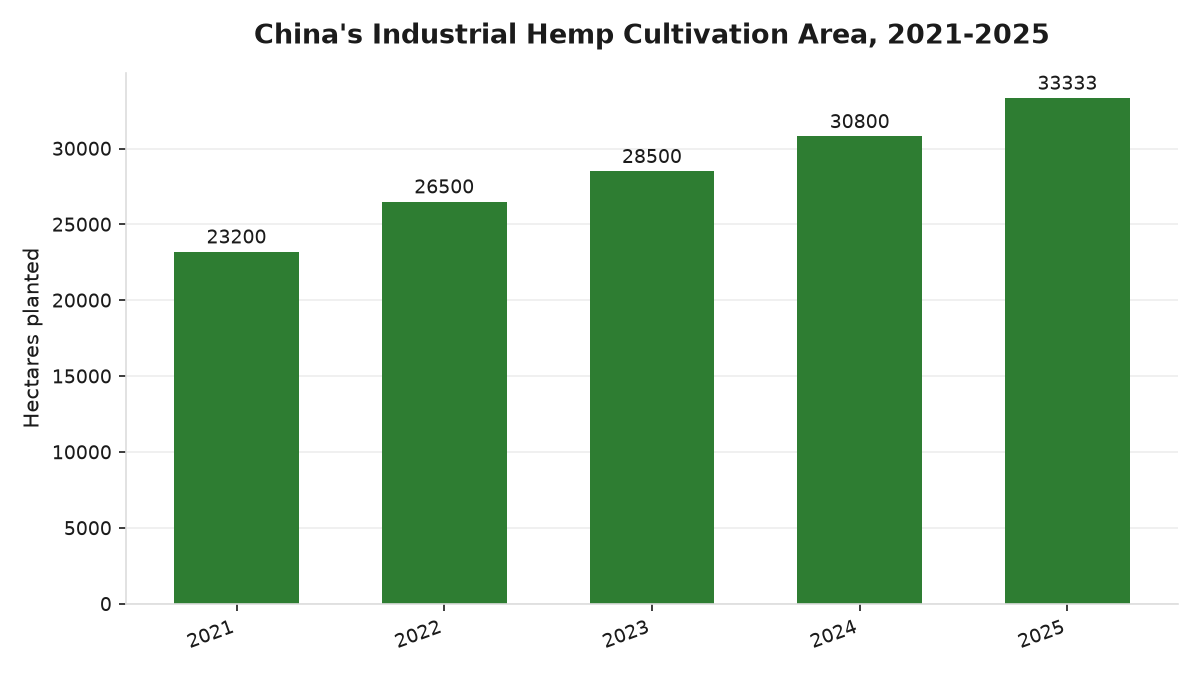
Ask three different sources how much of the world's industrial hemp comes from China and you'll get three different answers, and none of them are wrong exactly -- they're just measuring different things. One widely cited figure puts China at 70% of global hemp production in 2025, with somewhere between 40,000 and 50,000 tonnes grown annually. Another estimate, focused specifically on fiber, says China supplies more than half the world's natural hemp fiber. A third, looking at cultivated area rather than output, lands closer to one-third of global hemp acreage. All three can be true simultaneously because China's hemp operations are unusually fiber-efficient and processing-heavy compared to hemp grown elsewhere for seed oil or grain.
What the raw hectarage numbers show is a steady, almost boring climb rather than a boom. In 2021, China planted about 23,200 hectares of industrial hemp, yielding roughly 128,000 tons. That grew to 26,500 hectares and 145,000 tons in 2022, then 28,500 hectares in 2023. Estimates put 2024 planting at around 30,800 hectares, with 33,333 hectares projected for 2025. Year over year, that's growth in the high single digits to low double digits -- not the kind of spike you'd see in a market chasing a speculative wellness boom.
That steadiness is itself informative. A crop expanding this predictably, within a fixed geographic footprint, points to a state-managed industry rather than a gold rush. Provincial agriculture bureaus are issuing licenses at a measured pace, processors are scaling capacity in step with supply, and there's no sign of the volatility you'd expect from a market driven by consumer demand swings. It behaves like grain or cotton policy, not like a commodity chasing a trend.
The methodology gap matters for anyone trying to size the market from outside China. If you're sourcing raw hurd for construction material, hectares planted is your relevant number. If you're buying processed fiber for textile blending, tonnage of finished fiber matters more. Conflating the two -- or citing a single percentage without specifying which one -- is how a lot of the wilder claims about China's hemp dominance get repeated without much scrutiny.
Why It All Happens in Two Provinces
Photo by Mark Stebnicki via Pexels.
China didn't decide to become a hemp fiber power through some sweeping national agricultural reform. It happened because two provincial governments got permission in 2010 to run commercial industrial hemp programs, and no other province has been added to that list since. Heilongjiang, bordering Russia in China's far northeast, and Yunnan, in the mountainous southwest near Myanmar and Laos, remain the only two legal cultivation zones in the entire country fifteen years later.
This isn't a market anyone can simply enter with capital and farmland. Cultivation and processing both require licenses tied to specific companies and named individuals, issued by provincial authorities under rules that function more like a controlled quota system than an open agricultural sector. Yunnan's licensing data from early 2020 gives a sense of the granularity: 158 companies licensed to plant industrial hemp, 101 licensed to process flower and leaf material, 14 licensed specifically for extraction work, and 87 holding pre-processing approval. Every stage of the supply chain, from seed in the ground to processed material leaving a facility, has its own permission slip.
The system isn't frozen, though -- it's just expanding within its existing lines rather than drawing new ones. Between March 2023 and April 2026, Yunnan issued 50 additional industrial hemp cultivation licenses, a meaningful increase in participants without any suggestion that a third province is about to join the program. Combined, Yunnan and Heilongjiang cultivate more than 150,000 hectares annually according to China's Ministry of Agriculture and Rural Affairs, most of it destined for textile fiber, traditional medicine ingredient supply chains, and export.
Jilin province, north of Heilongjiang, actually drafted hemp cultivation regulations back in 2018 that looked like a step toward becoming the third legal growing zone. That language never made it into Jilin's final 2022 Anti-Drug Regulations -- it was dropped. That's a small but telling data point: Beijing has had chances to widen the legal map and has consistently chosen not to. The two-province model isn't a starting point on the way to something bigger. It looks like the intended endpoint.
Grow It, Export It, Don't Use It at Home

Photo by Jess Loiterton via Pexels.
Here's where China's hemp policy gets genuinely strange to outsiders: the plant that supplies a huge share of the world's industrial fiber and hurd is legally walled off from the country's own food, medicine and cosmetics shelves. Industrial hemp cannot be used in Chinese medicines or foods under current rules. CBD, hemp fruit, seed oil and leaf extract are all barred from cosmetic formulations sold domestically. If you're a Chinese consumer, the plant grown in your own provinces isn't something you can legally buy as a wellness product, a food additive, or a skincare ingredient.
Beijing tightened this further rather than loosening it. On August 5, 2024, six government departments -- including the Ministry of Public Security and the National Medical Products Administration -- jointly issued an announcement specifically regulating cannabidiol alongside six other controlled substances. That's a coordinated, multi-agency move, not a minor administrative update, and it signals CBD is being treated with the same regulatory seriousness as other controlled compounds rather than being carved out as an industrial hemp derivative with lighter oversight.
And yet roughly 150 CBD extraction companies operate inside China right now, running facilities that process hemp biomass into cannabidiol isolate and distillate almost entirely for buyers overseas. These aren't black-market operations -- they're licensed extraction businesses producing a compound their own domestic market won't let them sell locally. The entire commercial logic of that sector depends on export demand from the US, Europe and elsewhere absorbing product that Chinese law keeps off Chinese shelves.
The policy reasoning behind this split treats hemp as an industrial fiber and seed crop -- something closer to cotton or flax in the state's eyes -- while treating cannabis, and by extension CBD extraction, as adjacent to controlled substance territory. CBD extraction sits right at the seam between those two categories, which is exactly why it draws the tightest scrutiny even as raw fiber and hurd move freely through customs. China has essentially decided it will grow the plant and process the intermediate compound, but not let the finished consumer product circulate at home.
Where the Fiber Goes

Photo by RAJESH KUMAR VERMA via Pexels.
Chinese hemp fiber, hurd and seed move through a fairly identifiable set of destinations: the United States, Bangladesh, Vietnam, Cambodia, Indonesia, India, Turkey, Italy, Spain and Brazil show up consistently as the major buyers. Notice what that list is mostly made of -- large textile manufacturing economies. Bangladesh, Vietnam and Cambodia aren't importing Chinese hemp to stock wellness shelves; they're blending it into cotton and other fibers on an industrial scale for garment and textile production. That's a very different demand driver than the CBD-focused framing that dominates hemp coverage in North America and Europe.
The dollar figures show real scale with some recent softening. Hemp-fiber exports are estimated at $2.018 billion in 2025, which is actually down 15.23% from 2024. Zoom out further, though, and that 2025 figure is still up 68% from the roughly $1.2 billion China exported back in 2018. So the single-year dip reads less like a structural problem and more like normal fluctuation layered on top of a genuine multi-year growth trend.
That 2024-to-2025 pullback is more plausibly tied to softening global textile demand and shifting trade routes than to any hemp-specific policy shift out of Beijing or the provinces. Textile orders move with broader consumer spending cycles, and hemp fiber, as an input rather than a finished good, rides those cycles rather than setting them.
None of this happens in a vacuum separate from the larger US-China trade relationship, either. The 2025-26 IEEPA disputes, ongoing Section 301 tariff actions, and the November 2025 Busan trade truce haven't singled out hemp fiber specifically -- but they're the backdrop against which every buyer and seller in this trade has to operate. A tariff schedule change or a fresh round of trade friction doesn't need to mention hemp by name to still hit hemp shipments sitting in a container alongside other Chinese agricultural and textile exports.
What This Means for Global Buyers
Photo by Bilal Ahmed via Pexels.
If your business depends on hemp fiber, hurd or seed sourced from China, you're not really buying into a diversified global commodity market -- you're buying into a licensing system run by two provincial governments. That's a materially different risk profile than sourcing, say, cotton, which comes from dozens of countries with independent growing seasons, currencies and regulatory regimes. A weather event, a licensing freeze, or a provincial policy shift in Yunnan or Heilongjiang doesn't compete against alternative supply the way a disruption in a more geographically distributed crop would -- it just directly constrains global supply.
That concentration risk is easy to underweight because the growth curve out of China has looked so calm for the past several years. Steady annual increases in hectares and tonnage can create a false sense that the supply is as reliable as any other agricultural input. But steady growth within a licensing system controlled by two provincial governments is not the same thing as steady growth in an open market -- the reliability so far reflects policy continuity, not structural redundancy.
Meanwhile, countries building out their own hemp sectors -- the US, EU member states, Canada -- aren't really trying to beat China on raw fiber cost. That's a losing fight given China's scale and processing infrastructure. Where they're actually competing is in CBD and food-grade extraction, the exact segment China's own domestic ban keeps its companies from serving inside China. China's 150-odd CBD extraction operations sell abroad by necessity, which means Western and Canadian producers aren't fighting Chinese competitors for domestic wellness-market shelf space so much as they're fighting each other, with China supplying some of the raw and intermediate material to everyone involved.
The number worth watching going forward is license issuance in Yunnan. Fifty new cultivation licenses between 2023 and 2026 is a meaningful signal that Beijing intends to keep scaling within its existing two-province structure. If that pace continues or accelerates, expect global fiber supply to keep growing steadily. If it stalls, that's the first sign the licensing regime -- not weather, not demand -- is capping how much hemp reaches world markets from China.
Strip away the percentage debates and the trade figures, and what's left is a fairly simple structural fact: China's hemp dominance is a function of who holds a license, not how much farmland is theoretically available. Beijing has kept the legal growing map limited to two provinces for fifteen years, even as output within that footprint has climbed nearly every year. That's a choice, repeated deliberately -- Jilin's dropped 2018 hemp language shows Beijing had an opening to expand the map and passed on it.
At the same time, China has built one of the world's largest hemp export operations while keeping its own population largely locked out of CBD, hemp seed oil and leaf extract as consumer products. The August 2024 joint regulatory action, coordinating six government departments around cannabidiol specifically, makes clear this isn't an oversight waiting to be corrected -- it's a deliberate policy stance that shows no sign of softening soon.
For anyone building supply chains or policy around hemp outside China, the practical takeaway is to stop thinking of China as a wellness-product competitor and start thinking of it as what it actually is: a raw-material supplier operating under a concentrated, government-controlled licensing system. That reframes the real risk -- not that Chinese CBD floods your market, but that a policy shift in two provincial capitals could tighten global fiber and hurd supply in a way no amount of diversified cotton or synthetic-fiber sourcing elsewhere would fully offset.


