

Colombia's Bid to Become the World's Cannabis Farm
Photo by Cannafornia via Pexels.
Talk to anyone in Colombia's cannabis industry for more than five minutes and you'll hear the pitch: this is a country that gets roughly 12 hours of equatorial sunlight every single day of the year, where land leases and farm labor cost a fraction of what they do in Ontario or Oregon, and where you can pull four cannabis harvests a year instead of one or two. It's a compelling story, and it's mostly true. What's less true is the revenue picture that got attached to it back when Canadian capital was flooding into Bogotá and Rionegro around 2019 and 2020.
Export figures have in fact climbed every year since 2020 -- there's no reversal in the trend line, no collapse to point to. But the climb has been arithmetic, not exponential. The billion-dollar projections that consultancies and eager analysts floated a few years back haven't materialized, and probably won't anytime soon. What Colombia actually has is a slow, grinding build-out of a niche medical export business, propped up by genuinely superior growing economics, running years behind the hype cycle that financed it.
That makes 2026 an unusually loaded moment to check in on the industry. Colombia's Congress is moving a recreational legalization bill through committee, President Gustavo Petro is publicly campaigning for it as part of a larger break from prohibition-era drug policy, and Washington is simultaneously dangling tariff threats tied to drug-policy disagreements. None of that changes the sunlight or the soil. But it could change who's allowed to profit from them.
From $5 Million to $10.8 Million: The Real Numbers
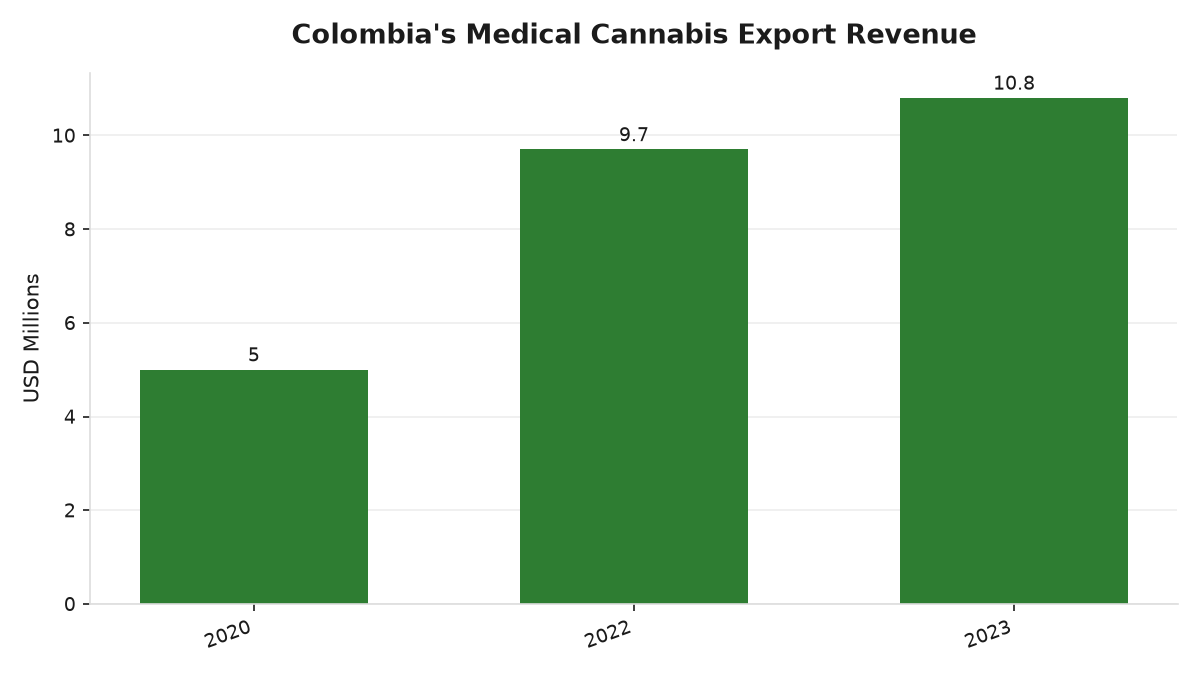
The cleanest way to understand Colombia's cannabis export story is to just line up the numbers, because they tell a much more sober story than the marketing decks did. Medical cannabis exports were worth about $5 million in 2020. By the first half of 2021 alone, exports had already hit $8 million, suggesting real acceleration. The momentum held: from January through November 2022, exports reached $8.4 million, a 96% increase over the same eleven-month stretch in 2021. Full-year 2023 numbers came in at $10.8 million, up 11.3% from $9.7 million in 2022.
Those are genuinely positive growth rates -- doubling, then growing another double-digit percentage the following year is nothing to dismiss. The problem is what those numbers were supposed to be. Fedesarrollo, one of Colombia's most respected economic think tanks, had projected the industry would be generating $800 million annually by 2025, on its way to $2.3 billion within a decade. Actual 2023 exports of $10.8 million aren't a rounding error away from $800 million -- they're roughly 1.3% of that projection.
Statista's more recent modeling is far more conservative and, frankly, more credible given what's actually happened: it pegs the broader legal Colombian cannabis market at $64.59 million by 2025, growing to $71.64 million by 2029 at a compound annual growth rate of just 2.09%. That's a market finding its real size after a few years of speculative overshoot, not a market about to explode. For investors who bought into the early hype, that gap between promise and delivery has been the defining disappointment of the last five years. For everyone else, it's a useful reminder that agronomic advantage doesn't automatically translate into market size -- distribution, regulation, and buyer demand still have to catch up.
Who's Buying: Brazil, Australia, Germany

Photo by Wolfgang Weiser via Pexels.
Colombia's export book isn't concentrated in one or two markets, and that's mostly by design. In 2023, 32% of Colombian cannabis exports went to Brazil, 25% to Australia, and 14% to Germany, with the remainder spread across smaller Latin American and European buyers. That kind of spread is healthy for a young export industry -- it means no single country's regulatory mood swing can sink the whole sector.
Germany's number is worth sitting with for a second: the country imported a record 31,398 kilograms of Colombian medical cannabis products in 2023, a figure directly tied to the expansion of Germany's own medical cannabis prescribing market, which has grown steadily since the country loosened its medical access rules. Colombian growers essentially caught a wave that Germany created domestically, supplying flower and extract to a European market that doesn't have the climate to grow it as cheaply itself.
Brazil, though, is the market to watch. It's now Colombia's single largest cannabis buyer, and demand there has been rising as Brazil's own medical cannabis patient base grows and its import pathways for foreign-produced cannabinoid products mature. Avicanna CEO Aras Azadian has pointed to something structurally important underneath these numbers: reciprocal regulatory agreements with INVIMA, Colombia's national drug regulator, that allow products like Avicanna's Trunerox to be registered across 22 other Pan-American countries once approved domestically. That kind of regulatory leverage -- one approval opening doors across a hemisphere -- is arguably more valuable long-term than any single year's export total.
The flip side of a diversified buyer base is diversified exposure. Colombia isn't beholden to one country's politics, but it is now watching import rules in Brasília, Canberra, and Berlin simultaneously, and any one of those markets tightening its medical cannabis import framework would show up in Colombia's export ledger within a year.
The Companies Doing the Growing

Photo by Mikhail Nilov via Pexels.
Four companies dominate the visible landscape of Colombian cannabis cultivation and processing: Clever Leaves, PharmaCielo, Khiron Life Sciences, and Avicanna. They're the names that show up in export data, investor filings, and INVIMA registration records, and they've collectively absorbed the industry's boom-and-bust cycle in real time.
PharmaCielo's facility in Rionegro, in Antioquia department, is the physical anchor of the industry -- Colombia's largest cannabis processing center, with capacity to handle 360 tons of biomass annually. That's the kind of infrastructure that only makes sense if you're betting on volumes far larger than what's currently moving through Colombian ports. It was built, largely, during the 2019-2020 period when Canadian capital was pouring into Colombian cannabis on the strength of exactly the kind of billion-dollar projections that haven't panned out. What followed was predictable: consolidation, write-downs, and a much leaner set of survivors than the number of companies that originally chased licenses.
The firms still standing have learned to care intensely about regulatory detail, because small rule changes translate directly into commercial breathing room. Colombia recently extended the shelf life for THC-containing products from 24 to 48 months, which matters enormously for export logistics -- a product that degrades in two years is a much harder sell to a buyer six weeks away by container ship than one rated for four. Regulators also approved domestic pharmacy sales of medical cannabis flower, opening a local revenue channel that didn't previously exist and giving companies a market to sell into while export volumes slowly build.
Both changes came out of coordinated work across the ministries of Health, Justice, and Agriculture -- not glamorous, but exactly the kind of bureaucratic plumbing that determines whether a processing plant like Rionegro is running at capacity or sitting half-idle.
Why Colombia Grows Cannabis Cheaper Than Almost Anyone

Photo by Cannafornia via Pexels.
Strip away the market projections and the political drama, and Colombia's actual competitive advantage is agronomic, and it's a real one. The country sits close enough to the equator that farms get roughly 12 hours of solar radiation daily, essentially unchanged across the calendar year. There's no winter dieback, no seasonal light curve to work around, no need for supplemental lighting to stretch a growing season the way producers in Canada or the northern United States require.
That consistency is what allows Colombian growers to run up to four harvests a year. Compare that to most temperate-climate cannabis-producing countries, where growers typically manage one or two outdoor harvests annually and rely on energy-intensive indoor cultivation to fill the gaps. Four harvests a year on the same acreage is a fundamentally different cost structure -- it's not that Colombian cultivation is marginally more efficient, it's that the underlying unit economics are in a different category.
Growers in Colombia use three broad cultivation methods: open sky, where plants grow with minimal structural intervention; semi-automated open sky, which adds some irrigation and climate monitoring without full enclosure; and indoor, reserved mostly for genetics work and higher-value pharmaceutical-grade product. Each has its place, but the open-sky and semi-automated approaches are where the real cost advantage lives, since they avoid the capital and energy overhead that indoor cultivation demands in colder climates.
The number that gets repeated most often in industry pitches is production cost: as low as $0.06 per gram of dried flower, among the lowest reported anywhere in the world. That figure is the entire foundation of Colombia's pitch to international buyers and investors -- not projected market size, not regulatory sophistication, just the plain fact that nobody else can grow this cheaply at scale. It's why the export numbers, modest as they are, keep climbing rather than stalling out.
The Legal Foundation: From 2016 Law to 2021 Export Decree

Photo by Andrius La Rotta via Pexels.
None of the current export activity would be legally possible without two specific pieces of Colombian law, and it's worth understanding what each one actually did. Law 1787 of 2016, signed July 6, 2016, legalized the cultivation and manufacturing of medical cannabis in Colombia. It created the licensing framework -- cultivation licenses, manufacturing licenses, seed licenses -- that every company operating today, from PharmaCielo to Clever Leaves, still operates under. Before this law, Colombia's relationship to cannabis was defined almost entirely by its role in illicit trafficking networks; Law 1787 was the formal pivot toward a licensed, regulated medical industry.
The second pivotal moment came five years later. President Iván Duque's Decree 811, issued July 23, 2021, lifted the ban on exporting dried cannabis flower. This is easy to understate but it was genuinely a turning point. Before Decree 811, Colombian companies could only export extracts and derivatives -- oils, isolates, processed pharmaceutical ingredients -- not the raw dried flower itself. That restriction capped revenue potential significantly, since flower exports open up entirely different buyer categories and price points than derivative-only sales, and many international medical markets specifically want flower rather than extract.
It's worth being precise about what these two laws did and didn't do: neither one touched recreational or adult-use cannabis. Colombia's export growth since 2020, all $10.8 million of it in 2023, sits entirely within a medical-cannabis legal framework built by Law 1787 and expanded by Decree 811. Whatever happens with the recreational legalization bill currently moving through Congress, it would be layered on top of this existing structure, not a replacement for it. Anyone trying to understand where Colombia's export industry is today needs to start with these two dates -- July 2016 and July 2021 -- because everything currently happening in Rionegro warehouses and INVIMA registration offices traces back to them.
The 2026 Legalization Push and a Looming U.S. Tariff Threat

Photo by raksasok heng via Pexels.
Colombia's Congress took a real step toward broader legalization in 2026: a House committee voted on May 12, 2026, to advance a recreational cannabis bill filed by Representative Alejandro Ocampo, sending it on to the full chamber for debate. The bill isn't a simple legalization measure -- it would levy a 20% tax on cannabis sales and, more strikingly, require that 50% of cannabis production come from ethnic and peasant associations. That's a direct attempt to tie legalization to rural and Indigenous economic inclusion rather than letting the existing corporate medical cannabis industry simply absorb a new adult-use market.
This isn't the first attempt. A prior legalization bill failed in the Senate in 2023, and there's real uncertainty about timing this time around too -- debate on the current version could slip to the legislative session that begins July 20, 2026, rather than moving quickly through the full chamber. President Gustavo Petro has been an outspoken backer of legalization, framing it as part of a broader effort to move Colombian drug policy away from decades of prohibition-focused enforcement that he argues has done more harm than good, particularly in rural and coca-growing regions.
Hanging over all of this is a separate, purely geopolitical complication: in late 2025, Washington floated tariffs on Colombian exports, citing disagreement over Colombia's drug policy direction. Whether or not those tariffs materialize, or whether Congress passes the Ocampo bill at all, the threat itself is a reminder that Colombia's cannabis export story doesn't play out in isolation -- it's tangled up with the broader, often tense relationship between Bogotá and Washington on drug policy generally.
The ethnic and peasant production quota is the detail that deserves the closest attention going forward. If it survives committee negotiation, floor debate, and a Senate vote, it would represent a genuine departure from how Colombia's medical cannabis industry has been organized to date -- an industry currently dominated by a handful of well-capitalized firms like PharmaCielo and Clever Leaves, with little structural role for the ethnic and peasant communities the quota is designed to include.
Strip away the legislative drama in Bogotá and the tariff noise from Washington, and Colombia's underlying pitch hasn't changed since Law 1787 first opened the door in 2016: cheap sun, cheap land, cheap labor, four harvests a year. That advantage is agronomic, not political, and it will keep drawing buyers in Brazil, Germany, and Australia regardless of whether Petro's legalization push clears the Senate this time or stalls the way it did in 2023.
The more interesting question isn't whether exports keep growing -- they will, the trend since 2020 is unambiguous even if the pace has badly disappointed the analysts who called for billion-dollar numbers. The real test is whether that growth accelerates fast enough to justify what's already been poured into infrastructure like PharmaCielo's 360-ton Rionegro facility. A plant built for hemispheric scale doesn't pay for itself on $10.8 million a year in exports, and the gap between built capacity and actual throughput is the industry's real vulnerability right now, more than any single regulatory threat.
And if the 50% ethnic and peasant production quota actually survives to final passage in the Ocampo bill, it won't just be a footnote in Colombia's drug policy history -- it could genuinely redistribute who profits from this industry, shifting value away from the handful of well-capitalized firms that have run the medical export business since 2016 and toward the rural and Indigenous communities the current model has mostly left out. That's a bigger story than any export total, and it's one worth watching closely through the rest of 2026.
Sources
- Colombia Emerging as a Global Supplier of Cannabis
- Colombia’s Cannabis Export Boom: How the Country Is Becoming a Global Medical Marijuana Powerhouse | Get Med Card
- Colombian Cannabis Exports Nearly Doubled Last Year
- Is Weed Legal in Colombia? 2026 Cannabis Laws Explained
- Colombia Authorizes Exports of Dried Cannabis Flower for Medicine | Cannabis Business Times


