Piedmont's Hemp Golden Age and Italy's Long Decline
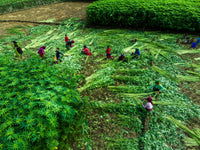
Photo by Mark Stebnicki via Pexels.
Carmagnola is a town of a few tens of thousands of people southeast of Turin, and its name is still attached to a hemp cultivar. A cultivar name outlasting the industry that made it is a small, stubborn survival. The plant carrying that name was once prized for tall stalks and fine fibre, and the farming knowledge behind it filled a whole regional economy.
By the late twentieth century almost none of that was in use. A country often described as second only to the Soviet Union in hemp output had, within a few decades, next to no commercial crop. How does a leading producer disappear that fast?
A caveat before going further. Historical acreage figures vary by source, and the numbers here are approximate and drawn from secondary accounts. Italian law has also moved quickly in recent years, so check current rules against the Gazzetta Ufficiale before acting on anything below.
Key takeaways
- Italy was long one of the world's largest hemp producers, with Piedmont, Emilia-Romagna and Campania as core growing regions.
- Synthetic fibres, cheap cotton and postwar drug-control law all contributed to the industry's collapse in the decades after World War II.
- Law 242/2016 revived industrial hemp, but the 2025 security decree's reported flower restrictions leave the sector's legal footing contested.
When Italy Grew Hemp on an Industrial Scale
Italy is widely described as the world's second-largest hemp producer after the Soviet Union during the early-to-mid twentieth century. The figure you will see most often is roughly 100,000 hectares under cultivation. Treat that as approximate and unconfirmed. Sources disagree on both the number and the peak years, and this section leans on secondary historical accounts rather than archival statistics.
Three regions anchor the story: Emilia-Romagna, Campania and Piedmont. They did not play identical roles. Each had its own place in the chain from field to finished cordage and cloth, with local traditions of growing and processing that shaped what came out of it.
Piedmont's calling card was the Carmagnola cultivar, from the area near Turin. It had a reputation for tall plants and high-quality fibre, the kind of raw material spinners and ropemakers paid attention to.
Geography helped. The plains of northern Italy offered level, fertile land and ready access to water, both useful for a crop that grows fast and needs processing in wet conditions. I am keeping this general on purpose, because quoting yields without a sourced record would be guesswork.
The takeaway is simple. Italian hemp was not a hobby crop on the margins. It was a structured agricultural sector with regional specialisations, and Piedmont sat near the quality end of it.
Rope, Sails and Cloth: What the Fibre Was For

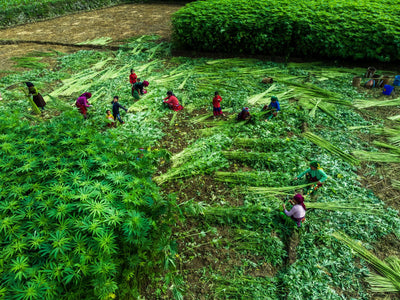
Photo by İpek Dükel via Unsplash.
Hemp was a working fibre. It went into rope, sailcloth, canvas, sacking and household textiles such as sheets and heavy linens. Seafaring states depended on cordage and sail, so a steady domestic supply of strong fibre mattered strategically as well as commercially.
Getting from standing stalk to usable fibre took a great deal of hands-on labour. The rough sequence went like this:
- Cut the stalks at harvest.
- Ret them, soaking the stalks so the fibre loosens from the woody core.
- Dry them.
- Break the stalks, then scutch them to separate the fibre.
That sequence set the rhythm of the rural year. Families and neighbours worked through it together, and the calendar bent around it.
Retting often took place in ponds and streams, which made it a visible part of the landscape in hemp districts, and, by many accounts, a smelly one. Exactly which waterways and villages were involved varies by locality, so verify local specifics with regional historical societies before repeating any particular claim.
For many farming families this was a cash crop, not a niche product. It brought in money in a part of the year and fed a web of local trades: ropemakers, weavers, merchants and carters.
Italian fibre was valued abroad, and that much is well supported in general terms. Precise export volumes, destinations and prices are a different matter. Those need archival trade records, and I would not trust any number quoted without one.
How a Leading Producer Collapsed After 1945

Photo by jovan curayag via Pexels.
In the decades after World War II the pressure came mostly from markets. Synthetic fibres such as nylon offered cheap, uniform rope and textiles. Imported cotton and jute undercut hemp on price for many uses. Meanwhile mechanisation made other crops easier to grow, while hemp stayed stubbornly labour-intensive.
Then there was the law. The 1961 UN Single Convention on Narcotic Drugs treated cannabis broadly, and that framework made hemp cultivation harder to defend politically even when the fibre had nothing to do with drug use. Italy's 1975 drug law, Law 685/1975, is often cited in accounts of the decline too. How much it changed life for actual farmers is a question for legal scholarship, and anyone relying on it should check that literature.
So which mattered more? My reading, and it is an informed reading rather than settled fact, is that economics did most of the damage. A crop that cannot compete on price does not need a prohibition to vanish. Law then compounded the problem by raising the risk and cost of staying in or returning to the business.
The knock-on losses are what made the collapse so hard to reverse:
- Processing mills closed or converted.
- Retting know-how stopped being passed down.
- Seed stock, including heritage lines, was lost or left unmaintained.
Acreage can return in a season. Mills and skills take far longer. That gap explains why Italy's revival has been so much slower than its heritage might suggest.
Law 242/2016 and the Return of Industrial Hemp

Photo by Daniel Lucia via Unsplash.
Law 242/2016 was written as a farm-support measure. It created a framework to back the hemp supply chain and allowed cultivation of certified varieties without prior authorisation. Verify the exact wording at gazzettaufficiale.it, since summaries, including this one, compress the details.
The law also sets THC thresholds for permitted crops, along with tolerances for testing. Readers should confirm the current limits and how they are applied, because these are the numbers that decide whether a harvest is legal.
For Piedmont the practical effect was to reopen the door to heritage varieties such as Carmagnola. Farmers could return to fibre and seed, and to newer uses such as hempcrete, the hemp-and-lime building material. It was a chance to reconnect with local genetics rather than starting from imported seed alone.
For sector data, go to the people who track it. The main trade bodies are Federcanapa, Canapa Sativa Italia, Assocanapa and Coldiretti. I am not quoting hectare or revenue figures here because none are sourced for this piece.
There is a complication. The post-2016 market leaned heavily on flower and CBD products, not just fibre. Retail shops selling hemp flower spread quickly, and for many growers that was where the money was. A law aimed at agriculture had quietly become the legal foundation for a consumer product category, and that set up the later conflict.
The 2025 Security Decree and an Unsettled Sector

Photo by Elsa Olofsson via Unsplash.
The next turn came through a very different kind of law. Decree-Law 48/2025, the so-called Decreto Sicurezza, was converted into law in June 2025. It is reported to restrict the sale of hemp flowers and inflorescences. Readers should verify the final text rather than rely on this summary.
In practical terms, that matters most for retailers and farmers who built businesses on flower. Shops selling it and growers supplying them face the biggest exposure. Fibre and seed are not the target as reported, so those parts of the industry should be left largely untouched, though that too should be checked against the text.
Several questions remain open and need confirming before anyone treats the picture as settled:
- Whether court challenges have been filed or decided.
- Whether an EU TRIS notification was made, and whether the European Commission has responded.
- What the Ministry of Health's current enforcement position is.
The history makes the irony hard to miss. A crop revived under a farm-support law is now being reshaped through a public-security law. The framing has shifted from supporting a supply chain to policing a product.
Laws change, and enforcement can differ from what the text suggests. Check current rules with official sources, or a qualified Italian lawyer, before growing or selling anything.
What Piedmont's Legacy Still Offers

Photo by Ekaterina Grosheva via Unsplash.
Can Italy regain anything like its former standing? Realistically, no. Land use has changed, processing capacity has been lost, and the markets that once absorbed Italian fibre now buy from elsewhere or buy something else entirely.
Niches look more plausible than a return to bulk. Building materials such as hempcrete are one candidate. Textiles are another, especially at the higher-value end. Seed and heritage genetics are a third. I would not put market figures on any of them without sourced data.
Piedmont's strength is knowledge and a documented cultivar, not scale. Carmagnola gives the region a story and a genetic asset that newer entrants lack. What it does not give is machinery.
The real bottleneck is infrastructure: retting and decortication capacity, meaning the equipment that strips fibre from stalk. Without it, farmers can grow a fine crop and have nowhere nearby to turn it into something sellable.
As a general observation, to be checked before anyone relies on it, comparable European producers such as France have kept a larger fibre industry. The lesson there is about continuity of processing, not about soil or climate.
Italy's hemp story shows how an industry can be lost to economics and regulation together, and how little seed alone can do to bring it back. Rebuilding takes mills, skills and legal certainty, and the last of those is the hardest to guarantee.
The irony is that the Carmagnola name survives while the supply chain that made it famous has to be rebuilt from scratch. Whether that happens depends partly on how the 2025 rules are applied and challenged, and partly on whether anyone invests in processing before the next legal shift.
Sources
- Italy hemp flower ban faces fresh scrutiny after Supreme Court ruling on confiscations
- "Light" Cannabis in Italy: Ban on Hemp Flowers to Be Decided by the Constitutional Court in February 2027 - Newsweed
- Industrial Hemp Italy: Cultivation Laws & THC Limits 2026
- Is Cannabis Legal in Italy? 2026 Rules Explained
- Is Hemp Legal in Italy? 2026 Industrial Hemp & Cannabis Light Laws
- Italy Cannabis & Hemp Regulations News & Updates