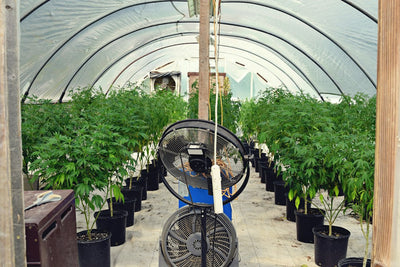
Best LED Grow Light Settings to Maximize Bud Density
Photo by CRYSTALWEED cannabis via Unsplash.
Introduction
A dense, rock-hard cola is the holy grail for any cannabis grower. It’s what separates a trophy harvest from a disappointing one. You can have the perfect strain and the best nutrients, but if your buds are airy and loose, you're left wondering where you went wrong. For years, the conventional wisdom was to play it safe with light, capping intensity to avoid stressing the plants. But a growing body of real-world data is starting to flip that script. The truth is, for those willing to look past the old rules of thumb, the secret to density isn't hidden in a bottle of bloom booster—it's hiding in plain sight, and it’s all about how many photons you're hitting the canopy with. Let’s break down why light intensity is the single most powerful lever you have for building bud density, and how you can use it without torching your garden.
Why Light Intensity Drives Density More Than Almost Anything Else

Photo by Ndispensable via Unsplash.
Run the numbers on a cola from a plant grown at 400 PPFD next to one grown at 1,200 PPFD and the difference isn't subtle. The high-light plant isn't just heavier at harvest -- it's built differently, with tighter internodes stacked into a dense, resinous spear instead of a loose, airy branch. That difference comes almost entirely down to one variable: how much light hit the canopy every single day of flower, not the strain, not the pot size, not the brand of nutrients.
The research backing this up comes from the University of Guelph, where Rodriguez-Morrison, Llewellyn, and Zheng ran cannabis under a range of canopy-level PPFD values and tracked dry inflorescence yield against light intensity. What they found upends a lot of the light-capping advice that circulated for years: dry flower yield increased linearly all the way up to 1,800 µmol/m²/s. There was no plateau, no point of diminishing returns within the range they tested. That's a striking result given that leaf-level photosynthesis in cannabis saturates much lower, generally somewhere in the 700-1,000 PPFD range depending on CO2 and temperature. The whole-canopy response kept climbing well past the point where a single leaf stops photosynthesizing faster.
The explanation is architectural, not just biochemical. In a real canopy, light doesn't hit every leaf evenly -- upper leaves shade lower ones, and inner bud sites sit in partial shade even under strong lighting. Cranking up PPFD pushes more usable light down through those shaded layers, driving photosynthesis in tissue that would otherwise be running on scraps. That's why the yield curve keeps rising even after individual top leaves have technically saturated: you're not measuring one leaf, you're measuring the whole plant's light budget.
Just as important, the Guelph data showed apical inflorescence density and harvest index rising linearly with intensity too. That means you're not just growing more plant mass at higher PPFD -- you're growing a much larger share of that mass as dense, marketable flower rather than stem and fan leaf. This is the density conversation in a nutshell: light intensity is doing double duty, pushing total yield up while also shifting the ratio of the harvest toward the part you actually sell or smoke.
Cannabinoid concentration held essentially flat across the entire 120-1,800 PPFD range in that study, which tells you THC/CBD percentage isn't a light-intensity lever the way people assume. Total terpene content did tick up modestly at the high end, though, hinting that aroma and flavor benefit a little more from intensity than potency percentage does.
What this really kills off is the old rule of thumb capping PPFD around 600-800 to avoid stressing plants. For genetics that can handle it, that ceiling was leaving real density and yield on the table. But genetics and root zone still set the actual limit -- a small pot with a cramped root mass and mediocre airflow can't support the transpiration and nutrient uptake that 1,200+ PPFD demands, and pushing light without matching feed strength, CO2, and airflow just gets you nutrient burn or bleached, crispy tops instead of denser buds. Quality genetics from a source like Seedtiva that's bred for vigor gives you the headroom to actually use that extra light instead of just cooking the canopy.
PPFD and DLI Targets by Growth Stage

Recommended light intensity (PPFD) rises sharply as plants mature, from just 200 µmol/m²/s for seedlings to 800 µmol/m²/s during standard flowering—and up to 1300 µmol/m²/s when CO2-enriched, more than 6x the seedling requirement.
Every PPFD number you'll see thrown around in a grow forum is meaningless without knowing what stage the plant is in, and mismatching light intensity to growth stage is one of the most common ways new growers stall a plant that had every genetic advantage going for it. Seedlings in particular get hammered by over-eager growers who slap a 600-watt LED at full power over a two-week-old taproot. At that stage, with a root mass that couldn't support rapid transpiration if it wanted to, you want 100-300 µmol/m²/s. That's it. Anything higher and you're not accelerating growth, you're inducing stress responses -- curled leaf margins, stunted node spacing, sometimes outright bleaching on the cotyledons. Counterintuitively, too little light at this stage causes stretch just as badly as too much heat, so the goal is steady, moderate photon delivery, not minimalism for its own sake.
Once you've got 3-4 true node sets and roots have filled a decent chunk of their container, you move into vegetative growth under an 18/6 photoperiod. This is where you build the scaffolding -- canopy width, branch count, internodal spacing -- that flower stage will later load with weight. PPFD in the 400-600 µmol/m²/s range is the sweet spot for most cultivars during veg. You're not trying to max out photosynthetic rate yet; you're trying to build a structurally sound, evenly lit canopy that can actually absorb the intensity you'll throw at it later. Pushing veg PPFD past 600 rarely buys you anything except a bigger electric bill, since a young plant's leaf area index simply isn't large enough to use that many photons efficiently.
Flower is where the real intensity math kicks in, and it trips people up because they forget the photoperiod changes too. On 12/12, most growers target 600-1,000 µmol/m²/s at canopy, with advanced CO2-enriched rooms pushing 1,000 and sometimes 1,500+. Here's the part that gets skipped in a lot of grow guides: because 12/12 delivers only two-thirds the lit hours of 18/6, you need roughly 50% higher PPFD in flower just to match the same daily photon budget you had in veg, let alone exceed it for the bud-building push you actually want. That's the logic behind the jump from 500 to 800 µmol/m²/s at the switch -- it's not arbitrary escalation, it's compensating for six fewer hours of light per day.
The number that actually matters more than instantaneous PPFD is Daily Light Integral -- total photons landing on canopy over 24 hours. For flower, you want 35-50 mol/m²/day measured at canopy height with a quantum PAR meter, not a lux meter or your light's marketing spec sheet. Do the math on your own setup: 800 µmol/m²/s times 12 hours times 3600 seconds, divided by a million, lands you around 34.5 mol/m²/day -- right at the floor of that target range. Push to 1,000 µmol/m²/s and you're at roughly 43 mol/m²/day, comfortably mid-range.
One hard ceiling worth respecting: without CO2 supplementation, cap PPFD around 1,000 µmol/m²/s. Ambient CO2 sits near 400-420 ppm, and photosynthetic rate in cannabis plateaus right around that intensity when carbon is the limiting factor rather than light. Running 1,300 µmol/m²/s in a room without enrichment doesn't get you more bud, it gets you heat stress and bleached cola tops. That extra headroom up to 1,500 only pays off when you're also running CO2 at 1,200-1,500 ppm, which is a whole separate investment in sealed-room infrastructure most home growers haven't made yet. Match your intensity ambitions to your actual CO2 setup, not the other way around.
How Far Can You Push It? Lessons From High-PPFD Commercial Trials

Photo by CRYSTALWEED cannabis via Unsplash.
Most of what gets published on high-PPFD flowering comes from grower forums and anecdote. The Texas Original Compassionate Cultivation trial with Fluence by OSRAM is one of the few real commercial datasets worth citing, because it wasn't a one-off tent experiment -- it ran across production rooms starting in early 2020, with sole-source LED lighting pushed well beyond what most cultivators would consider sane. Cultivation head Jason Sanders and his team stepped intensity up in stages, from a baseline of 1,000 PPFD up to 2,500 PPFD, tracking yield, quality, and plant response at each increment rather than guessing.
The headline result: yield kept increasing all the way to 2,500 PPFD. That alone surprised a lot of people who assumed photosynthetic saturation would cap gains somewhere in the 1,200-1,500 range, which is where a lot of older HPS-era thinking still sits. But the shape of that yield curve matters more than the fact that it kept climbing. Past roughly 1,800 PPFD, the gains flattened into a classic bell curve -- each additional 100 PPFD bought less than the last. You were still moving forward from 1,800 to 2,500, just at a fraction of the return you got moving from 1,000 to 1,800.
What genuinely surprised the team was the absence of phototoxicity, even at 2,500 PPFD, which on paper should be scorching canopy on most strains. That's not a green light to blast light at plants indiscriminately -- it's a reminder that photobleaching and heat stress are usually failures of everything around the light, not the light itself. When CO2, airflow, temperature, and feed are all dialed to match the intensity, cannabis tolerates far more PPFD than conventional wisdom allows. Pull any one of those support systems out from under high intensity and you'll see the leaf damage everyone expects.
For home growers and small commercial operations without industrial CO2 injection and precision climate control, the practical number to take from this trial isn't 2,500 -- it's 1,800. That's the point where the curve bends, and it's achievable with a strong CO2 enrichment setup (1,000-1,500 ppm), tight VPD management, and real airflow across the canopy, without needing the kind of environmental infrastructure a licensed cultivation facility runs. Chasing 2,500 PPFD in a room that can't support it doesn't just waste electricity -- it actively stalls growth, because intensity without matching CO2 and feed strength just pushes plants past what their metabolic machinery can use, and you end up with locked-up growth instead of denser buds.
Dialing In Spectrum: Red, Blue, and the Density Tradeoff

Photo by maxsel via Pixabay.
Red light between 600 and 700nm is what actually pays the bills during flower. It sits near the peak of chlorophyll absorption, drives the bulk of photosynthetic electron transport, and lines up closely with what McCree's original action spectrum work identified as the most efficient region for converting photons into carbon fixation. In practical terms, that means red is what's building the sugars that get shuttled into your colas as trichome-loaded flower mass. If you're chasing density, red isn't just part of the recipe -- it's the base you build everything else around. Most modern full-spectrum flowering fixtures run somewhere in the 65-75% red fraction of total PPFD, and that's not an accident of LED bin economics. It reflects what actually pushes dry weight.
Blue light (400-500nm) plays a completely different role. It doesn't drive much biomass accumulation directly, but it triggers phytochrome and cryptochrome responses that shorten internode spacing and thicken stem tissue. A plant grown under blue-heavy light in veg comes out short, stocky, and structurally sound -- exactly what you want holding up a dense cola instead of flopping over under its own weight by week 6. The mistake a lot of growers make is assuming that because blue has a reputation for boosting THC and driving compact bushy growth, more must be better all the way through flower. It isn't. A well-controlled peer-reviewed trial tracking blue fraction from 4% up to 20% of total PPFD found a strikingly consistent, linear yield penalty -- about a 12% drop in dry flower weight across that range, with no plateau or diminishing effect. Every percentage point of extra blue past the low single digits cost yield, even as growers assumed they were dialing in potency. That's a real tradeoff, not a myth, and it means maxing out your blue channel because you read blue boosts cannabinoids is likely working against your harvest weight.
The clearest commercial-scale data on this comes from the Fluence/Wageningen University trial run in 2019-2020 with TGOD and TOCC cultivars. Researchers compared a broader-spectrum recipe (R4) against a redder, more narrow-band recipe (R6), both run at 1,500 PPFD. The broader R4 spectrum outyielded the redder R6 by 17% in dry bud weight. That's a substantial gap for a spectrum-only variable, and it confirms that stacking red past a certain point without the supporting green and far-red wavelengths in a full spectrum actually underperforms a more balanced recipe -- even one with a lower nominal red percentage.
The practical takeaway: favor a broad, red-heavy full spectrum over a narrow-band deep-red diode setup, and keep blue present but modest -- generally in the 5-10% range of total PPFD rather than pushed to 15-20% chasing potency claims. If your fixture has independent red, blue, and white dimming channels, this is exactly where that hardware earns its keep: run blue a bit higher through veg for internode control, then dial it back 30-40% relative to red once you flip to flower, letting the broader white/red channels take over as the dominant yield driver.
Fixture Efficacy and Practical Room Setup

Photo by kundennote_com via Pixabay.
When you're shopping fixtures for a serious flower run, efficacy (measured in µmol/J, or micromoles of photons per joule of electricity) tells you more than wattage ever will. Going into 2026, treat 2.5 µmol/J as the baseline for anything you'd call a modern full-spectrum flower fixture. That's the number where a quality board-and-bar LED with decent drivers should land. If you're paying premium prices, you want to see 3.0 µmol/J or higher -- that's the top tier right now, the fixtures using the latest Samsung LM301H EVO or Osram diodes paired with efficient constant-current drivers. Anything meaningfully below 2.2 µmol/J in a new fixture in this market is dated technology, full stop, regardless of what the PPFD chart on the box claims.
The practical payoff of higher efficacy isn't just a lower power bill -- it's thermal headroom. A fixture converting more of its input watts into usable photons and less into waste heat lets you run higher PPFD without cooking your canopy or blowing out your VPD targets. This is what actually unlocks bud density: you can push flower-stage PPFD into the 900-1100 µmol/m²/s range (for cultivars that can use it) while keeping leaf surface temps in check, something a 2.0 µmol/J fixture from five years ago simply can't do without an industrial-scale exhaust setup.
Peak PPFD at dead center of the canopy is a vanity number if the corners of your tent are starving. Take readings with a quantum PAR meter at nine points across the canopy -- corners, edges, and center -- at actual bud height, not floor height. A well-designed fixture with good secondary optics should keep you within 15-20% uniformity across that grid. If your corners are reading 40% below center, you're leaving yield on the table in most of your footprint no matter how impressive the peak number is. Adjust hang height first before assuming you need a bigger light; raising a fixture 4-6 inches often does more for uniformity than it costs you in peak intensity.
Don't flip the switch to target PPFD on day one of flower. Ramp intensity over the first 10-14 days, moving up in 10-15% increments every 2-3 days, giving the plant time to build leaf thickness and adjust stomatal density before you demand full photosynthetic output. Skip this and you'll see canopy bleaching, tip burn, or stalled growth in week 2 instead of the stretch-then-stack pattern you want.
None of this works in isolation. Higher PPFD without a corresponding bump in feed strength just starves the plant at the exact moment it needs more raw material -- expect to run EC 0.2-0.4 higher than you would under a weaker light, alongside tighter VPD control (0.9-1.2 kPa through early-to-mid flower, 1.2-1.6 kPa approaching harvest). And genetics still set the ceiling: some cultivars pack rock-hard colas under 1000+ µmol/m²/s while others hyperaccumulate stress before they hyperaccumulate resin. Match your strain selection to your lighting ambitions -- Seedtiva's genetics are bred with high-intensity indoor setups in mind, but results will still track your specific room, climate, and dial-in.
Conclusion
In the end, growing dense, high-quality flower comes down to understanding that light isn't just fuel—it's the architect of your final product. The science is clear: your plants can take more than you might think. The plateau that old-school growers feared is largely a myth, as long as your environment is dialed in to match the intensity. High PPFD is the key to unlocking the yield that your genetics are capable of, shifting the harvest ratio towards the heavy, resinous buds we all want.
But this isn't a license to just blast your plants. It’s a recipe that requires balance. Spectrum, CO2, temperature, and feed all have to be in harmony with your light levels to avoid causing more harm than good. The name of the game is consistency and providing that daily light integral your plants need to pack on weight.
So, as you plan your next grow, think beyond the wattage. Focus on the PPFD, understand the DLI, and invest in a meter that lets you see what’s really happening. The data doesn't lie—when you get the light right and support it with a tight grow environment, you're not just growing plants; you're engineering a harvest that's dense, potent, and aromatic. It’s hard work, but the payoff is unmistakable.
Sources
- 20+ Best LED Grow Lights for Indoor Marijuana Growing in 2026 - Plants Of Merit
- Cannabis Flower Room Lighting: 2026 Guide to PPFD & DLI | Thrive Agritech
- LED Grow Light Buyer’s Guide (2026): How to Choose the Best Grow Light for Cannabis - Mr. Grow It
- LED Grow Lights for Cannabis: PPFD, Spectrum, and Room Design (Complet – FloraFlex
- Maximize Indoor Plant Yield With LED Grow Lights — LED Grow Lights Depot