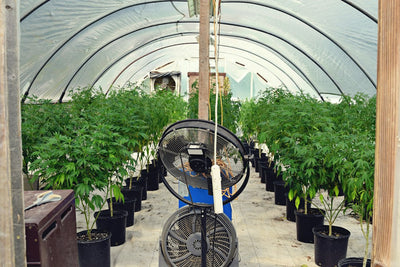
Defoliation Strategy: When It Boosts Yield and When It Backfires
Photo by Esteban López via Unsplash.
Walk into any grow forum thread about defoliation and you'll find two camps shouting past each other. One side strips their plants nearly bare twice during flower, convinced they're forcing every remaining leaf and bud site to work harder. The other side won't touch a fan leaf after week two of veg, arguing that every leaf you cut is a solar panel you just threw in the trash. Both camps have grow logs to back them up, which is part of why this argument never seems to resolve itself around here.
What's changed is that the science finally caught up to the debate. A September 2025 study looking at defoliation across different LED spectra gave us something the forums never could: actual numbers on the trade-off between floral biomass and cannabinoid concentration, and confirmation that the response is cultivar-specific rather than universal. That's a meaningfully different finding than what the defoliation gurus have been selling for a decade.
The practical upshot is that the gap between a 15-30% yield bump and a scorched, hermied-out disaster usually isn't about whether you defoliate. It's about a timing window that's narrower than most growers assume, and about matching intensity to the specific plant in front of you. This piece breaks down what the research actually supports, what's still grower folklore, and where techniques like schwazzing fall on that spectrum.
What Defoliation Actually Does to the Plant

Photo by CRYSTALWEED cannabis via Unsplash.
Every fan leaf you remove does two things at once, and they pull in opposite directions. On one hand, stripping the leaves shading a lower bud site lets light reach that node directly, which can wake up growth that would otherwise stay small and airy. On the other hand, you've just cut into the plant's total photosynthetic surface area, meaning less total carbohydrate production to fuel flower development across the whole canopy. Defoliation isn't a free lunch. It's a redistribution, and whether that redistribution nets out positive depends heavily on how much leaf area you remove and when.
The September 2025 ScienceDirect study testing defoliation across multiple LED spectra put real data behind this tension. Working with a cultivar labeled BL, researchers found that defoliation reduced total floral biomass but increased cannabinoid concentration in the harvested flower. That's not a minor footnote — it showed up consistently enough that the researchers reported a significant negative correlation between inflorescence weight and cannabinoid concentration across every spectrum and treatment combination they tested. Heavier flower, on average, meant lower potency; higher potency flower tended to come in lighter.
That correlation matters because it reframes what growers are actually optimizing for. If you're chasing maximum dried flower weight off a plant, and you're separately chasing maximum THC or total cannabinoid percentage, you may be pulling two levers that fight each other rather than levers that move together. A lot of grower marketing around defoliation implies you get more of both. The data says you're more likely trading some of one for some of the other, and the ratio of that trade depends on cultivar.
That cultivar-dependence is the part that gets lost in most defoliation advice, which tends to get written as if there's one correct schedule for every plant. The same defoliation regimen that tightens up a dense, leafy indica-dominant phenotype can leave a lanky sativa-leaning plant under-fueled and stretched thin. Seedtiva breeds with this variability in mind, selecting genetics that respond predictably to training and pruning, but predictable still isn't identical. You still need to run your own test on a given cultivar before committing a full room to an aggressive schedule.
The Timing Window That Makes or Breaks the Technique

Defoliation risk to yield and potency rises sharply the later it's performed, with minimal risk during late vegetative and early flowering stages but a fivefold increase in risk after day 28 of flowering.
If there's one number worth tattooing on your grow room wall, it's this: stop major defoliation by day 25 to 28 of flowering. That window shows up again and again across grower consensus and the more recent 2026 cultivation guides that have synthesized field reports at scale, and it lines up with basic plant physiology. Past roughly the 3.5 to 4 week mark in flower, the plant has shifted into a resource-allocation mode where it's pulling on stored reserves to fatten existing buds and finish out terpene and cannabinoid production. Stripping leaf area at that point doesn't redirect energy toward the buds — it removes energy the buds are actively drawing on.
A Frontiers in Plant Science study on planting density gives a useful data point on the other end of the timeline. Researchers tested a bottom branch and leaf removal treatment, referred to as BBLR, done early in the cycle, and found it did not reduce yield — a result that stood in contrast to the yield losses typically seen with standard mid- or late-flower defoliation in the same body of research. Their explanation was straightforward: because BBLR happened early enough, it never choked off light to developing floral sites the way later removal does. The plant had time to compensate before it was locked into a resource-allocation pattern that couldn't absorb the loss.
That timing principle tracks with what shows up repeatedly in grower field reports. Defoliation done correctly — meaning late veg through roughly the first three weeks of flower — is associated with yield increases in the 15 to 30% range along with noticeably improved trichome quality on the bud sites that get newly exposed to direct light. That's a real, meaningful gain, and it's the number that gets cited by defoliation advocates. What often gets left out is that the gain is timing-dependent, not technique-dependent.
Push past that window and the risk profile changes fast. Late or excessive defoliation puts real stress on the plant at a stage when it has limited capacity to recover, and the downside list is long: hermaphroditism from stress-induced pollen sac development, drastic drops in THC as the plant diverts energy to repair rather than cannabinoid synthesis, and in severe cases outright crop failure. The same action that helps at day 15 can wreck a harvest at day 40.
Uniformity vs. Total Yield: A Distinction Growers Miss

Photo by GB The Green Brand via Pexels.
One of the most-cited papers in defoliation discussions is Danziger and Bernstein's foundational work on canopy architecture manipulation, and it gets misquoted more often than it gets accurately summarized. The study found that manipulating plant architecture — including defoliation — increased cannabinoid concentration at the bottom and middle bud sites of the plant, sites that normally underperform the top cola in both size and potency because they're light-starved. That's a real and useful finding. But the framing of the study was about improving uniformity across the canopy, not about boosting total yield, and those are different claims that get conflated constantly in grower discussions.
The distinction matters more than it sounds like it should. A plant where the bottom third produces dense, well-developed bud instead of thin popcorn is a plant that's more efficient to harvest and trim, and it's a plant that's more consistent from top to bottom in potency and bag appeal. That's not the same as saying the plant produced more total grams of dry flower, or that any individual grower's overall yield went up because of the technique. When people cite this paper as proof defoliation increases yield, they're usually skipping past what the researchers were actually measuring.
Even within that uniformity-focused result, cultivar variation showed up again — the same manipulation didn't produce identical improvements across every genetic line tested. That's the third time this pattern surfaces across different studies in this space, and at some point it stops being a caveat and starts being the headline. There is no single defoliation recipe that transfers cleanly from one cultivar to the next.
Where this distinction earns its keep is in how you think about your own goals for a given run. If you're running a commercial-style grow where you're harvesting the whole plant and every bud site needs to hit a sellable grade, uniformity is the metric that actually controls your bottom line — underdeveloped popcorn bud gets trimmed off, discounted, or turned into extract feedstock, all of which cut into revenue per plant. If instead you're chasing a single show-stopping main cola and don't care what the lower branches produce, architecture-driven defoliation for uniformity is solving a problem you don't have. Know which grower you are before you copy someone else's defoliation schedule.
The Hemp Data and the Schwazzing Controversy
Hemp research fills in a piece of this puzzle that cannabis-specific studies haven't fully covered, and the timing story holds up. One hemp study found that applying defoliation stress during early flowering produced a significant increase in total CBD and THC percentage compared to untreated control plants — a clean result showing that a controlled stressor, applied at the right point in the cycle, can push cannabinoid synthesis upward. A related hemp study looked at defoliation applied close to harvest instead, and found the phytocannabinoid increase in that scenario wasn't statistically significant against controls. Same general action, different window, and a meaningfully different outcome. That's about as clear a confirmation as you'll find that when you defoliate matters more than whether you defoliate.
That timing-dependence is exactly what's missing from the case for schwazzing, the near-total fan-leaf strip performed twice during flower that got popularized by Joshua Haupt's book Three A Light. The technique has a devoted following and plenty of forum testimonials, but it remains scientifically unvalidated. The commercial claims built around it haven't been independently verified through peer-reviewed trials, and the actual published research on heavy, late-stage defoliation doesn't show the clean yield gains the marketing implies — several studies show losses instead, consistent with the late-flower resource-drain problem covered earlier.
Part of the reason this gap persists is that cannabis-specific defoliation research is still genuinely thin. One review pointed out that a large share of what growers treat as established technique knowledge is actually borrowed from horticultural research on tomatoes, peppers, and cucumbers — crops that share some physiological similarities with cannabis but aren't the same plant, don't produce cannabinoids, and haven't been bred under the same selection pressures. Extrapolating pruning science from greenhouse tomato trials to a flowering cannabis plant is a reasonable starting point, but it's not the same as having direct evidence.
Until that direct evidence exists in more depth, the responsible way to treat schwazzing and similar heavy late-flower stripping methods is as a high-risk experiment you're running on your own plants, not as an established best practice you can deploy with confidence. If you want to test it, do it on a couple of plants in a larger run and compare against untreated controls rather than committing your whole room to it.
A Practical Defoliation Approach for Your Grow

Photo via Pexels.
Given everything above, a defoliation approach that actually holds up looks conservative compared to what gets hyped online, and it's built around a few concrete checkpoints rather than a rigid script. Start with a moderate first pass at the transition into flower, roughly day 1 to 3, removing the large fan leaves that are shading lower nodes. Leave the sugar leaves near your developing colas alone at this stage — they're doing real photosynthetic work close to the bud sites that matter most.
If the canopy is still dense enough that light isn't reaching mid-tier bud sites by week 2 or 3, a lighter second pass is reasonable. This isn't a full strip — it's selective removal of whatever's still creating meaningful shade, judged by actually looking at the canopy rather than following a preset percentage.
Then stop. Regardless of how bushy the plant still looks, day 25 to 28 of flowering is a hard cutoff for any major defoliation. Past that point you're not opening up light penetration for developing bud, you're pulling resources away from bud that's already finishing.
How aggressive you get within that window should track the specific cultivar, not a generic template. Dense, leafy phenotypes with tight internodal spacing can tolerate more leaf removal because they typically have leaf area to spare and benefit more from opened-up airflow and light penetration. Airy, sativa-leaning plants with long internodes and thinner leaf coverage are relying on more of that leaf area for energy production, and stripping them as hard as you would a dense indica-leaning plant tends to backfire.
The single most useful thing you can do beyond following this framework is track your own results run over run — bud density, trichome coverage, any stress signs like hermie tendencies — and adjust your next cycle based on your own data rather than someone else's grow log. Outcomes here vary by climate, room setup, and genetics, so what worked in someone else's tent isn't a guarantee in yours. Starting with stable, well-bred genetics, the kind Seedtiva focuses on, at least removes genetic inconsistency as a variable, so the results you're tracking actually reflect your technique rather than random phenotype variation.
Defoliation keeps getting talked about as if it's a single yes-or-no decision, but the research and the field reports both point to something more like a dial. Push it one direction and you trade floral biomass for cannabinoid concentration and canopy uniformity. Push it too far past the wrong point in the cycle and you're not trading anything — you're just losing yield, potency, and in bad cases the plant's stability altogether.
The one thread that holds up consistently, across a hemp study, a planting-density trial, an LED-spectra study, and a decade of grower field reports, is that timing beats intensity. Early and moderate consistently outperforms late and aggressive, no matter how good the late-flower method sounds on paper or how big the before-and-after photos look in someone's promotional material.
Until cannabis-specific trials on heavy late-flower stripping catch up to the claims being made about them, the sensible move is to treat schwazzing-style approaches as an unproven gamble rather than a shortcut worth betting a full harvest on. Run your own controlled test if you're curious, keep your records honest, and let your own plants — not someone else's forum post — tell you what your specific genetics and setup actually reward.
Sources
- LED spectra and defoliation independently shape canopy architecture and cannabinoid yield in indoor Cannabis cultivation - ScienceDirect
- "Defoliation Deep Dive" Cannabis Yield Multiplier | Grow Weed Easy
- Summary of Cannabis Defoliation Side-by-Side Experiment | Grow Weed Easy
- Strategic Defoliation Techniques During Cannabis Flowering - Seeds Genetics Co. US
- Does Defoliation Increase Yield? Best 2021 Study