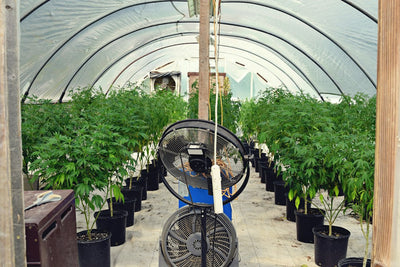
Does Organic Growing Really Improve Cannabis Flavor?
Photo by Colin redwood via Unsplash.
Walk into any dispensary and ask the budtender which flower smells better, and you'll hear some version of the same answer: the organic stuff, always the organic stuff. It's practically gospel among growers too -- living soil produces louder terpenes, synthetic salts produce flat, one-note weed. I've heard this argument made with total conviction by cultivators who've never run a side-by-side comparison in their life. The claim isn't crazy. It's just a lot less settled than the trade press headlines make it sound.
The more useful question isn't organic versus synthetic as competing labels. It's which specific nutrient regimes, microbial communities, and feeding schedules actually move the needle on terpene and cannabinoid chemistry -- because the answer turns out to be more about precision than philosophy. A 2017 University of Guelph study and a 2025 paper in the journal Plants both point the same direction: dose and timing matter more than whether the bag says organic on the label. That's not the answer growers want to hear at a trade show, but it's the one the data actually supports, and it's a far more actionable framework for anyone trying to grow better-tasting flower this season rather than just a better-marketed one.
What the Peer-Reviewed Research Actually Shows

Photo by Mikhail Nilov via Pexels.
The Guelph study, published in 2017, is one of the few controlled looks at how organic fertilizer rate affects cannabinoid concentration during flowering, and its finding cuts against a lot of grower intuition. Researchers increased organic fertilizer application rates through flowering and found that THC, THCA, and CBGA concentrations actually declined as feeding rates went up. More organic input did not mean more potent flower -- it meant dilution. The plants got bigger, the biomass numbers looked fine, but the cannabinoid density per gram dropped. That's a classic case of growth outpacing chemistry: nitrogen and other inputs pushed vegetative and floral tissue production faster than the plant could concentrate its secondary metabolites.
The Mycorrhizal Fungi Connection

Photo by Walter Cunha via Pexels.
Living soil growers have long avoided dumping heavy phosphorus loads into their beds, and there's a specific biological reason for that beyond general organic philosophy: high-phosphorus synthetic fertilizers are well documented to suppress mycorrhizal colonization in root systems. Arbuscular mycorrhizal fungi form symbiotic relationships with roots, trading soil-scavenged phosphorus and micronutrients for plant sugars, but when soluble P is already abundant, the plant has little incentive to maintain that costly partnership and colonization rates drop off. Flood a root zone with synthetic phosphate and you can functionally shut down the fungal network before it establishes.
Nitrogen, Phosphorus, and the Chemistry They Actually Drive

High nitrogen levels are reported to decrease THCA/CBDA, while high phosphorus similarly reduces THC but boosts CBD, CBG, and CBN, highlighting how nutrient inputs can steer cannabinoid profiles in different directions.
Strip away the organic-versus-synthetic framing entirely and look at nitrogen and phosphorus on their own terms, and the chemistry gets a lot clearer -- and a lot more useful to a grower standing in front of a feed schedule. Nitrogen is essential for building inflorescence biomass; you need it to construct the sugar leaf, calyx, and stem tissue that the resin glands eventually sit on. But research has repeatedly shown that excess nitrogen, particularly carried too far into flowering, depletes major cannabinoids like THCA and CBDA. The plant is allocating carbon and energy toward vegetative-style growth instead of finishing resin production, and you end up with dense-looking colas that test lower than expected.
The Oregon Case Study: What a 5,000-Plant Split Trial Showed

Photo by CRYSTALWEED cannabis via Unsplash.
Peer-reviewed trials are useful for isolating variables, but they rarely operate at commercial scale, which is what makes an Oregon case study worth mentioning even though it doesn't carry the weight of controlled research. A cultivator running a 5,000-plant operation split the crop between a living-soil/organic system and a conventional synthetic-salt program, growing the same three strains side by side under otherwise matched conditions. Third-party blind lab testing on the finished flower found the organic side carried 15 to 20 percent higher total terpene content across all three cultivars -- a meaningful spread, not statistical noise.
Applying This to Your Own Grow

Photo by cottonbro studio via Pexels.
None of this research is actionable if it stays in the abstract, so here's how it translates to an actual grow room or outdoor plot. Precision dosing is the through-line regardless of what's in your reservoir -- living soil, organic bottled nutrients, or synthetic salts all require the same discipline in matching input to plant demand at each growth stage. Sloppy feeding dilutes cannabinoids and terpenes under any system; the Guelph study proves that for organics, and every synthetic grower who's burned a crop with excess nitrogen knows it's just as true on their side.
Strip the marketing language away and the organic-versus-synthetic debate stops being about ideology and starts being about precision. Dose, timing, and the health of the soil biology under your plants drive the chemistry -- not what's printed on the fertilizer label. A grower running dialed-in synthetic salts with attention to nitrogen taper and P timing can outperform a sloppy organic setup, and the Guelph data proves the reverse is just as true when organic feeding gets overdone.
If you're chasing terpene expression specifically, put your effort into mycorrhizal health and nutrient ratios rather than assuming a bag of compost or a bottle labeled organic guarantees better flavor. Build the fungal network early, keep phosphorus modest until the plant actually needs it, and taper nitrogen deliberately as flowering progresses regardless of your feeding philosophy. Genetics still set the ceiling -- starting with stable, well-bred seeds gives any of these techniques something worth optimizing.
Until someone runs a proper blinded sensory panel alongside cannabinoid and terpene assays at scale, the honest position is to treat organic methods as one more precision tool in the kit, not a shortcut that guarantees better weed. The growers getting the loudest, most complex flower right now are the ones paying attention to ratios and biology, not the ones simply picking a side in a label war.
Sources
- Best Cannabis Strains of 2026: Flavor, Terpenes & Trends
- Cannabis Terpene Chart & Effects Guide (2026)
- Explore flavor options for edibles: a 2026 guide | Edwin's Edibles & Elixirs
- Organic vs Conventional Hemp: Key Terpene Differences in CBD - CBD Advisor 2026
- The 25 Best Cannabis Strains of 2026: Data-Driven Rankings by Effect, Potency, and Terpene Profile | Green Rush