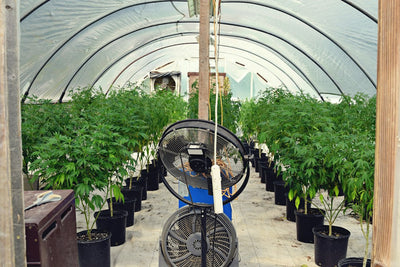
Engineering Airflow Across Commercial Cannabis Canopies
Photo by Kristina_Dotsenko via Pixabay.
Walk into most home grow tents and you'll find a single clip fan pointed at the canopy, oscillating back and forth, doing just enough to keep the leaves rustling. That's the mental model most growers carry: airflow is a "yes/no" input, like a light switch. Either the fan is on and the room feels "fresh," or it's off and things get stuffy. Nobody's measuring anything.
Walk into a commercial facility running twenty or thirty rooms, and airflow stops being a vibe and becomes a fluid dynamics problem with real velocity targets, real dead-zone mapping, and real yield consequences tied to specific feet-per-minute numbers. The air moving across a canopy isn't just cooling leaves and shaking off boundary-layer humidity -- it's mechanically interacting with stem tissue, redistributing CO2, and determining whether every plant in a room finishes at the same size or whether you've got a 30% spread in bud weight from row to row.
What's changed recently is that this is no longer just operator intuition passed down from one head grower to the next. New replicated research out of Dr. Allison Justice's Cannabis Research Coalition, run with Clemson's Flowering Physiology Lab and presented at Cornell's Hemp Webinar Series in April 2026, finally put hard numbers on what airflow does -- to height, to yield, to uniformity, and critically, to the point where more air stops helping and starts hurting. That last part is the piece most cultivators get wrong: airflow has a real sweet spot, and overshooting it causes mechanical damage that shows up as reduced yield, not increased.
This piece walks through what the research actually found, how it translates into commercial-scale trial data, and how the engineering principles behind it scale from a four-plant tent up through a multi-tier vertical facility running thousands of square feet of canopy.
What the New Airflow Research Actually Found

Photo by ThisIsEngineering via Pexels.
Dr. Allison Justice isn't a newcomer making noise for attention. She founded The Hemp Mine, one of the more research-forward cultivation operations in the hemp and cannabis space, and in 2022 launched the Cannabis Research Coalition specifically to bring replicated, peer-reviewable science to cultivation questions that had previously been settled by forum consensus and vendor marketing. Partnering with Clemson University's Flowering Physiology Lab gave the CRC access to the kind of controlled environmental chambers that make it possible to isolate one variable at a time -- something that's genuinely rare in cannabis research, where temperature, humidity, CO2, light, and airflow all tend to get changed together and muddy the results.
For this trial, the team held vapor pressure deficit constant across all treatment groups and varied only air velocity: 0 feet per minute, 200 fpm, and 400 fpm. That's the whole point -- by locking VPD, they made sure any differences in plant response could be attributed to mechanical air movement itself, not to the humidity or temperature shifts that moving air usually drags along with it.
The results, presented by graduate student Maylin Murdock during the April 8, 2026 Cornell Hemp Webinar Series session, showed a clear directional trend: plants in higher airflow treatments grew taller, yielded more, and showed noticeably tighter uniformity between individual plants than the still-air control group. That uniformity finding matters more than it sounds -- in a commercial room, the difference between your best and worst performing plants is often what separates a profitable harvest from a mediocre one, and airflow turned out to be a direct lever on closing that gap.
But the nuance is where this study earns its attention. The 400 fpm group didn't simply outperform the 200 fpm group across the board. At the higher velocity, researchers documented an increased risk of mechanical stress -- stem bending, leaf abrasion, physical damage from constant high-velocity buffeting -- that started to eat into the gains. In other words, airflow doesn't behave like light intensity, where more nearly always helps until you hit photoinhibition way out at the extreme. It behaves more like a dosage curve with a real ceiling that shows up sooner than most growers assume. This is one of the first replicated studies to strip airflow out from the usual bundle of environmental variables and test it on its own, which is exactly why cultivators who normally ignore academic conference presentations are paying attention to this one.
The Pipp/VAS Trial: Turning Airflow Into a Yield Number

Increasing airflow velocity directly boosts dry weight gains, with 400 fpm doubling the dry weight increase (20%) compared to 200 fpm (10%), while stagnant air (0 fpm) shows no gain.
Lab-chamber data is convincing, but commercial growers live and die by numbers generated at commercial scale, in rooms that actually look like the ones they're building. That's where the CRC's parallel trial comes in, and it's arguably the more directly useful dataset for anyone sizing equipment for a real facility.
The setup used three identical grow rooms, each 12 by 8 feet with 9-foot ceilings, built with Pipp Horticulture and sharing a single dry room downstream so post-harvest handling wouldn't introduce its own variability into the yield comparison. Growlink handled the environmental monitoring and control, Vertical Air Solutions supplied the airflow hardware, and Athena managed the nutrient program -- meaning this wasn't just an airflow test in isolation, it was a full-stack commercial simulation with airflow as the deliberate variable being manipulated across the three rooms.
According to Pipp Horticulture's Director of Cultivation Michael Williamson, working alongside Xavier G. of Avitas Global, the room running the highest airflow velocity produced a 20% increase in dry weight compared to the lower-airflow rooms, as of the April 2026 reporting. That alone would justify the investment in better airflow hardware. But the more interesting number sitting next to it is a 5% reduction in overall trim in that same high-airflow room.
Trim reduction is the detail worth sitting with. It's not just that these plants grew bigger -- they grew denser, tighter buds with less airy, leafy material needing to be removed in post-production. That points to airflow doing something structural to bud development, not just pushing more biomass onto the plant. Tighter internode spacing, better light penetration into lower bud sites, and reduced humidity pockets inside dense colas all plausibly contribute to that trim number, and it's the kind of secondary effect that rarely shows up in older spec-sheet marketing from fan manufacturers.
That's really the core reason this data matters right now: a lot of airflow guidance still circulating online traces back to 2022-era vendor literature built around CFM ratings and generic "keep air moving" advice, with no yield data attached. This is the first current, empirical, commercial-scale number set growers actually have to work from.
Designing Horizontal Airflow (HAF) Like an Engineer, Not a Fan Salesman

Photo by Public Domain Pictures via Pexels.
Good horizontal airflow (HAF) design isn't about brute-forcing air into a room -- it's about establishing a coherent, continuous pattern that behaves more like a racetrack or a whirlpool than a chaotic mixing bowl. The physical goal is straightforward: hot, humid air rises and stalls near the ceiling, and it needs to be pulled back down and funneled into the top of the canopy, where it displaces the stagnant boundary layer sitting against leaf surfaces and gets pushed through and out the other side of the room in a continuous loop.
The most common failure mode looks nothing like that. One HVAC engineer working commercial cultivation described walking into a 500 square foot flower room with roughly 40 oscillating fans crammed in, each pointed in a different direction with no relationship to the others. It looks aggressive on a walkthrough -- lots of visible motion, leaves clearly moving -- but it's functionally closer to turbulence than airflow. Fans fighting each other create dead zones behind plants, pressure pockets in corners, and localized microclimates that never get flushed, even while the room-average sensor reads perfectly acceptable temperature and humidity.
Proper HAF layout follows the room's actual geometry instead. Corner-mounted fans driving air along the walls and ceiling in one consistent rotational direction, rather than units aimed straight down the middle of plant rows, tend to establish that racetrack pattern far more reliably. The air picks up momentum along the perimeter, gets pulled down and across the canopy top, and exits back up the opposite side to repeat the loop -- continuous exchange instead of random collision.
What Justice's research adds to this is something HAF design has been missing for years: an actual velocity target. Instead of eyeballing "enough" airflow off how much the leaves visibly move, designers now have a validated 200 to 400 fpm range at canopy height to size fans and space them against. That number turns fan selection from guesswork into an engineering calculation -- CFM output, room volume, and mounting height all get worked backward from that target velocity.
The cost of getting this wrong doesn't show up as a dramatic failure. It shows up quietly, as inconsistent bud density from one side of the room to the other, and as botrytis or powdery mildew pressure concentrated specifically in the densest interior canopy zones -- even while the wall-mounted sensor across the room reports RH sitting comfortably in range.
Vertical Farms Turn Airflow Into a 3D Problem

Photo by neil macc via Unsplash.
Stack four or five tiers of canopy in a vertical rack system and airflow stops being a single-number problem entirely. A room-average temperature and humidity reading is nearly meaningless in a vertical build, because every tier effectively behaves like its own microclimate -- and without deliberate per-tier airflow management, those microclimates compound as you move up the rack instead of averaging out.
Heat rises, and so does moisture load from transpiration on the tiers below, which means the top tier in an unmanaged vertical system tends to run hotter and drier than intended while the bottom tier stays cooler, more humid, and more stagnant -- the exact conditions that invite mold and inconsistent finishing. This isn't a minor edge case; it's become the single most cited failure mode in multi-tier cultivation, and it's why serious vertical operators now treat airflow design as a genuine three-dimensional engineering exercise rather than a scaled-up version of a single-room HAF layout.
Computational fluid dynamics (CFD) modeling has moved from a nice-to-have to something closer to standard practice for any vertical build running more than two tiers. Modeling airflow behavior across the whole rack structure before construction lets designers see where velocity drops off, where tiers will trap heat, and where CO2 distribution will fall short -- all before a single fan gets bolted in.
On the hardware side, Vertical Air Solutions, a division of Pipp Horticulture, builds patented in-rack systems that deliver airflow vertically and top-down through each individual canopy layer, rather than relying on oscillating or HAF fans that only mix air horizontally across an open room. That distinction matters structurally: a fan pushing air sideways across a 6-inch tier gap can't do what a system engineered to drive air downward through that same tier can. Each layer effectively gets its own dedicated exchange instead of depending on spillover from a room-level airflow pattern that was never designed with tiers in mind.
These systems run on EC motors with variable speed control and 0-10V signal integration, which means they slot into existing building management or cultivation automation platforms most facilities already have installed, rather than requiring an entirely separate control layer bolted on afterward. For a facility operator, that's the difference between adding real per-tier climate control and adding one more disconnected system to babysit. The payoff is direct: instead of the top tier baking while the bottom tier sits stagnant, every tier gets pushed toward that same 200-400 fpm target the CRC research validated, layer by layer.
Modeling and Mapping Airflow Before You Build

Photo by Lucy Meadows via Pexels.
Even with good HAF principles and per-tier hardware, there's still a meaningful gap between designing a room on paper and knowing how air actually behaves once it's built, loaded with canopy, and running at full density. That's the gap airflow mapping services are built to close. Quest, through its partnership with Hawthorne Gardening Company, now offers exactly this: a computer-aided modeling service that simulates canopy-level airflow before any equipment goes into the ground.
The value of doing this on paper rather than in a finished flowering room is hard to overstate. CFD modeling can flag a dead zone in the back corner of a room, a short-cycling loop where air recirculates locally without ever reaching the far side of the canopy, or a pressure imbalance between adjoining rooms sharing a return -- all before that dead zone becomes a botrytis outbreak discovered three weeks into flower, when the crop is already hanging and there's nothing left to do but cut losses.
Where does the line sit between "map it" and "just walk the room with a fan"? Roughly, anywhere beyond what a handful of HAF fans in a single open room can be visually and physically confirmed -- meaning any facility running more than about two tiers vertically, or any large single-level canopy where corners and interior rows are too far from the door to check by feel. Below that scale, careful manual verification is usually enough. Above it, mapping is becoming the expected standard rather than an optional upgrade.
For a grower scaling from a tent into a dedicated room, there's a practical version of all this that doesn't require CFD software: buy a simple handheld anemometer, hold it at canopy height in several spots around the room, and compare the reading against the validated 200-400 fpm range rather than trusting the CFM rating printed on the fan's box. Rated CFM tells you what a fan can theoretically move through free air -- it tells you nothing about what actually reaches your canopy once you account for room geometry, plant density, and obstruction from your own equipment.
It's also worth being honest that no airflow number works identically across every room. Canopy density, room geometry, and genetics all shift what "correct" airflow looks like -- a wide, bushy phenotype with dense lateral branching needs a different velocity and pattern than a tall, columnar plant with more open structure and better natural light and air penetration. This is part of why choosing structurally consistent, well-bred genetics -- something we pay close attention to at Seedtiva -- makes the downstream airflow engineering considerably easier, since you're not compensating for wildly inconsistent plant architecture on top of everything else.
The practical shift here is bigger than one study or one trial. Airflow has moved out of the realm of rule-of-thumb advice -- keep the leaves gently rustling, point a clip fan at the canopy and call it done -- and into the realm of an engineered parameter with an actual measured range behind it. 200 to 400 feet per minute at canopy height isn't a marketing number or a guess passed down through grower forums; it's a figure backed by a replicated chamber trial and confirmed by commercial-scale results showing real yield and trim differences.
The part worth remembering just as much as that range, though, is the ceiling sitting at the top of it. Cranking every fan in the room to maximum output used to be treated as an obviously safe move -- more airflow, more exchange, more good. The research says otherwise. Mechanical stress from excessive velocity is now a documented cost, not a theoretical caveat buried in a footnote, and it means airflow design has to aim at a target rather than a maximum.
What's genuinely useful about all this is that it scales down as cleanly as it scales up. Whether you're running four plants under a single oscillating fan in a tent or managing airflow across a 40,000 square foot vertical facility with CFD-modeled tiers and in-rack EC-motor systems, the underlying discipline is identical: know your actual air velocity at canopy height, verify it with an instrument, and don't take a fan's rated spec sheet as a proxy for what's actually reaching your plants. Everything else -- room geometry, canopy density, genetics, tier count -- just determines how much engineering you need to hit that number consistently.
Sources
- Cannabis Cultivation Trends 2026: Facility Design & Efficiency
- Under Canopy Lighting for Cannabis: Increase Yield & Quality
- What's changing in cannabis cultivation in 2026?
- 10 Critical Elements of a High Performance Vertical Cannabis Cultivation Facility Design - Design. Review. Manage.
- Airflow System for Commercial Vertical Cannabis Grow Racks