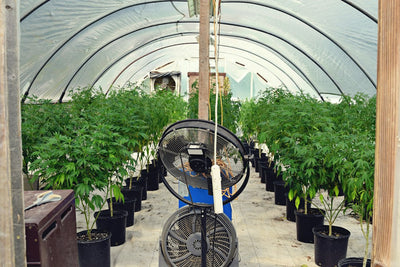
Grow Box vs Grow Tent: Which Costs Less to Power?
Photo by Juan Miguel Restrepo Barrera via Pexels.
Every few weeks someone posts the same question in a grow forum: does a sealed grow box actually save money over a mesh grow tent? The framing assumes the enclosure itself is doing something -- that a plastic cabinet with built-in lighting is somehow sipping electricity while a tent frame guzzles it, or vice versa. It's an understandable instinct, especially when box manufacturers lean hard into "energy-efficient all-in-one" marketing copy. But it's the wrong question.
The shell around your plants doesn't use a single watt. What draws power is the LED, the inline fan, the dehumidifier, and whatever climate control you've bolted on -- and those components exist in both formats, sized however you or the manufacturer chose. The real cost drivers are LED efficacy, total wattage relative to your canopy footprint, and the rate your utility charges per kilowatt-hour. That last variable has gotten a lot more expensive to ignore. The national average residential electricity rate hit 18.83 cents per kWh in April 2026, up 7.4% from a year earlier and roughly 25% higher than it was back in 2022. When rates climb that fast, a poorly matched setup that would've cost you an extra $10 a month in 2022 now costs an extra $15-20, month after month, for the life of the grow.
This piece breaks down what actual grow boxes and grow tents draw in the real world, at real rates, and then walks through the handful of variables that actually move your power bill -- so you can stop shopping by enclosure label and start shopping by numbers that matter.
Grow Box vs Grow Tent: What's Actually Different

Photo by Vera Rishkevich via Pexels.
Strip away the branding and a grow box is just a cabinet: a rigid enclosure, usually smaller than a standard tent footprint, sold with the light, exhaust fan, and sometimes a carbon filter already mounted inside. The pitch is convenience -- plug it in, add water, and go. Grow tents flip that arrangement. You buy a frame and reflective mylar shell, then choose your own LED, your own inline fan and ducting, your own filter, and your own dehumidifier or AC if you need one. A tent is a kit you assemble; a box is an appliance you unbox.
That distinction matters for your workflow and your budget up front, but it has almost nothing to do with your monthly power bill. A box trades customization for convenience -- you're accepting whatever the manufacturer decided was an adequate light and fan for that cabinet size, often at a price premium for the integration. A tent trades a bit of assembly time for the ability to size every single component to your actual footprint and climate, which usually means you can hit a more efficient configuration for less money, provided you do your homework.
Here's the part that trips people up: neither format inherently uses more or less electricity, because the enclosure itself doesn't consume power. A 4x4 tent with a 400W high-efficacy LED and a properly sized dehumidifier will draw meaningfully less than a grow box running a 500W fixture with mediocre efficacy crammed into a 2x2 footprint, and it'll produce more usable light doing it. Box marketing -- and you'll see this pattern repeated across a lot of box4grow-style product pages -- likes to imply that the sealed, integrated design is itself more power-efficient. Once you actually match wattage and LED quality apples-to-apples between a box and a tent, that efficiency claim evaporates. What's inside the enclosure is the whole story.
Real-World Power Draw: 4x4 Tent Numbers

Recommended LED wattage rises sharply with grow tent size, from 225W for a 2x2 tent to 725W for a 5x5 tent—more than tripling as footprint increases.
Numbers help more than generalities here, so let's look at what a typical 4x4 tent actually pulls from the wall. A well-outfitted 4x4 running a 600-650W LED alongside an inline fan and a small dehumidifier typically lands between $40 and $80 a month at average US rates, depending on your local $/kWh and how many hours a day the dehumidifier is actually cycling versus idling. That's a wide range, and the light is usually the smaller variable -- the dehumidifier's duty cycle in a humid basement versus a dry attic can swing the bill by 20-30% on its own.
Drop down to a leaner build -- a 400W LED plus fans and a dehumidifier in that same 4x4 space -- and you're looking at roughly 10-14 kWh per day, which works out to about $35-$55 a month at $0.13/kWh. That's a meaningful chunk of the higher-wattage setup's cost, for a light that's still well within the sizing range that footprint needs.
Speaking of sizing: a 4x4 space wants somewhere around 400-450W of actual draw from the light. A 3x3 needs 300-350W, a 2x2 needs 200-250W, and if you're running a 5x5, budget 700-750W. These aren't arbitrary -- they come from the 30-40 watts per square foot rule that growers have converged on for LED fixtures, and they hold whether that light is bolted into a box or hung in a tent.
For context on scale, a commercial 10-light room running 1,000W HPS fixtures with full climate control -- big dehumidifiers, air conditioning, CO2 injection -- can run $1,500-$2,500 a month in electricity alone. Next to that, even an inefficient home tent or box is a rounding error. But home growers don't have commercial margins to absorb waste, which is exactly why getting the wattage and equipment sizing right in a single tent matters more, proportionally, than it does at scale.
Why LED Efficacy Matters More Than Tent Size

Photo by Erik Mclean via Pexels.
If you take one number away from this article, make it efficacy: micromoles of photosynthetically active light produced per joule of electricity consumed, written as µmol/J. This is the metric that actually determines how much usable light you get per dollar of electricity, and it varies enormously between fixtures that draw the exact same wattage. A 400W light isn't a 400W light -- it's a number that tells you nothing about output until you know the efficacy behind it.
As a rough scale: 2.5+ µmol/J counts as high-efficiency for a horticultural LED, 3.0+ is elite territory, and the best fixtures on the market as of 2026 are pushing 3.1+ µmol/J. The gap between a 2.3 µmol/J budget fixture and a 3.1 µmol/J premium one, at identical wattage, can mean a real difference in yield per kilowatt-hour -- you're paying for the same electricity either way, but one light is converting more of it into photons your plants can actually use.
This isn't just anecdotal. Department of Energy analysis on horticultural lighting has found that switching to LED technology broadly could cut lighting energy use in this space by roughly a third, translating to an estimated $350 million in savings across the industry. That's the scale of what efficacy improvements are worth when applied across an entire sector -- and it's the same math, shrunk down, sitting in your basement tent.
Practically, this means you size your light using the 30-40W per square foot rule to land in the right power range, then spend your remaining budget chasing the highest efficacy rating you can afford, not the highest wattage or the most marketing gloss. Ask the manufacturer for the tested µmol/J number directly -- reputable ones publish it. And don't stop at the light: pairing an efficient fixture with well-bred genetics closes the loop, since quality seeds -- the kind Seedtiss and other serious breeders, including Seedtiva, focus on -- convert that efficient light into usable yield more reliably than genetics that weren't bred with vigor and light response in mind. An efficient light wasted on weak genetics is still money left on the table.
Your Electric Rate Matters More Than Your Enclosure

Photo by Robert So via Pexels.
Everything in the previous two sections assumes a rate of roughly $0.13/kWh, which is a reasonable planning number but not necessarily your number. The national average sits at 18.83 cents per kWh as of April 2026, but that average is hiding an enormous spread. North Dakota residents pay around 12.35 cents per kWh. Hawaii residents pay 46.62 cents. That's nearly a 4x difference for identical equipment running identical hours -- the same 4x4 tent, same LED, same dehumidifier, can cost four times as much to operate depending purely on your zip code.
And rates aren't standing still. The climb from 15.04 cents in 2022 to 18.83 cents in April 2026 is a 25% increase in four years, and the EIA is forecasting continued growth in the 3-5% annual range through 2027. If you budgeted your grow's operating cost based on 2022 numbers, you're underestimating your current bill by a meaningful margin, and that gap is likely to keep widening rather than closing.
California growers have an extra layer to account for. Since 2024, time-of-use rates are the default structure for new residential customers, not an opt-in program. Under PG&E's E-TOU-C plan, for example, peak rates run $0.45-$0.65/kWh while off-peak rates sit at $0.20-$0.25/kWh -- roughly double to triple the cost depending on when you draw power. Running an 18-hour vegetative photoperiod that happens to straddle the 4-9pm peak window on that plan can meaningfully inflate a bill compared to the identical setup running lights during off-peak hours.
The takeaway is simple: don't budget your grow's power cost off a national average headline. Pull up your actual utility's rate schedule, check whether you're on a flat rate or TOU structure, and do the math for your specific plan. The enclosure you chose won't move that number by more than a few dollars. Your rate structure can move it by hundreds.
Cutting Your Bill: Practical Moves That Actually Work

Photo by Resham Kumari via Pexels.
Once you accept that the box-versus-tent question is mostly noise, the actual cost-saving levers become pretty clear -- and none of them require buying a fancier enclosure.
- Size your LED to your footprint using the 30-40W per square foot rule rather than oversizing out of caution. An extra 100-150W running 12-18 hours a day for a full flowering cycle adds up fast, and most home canopies don't need the ceiling-mounted PPFD that oversizing produces anyway.
- When comparing fixtures, ask for the manufacturer's tested µmol/J efficacy rating before you look at wattage. Two lights at the same price and same draw can differ enough in efficacy to change your effective cost per gram of yield.
- Run dehumidifiers and AC off a humidity/temperature controller set to your actual VPD targets, rather than leaving them on a constant cycle. These loads can add 20-30% on top of your light's wattage in humid climates, and most of that runtime is unnecessary once you're not fighting a leaky, drafty tent.
- If you're on a time-of-use plan, shift your photoperiod so lights run during off-peak hours wherever it's legally and practically workable. This costs nothing but a scheduling change and can meaningfully cut your bill on plans like PG&E's E-TOU-C.
- Seal and insulate your tent properly -- zippers fully closed, ducting sealed at the collar, no gaps letting conditioned air escape. A drafty tent forces your dehumidifier and fan to work harder than they should, and that hidden inefficiency is often larger than any difference between box and tent formats.
None of this comes with a single guaranteed dollar figure, and it shouldn't -- your climate, your local rate, your equipment quality, and how tightly you dial in your setup all shift the outcome. A grower in Fargo running a well-sealed tent on a flat 12-cent rate is going to have a very different bill than a grower in Honolulu running a leaky box on tiered peak pricing, even with identical light wattage.
If you walk away from this with one shopping rule, make it this: stop asking whether a box or a tent is cheaper to run, and start asking what the wattage-per-square-foot and efficacy rating actually are on the equipment you're considering. That's where the money gets spent or saved -- not in the shell, not in the brand name, not in whether the product page calls itself all-in-one.
Before you commit to a monthly budget for a grow, pull your actual utility rate and check whether you're on a flat structure or time-of-use pricing. The spread between a 12-cent state and a 46-cent state, or between off-peak and on-peak California rates, dwarfs anything you'll save by picking one enclosure format over another. That's the number that decides whether your grow costs $35 a month or $150 a month far more than the tent-versus-box choice ever will.
Get the fundamentals right -- a properly sized, high-efficacy LED, climate control that only runs when it needs to, and genetics bred to actually use the light you're feeding them -- and you'll beat a more expensive box or an oversized tent on cost per gram every time. The enclosure is just packaging. The equipment inside it, and the rate you're paying for the electricity that runs it, is the grow.