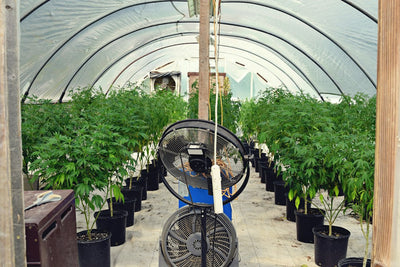
How Commercial Growers Keep Massive Harvests Consistent
Photo by Cannafornia via Pexels.
Ten years ago, a "large" cannabis grow meant maybe a dozen rooms and a few thousand plants under HPS. That reference point is gone. The facilities coming online now are measured in acres and megawatts, and the conversations happening at the top of the industry aren't about grow room square footage anymore -- they're about power purchase agreements, GMP audits, and production cost per pound at a scale that would have sounded like science fiction a decade ago.
What's changed underneath that scale-up is just as important as the scale itself. Consistency -- not just yield -- has become the product buyers are actually paying for. A dispensary buyer, a pharmaceutical partner, or a state regulator doesn't want to hear that most of a 40-tonne harvest tested well. They want batch #1 and batch #40,000 to test the same, look the same, and moisture-test the same. That's a manufacturing standard, not a farming standard, and it's forcing commercial operators to rethink everything from what genetics they plant to how they dry the final product.
Two moves happening right now show exactly where this is headed. In February 2026, Nature's Miracle Holding Inc. signed a $150 million MOU with CCBP Holding LLC for an 88-acre site in California City, California -- a facility built around 660,000 square feet of indoor greenhouse space running on its own solar microgrid. Around the same time, Village Farms International announced it's converting another 550,000 square feet of greenhouse space in British Columbia, pushing its total active canopy to 2.2 million square feet. These aren't incremental expansions. They're a signal of where the ceiling on commercial cultivation is actually going, and they force a real question: how do you keep a harvest that size uniform? This piece walks through the four levers real operators are pulling -- genetics, environmental engineering, post-harvest handling, and data infrastructure.
Why Scale Changes Everything About Consistency

Photo by Markus Spiske via Pexels.
Nature's Miracle Holding Inc.'s $150 million MOU with CCBP Holding LLC, signed in February 2026, is worth sitting with for a moment because the numbers tell you exactly what problem this facility is built to solve. An 88.38-acre site in California City, California, with roughly 660,000 square feet of indoor greenhouse space designed for year-round cultivation, running off an off-grid 40-megawatt solar array with battery storage. That power infrastructure isn't a sustainability footnote -- it's mainly there to run supplemental lighting and HVAC at a targeted cost around $0.10 per kilowatt-hour, which is a fraction of what many indoor operators pay on grid power in high-cost states. The stated goal is production under $200 per pound, which would put the facility among the lowest-cost producers in the country.Genetics: Trading Clones for Stabilized Seed Lines

Photo by Jael Rodriguez via Unsplash.
Ask any cultivation manager who's tried to scale a clone-only program past a few dozen mother plants and you'll hear the same complaints: genetic drift creeps in over generations of cuttings, phenotypic variability shows up as some plants finishing early and others dragging on for two extra weeks, and any pathogen sitting in a mother room gets propagated into every single clone taken from it. At a boutique scale, that's an annoyance. At industrial scale, it's a structural problem, because a facility running thousands of plants per flower room needs those plants to behave like a single crop, not a thousand individual experiments.Environmental Control at Industrial Scale

Photo by Tim Witzdam via Pexels.
Ask a cultivation manager running a single 20-light room how they hold VPD steady, and they'll usually tell you they just walk the room and feel it -- check the leaves, glance at the hygrometer, crack a vent. That approach breaks down completely somewhere between 50,000 and 500,000 square feet of canopy, because you're no longer managing one room's air, you're managing dozens of microclimates simultaneously, and you can't be in all of them at once. Large-scale facilities have had to replace feel with infrastructure -- and that infrastructure is exactly what's being built into projects like the California City facility.Drying and Curing as a Manufacturing Step, Not an Art

Photo by Terre di Cannabis via Unsplash.
For most of the industry's history, drying and curing has been treated as the most subjective step in the whole process -- something a grower does by feel, by smell, by squeezing a bud and deciding it's ready. That approach worked fine when a harvest meant a few hundred pounds handled by someone with fifteen years of pattern recognition. It does not work at 40 metric tonnes of annual production, and cultivation technology providers serving large-scale operators are increasingly blunt about this: drying and curing is now understood as the stage in the process where quality, yield, and consistency are either locked in or lost, full stop, regardless of how well the plant was grown up to that point.Data, Compliance, and the Pharma-Style Standard

Photo by Tima Miroshnichenko via Pexels.
There's no federal GMP certification requirement for cannabis in the United States today -- that's still true as of this writing. But treating that as the end of the story misses what's actually happening on the ground. State cannabis regulations increasingly mirror GMP-style expectations around record-keeping, environmental controls, and batch traceability, and multi-state operators with real capital behind them are adopting full GMP practices well ahead of any mandate, because they can see where the puck is going.None of this happens by accident, and none of it happens cheap. Consistency across a harvest measured in tonnes is the output of stabilized genetics chosen specifically for uniform timing, climate infrastructure engineered to hold tight bands across acres rather than a single room, and post-harvest handling run with the discipline of a pharmaceutical manufacturing line rather than a farm shed. Pull any one of those levers out and the other two can't compensate -- perfect genetics still drift in an unstable climate, and a perfectly grown plant still gets ruined by sloppy drying.
The good news for growers who aren't building 660,000 square feet of anything is that the underlying logic scales down just fine. A five-plant closet grow benefits from stabilized seed genetics over unpredictable clones the same way a 2.2-million-square-foot greenhouse does -- you get more predictable flowering windows, more even canopy height, and fewer surprises at harvest. A disciplined dry-and-cure protocol, run on real humidity and temperature targets instead of guesswork, pays off whether you're hanging four plants or four hundred. Genetics quality still matters more than almost anything else in that equation, which is part of why Seedtiva puts real effort into breeding stable, well-bred seed lines rather than chasing novelty -- though it's worth saying plainly that results still depend heavily on your own climate, equipment, and growing skill, not just the seed.
What's happening in California City and British Columbia right now isn't just two companies getting bigger. It's the industry quietly setting a new baseline for what consistent, at-scale cannabis production is supposed to look like -- and within a few years, every serious commercial operator, and probably a good number of serious home growers, will be measured against it.
Sources
- Cannabis Cultivation Market, Global Market Analysis Report - 2036
- Cannabis Cultivation Guide Best Practices for July 2026 - Cannabis News | NUG Magazine
- Refined Genetics | Top Cannabis Genetic Development Service 2026
- The Business of Cannabis Funding, Scaling, and Regulation - Cannabis News | NUG Magazine
- Cannabis Cultivation Guide: Best Practices for June 2026 - Cannabis News | NUG Magazine