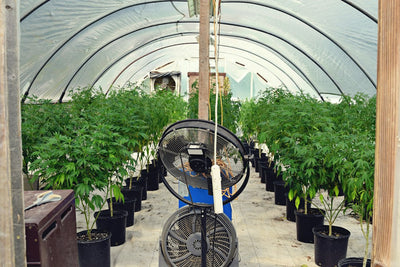
How Large Grows Keep Canopy Temperature Consistent at Scale
Photo by Pexels via Pixabay.
Walk into almost any large-scale cannabis facility and you'll find a wall panel somewhere near the entrance, glowing with a calm, reassuring number: 78F, 55% RH, right where it's supposed to be. Meanwhile, ten feet into the room, upper canopy under a 700-watt LED fixture is running four degrees hotter and 15 points drier than that readout suggests, while the lower fan leaves near the perimeter wall are sitting in a damp, stagnant pocket that never quite dries out between irrigation cycles. The panel isn't lying, exactly. It's just measuring the wrong thing.
The number that actually determines yield, potency, and disease pressure isn't room-average air temperature. It's the microclimate sitting right at canopy height, inches from the leaf surface, where transpiration, light heat load, and airflow (or the lack of it) all collide. A single hallway sensor or a return-air reading tells you what's happening at the air handler. It tells you almost nothing about what an individual plant, three rows deep in a 20,000 square foot flower room, is actually experiencing.
At small scale, this drift is annoying. At the scale of thousands of plants, it compounds into something much worse: uneven ripening across a room, hot spots that push mold pressure past the threshold, and yield loss that shows up not as one bad plant but as an entire section of a harvest that underperforms the rest. This is why canopy uniformity has become a systems engineering problem rather than an HVAC shopping decision -- sensors, airflow design, and zoning all have to work together, because no single bigger air conditioner fixes a distribution problem.
Why Room-Average Readings Lie to You

Photo by Tim Witzdam via Pexels.
Most facilities still run their climate control off one or two fixed sensors -- typically wall-mounted at eye level, often near a doorway or return duct because that's where conduit and power happen to be convenient. That location is measuring hallway air, or air that's already been pulled back toward the handler. It is not measuring the boundary layer around a cola sitting under an 800 PPFD light source, and it's definitely not measuring the humid, low-airflow zone six inches off the substrate where lower fan leaves live out most of their life.
Heat and moisture don't distribute evenly in a room just because the thermostat says they should. Warm air stratifies upward, so ceiling and upper-canopy temperatures in a tall flower room can run 3-6F above what a mid-height sensor reports, especially directly under dense LED arrays. Moisture behaves the opposite way -- it pools low, where airflow velocity drops off and cooler surfaces encourage condensation. The result is a single room that's simultaneously running hot and dry up top and cool and damp at the bottom, and a controller reading one averaged number in between has no way to know that either extreme exists.
Without zoning, this split is exactly what invites trouble. Upper canopy running hot and dry stresses the plant and can push trichome degradation or leaf curl under intense light. Lower canopy sitting damp and still is a textbook setup for Botrytis cinerea -- bud rot doesn't need standing water, it needs prolonged leaf wetness and stagnant air, both of which a stratified, unmonitored room provides for free.
The only way to actually confirm a room is uniform, rather than assume it, is distributed sensor coverage -- multiple sensors at canopy height, mid-canopy, and ceiling, spread across different zones of the room rather than clustered near one wall. That's not a minor calibration nicety. It's the difference between a controller that thinks the room is sitting at setpoint and a crop that's experiencing something meaningfully different than what's on the readout, day after day, for the entire flowering cycle.
Airflow Is the Variable Everyone Underrated

Photo by Pexels via Pixabay.
Ask cultivation teams in 2026 what they'd fix first if they had to redo their build, and airflow comes up more than temperature or humidity setpoints. That's a shift from a few years ago, when most conversations centered on chasing the perfect VPD chart. The setpoints matter, but they're theoretical until air is actually physically moving across the leaf surface -- a leaf sitting in still air doesn't experience the room's RH number, it experiences its own boundary layer, which can run wildly different from what's a foot away.
This is where stagnant pockets become the real enemy. Dense canopy, tight plant spacing, and heavy colas create pockets of dead air between plants and underneath top growth where a fan's throw simply never reaches. Room-average sensors don't see these pockets because they're not designed to -- averages smooth out exactly the variation that matters. A pocket like that can sit 8-10 points higher in RH than the rest of the room, invisible to anyone watching the wall panel, and it's precisely the kind of microclimate that produces uneven bud density, localized mold, and inconsistent cannabinoid development across an otherwise identical genetic run.
The fix isn't more air conditioning tonnage -- it's air movement design that actually gets air past leaf surfaces rather than around the room's perimeter. Horizontal airflow (HAF) fans mounted to create a continuous circular pattern across a room are the baseline, but larger operations are increasingly adding sub-canopy ducting that pushes air up from below plant level, directly disrupting the still zones that HAF alone can miss under dense canopy. Vertical laminar flow systems, used especially in multi-tier setups, aim for a more uniform sheet of moving air rather than the swirling, uneven pattern oscillating fans tend to create.
None of this shows up on a spec sheet the way tonnage or dehumidification capacity does, which is exactly why it's been underrated for so long. A facility can have more than enough cooling and dehumidification capacity in aggregate and still produce inconsistent flower, because the air with the right properties never actually reaches the plant.
Vertical and Multi-Tier Facilities: The Hardest Case

Photo by Manuella Schorchit via Pexels.
Multi-tier and vertical facilities take every uniformity problem from a single-level room and multiply it by however many tiers are stacked. Each tier is functionally its own room -- its own heat load from its own lighting layer, its own airflow access (or restriction) from the structure above and below it, and its own distance from the main air handlers. A grower who nails uniformity on tier one has told you nothing about whether tier four, sitting closer to the ceiling with less clearance for fan placement, is running the same way.
The industry conversation around vertical growing has also matured. A few years back, the pitch was almost entirely about density -- stack more tiers, get more canopy per square foot of floor space. In 2026, as more facilities move past their first build-out and into their second or third generation of design, the emphasis has shifted to efficiency and system maturity: does the vertical system actually deliver consistent performance across every tier, or does it just deliver more square footage that needs to be babysat.
Purpose-built mobile vertical grow systems have become one answer to this, letting cultivators add canopy while preserving the access aisles, airflow paths, and workflow that consistent performance actually depends on -- rather than cramming tiers together in a way that solves the space problem while creating a climate problem. Microclimate zoning is the other half of the solution: dedicated ducting and dedicated sensor sets per tier, rather than one HVAC loop serving the whole vertical stack, so that heat buildup on an upper tier under intense lighting doesn't get masked by cooler air readings from a lower tier further from the ceiling.
One useful example of solving this before it becomes a physical problem: a modeling exercise using Carrier's HAP (Hourly Analysis Program) software tested two tiers of flowering canopy under LED lighting against a lights-on target of 82F and 58% RH, comparing multiple HVAC configurations against that target before any construction happened. That kind of upfront modeling is what catches a mismatched tier -- one that would run hot or humid relative to its neighbor -- while it's still a set of numbers on a screen, not a $40,000 rework after the tier is built, wired, and full of plants.
Sensor Networks and AI Scouting Replace the Clipboard Walk

Photo by Gustavo Fring via Pexels.
For years, the default way to check on plant health across a large room was a human walking the rows with a handheld thermometer and a trained eye, checking leaf temperature and color plant by plant. Done properly, that's a 5-to-10 minute process per plant. Multiply that across a few thousand plants and it becomes obvious why manual scouting was never actually keeping pace with what was happening in the room -- by the time a technician finished one end of a large flower room, conditions at the end they started from had already shifted.
Automated canopy scouting is what's replaced it at the leading edge of commercial cultivation. Neatleaf's Spyder system, deployed at 22Red, is one concrete example: sensors that physically traverse the canopy, tracking leaf color, temperature, and humidity multiple times a day, per plant, per microclimate zone. That's not a spot check -- it's continuous coverage that catches drift within hours rather than whenever a technician happens to walk that row again.
The staffing math is part of why this has spread. Facilities running this kind of automated scouting have reported cutting on-site staff from around 10 down to 6, while actually increasing data frequency and resolution over what the larger manual team was collecting. Subscription costs for this level of monitoring run around $600 a month per deployment -- a number that's easy to justify once you weigh it against the labor cost of the scouting it replaces, plus the crop loss it prevents by catching problems days earlier.
On the environmental control side, RapidGrow-style controllers have moved in the same direction, using four precision digital sensors with aspirated fans that actively draw canopy air through the sensor housing continuously, 24 hours a day, rather than passively waiting for air to drift past a static sensor. That active sampling produces meaningfully more accurate temperature, RH, and CO2 readings per room, because the sensor is pulling a real sample of canopy air rather than reading whatever happens to settle near it.
The larger shift across both examples is the same: from spot-checking a sample of plants and hoping it represents the room, to continuous, per-zone data that feeds directly into automated HVAC and dehumidification responses -- closing the loop between what the plant is experiencing and what the equipment does about it.
What Happens When Uniformity Fails

Under high humidity, plants experience severe losses compared to optimal conditions, with total biomass dropping 75.3% and flower biomass alone falling 71%, highlighting humidity control as critical to cultivation yield.
The cost of getting this wrong isn't theoretical. A 2025 study published in Frontiers in Plant Science measured what high relative humidity conditions actually do to a cannabis crop, and the numbers are stark: a 71% reduction in flower biomass and a 75.3% reduction in total biomass compared to plants grown under optimal humidity. That's not a modest quality dip -- that's most of a harvest's weight simply not materializing.
The same high-humidity conditions pushed harvest three weeks later than the control group, and dropped CBD-A content nearly five-fold. For any facility running on a fixed cropping schedule tied to lease costs, labor scheduling, and downstream processing commitments, a three-week delay across a room isn't an inconvenience -- it's a scheduling failure that ripples through the entire production calendar.
Scale that up to a 20,000 square foot canopy footprint, which is a modest size for a commercial cultivation facility, and a systemic humidity miss like this stops being a bad batch story and becomes a genuinely catastrophic financial event -- the kind that shows up in quarterly numbers, not just a grower's notes. This is exactly why canopy-level uniformity gets treated as a serious engineering problem rather than a nice-to-have at commercial scale: the downside isn't a slightly lower yield, it's a fraction of expected biomass, delayed by weeks, with degraded potency on top of it.
The financial argument isn't only about avoiding disaster, either. Vendor-cited figures on right-sized climate systems -- ones actually matched to real canopy heat and moisture load rather than oversized as a hedge -- show energy use dropping from roughly 1,200 kWh to 800 kWh per pound produced. At a facility running thousands of plants, that difference translates to savings close to $200,000 a year, with payback on the system investment landing around three years. Precise canopy-level control has become as much an energy efficiency and risk-avoidance case as it is a quality argument -- the kind of number that gets a facility's finance team, not just the cultivation team, paying attention.
Building Uniformity Into the Design, Not Bolting It On After

Photo by Jonathan Cooper via Pexels.
Every example in this discussion points the same direction: uniformity problems get solved cheaply on paper and expensively in concrete. Modeling HVAC configurations before construction -- the same approach behind the Carrier HAP tier study referenced earlier -- catches dead zones, tier mismatches, and heat load miscalculations while they're still adjustable inputs in a program, rather than fixed ductwork behind a finished ceiling. Any facility planning a multi-room or multi-tier build should treat that modeling step as non-negotiable, not an optional add-on for the budget that's left over.
Zoning strategy needs to be built around the actual variables that drive heat and moisture load -- tier height, the specific heat output of the light source in use, and plant density per zone -- rather than simply totaling up BTU load for the room and assuming even distribution follows automatically. Two rooms with identical total tonnage can perform completely differently if one has that capacity delivered through a well-designed zoned system and the other pushes it all through one central loop.
Sensor placement is the other half of the equation, and it needs to happen at canopy height across multiple zones, using aspirated, continuously-sampling hardware rather than passive wall sensors. That's the only way to get ground truth a central thermostat physically cannot provide, since the thermostat is, by definition, reading air somewhere other than the leaf surface.
Growers scaling from a single flower room to several rooms should resist the temptation to treat expansion as a copy-paste exercise. Each room has its own structural quirks, its own relationship to exterior walls and building envelope, its own lighting layout -- and each deserves its own zoning plan built around those specifics rather than a scaled version of whatever worked in room one.
Genetics are worth factoring into this equation too. Some cultivars handle humidity swings and heat stress with far more resilience than others, tolerating a wider environmental band before showing stress or opening the door to mold. Pairing environmental design that's actually built for uniformity with well-bred, resilient genetics -- the kind of quality seed stock Seedtiva focuses on -- reduces risk from both directions at once, rather than asking the HVAC system to compensate for genetics that were never suited to the environment they're being grown in.
None of this gets fixed after the fact with a bigger compressor or a more aggressive dehumidifier setting. Canopy uniformity at the scale of thousands of plants is won or lost during design and sensor layout, long before a single clone goes into a pot -- in the modeling software, in the duct runs, in the decision about where sensors actually get mounted relative to the top of the canopy.
The facilities getting this right in 2026 aren't necessarily the ones with the largest HVAC tonnage on their spec sheet. They're the ones running the most distributed, continuous data collection at the height that actually matters to the plant -- multiple sensors per zone, per tier, feeding automated responses rather than one number on a wall panel that everyone's agreed to trust.
Outcomes will still vary by climate, by building envelope, and by the genetics in the pots -- a facility in a humid coastal region is fighting a different battle than one in an arid inland climate, and some cultivars simply give more room for error than others. But the operators treating airflow and zoning as first-class engineering problems, rather than an afterthought bolted onto whatever HVAC system was on sale, are the ones who aren't finding out about a humidity failure three weeks before harvest, when there's nothing left to do about it.