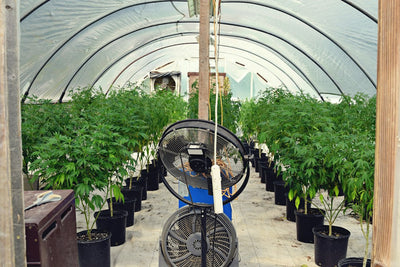
How to Take Cannabis Clones That Actually Root Reliably
Photo by Mikhail Nilov via Pexels.
Somebody messages me every week with a version of the same complaint: cuttings turning brown and mushy at the base, or just sitting there doing nothing for three weeks before finally collapsing. The first question they usually ask is what rooting gel to switch to. It's almost never the answer. In the vast majority of failed clone runs I've diagnosed, the hormone product was fine -- the environment around the cutting was quietly working against it the entire time.
A grower I talked to last winter had done everything by the book on paper. Real Clonex, sterile razor, labeled trays. He still lost 14 of 20 cuttings to stem rot inside ten days. When we walked through his setup, the problem wasn't the gel at all -- it was a dome sealed down tight with no venting, sitting on a concrete basement floor holding steady at 65°F. Cold, stagnant, saturated air is a rot incubator, and no hormone concentration fixes that.
Rooting isn't a matter of hoping a cutting decides to grow roots -- it's a hormone-driven biological process, driven specifically by auxin accumulation at the cut site, and it responds predictably to the conditions you give it. Once you understand that mechanism, cloning stops being a coin flip and starts being something you can engineer for. That's what this piece is actually about: the biology underneath the process, the specific numbers -- ppm, temperature, RH, pH, days to root -- that separate a 90% success rate from a 30% one, and where the technology around propagation is headed next.
The Biology: Why Cuttings Root at All

Photo by CRYSTALWEED cannabis via Unsplash.
When you slice a cutting away from a mother plant, you're severing its connection to the root system that was supplying it water, nutrients, and a whole set of hormonal signals it had been relying on. The plant's immediate problem is that it now has a wound and no roots. Its response is a metabolic shift: cells near the cut begin redirecting resources toward auxin production, the plant hormone responsible for growth and differentiation at that wound site.
Auxin is what actually builds a root. It triggers dedifferentiation in the cells near the cut -- basically, it convinces mature stem cells to forget what they were and revert to a more flexible, embryonic-like state -- and then organizes some of those cells into root primordia, the tiny root initials that will eventually elongate and emerge through the epidermis. This isn't a metaphor for what rooting hormone does; it's the literal mechanism, whether the auxin comes from the plant itself or from a bottle.
Here's the catch: the auxin a fresh cutting produces on its own is inconsistent. Some genetics, some mother plants, and some individual cuttings naturally generate enough to root fast and clean. Plenty don't, or the levels degrade before enough root initials have formed. That inconsistency is exactly why synthetic auxin products exist -- they're not a crutch, they're a way of guaranteeing the hormone signal is present at an effective concentration right when the cutting needs it most, instead of leaving it to whatever the plant happens to produce on its own.
This is also why the mechanics of the cut itself matter more than most growers give them credit for. A clean 45-degree cut through healthy, non-woody tissue with a sharp, sterile blade exposes more cambium surface area for hormone uptake and heals faster than a crushed or ragged cut from dull scissors. And because auxin synthesis and hormone uptake both start losing effectiveness the moment tissue begins to dry out or oxidize, the window between cutting and getting that stem into hormone and media is not a leisurely one. Minutes matter here, not because of superstition, but because you're racing a biological clock that started the second you made the cut.
Choosing and Using Rooting Hormone Correctly

Photo by https://kaboompics.com/ via Pexels.
IBA -- indole-3-butyric acid -- is the synthetic auxin behind most commercial rooting products, Clonex included. It performs the same job as the auxin your cutting produces naturally, but at a known, reliable concentration instead of whatever your genetics and stress levels happen to generate. That reliability is the entire point of buying a bottle instead of just waiting.
Concentration is where a lot of growers get tripped up, because rooting hormone isn't one-size-fits-all across plant species. For soft-tissue cuttings like cannabis, 0.3% IBA -- 3,000 ppm -- is the calibrated sweet spot. It's strong enough to trigger fast, reliable root primordia formation without overwhelming the tissue. Products in the 5,000-8,000 ppm range exist too, but those are formulated for woody ornamentals with thick, lignified stems that can tolerate a much hotter dose. Use one of those on a cannabis cutting and you're not giving it an extra boost -- you're chemically burning the cut site, which damages the very cells that need to dedifferentiate and root. I've seen success rates drop by half or more from this mismatch alone, and it's an easy mistake to make when you're grabbing whatever rooting hormone is on the shelf at a garden center that mostly serves people rooting rose cuttings.
On the other end, herbal-strength products around 1,000-1,500 ppm will still root cannabis cuttings. They're not wrong, just slower -- you're giving the cutting a real but modest auxin signal, so root initiation takes noticeably longer and you'll see more variability between cuttings from the same batch.
Format matters almost as much as concentration. Gel formulations consistently outperform powders, by roughly 10-20% in success rate in my experience and in what most experienced propagators report. The reason is mechanical, not chemical: gel seals the cut, excludes air from the wound, and keeps the hormone in constant physical contact with the tissue as it heals. Powder dusts on, then a lot of it sloughs off the moment you insert the stem into media, leaving inconsistent hormone exposure right when you need it most.
Dialing In Temperature, Humidity, and Media

Photo by NoblePrime via Pixabay.
Temperature and humidity are where most clone runs actually succeed or fail, and the target numbers aren't complicated. Stem and root-zone temperature should sit in the 70-80°F (21-27°C) range, with 75-80°F being the genuine sweet spot for fast root initiation. Below that range, metabolic activity slows down across the board -- including auxin-driven cell division at the cut site -- and rooting drags out or stalls entirely. This is the single most underrated variable in home cloning setups, because heat mats get skipped constantly while people obsess over gel brands.
Humidity matters for a different reason: a cutting with no roots can only take up water through its leaves, via the stomata, until roots form and take over that job. That means dome or mist humidity needs to run high initially -- 80-90% RH -- to keep the cutting from desiccating while it's rootless. As roots develop over the following one to two weeks, you taper that humidity down gradually, both to harden the plant off and because a constantly saturated environment starts working against you instead of for you.
That's exactly what happened to the grower I mentioned earlier. His dome was sealed with zero daily venting, his rockwool cubes were saturated to the point of dripping, and his basement floor was holding at 65°F. Every one of those factors compounds the others: cold slows rooting, oversaturated media stays anaerobic and invites Pythium and other rot pathogens, and a sealed dome with no gas exchange lets stagnant, moisture-loaded air sit directly on the stem. Fourteen of his twenty cuttings rotted at the base within ten days -- not because his hormone was weak, but because his environment was actively hostile to a rootless plant.
Media pH deserves a specific number too, and it doesn't change based on substrate: whether you're using rockwool, peat plugs, or an aeroponic mist system, keep it at 5.8-6.0. Outside that band, nutrient and water uptake through the stem and developing root hairs gets inefficient even when everything else is dialed in. And don't skip venting the dome for a few minutes daily -- it prevents stagnant air and fungal buildup without crashing your humidity back down, which is the balance that saved a lot of my own early cuttings once I started doing it.
How Long Rooting Actually Takes, By Method

How long a clone actually takes to root depends heavily on the method, and the differences aren't small. If you're working with rockwool cubes or peat plugs -- the most common home setup -- expect visible roots emerging from the sides or bottom somewhere in the 7-14 day window under decent conditions. Push everything into the ideal range -- 75-80°F, correct hormone strength, tight humidity control -- and some fast-rooting strains will show roots in as little as 5 days. Stressed cuttings, or ones dealing with a temperature or humidity mismatch, can take up to 21 days, and by that point you're usually looking at reduced overall success even among the ones that do eventually root.
Water-cup cloning -- suspending a cutting's stem directly in a jar of plain water -- is the least consistent method out there, and I'd steer most growers away from it as anything but a backup. Some cuttings will root in two weeks. Most take closer to four. And it's not unusual to see stragglers stretch past six weeks before finally throwing roots, if they make it that far at all. The lack of consistency comes down to oxygenation and rot risk: stagnant water around a submerged stem section is a much less controlled environment than moist-but-aerated media.
Aeroponic cloners sit at the opposite end of the spectrum. These units suspend cuttings with their stems in an enclosed chamber and circulate a fine, nutrient-free mist continuously across the cut surface, delivering constant moisture and oxygen without ever saturating the tissue. Root development under this method typically happens in 5-10 days, with success rates in the 90-95% range under most home growers who use one consistently -- the best numbers of any method available without a lab.
None of this means one method is objectively correct for everyone. Choosing a cloning method is really choosing a tradeoff between upfront cost, hands-on maintenance, and the success rate and timeline you're willing to live with. Rockwool is cheap and forgiving of minor mistakes. Aeroponic cloners cost more and need cleaning between runs, but they buy you speed and consistency that water cups simply can't match.
Your Mother Plant Is the Real Foundation

Photo by Jonathan Cooper via Pexels.
A cutting can only ever be as healthy as the plant it came from. If your mother plant is stressed, underfed, root-bound, or carrying a pest infestation like spider mites or russet mites, every single cutting you take from it inherits that same baggage -- assuming it roots at all. Cloning doesn't clean up problems; it copies them exactly.
A dedicated mother plant should live under permanent vegetative photoperiod lighting, 18 hours on and 6 off, in a space physically separated from any flowering room. That separation isn't optional housekeeping -- flowering rooms are where pest populations build up fastest and where stray pollen from a male or hermaphrodite plant can drift and seed your entire crop. Keeping mothers isolated protects both the genetics and every future harvest downstream of them.
Feed schedule matters more than growers expect. It's tempting to push moms with heavy nitrogen to maximize the volume of cutting material available, but that approach backfires: high-nitrogen growth comes in soft, watery, and full of easily ruptured cell walls, which roots noticeably slower and rots more easily than a slightly firmer, properly hardened-off cutting. A moderate feed schedule that keeps growth a touch on the firmer side, rather than lush and floppy, gives you better cloning material every time.
Mother plants also aren't meant to run indefinitely. Vigor and disease resistance decline the longer a mother is kept in continuous vegetative growth, and I'd recommend rotating in fresh mothers several times a year rather than leaning on one plant for its entire lifespan. Treat it as a maintenance schedule, not a reaction to visible decline -- by the time a mother visibly looks tired, you've likely already been taking compromised cuttings from her for weeks.
And the foundation underneath all of this is where that mother came from in the first place. Starting from well-bred, healthy seed stock -- rather than an unlabeled clone of unknown genetic and disease history passed around a local scene -- removes a huge amount of downstream risk before you've taken a single cutting. It's part of why Seedtiva focuses on breeding genetics with strong natural vigor: a healthy starting point makes every step after it, cloning included, measurably easier.
What's Next: Tissue Culture and Micropropagation

Photo by Trnava University via Unsplash.
Home cloning methods like rockwool and aeroponics are still catching up, in a sense, to what's already possible in a lab. A peer-reviewed micropropagation protocol for Cannabis sativa chemotype III, published in 2026, laid out a tissue culture process built around axillary buds -- the small dormant buds found at leaf nodes -- cultured on Murashige and Skoog (MS) medium, the standard nutrient gel base used across plant tissue culture work for decades.
The process uses plant growth regulators to do two distinct jobs. BAP or TDZ get used first, to stimulate rapid multiplication of shoots from that initial tissue sample, producing far more propagation material than you'd ever get from a single mother plant's node count. Then NAA and IBA -- the same class of auxin used in bottled rooting gels, just applied in a sterile lab context -- get tested to trigger rooting, both while the plantlets are still in vitro inside the culture vessel and after they're transferred out into a conventional growing medium.
What this buys you is scale and cleanliness that cutting-based cloning structurally can't match. A single tiny piece of tissue can be multiplied into large numbers of genetically identical, disease-free plantlets, all traceable back to one verified source. That matters enormously for preserving a specific genetic line long-term, especially one worth protecting against the pest and pathogen buildup that tends to creep into stock plants kept in continuous vegetative cycles for years.
None of this changes what you need to do in your own tent this weekend. Tissue culture requires sterile lab conditions, specialized media, and equipment that has no place in a home grow -- it's a tool for research institutions and larger commercial breeding programs working to preserve and multiply specific genetic lines at scale. But it's worth knowing about, because it signals where large-scale, clean-genetics propagation is heading industry-wide, and because the underlying chemistry -- auxin driving root formation -- is the exact same mechanism you're already leaning on every time you dip a cutting in gel.
Strip away the brand names and the forum debates, and clone failures almost always trace back to one of three things: the wrong hormone strength or format for soft cannabis tissue, a temperature or humidity setup that's working against a rootless plant instead of for it, or a mother plant that was compromised before you ever made a cut. It's rarely bad luck, and it's almost never the genetics themselves failing to want to root.
The fix is boring but effective: start writing down your numbers. Dome temp, RH at day 1 and day 7, media pH, hormone concentration, and days to visible roots, every single run. After three or four batches you'll have an actual dataset instead of a vague memory of what worked, and you'll be able to isolate exactly which variable moved when your success rate did.
Reliable cloning isn't really something that starts at the razor blade. It starts well before that, with a healthy, properly maintained mother plant grown from genetics with real vigor behind them -- everything after that point is just giving a naturally strong cutting the conditions it needs to do what it's already biologically wired to do.