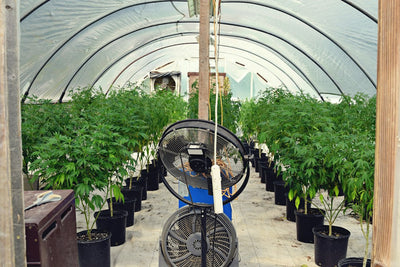
HVAC Mistakes That Quietly Kill Cannabis Yield
Photo by CRYSTALWEED cannabis via Unsplash.
Nobody's HVAC system fails with a bang. There's no alarm, no dramatic crash, no single moment where you can point and say that's what killed the crop. Instead it shows up as a harvest that comes in 8% light on yield for no obvious reason, a corner of the flower room that gets botrytis every third cycle, or a strain that tested beautifully in someone else's grow but turns out mediocre and inconsistent in yours over six months of runs. By the time anyone notices the pattern, it's already cost real money across multiple harvests.
That quiet erosion is exactly what a panel of facility designers zeroed in on during a Cannabis Business Times webinar held April 22, 2026, featuring representatives from Pipp, Claybourne Co., and Klutch Cannabis. Asked to name the single costliest mistake they see in new cultivation builds, the consensus wasn't lighting, benching, or automation software -- it was HVAC undersizing and bad load calculations, made at the design table before a single seed ever goes in a pot. The stakes behind that mistake are not abstract. Industry estimates put the annual cost of a suboptimal HVAC setup at $50,000 to $150,000 in lost revenue for a mid-sized facility, and that's before counting equipment failures, which can add another $50,000 to $75,000 per incident in downtime, crop loss, and emergency repairs.
What follows is a rundown of the specific mistakes -- sizing, VPD management, automation sequencing, filtration, and cold-climate design -- that quietly chip away at yield and quality even in rooms that look, on paper and to the naked eye, perfectly fine.
Undersized Systems and Bad Load Calculations

Photo by Brian Haddock via Pexels.
Sizing an HVAC system for cannabis cultivation is not the same exercise as sizing one for an office or a house, and treating it that way is the mistake the April 2026 CBT panel called out as the single most expensive design error they see repeated across new builds. The governing standard for load calculations, ACCA Manual J, accounts for the actual thermal and moisture load a space generates -- but a huge share of cultivation HVAC installs still get sized off a rough square-footage rule of thumb instead, the kind of shortcut a contractor might use for a retail buildout. That approach ignores the three things that actually drive load in a flower room: the heat output of the lighting system at full canopy, the transpiration rate of a mature plant population pushing moisture into the air around the clock, and the dehumidification tonnage needed to pull that moisture back out fast enough to keep RH in range overnight. A system sized on square footage alone routinely misses all three.Chasing Humidity Numbers Instead of VPD

Target vapor-pressure deficit (VPD) should rise steadily as cannabis plants mature, moving from about 0.6 kPa during clone/early vegetative growth to 1.3 kPa in late flower.
People fixate on relative humidity because it's the number every cheap sensor displays, but RH by itself tells you almost nothing about how hard the atmosphere is pulling moisture out of a leaf. Vapor pressure deficit is the actual driver of transpiration, and it's a function of both temperature and humidity together. A room sitting at 55% RH and 82°F has a meaningfully different VPD than a room at 55% RH and 72°F, even though the humidity readout is identical in both cases -- one is comfortable for the plant, the other is pushing it toward stress. Growers who set their controller to hold a fixed RH percentage and call it done can watch that number stay rock-steady on the display while VPD underneath it swings by half a kPa or more every time the lights cycle or an AC unit kicks on.
The other piece growers miss is that VPD targets aren't static across a grow cycle. Running the same setpoint from clone through harvest is one of the most common mistakes in commercial cultivation, full stop. Clones and early veg plants have underdeveloped root systems and need a gentler atmospheric demand, generally in the 0.4-0.8 kPa range, to avoid wilting and to encourage root development before top growth outpaces it. As plants move through flower, especially in the final few weeks, a higher VPD in the 0.8-1.2+ kPa range helps manage humidity around dense buds and reduces the moisture load that feeds mold. Skipping that staged shift means either coddling flowering plants into slow, mold-prone density or stressing young plants that can't yet handle the demand.
The practical fix is to control VPD directly rather than backing into it. That means a controller pulling leaf-surface temperature, not just ambient air temperature and RH, since leaf temperature -- which typically runs a degree or two below air temp depending on transpiration rate and airflow -- is what actually determines the vapor pressure gradient the plant experiences. From there, set VPD targets on a defined schedule tied to growth stage rather than one static number for the whole run. Treat the ranges above as a starting point: canopy density, room design, and genetics all shift where a given strain actually wants to sit, so expect to dial it in over a cycle or two rather than trusting a chart blindly.
Automating Irrigation Before Automating Climate

Photo by Caniceus via Pixabay.
There's a sequencing mistake that shows up constantly in commercial builds, and it has nothing to do with the quality of the equipment involved: growers get their fertigation schedule dialed to the milliliter before their climate system is actually holding steady. It's an understandable order of operations, since irrigation feels more controllable and more immediately actionable than climate does. But a perfectly executed feed schedule can't fix a room where VPD is swinging from 0.6 kPa to 1.8 kPa overnight. The plant experiences that swing directly through its stomata regardless of what's happening at the root zone, and no amount of precision at the drip line compensates for atmospheric whiplash happening twelve inches above it.
These overnight swings almost always trace back to the same root cause: an HVAC system cycling on temperature alone, with dehumidification staged as an afterthought rather than run in tandem. Lights-off periods are especially vulnerable -- ambient temperature drops, RH climbs as transpiration continues without the offsetting heat load from lighting, and a unit designed to satisfy a temperature setpoint alone will happily let humidity climb unchecked in the process. Ductless mini-splits in smaller flower rooms make this worse through short-cycling: the unit satisfies the temperature call quickly, shuts off, and the room's humidity creeps right back up until the next cycle, producing a sawtooth VPD pattern that never shows up on a daytime walkthrough.
The fix is a matter of sequencing, not equipment spend. Get temperature, RH, and air movement stable and repeatable across a full 24-hour cycle -- lights-on and lights-off both -- before layering irrigation automation on top of it. Building a fertigation program around an unstable climate just means automating inconsistency. And the only way to actually catch these overnight problems is continuous data logging rather than spot checks during a morning walkthrough; a data logger pulling readings every few minutes will show the swings that a single 9am glance at the controller display never will.
LED Retrofits Change the Heat Math

Photo by Daniel Norin via Unsplash.
Switching from HPS to LED changes more about a room's environment than most retrofit plans account for, and the piece that gets missed most often is radiant heat. HPS fixtures throw a substantial amount of infrared radiation directly onto the canopy, and that radiant heat load raises leaf surface temperature independent of the ambient air temperature around it. LEDs run far cooler in this respect -- at the same air temperature, a canopy under LED fixtures sits at a lower leaf temperature than the same canopy did under HPS, simply because it's not absorbing the same infrared signal.
That matters because leaf temperature, not air temperature, is what drives stomatal activity and transpiration. A facility that retrofits LEDs but leaves its old HPS-era temperature setpoints untouched often sees transpiration rates quietly decline, since the plant isn't getting the same thermal cue to open its stomata and move water. The room reads the same on every gauge that matters to a controller, but the plant is behaving differently underneath that reading, and yield or vigor can slip without an obvious cause showing up anywhere in the data the facility is actually tracking.
The fix is straightforward but frequently skipped: raise air temperature setpoints slightly after an LED conversion to restore the transpiration and VPD targets the plant was hitting before, rather than assuming numbers tuned for HPS still apply. This is one of the more commonly missed steps in lighting conversions -- facilities will spend serious capital upgrading fixtures for efficiency and heat reduction, then never revisit the HVAC controller strategy that was built around the old lighting's thermal signature. Since leaf temperature is the number that actually governs VPD, it's worth adding infrared thermometers or dedicated leaf-temperature sensors to the room after any lighting change. They're a modest cost relative to the fixture upgrade itself, and they're the only reliable way to confirm the plant is actually experiencing the environment the controller thinks it's creating.
Ignoring Filtration Until Contamination Hits

Photo by Sóc Năng Động via Pexels.
Most commercial HVAC installs, cannabis or otherwise, ship with MERV 8 filtration as a default, and that rating is fine for catching lint, larger dust, and pollen. It does essentially nothing against mold spores, bacteria, and the fine particulates that matter most in a flower room. Botrytis and powdery mildew spores are small enough to pass straight through a MERV 8 filter and recirculate through shared air handling, seeding new infection sites in rooms that otherwise look clean.
During the COVID-19 pandemic, the CDC and ASHRAE converged on MERV 13 as the baseline recommendation for critical air-quality environments, a standard aimed at capturing fine airborne particles including much of what drives mold and bacterial spread. A lot of cannabis facilities never adopted that standard, partly because there's no federal air-quality regulation written specifically for cannabis cultivation. Filtration remains entirely voluntary in this industry, which means standards vary enormously from one facility to the next -- some run MERV 13 or better as a matter of course, others are still running whatever the HVAC contractor defaulted to at installation.
The upgrade cost from MERV 8 to MERV 13 is genuinely modest set against what it protects against. A contamination event that forces destruction of an infected flower room, or that spreads through a shared HVAC trunk line into multiple rooms, costs vastly more than the filter upgrade would have. It's one of the cheapest insurance policies available in a cultivation facility.
Filtration alone isn't the full answer, though. Clean, well-filtered air moving through a room that's sitting at 65% RH during peak flower is still moving through mold-favorable conditions -- filtration removes spores from circulation, it doesn't change whether the room's humidity is inviting new colonization. The two have to be addressed together: upgraded filtration paired with dehumidification capacity that actually keeps RH in a range where botrytis and powdery mildew struggle to establish, particularly in the dense final weeks of flower when airflow through the canopy is already restricted.
Cold-Climate Retrofits That Skip Simultaneous Heating and Dehumidification

Photo by Yetkin Ağaç via Pexels.
A cultivator operating out of Macomb County, Michigan, lost 40 percent of a harvest to a single botrytis outbreak in the second year of operation. The root cause traced back to climate control that simply couldn't keep pace during a Michigan winter, in a building that had been converted from another industrial use rather than built from the ground up for cultivation. It's a pattern that repeats across northern climates: a facility opens, performs fine through its first summer, and then runs into serious trouble once heating season demands more from the HVAC system than it was ever designed to deliver.
Cold-climate cultivation needs simultaneous heating, humidification, and dehumidification capacity, often within the same 24-hour cycle, and that's a fundamentally different design problem than a single-purpose cooling system built with a warm-climate facility in mind. In deep winter, a facility might need to add heat to the incoming air while simultaneously pulling substantial moisture out of the room air, because transpiration doesn't slow down just because it's cold outside. A system that can only do one of those jobs well leaves a gap, and that gap is exactly where an outbreak like the Macomb County incident takes hold.
Converted warehouses and repurposed industrial buildings are especially prone to this, because they often inherit HVAC systems designed for human comfort loads -- keeping a warehouse crew comfortable in winter -- rather than the dramatically higher dehumidification demand of a room packed with vegetative and flowering plants. Comfort-load HVAC and cultivation-load HVAC look similar on a spec sheet but are not remotely the same system in practice.
The fix has to happen at the design phase. Budget for dedicated dehumidification equipment sized to the facility's actual plant transpiration load, calculated separately from whatever tonnage is handling heating and cooling, and size it for the coldest, highest-transpiration point in the year rather than an average. Retrofitting adequate dehumidification into a cold-climate building after the fact -- after the ductwork, electrical service, and structural layout are already locked in -- runs substantially more than specifying it correctly during the original build.
None of what's described above requires exotic equipment or a bigger budget than most facilities already have. A proper Manual J-style load calculation, a filter upgrade from MERV 8 to MERV 13, a controller reconfigured to track VPD by growth stage instead of a flat RH number -- these are design-stage and maintenance-stage decisions, cheap relative to the alternative. The alternative is finding out the hard way, mid-cycle or after a mold outbreak wipes out a room, that the system was never sized or sequenced for what the plants actually needed. Set against $50,000 to $150,000 a year in quiet yield losses, or $50,000-plus for a single equipment failure, the cost of getting this right up front isn't close.
Genetics only get you part of the way there. Well-bred seeds -- and Seedtiva puts real effort into selecting genetics that perform reliably across a range of setups -- still need a climate system that's actually matched to the room's real heat and moisture load, adjusted stage by stage as the plant's demands change. A strain with strong genetic potential grown in a room fighting erratic VPD or undersized dehumidification will never show what it's actually capable of, and there's no feed schedule or lighting tweak that substitutes for that.
The mindset shift that matters most is treating HVAC as something to keep tuning through every cycle, not a system you install once, set, and forget. Loads change as canopy density changes, as seasons turn, as lighting gets upgraded, as strains rotate through the room. A climate system dialed in perfectly for one stage of one grow won't stay perfect on its own -- it needs the same ongoing attention as anything else in the room that's actually driving the outcome.
Sources
- The 7 Most Expensive Design & Operational Mistakes in Cannabis Facilities | Cannabis Business Times
- Cannabis Business Risk Management: Unseen Threats to 2026 Profits - Cannabis Tech
- Complete Guide to Cultivation Facility Design in 2026
- Back to Basics: The ABC’s plus D of HVAC For Indoor Cannabis Growing Facilities | HVAC Know It All
- Cannabis HVAC ROI Calculator 2026: Proven Savings Guide