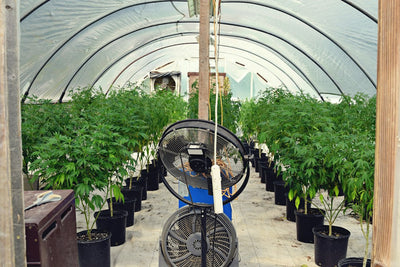
Keeping Grow Rooms Cool When the Grid Itself Is Melting Down
Photo by stux via Pixabay.
On July 2, 2026, PJM Interconnection — the grid operator serving 65 million people from Chicago to DC — forecast 166,147 megawatts of demand, enough to break the all-time record of 165,563 MW set back in 2006. Days earlier, the Department of Energy had issued Section 202(c) emergency orders letting PJM curtail data centers and waive pollution limits on backup generation through July 3, because the alternative was rolling blackouts. That's not a hypothetical stress test. That's a grid running out of margin in real time, and it happened because a heat dome parked itself over the eastern half of the country and refused to move.
The numbers on the ground were ugly. Heat indices hit 113°F in Washington DC, 112 in Philadelphia, 111 in both New York City and Nashville. Roughly 160 million people across 30 states were under some form of heat alert that week. Utilities like Con Edison weren't just issuing advisories — they were asking customers directly to cut AC and appliance use between 2 and 10pm, the exact window when demand peaks and the grid is most fragile.
For growers, this collides with plant physiology in an uncomfortable way. Cannabis wants to live between 70-85°F during the day, and prolonged exposure above 95°F stalls growth outright — right at the moment utilities are leaning on commercial operations to shed load during those same afternoon hours. A heat wave like this isn't just a climate-control inconvenience anymore. It's a scheduling conflict between what your plants need and what your grid can deliver, and the growers who treat it purely as an equipment problem are missing half the picture. This piece covers both sides: the physiology and mechanical fixes that keep a room in range, and the load-management moves that keep your utility bill and your relationship with the grid operator intact.
Why Grow Rooms Are Uniquely Vulnerable to Heat Waves

Photo by Brian Haddock via Pexels.
Most people outside the industry assume a grow room's energy bill is mostly about lighting. It isn't. HVAC alone typically accounts for roughly half of total energy use in indoor cannabis cultivation, and when you add lighting into that figure, the two together account for close to 90% of a facility's power draw. A 2021 study of Southern California cultivation facilities actually found that HVAC and dehumidification (HVACD) systems consumed more electricity than sole-source lighting — which surprises a lot of growers who assumed their lights were the dominant cost center.
Indoor cultivation facilities already run as much as 10 times more energy per square foot than a typical commercial office building. That's the baseline, on a normal day, in normal weather. There's very little slack built into that number, which means when a heat wave pushes outdoor temps into the 100s, there's almost no headroom left before HVAC systems are running flat-out just to hold ground, let alone gain it.
Here's the physics that makes it worse: every watt of light energy that doesn't get converted into photosynthesis becomes heat that your HVAC has to remove. Older HPS fixtures and first-generation LED diodes convert a smaller fraction of input energy into usable PAR and dump the rest as radiant and convective heat directly into the canopy zone. A large canopy running under legacy lighting during a heat wave isn't just adding heat load — it's adding it exactly where your dehumidifier and AC are already struggling hardest, right at the top of the plant.
And then there's timing. Con Edison and similar utilities specifically flagged 2pm to 10pm as the window to cut air conditioning and large appliance use during the July 2026 emergency. That's precisely the window when most commercial grow rooms have lights on, dehumidifiers running, and canopy transpiration peaking. Your highest-demand hours as a grower line up almost exactly with the grid's highest-stress hours. That's not a coincidence you can plan around lightly — it's a structural conflict that needs a deliberate response, not an improvised one.
The Temperature and VPD Numbers That Actually Matter

Cannabis plants thrive in daytime temperatures between 70°F and 85°F, but once temperatures climb to around 95°F, plants begin to experience heat stress.
The daytime target for cannabis is 20-30°C, or 70-85°F, and that range isn't arbitrary — it's where stomatal function, nutrient uptake, and photosynthetic rate all operate efficiently together. Push past 35°C (95°F) for any sustained period and growth visibly stalls. Leaves start cupping upward to reduce surface exposure, internodal stretch gets erratic, and in flower you can end up with bud structure problems that don't reverse once the heat breaks.
Nighttime temps should drop 5-10°F below whatever you're running during the day. That drop isn't just about mimicking a natural diurnal cycle — it's what keeps stretch in check and keeps your VPD (vapor pressure deficit) in a healthy range through the dark period. Skip that drop during a heat wave, when nights stay warm and humid, and you lose one of your few natural tools for resetting the room.
VPD is where a lot of growers get tunnel vision on the thermometer and miss what's actually happening. High heat combined with high humidity is a bad combination specifically because it crashes VPD — the plant's driving force for transpiration weakens even though the air feels hot, and nutrient and water uptake through the roots slows down as a result. You have to watch temperature and relative humidity as a single dial, not two separate numbers. A room reading 82°F at 45% RH is in a completely different physiological zone than the same 82°F at 70% RH, and only one of those is doing your plants any favors.
Flowering rooms carry the highest stakes during a heat event. Heat stress in flower risks foxtailing (that popcorn-like re-growth spike out of an existing bud), nutrient lockout as root zone chemistry shifts, and a measurable drop in terpene retention as volatile compounds off-gas faster than they're being produced. If you've got one room where you cannot afford to lose control during a heat wave, it's flower, every time.
A useful gut-check when things start slipping: if leaf surface temperature is climbing and RH is climbing right alongside it, that's not just a cooling problem — that's your AC losing the dehumidification fight specifically. Cooling and dehumidification are two different jobs for the same machine, and when a system is maxed out, dehumidification tends to be the first casualty.
Mechanical Fixes: Sizing, Redundancy, and Smarter Equipment

Photo by Archermech via Pixabay.
Undersized dehumidification is, in my experience, the single most common reason a room loses control during a heat wave. Dedicated dehu units sized properly to ACCA Manual D standards run $45,000-$75,000 for a commercial facility, and that number scares a lot of operators into buying smaller than they need. That's a mistake that only shows up when you actually need the capacity — during the one week a year it's 111°F outside and your latent load has doubled from canopy transpiration.
It's worth reframing HVAC as a seasonal budget line rather than a fixed cost. 2026 commercial HVAC operating costs, per DOE and EIA figures, run $0.85 to $1.50 per square foot per year depending on climate zone and planting density. A heat wave doesn't just spike that number for a day — it drags the whole season's average up, because the system is working harder for weeks before and after the actual peak event too.
On the lighting side, next-generation LEDs with genuinely lower heat output shrink your cooling load directly compared to legacy HPS or first-gen diode LEDs. This matters most on the hottest grid days, because a cooler light fixture means your HVAC is fighting less radiant heat at the canopy in the first place — you're not just saving on the light bill, you're saving on the AC bill that comes attached to it.
Heat recovery and condensate reuse systems are gaining real traction now. Capturing dehumidifier condensate for irrigation or reuse cuts water waste and recovers some of the energy you already spent extracting that moisture from the air — a smart move in any facility, but especially valuable when every watt is under scrutiny during grid stress.
Redundancy matters more than raw capacity here. A second, smaller AC or dehu unit that can carry a room if the primary trips is worth more during a heat wave than an oversized single unit with no backup — single points of failure are exactly what grid stress and equipment strain expose. And check your state's rules before you retrofit: some states now mandate minimum-efficiency HVAC and heat-pump standards for licensed cultivation facilities, and finding that out after you've already bought equipment is an expensive way to learn it.
Managing Demand Charges and Grid Stress Like a Commercial Grower

Photo by Pok Rie via Pexels.
The July 2026 event is a preview of how utilities will behave going forward, not an anomaly. The Section 202(c) orders that let PJM curtail data centers and waive pollution limits on backup generators through July 3 sent a clear signal: when the grid is stressed, stability wins over convenience, and large power users get asked — or ordered — to cut load first. Commercial cultivation facilities pulling 10x the energy density of an office building are squarely in that category, whether or not anyone's called your facility directly yet.
PJM's forecast of 166,147 MW for July 2 would have broken the grid's all-time record of 165,563 MW, set in 2006. Twenty years of grid growth, and this heat wave still nearly outran it. That's the scale of margin — or lack of margin — you're now operating inside as an energy-intensive commercial grower.
Con Edison and similar utilities asked customers directly to limit multiple AC units and large appliances between 2 and 10pm. If you're on a demand-charge rate structure — and most commercial growers are — that window is exactly where your bill gets hurt worst, because demand charges are calculated off your highest 15-minute peak draw in the billing period, not your average use. Stacking your heaviest HVAC and dehu load right into that window is the most expensive way to run a grow room.
Practical load-shifting helps more than most growers expect. Staggering light schedules across rooms so peak HVAC and dehu draw doesn't all stack at once smooths your demand curve. Some operators shift entire rooms to a night-cycle schedule during heat waves specifically — lights on overnight when it's cooler outside and grid pricing is lower, dark cycle during the punishing afternoon hours.
AI-driven climate control using predictive weather data is increasingly common in facilities that take this seriously — pre-cooling rooms and pre-charging thermal mass ahead of a forecasted heat spike, rather than reacting once the room's already climbing. And battery storage or on-site generation isn't just backup power anymore; it's a direct hedge against demand charges during exactly these grid emergencies, letting you draw from stored power instead of the grid during the 2-10pm window when both your rate and the grid's stress are highest.
Low-Cost and Emergency Tactics When the AC Is Losing the Fight

Photo by Max Vakhtbovych via Pexels.
When your AC is already maxed and the room is still climbing, airflow is your cheapest and fastest lever. Oscillating fans and better canopy-level circulation don't fix a cooling deficit, but they buy time by keeping the leaf boundary layer thin and preventing hot pockets from forming around dense canopy — cheap insurance while your cooling capacity tries to catch up.
If your facility's rate structure and staffing allow it, shift lights to run overnight during a heat wave. Running your photoperiod during the coolest hours reduces the total heat load your HVAC has to fight during the day, and it sidesteps the utility's peak pricing and curtailment windows at the same time — a rare case where the plant-care move and the grid-management move point the same direction.
Sealing and insulating the room matters more than most growers give it credit for. A surprising share of heat gain during a wave comes from poor door seals and leaky ductwork letting outside heat bleed straight into a room your HVAC is already struggling to hold. Weatherstripping and duct sealing are a few hundred dollars of fix for a problem that otherwise looks like you need another $30,000 of cooling capacity.
Watch your irrigation and runoff temps too, not just air temp. Warm root zones above roughly 78-80°F invite pythium and other root pathogens, and slow nutrient uptake even when the air temperature reading looks fine. Water more conservatively during a heat wave and actually check runoff temperature — a healthy-looking thermostat reading upstairs doesn't tell you what's happening at the root zone.
Have a written heat-wave contingency plan before you need it: backup fans staged and ready, a portable AC unit on hand, generator fuel topped off. Grid curtailment orders in events like this one can arrive with only days of notice, and improvising a response mid-crisis costs you time you don't have. Genetics matter here too — some strains simply handle heat stress and humidity swings better than others, and choosing well-bred seeds suited to your climate takes real pressure off equipment that's already working overtime. Seedtiva's genetics are selected with exactly this kind of resilience in mind, which won't replace a properly sized dehu, but it does lower how hard that dehu has to work on the worst week of the year.
The early-July 2026 PJM emergency made something clear that a lot of growers had been able to ignore until now: grow room cooling isn't purely a plant-care issue anymore. It's tangled up with grid reliability, demand-charge rate structures, and utility curtailment orders that can arrive with days of notice. Ignore that connection and you end up paying for it twice — once in stalled growth and lost terpenes, and again in a demand-charge spike on the bill that shows up a month later.
The facilities that came through that week without losing quality weren't running exotic equipment. They were the ones where dehumidification had been sized correctly against ACCA standards in the first place, where door seals and ductwork had been checked before the heat arrived, and where airflow at the canopy was already dialed in as a baseline practice, not a panic response. The boring, unglamorous fundamentals are what actually held the line.
Treat every heat wave, this one and the next one, as a stress test rather than an emergency to survive and forget. Whatever breaks first — an undersized dehu that can't keep pace, a leaky door seal, a single AC unit with no backup — that's not bad luck. That's next season's upgrade list, handed to you for free. The growers who write it down and act on it in the off-season are the ones who aren't scrambling the next time the forecast says triple digits.
Sources
- Cannabis Heat Stress: How to Beat the Heat - Cannabis Seeds | Humboldt Seed Company
- Cannabis Cultivation Guide: Best Practices for June 2026 - Cannabis News | NUG Magazine
- Demystifying HVACD for Cannabis Grow Facilities | Catalyst BC
- How to Keep Your Grow Tent Cool in Summer - RQS Blog
- Cannabis HVAC ROI Calculator 2026: Proven Savings Guide