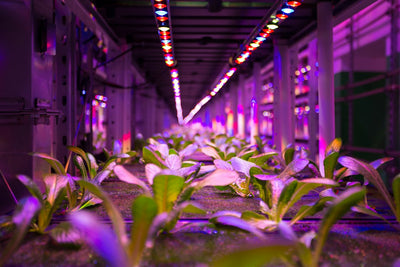
Managing CO2 and HVAC Together in a Sealed Grow Room
Photo by vjkombajn via Pixabay.
Seal a flower room to hold CO2 and you've just created a second, less obvious job for your HVAC system. Every gram of water the plants transpire, every bit of heat the lights and dehumidifier dump into the space, now has nowhere to go. There's no cracked window, no exhaust fan pulling fresh air through to reset humidity. It all has to be caught, conditioned, and recirculated by machines you're also asking to hold a tight temperature and VPD target around the clock.
The mistake a lot of operators make is treating CO2 enrichment and HVAC as two separate projects running in the same room. They're not. Bump your injection rate and you've changed the latent load your dehumidifier has to handle. Change your exhaust fan's duty cycle and you've just vented gas you paid for straight into the ceiling plenum. One decision ripples into the other every single time. Cannabis Industry Journal put the real problem well: it's not about getting CO2 into the room, it's about holding a target concentration consistently without wasting gas, wrecking relative humidity, or creating a safety hazard for whoever walks in next. This piece walks through what PPM target actually makes sense, why sealed rooms behave the way they do, the exposure limits that matter more than growers usually realize, and how current-generation controllers are finally closing the gap between CO2 and HVAC instead of letting them fight each other.
Why Seal the Room in the First Place

Photo by Bingqian Li via Pexels.
The logic behind sealing a room comes down to one wasteful habit it eliminates: venting conditioned, CO2-enriched air to bring in fresh outside air. Open-air exchange rooms dump that enriched air outside constantly, which means every bit of CO2 you injected gets thrown away before the plants finish using it. A sealed or semi-sealed room stops that bleed. You inject gas, hold it in a closed envelope, and the canopy gets the benefit of the full dose instead of a fraction of it.
But retaining the air means retaining everything else in it too. Plant transpiration is relentless -- a mature flower room can push hundreds of pints of water vapor into the air per day, and with no path to vent that moisture outside, your dehumidification equipment has to catch every bit of it mechanically. The design standard most commercial facilities land on is 100% recirculated air, specifically because it prevents outside contaminants from entering and minimizes CO2 usage at the same time. That's the efficiency win.
The cost of that win is that cooling and dehumidification stop being seasonal concerns and become a near-continuous duty cycle. It doesn't matter if it's 40°F and dry outside in February or 95°F and humid in August -- the HVAC system inside a sealed room is working at essentially the same intensity year-round, because the load it's responding to is generated entirely inside the room by lights, plants, and equipment, not by outdoor conditions. This is the trade-off that catches new facility operators off guard: you don't get to size HVAC for a mild local climate and call it done. You're sizing for the room's internal load, full stop, every day of the year.
This is really the core coupling that the rest of this piece builds on. You don't get the CO2 efficiency benefit of a sealed room without also taking on full-time mechanical responsibility for moisture and heat that used to just blow out a vent. Understand that trade going in, and the rest of the design decisions make a lot more sense.
Target PPM: What You're Actually Aiming For

Day-cycle CO2 targets for grow rooms (1,000–1,500 ppm) sit well above ambient outdoor levels (~420 ppm) but remain far below OSHA and NIOSH occupational safety limits (5,000 and 30,000 ppm), indicating a wide safety margin for growers.
Most commercial operators run daytime CO2 enrichment somewhere in the 1,000-1,500 ppm range, with a lot of experienced growers tightening that further to an optimal band of 1,200-1,500 ppm during peak photosynthetic demand in flower. As a rule of thumb, flower rooms are typically held at three to four times ambient atmospheric CO2 levels -- ambient outdoor air runs around 420 ppm, so you're looking at roughly 1,200-1,700 ppm depending on how aggressive the program is.
Here's the part that gets skipped in a lot of grow room marketing: CO2 enrichment is not a standalone lever. Pumping a room to 1,400 ppm does nothing useful if your light intensity is weak and your leaf temperature is drifting into the high 70s. Photosynthesis has to be limited by CO2 availability before adding more CO2 helps -- which means light, temperature, and airflow all need to be dialed in first. Enrichment pays for itself on a room that's already running strong light levels in flower under well-matched fixtures and tight thermal control. Crank CO2 on a room that's light-limited or heat-stressed and you're just burning gas for nothing.
Injection also needs to track the light schedule, not run as a flat setpoint around the clock. CO2 demand ramps up as lights come on and photosynthesis kicks into gear, holds through the light period, and should drop back to near-ambient during the dark cycle since the plant isn't fixing carbon at night -- there's no photosynthetic use for it, and running enrichment through the dark period is pure waste plus an unnecessary safety load. The better controllers schedule a ramp-up shortly before or at lights-on, hold through the photoperiod, and cut back automatically at lights-off.
The more advanced facilities take this a step further and coordinate CO2 injection with the full environmental sequence -- lighting schedule, HVAC duty cycle, dehumidification timing -- rather than letting CO2 run as its own independent system with its own clock. That coordination is where the real efficiency gains show up, and it's the thread that runs through the rest of this piece.
The Safety Numbers Every Operator Needs to Know

Photo by PublicDomainPictures via Pixabay.
Grow room CO2 levels sound high compared to outdoor air, but they're still well under the thresholds that matter for worker safety -- the problem is that people walk in and out of these rooms repeatedly, and the numbers deserve to be taken seriously rather than assumed. OSHA's permissible exposure limit for CO2 is 5,000 ppm as an 8-hour time-weighted average. That's a legal occupational exposure limit, not a grow target, and it sits well above typical enrichment levels of 1,200-1,500 ppm. But it's a limit built around sustained exposure over a workday, and staff entering an enriched flower room multiple times per shift are accumulating exposure against that number whether anyone's tracking it or not.
Above that, NIOSH sets a short-term exposure limit of 30,000 ppm, and concentrations climb into territory considered dangerous to life and health not far beyond that. Those numbers feel abstract until you remember that a malfunctioning regulator or a stuck solenoid valve in a sealed room with no air exchange can climb toward those concentrations faster than most people expect, with nothing to dilute it.
Code bodies have caught up to the fact that enriched grow rooms are now common commercial spaces. Both the International Fire Code, in Chapter 53, and NFPA 1, in Chapter 38, carry sections written specifically for CO2-enriched environments, covering monitoring, ventilation interlocks, and signage requirements. For fire protection and sprinkler design purposes, NFPA 13 generally classifies grow rooms as Ordinary Hazard Group 2 (OH2) occupancy, which affects sprinkler density and spacing requirements during facility design.
None of this is theoretical paperwork -- it's the baseline for a real safety stack. That means CO2 monitors with audible, visible alarms at the room entrance, documented lockout procedures before anyone enters an enriched space, and hard interlocks that cut gas flow the moment the room drifts outside safe parameters. Critically, those control sequences need to suspend injection automatically on an alarm condition or a sensor fault -- not wait for a tech to notice a number looks wrong on a dashboard. Automated shutoff isn't a nice-to-have add-on; it's the difference between a monitored system and a liability.
Stratification and the Multi-Tier Problem

Photo via Unsplash.
Stratification is the problem that shows up the moment you move from a single-canopy room to a multi-tier vertical setup, and it's one that open-air CO2 injection simply can't solve on its own. Plants near the top tier, closest to the injection point and the strongest airflow, consume CO2 fast and stay well-fed. Plants on the bottom tier are working with whatever's left after it's been metabolized and diluted on the way down -- which in a lot of rooms is noticeably short of target. You end up with top-tier plants photosynthesizing at full tilt while bottom-tier plants are quietly CO2-limited the entire cycle, even though the room-average sensor reading looks fine.
Heat stratification rides along with it and makes the problem worse. It's common for the top of a three-tier room to run 10-15°F warmer than the floor level, since heat rises and lighting fixtures are concentrated per tier. That temperature gradient drags RH and VPD out of alignment by level too -- so you're not just dealing with uneven CO2, you're dealing with uneven everything, stacked on top of each other, tier by tier.
The engineering fix that's gaining traction in newer facility builds is injecting CO2 directly into the HVAC supply airstream upstream of the canopy, rather than releasing it into open room air and hoping diffusion evens things out. When CO2 travels through the same ducted supply path as the conditioned air, every tier gets a consistent, metered concentration instead of relying on buoyancy and air currents to distribute gas evenly across a room that's 12 or 16 feet tall with racking in the way.
That same ducted approach smooths out humidity delivery at the same time, since moisture and CO2 are now riding the same conditioned air path to every zone instead of being managed as two separate release points fighting over the same airspace. This matters most in multi-tier and multi-zone facilities specifically -- a single-layer room with a modest footprint can often get away with open-air injection and a couple of oscillating fans. Once you're racking three or four tiers deep, a single open-air injection point physically cannot reach every layer evenly, and supply-air injection stops being an upgrade and starts being a requirement.
Controllers That Actually Coordinate CO2 and HVAC
Running CO2 and HVAC as two systems that don't talk to each other wastes gas every single time the air conditioner cycles or an exhaust fan fires and pulls enriched air straight out of the room. That's not a rare edge case -- it's happening on a normal thermostat cycle multiple times a day in most rooms, which means a chunk of every CO2 tank is being vented before the plants get to use it.
This is exactly the gap current control hardware is built to close. TrolMaster's Carbon-X system automates solenoid valves and interlocks CO2 injection directly with exhaust fan operation, so the system stops injecting the moment an exhaust event is about to pull air out of the room, instead of injecting blind and wasting gas on the exhaust cycle's schedule. AC Infinity's Controller AI+ goes a layer further, pulling temperature, humidity, CO2, and light data into one unified system and applying onboard machine-learning logic to flag anomalies and suggest adjustments before a drifting sensor turns into a wasted day of enrichment.
VPD-based controllers add the piece that ties humidity and CO2 strategy together instead of letting them work against each other. By calculating vapor pressure deficit in real time across zones and adjusting temperature and humidity setpoints in tandem, these controllers keep the room in a state where CO2 enrichment is actually usable by the plant -- there's no point holding 1,400 ppm in a room where VPD has drifted so far out of range that stomata are closed and the plant isn't taking up CO2 at all.
The financial stakes here are real, not theoretical. HVAC and lighting together typically account for 20-50% of an indoor grow's total operating cost, and energy intensity in a controlled-environment cannabis facility runs roughly 10 times that of a standard office building of the same square footage. Every bit of CO2 vented through an uncoordinated exhaust cycle is money leaving the building on top of an already steep energy bill. The practical takeaway for anyone speccing new equipment: buy a controller that treats CO2, temperature, RH, and light as one coordinated decision, not four separate dials that happen to live in the same room.
A sealed room with CO2 and HVAC running on separate logic doesn't eliminate the waste you built the sealed room to avoid -- it just moves it. Instead of venting enriched air to the outdoors, you're venting it through an exhaust cycle that fires with no idea CO2 is in the room, or holding a target PPM in a space where VPD has drifted so far off that the plant's stomata are closed and none of it is being used anyway. The equipment has to be interlocked, genuinely coordinated, or you're paying for gas you're injecting into thin air.
It's also worth being honest that environmental control has a ceiling, and that ceiling is set by genetics. Tight VPD, well-timed enrichment, and a stratification-free supply air path only pay off on plants bred with the vigor to actually use that extra carbon and light. Push a weak or unstable line that hard and you'll hit its genetic limit long before you hit the room's. That's part of why starting with well-bred seeds matters as much as the mechanical side of this -- Seedtiva's genetics are selected to hold up under exactly this kind of high-input environment, though results will always depend on your specific climate, equipment, and how dialed-in the rest of the room is.
The mental shift that actually changes outcomes is treating CO2 as a scheduling problem, synced tightly to the light cycle and the HVAC duty cycle, rather than a tank you crack open at lights-on and forget about until the alarm goes off. Get that scheduling right and the sealed room does exactly what it's supposed to do: hold a consistent, usable concentration at every tier, without wrecking your humidity or your gas budget in the process.
Sources
- CO2 for Indoor Growing: The Complete Beginner's Guide
- How to Use CO2 to Increase Cannabis Yields!
- Why CO₂ Management Matters in Commercial Cannabis Cultivation - Cannabis Industry Journal
- Cannabis Grow Room: Mastering Humidity, Temperature, and CO2
- How to Add CO2 to a Cannabis Grow Room: PPM, Setup and Safety