Micronutrient Deficiencies in Cannabis: What Research Says
The tops of a plant in week three of flower stop stretching. New leaves come in small and bunched, the tips look like tight little rosettes, and the grower reaches for the cal-mag bottle. Or bumps the nitrogen. Neither helps, because the problem was never in the macros.
Trace elements cause this sort of confusion constantly, and most of what circulates about them in cannabis is forum lore. Ppm targets get passed around with no data behind them. That is why a peer-reviewed paper deserves a slow read when one turns up.
The anchor for this article is one: The power of zinc, published in the Journal of Cannabis Research in March 2026 (volume 8, article 33). It is a single study, and I have only worked from a summary of its findings rather than the full dataset. Evidence on the other micronutrients in cannabis is thin, and I will say so where it applies.
Key takeaways
- A 2026 Journal of Cannabis Research paper found that both zinc deficiency and zinc excess reduced cannabinoids in cannabis.
- Zinc-deficient plants were shorter with rosetted growth, yet main stem node count stayed the same.
- Leaf zinc below roughly 20 mg/kg dry weight signals deficiency, and cannabis may need a slightly higher threshold.
What the 2026 Zinc Paper Actually Reports
The paper was published on 5 March 2026 in the Journal of Cannabis Research, volume 8, article 33. Its title carries the main result: excess and deficiency of zinc both decreased cannabinoids in cannabis. The title adds that this came without zinc-toxicity concerns for consumers, so the higher tissue zinc in the excess treatments did not become a consumer safety issue in this work.
The first point is the one that matters most. Zinc showed a two-sided response. Plants short on zinc lost cannabinoids, and plants given too much lost them too. More was not better.
That shape is typical of a narrow-window nutrient. Correcting a deficiency should mean returning the plant to adequate, not overshooting to be safe. A grower who sees tight new growth and doses zinc heavily may trade one cannabinoid penalty for another.
A caution before anyone copies a number. I have not seen the treatment concentrations, the cultivar, or the exact cannabinoid percentages from the full paper, and I am not going to guess at them. Pull the paper itself before you adopt any rate. Results will also shift with medium, water source and genetics, so even a confirmed rate is a starting point for your own room, not a recipe.
What Zinc Deficiency Looks Like on the Plant
Deficient plants in the study were shorter, which the authors describe as growth restriction in medicinal cannabis. The detail I find most useful is what did not change: the number of nodes on the main stem was unaffected. The plants stacked the same count of nodes. They just packed them closer together.
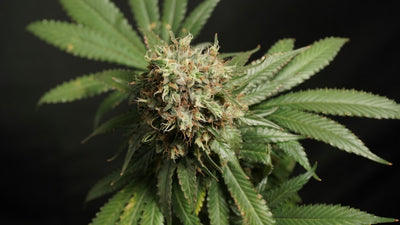
That is the rosetting the authors describe, meaning shortened internodes, along with smaller leaf area. In the garden it reads as a bunched, tight look at the growing tips, with small leaves crowded around a stalled apex.
The authors link this to zinc's role in regulating indoleacetic acid (IAA) metabolism. IAA is an auxin, the hormone family that drives cell elongation. They frame the connection as believed to be related, not as a demonstrated mechanism, and I would hold it the same way. It is a plausible explanation, not settled biochemistry.
The practical read is straightforward. If your plant keeps adding nodes but stalls in stretch, put zinc on the list of suspects alongside root-zone pH and general root health. Do that before you blame the light or write the phenotype off as a genetic quirk. Ruling out the cheap explanations first saves you from swapping lamps over a feed problem.
The Phosphorus Connection
One of the more interesting results is that zinc deficiency substantially affected phosphorus concentration in the leaves. The authors suggest the reduced P concentration may have resulted from zinc-induced P toxicity. That is offered as a possibility, not a conclusion, and I would not read more into it than they do.
It fits some well-known horticultural background, though. In many crops, high phosphorus can antagonize zinc uptake, and the interaction runs in both directions. That is general crop knowledge, not a cannabis finding from this paper.
It makes heavy bloom boosters worth scrutiny. Many growers add a high-P product at the flip and keep it going, and some stack a second one on top. If new growth then turns tight and rosetted, the instinct is to add a zinc additive. That treats a symptom while leaving a likely cause in the reservoir.
The better move is to review the whole feed. Look at the total phosphorus you are delivering, check pH, and compare runoff to input before adding anything. Keep the interpretation honest, too. This is one paper under one set of conditions, so treat the P and zinc relationship as a lead to test in your own grow, not a rule to enforce.
Leaf Thresholds and Why Tissue Testing Beats Guessing
In the deficient treatments, leaf zinc concentrations fell within the deficiency range. The literature documents a critical deficiency threshold of about 20 mg Zn per kg dry weight for other species. The authors say the cannabis leaf threshold is slightly higher than that.
I did not confirm the exact cannabis figure, so the honest statement is: slightly above 20 mg/kg. Check the paper for the specific value before you set a benchmark.
This is where tissue testing earns its cost. The process is simple:
- Sample the same leaf position on every plant, ideally recently matured leaves, at a consistent growth stage.
- Dry the tissue and send it to a lab that runs ICP analysis, which measures the elemental content.
- Compare the results against a published range for the stage you sampled.
Visual symptoms overlap badly. Zinc, manganese and iron problems can look alike, and pH lockout imitates all of them. A leaf analysis paired with runoff pH and EC readings turns a guess into a diagnosis. Without those numbers you are choosing a bottle based on how a leaf looks under LEDs, which is not a reliable method.
What We Still Don't Know About Boron, Iron, Manganese, Copper and Molybdenum
The zinc paper does not cover boron, iron, manganese, copper or molybdenum, and cannabis-specific peer-reviewed thresholds for them remain sparse. Everything below is general horticultural knowledge, not cannabis findings.
- Iron: deficiency shows as interveinal yellowing on new leaves, and it usually comes from high pH rather than a shortage in the feed.
- Manganese: can look similar to iron deficiency, and uptake of both is strongly pH dependent.
- Boron and copper: both have narrow adequacy windows in most crops.
That last point echoes the zinc result, where deficiency and excess both cost the plant something. I would not claim the same pattern holds for cannabis, only that it is a reasonable expectation to test rather than ignore.
Because of the pH dependence, check pH first whenever new growth yellows. A reservoir full of iron cannot help a root zone sitting at 7.2.
My advice is to be skeptical of any source quoting precise cannabis ppm targets for these elements without citing data. If a chart gives you a boron number to two decimals and no reference, treat it as someone's habit, not a finding.
A Diagnose-First Protocol for Your Next Grow
Here is the sequence I would follow before touching a micronutrient additive.
- Confirm root-zone pH. Aim for roughly 5.8 to 6.3 in hydro and coco, and 6.2 to 6.8 in soil. Lockout mimics true deficiency, so this comes first.
- Compare runoff EC to feed EC. A runoff reading well above input points to salt buildup. A reading below it points to starvation. Know which before adding anything.
- Run a complete, balanced base nutrient. Good base lines supply trace elements at modest levels. Avoid stacking extra micronutrient additives on top.
- If symptoms persist, test tissue. Correct in small steps and watch new growth over the following week or so. Old damage will not reverse, so judge the correction by what emerges next.
Genetics matter here as well. Quality genetics from Seedtiva give you a stable baseline, so a deficiency is easier to separate from a quirk of the plant.
Outcomes vary by medium, water source and cultivar. Hard tap water, for example, changes the pH and mineral picture before a drop of nutrient goes in. Log your readings each week so patterns show up across runs, not just in one.
The most useful lesson from the zinc work is the shape of the response. Too little cost cannabinoids, and too much cost them as well. The goal is adequacy, not maximum dosing, and that mindset applies well beyond zinc.
This is one early paper in a thin field, and it should be read that way. Its best use is as a reason to test tissue and fix root-zone conditions before reaching for another bottle. A leaf analysis and a pH meter will tell you more than any additive on the shelf.
Sources
- The power of zinc: excess and deficiency of Zn decrease cannabinoids in cannabis without Zn toxicity concerns to consumers - PMC
- (PDF) Foliar Symptomology, Nutrient Content, Yield, and Secondary Metabolite Variability of Cannabis Grown Hydroponically with Different Single-Element Nutrient Deficiencies
- (PDF) Characterization of Nutrient Disorders of Cannabis sativa
- Marijuana Smoke Inhalation and Potential Micronutrient ...
- From deficiency to toxicity: Magnesium increases cannabinoid and terpene production in cannabis plants - PMC
- Cannabis Nutrient Deficiency Chart: Symptoms, Causes, and How to Fix Each One