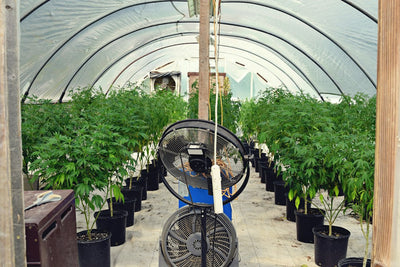
Mutant Cannabis: The Future of Ornamental Plant Breeding
Photo by Matej Bizjak via Pexels.
Walk into any garden center in spring and you'll find tables of coleus with leaves like stained glass, calatheas prized purely for their patterned foliage, and fern varieties that cost more than they have any right to because of some quirk in how their fronds unfurl. Cannabis, meanwhile, sits behind a counter somewhere, sold as flower or seed, judged almost entirely on cannabinoid percentage. That's strange, because botanically speaking cannabis has everything an ornamental buyer wants: a fast, satisfying growth cycle, dense palmate foliage, a branching habit that responds well to training, and an aromatic terpene profile that rivals anything in the herb aisle. It has the bones of a houseplant hit. It just never got to audition for the part.
That's not an accident of biology -- it's an accident of history. For roughly fifty years, every serious cannabis breeding program on the planet has selected for one thing: cannabinoid and resin production. Leaf shape, branching irregularities, variegation, anything that didn't directly feed trichome density or THC/CBD content, got treated as noise to breed out, not a trait to breed toward. Combine that with the plant's legal status and you get a crop that was never allowed to develop the way roses, orchids, or succulents did -- through decades of collectors chasing weird, beautiful, useless-but-charming mutations.
That's starting to change, quietly, at the edges of the industry. Patent filings, university horticulture programs, and hobbyist breeder forums are all circling the same idea from different directions: cannabis as a collector's plant, not a crop. The mechanism making this possible isn't some far-off genetic breakthrough -- it's mutagenesis, both the deliberate chemical kind and the spontaneous kind that's been showing up in grow tents and breeder stock for years already. This piece walks through where that science actually stands, what's already been patented, and what it would take for a variegated or fern-leafed cannabis plant to end up on a garden center shelf next to the pothos.
Why Cannabis Already Looks Like an Ornamental Crop

Photo by Kindel Media via Pexels.
Look at cannabis without the cultural baggage and it reads like a plant that horticulturists would have bred for looks decades ago if they'd been allowed to. The palmate leaf -- that iconic five-to-nine-fingered symmetry -- has a graphic quality that few other plants match; it's practically a logo. Under the right light regime the plant branches densely and predictably, which makes it responsive to the kind of training (topping, LST, mainlining) that ornamental growers already use on bonsai and espaliered shrubs. And the terpene profile, the same compounds responsible for the smell breeders chase for flavor, gives it an aromatic presence that most foliage plants can't offer at all. Dense green structure, fast four-to-five-month cycle from seed to mature plant, and a scent you can build a product line around -- that's a rare combination.
So why isn't it sitting on a shelf at your local nursery? Because every gram of selection pressure applied to this plant for the last several decades has gone toward a single output: cannabinoid and resin yield. Breeders culled for trichome density, flower structure, and potency, and anything that didn't serve that goal -- odd leaf shapes, unusual branching, chlorophyll irregularities -- got discarded as off-type, not preserved as a novelty. On top of that selection pressure, the plant's legal status kept it out of the ornamental supply chain entirely; garden centers dealing in federally or provincially regulated nursery stock had no legal pathway to carry it, regardless of how it looked.
Meanwhile, the ornamental plant market this crop has been locked out of is enormous. Ornamental varieties account for more than half of all plant patents and plant breeder's rights granted across the US and EU -- collectors will pay real money for a plant whose only job is looking unusual on a windowsill. Variegated monstera cuttings have sold for thousands of dollars; novel calathea cultivars command premium pricing on release. That's the market cannabis has been structurally excluded from, despite having a genetic toolkit -- fast generation time, high mutation visibility, strong grower community -- that's arguably better suited to producing collector-grade novelties than most of the plants currently filling that market. The reconsideration underway right now isn't about changing the plant. It's about changing which traits get valued when you look at it.
The Science of Making a Mutant: Chemical Mutagenesis Explained

Photo by Khairul Munir via Pexels.
The formal science behind this shift has already been filed with the patent office. US patent US11622515 documents a protocol for treating isolated cannabis cells with chemical mutagens -- specifically ethyl methane sulfonate (EMS) and nitrous acid (HNO2) -- to generate stable mutant lines. Both compounds work by directly altering DNA base pairing: EMS primarily causes G-to-A transitions by ethylating guanine, while nitrous acid deaminates cytosine and adenine, producing point mutations that ripple through the plant's phenotype once the cells are regenerated into whole plants. This patent matters less for the chemistry, which has been used in other crops for decades, and more because it's the first disclosed protocol specifically for generating mutant cannabis cultivars this way -- it puts a legally documented, repeatable method on record for an industry that's mostly operated on informal breeder folklore until now.
The regulatory framing attached to this technique is arguably more consequential than the chemistry itself. Plants generated through chemical or radiation-induced mutagenesis are not classified as genetically modified organisms under most current frameworks, because no foreign DNA is introduced -- the mutations are treated as functionally equivalent to naturally occurring ones, just accelerated. That means mutant lines produced this way skip the legally mandated GMO testing and labeling requirements that would otherwise apply, and in many jurisdictions they can be marketed and grown as organic. For an industry where GMO cannabis has effectively never made it to market because of exactly those regulatory hurdles, that distinction is a real opening -- it offers a path to novel, stable phenotypes without wading into the GMO approval process that has stalled genetically engineered cannabis products entirely.
None of this is unprecedented outside cannabis. The Joint FAO/IAEA Mutant Variety Database currently lists more than 2,300 mutant crop varieties registered worldwide, spanning rice, barley, cotton, and ornamentals like chrysanthemum, all produced through induced mutagenesis and released commercially without GMO classification. Cannabis isn't asking regulators to accept a novel legal category here -- it's asking to be treated the same way barley and chrysanthemums already are.
Meet the Mutants: Freakshow, Ducksfoot, and the Freaks Already on the Market

Photo by TIORHISTA R via Pexels.
Long before any of this made it into a patent filing, growers were already trading mutant cannabis phenotypes informally, purely because they looked interesting. Ducksfoot is probably the best known: instead of the classic palmate fan, the leaves fuse into a rounded, webbed shape that genuinely resembles a duck's foot. It's been circulating among hobbyist breeders for years, valued as much for its novelty as for the stealthy, compact growth habit that tends to come along with it.
Freakshow takes a different route -- a fern-like mutation that produces feathery, deeply serrated foliage with almost no resemblance to standard cannabis leaf structure. It's prized specifically for how alien it looks next to a normal plant in the same tent, which is exactly the kind of visual distinctiveness that drives collector demand in other ornamental categories. Australian Bastard Cannabis pushes further into irregular territory: erratic, asymmetric branching that breaks the plant's usual predictable structure entirely, and it's built a genuine cult following among breeders who collect it specifically for how unpredictable each seed run turns out.
Then there are the structural mutants that read as almost architectural. Whorled phyllotaxy plants arrange their leaves in rings around the stem instead of the standard opposite-pairing pattern, producing a tiered, symmetrical look that stands out dramatically once the plant matures. Variegated mutants show patches of white or yellow tissue where chlorophyll expression has been disrupted -- the exact trait that makes variegated monstera, pothos, and philodendron so valuable in the wider houseplant market, just showing up in cannabis instead.
What all five of these have in common is that none of them exist because of a formal breeding program chasing ornamental value. They emerged in grey-market seed stock, got noticed by growers paying attention, and spread because people liked how they looked -- proof that the demand and the raw genetic material for an ornamental cannabis category already exist, well ahead of any legal framework built to support one.
'Divina': The Patent That Proves the Model Works

Photo by Jonathan Cooper via Pexels.
If you want proof that ornamental cannabis isn't a hypothetical, look at 'Divina.' US plant patent US20200170162P1 covers a spontaneous mutation discovered in 'Pilar,' a medicinal cultivar, that produces striking yellow-and-green variegated foliage. Unlike the mutants circulating informally in grow rooms, Divina went through the full formal process: it was identified, stabilized, documented, and patented specifically for its foliage appearance, not for any cannabinoid trait inherited from its parent line.
Codesido et al. documented the plant in a 2020 paper in Acta Horticulturae, and the detail that makes this genuinely significant is regulatory rather than botanical: Divina became the first cannabis cultivar to receive provisional plant breeder's rights protection from the Community Plant Variety Office, the EU body responsible for granting IP protection on new plant varieties. That's not a cannabis-specific workaround -- it's the same protection mechanism used for a new rose cultivar or a novel apple variety, applied to cannabis for the first time on the strength of its leaf pattern alone.
The significance here is less about Divina itself and more about what it proves is possible. A cannabis plant went through a formal IP protection process evaluated purely on ornamental merit, with no reference to potency, terpene content, or medicinal value, and the application succeeded. That's the proof of concept the rest of this industry has been missing. It tells breeders and seed companies that the CPVO and comparable bodies elsewhere are willing to evaluate cannabis on the same terms as any other ornamental crop, provided the application is framed correctly and the trait is stable and distinct.
For anyone thinking about building IP around a novel cannabis phenotype -- a stabilized variegation line, an unusual branching habit, a leaf-shape mutation -- Divina is the template. It demonstrates the legal pathway exists, the documentation standard is achievable with a rigorous stabilization and characterization process, and protection bodies outside the cannabis-specific regulatory apparatus are receptive to the application. The remaining barriers are less about whether this can be done and more about who does it next, and how many of these traits get identified and pushed through the same process before the ornamental cannabis category has enough patented cultivars to function as an actual market segment.
Chemotype V: The Real Foundation for an Ornamental Market

Photo by Rick Proctor via Unsplash.
Everything discussed so far solves the visual problem -- stable mutant phenotypes, legal pathways for protecting them -- without solving the bigger structural one: cannabis is still, culturally and legally, a drug crop first. Chemotype V may be the piece that actually resolves that. Chemotype V cannabis lines are nearly devoid of phytocannabinoids; they carry essentially no meaningful THC or CBD payload and no psychoactive effect. In practice, it's cannabis stripped of the exact property that's kept it out of every garden center for the last century.
That makes chemotype V the most plausible legal and practical foundation for a genuine ornamental cannabis category. A plant that can't be diverted for drug use sidesteps the bulk of the controlled-substance classification concerns that have kept nurseries, garden centers, and plant breeders' offices from touching cannabis at all, regardless of how it looks. It's a much simpler regulatory conversation to have about a plant with negligible cannabinoid content than about anything carrying even modest THC.
There's a second practical problem chemotype V breeding could solve alongside the legal one: pollen. Cannabis pollen is a known allergen, and it's a genuine obstacle to retail nurseries stocking the plant at scale -- nobody wants a houseplant that triggers respiratory reactions in customers browsing the aisle. Breeding feminized, zero-pollen chemotype V lines would remove that concern entirely, the same way seedless, low-allergen cultivars have been developed in other ornamental and food crops.
The real opportunity is in stacking traits. Chemotype V genetics combined with the mutagenesis techniques covered earlier -- plus somaclonal variation from tissue culture and targeted genome editing -- gives breeders a toolkit to layer variegation, novel branching, or leaf-shape mutations onto a base plant that's already cleared the biggest legal hurdle. The timeline for any of this reaching a garden center shelf has almost nothing to do with the science, which is largely ready now, and everything to do with legal status. The horticulture industry hasn't seriously engaged with cannabis as an ornamental not because the interest isn't there, but because there's been no legal category to engage with.
What This Means for Growers and Breeders Right Now

Photo by Terre di Cannabis via Unsplash.
None of this requires waiting on regulators to catch up. Home growers have been doing the actual legwork of this shift for years, without any formal ornamental market to sell into -- it's exactly how Ducksfoot and Freakshow spread in the first place. Someone noticed an off-type seedling, kept it instead of culling it, and ran seed from it. That's the entire mechanism, and it's available to anyone running their own grow right now.
The catch is that stabilizing a mutation isn't a one-generation project. An interesting phenotype showing up in an F1 seed run is often heterozygous for the trait, meaning the next generation from open pollination will throw a mix of normal and mutant plants, sometimes with the trait expressing inconsistently even among the mutants. Getting to a reliably reproducing line takes multiple generations of selfing or backcrossing, with careful selection at each stage to isolate the trait from the unwanted variability that tends to ride along with it -- reduced vigor, delayed flowering, or unstable expression are common companions to a striking mutation and need to be bred out separately from the trait you're actually chasing.
It's worth being honest that results here vary enormously by starting genetics, climate, and grow setup. A leaf mutation that looks dramatic in one phenotype under one light spectrum may barely express, or not reproduce reliably from seed at all, in a different genetic background or under different environmental stress. Variegation in particular can be notoriously unstable, shifting with light intensity, temperature, and even the individual plant's age. That unpredictability isn't a flaw in the process -- it's the nature of working with novel traits, and it's exactly why patient, generation-over-generation selection matters more than any single spectacular seedling.
Starting from strong, well-bred genetics matters more here than in standard cannabinoid-focused growing, because you're already introducing instability by selecting for an off-type trait -- you don't want unpredictable base genetics compounding that problem. Seedtiva's stable, well-bred seed stock gives growers a consistent baseline to work from when they're chasing something unusual, rather than fighting genetic noise on two fronts at once. For anyone curious about experimenting, the practical habit worth building now is simple: keep detailed phenotype records on every run, photograph and log anything unusual the moment it appears, and isolate odd seedlings early rather than culling on sight -- you won't know which off-types are worth chasing until you've given them a full cycle to show what they actually do.
Nothing described here is speculative. The chemical mutagenesis protocol is patented. Divina is a real, legally protected cultivar sitting in the CPVO's records right now, evaluated on foliage alone. Chemotype V lines already exist in breeding programs. The technical and legal groundwork for an ornamental cannabis category isn't a future project -- it's a set of small, patented, documented steps that have already been taken, mostly in isolation from each other, by people who weren't necessarily thinking about garden centers when they took them.
What's missing isn't science or precedent -- it's the market's willingness to look at this plant outside the drug-crop lens it's been stuck in for a century. Divina proves a patent office will grant protection to cannabis on ornamental merit alone. Chemotype V research proves you can breed the psychoactivity out entirely while keeping the foliage traits that make a plant worth collecting. Those two facts, sitting next to each other, describe a plant that's legally and biologically closer to garden-center-ready than most people in the industry currently assume.
The next decade of cannabis breeding may end up judged as much by leaf symmetry and variegation patterns as by THC percentage, if legal frameworks in enough jurisdictions catch up to where the science already sits. That's not a guarantee -- regulatory change moves slower than plant science, and it always has. But the raw material for that shift is already growing in tents and greenhouses right now, in the form of odd seedlings that somebody, somewhere, decided not to cull.