Nutrient Choices That Cut Equipment and Energy Costs
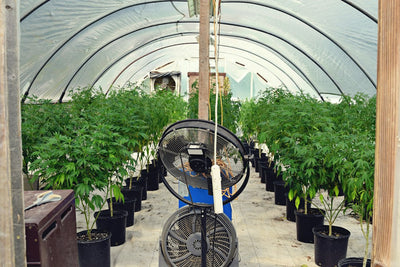
Photo by www.kaboompics.com via Pexels.
Ask most growers where their power bill comes from and you'll get the same answer every time: lights and climate control. Nobody argues with that math -- a 640-watt LED running 18 hours a day and the AC unit fighting to remove its heat are obviously the biggest line items. But there's a quieter drain sitting right under those numbers, one that almost never makes it into the spreadsheet: the nutrient program itself.
Every bottle of synthetic concentrate you pour into a reservoir implies a chain of equipment behind it. Something has to move that water -- a pump. Something has to keep it cool if you're running a deep water culture or flood table in a warm tent -- a chiller. Something has to tell you if your EC has drifted -- a meter, or on bigger setups, a doser with its own control board. RO units strip your tap water before any of that nutrient even goes in, and that's another unit pulling amps around the clock. None of this shows up when you're comparing fertilizer prices at checkout, but it shows up on the electric bill every single month.
The deeper point is that nutrient strategy isn't just a plant-health decision -- it's an infrastructure decision. Living soil, hydroponic/synthetic feeding, and dry-salt programs don't just differ in how the plant responds. They differ in how much gear you need plugged in to make them work at all. This isn't an environmental pitch. It's a practical look at what each feeding method actually costs you in equipment and electricity, separate from what it costs in bottles.
The Hidden Equipment Cost Behind Synthetic Nutrient Programs

Photo by Anna Tarazevich via Pexels.
A synthetic hydro or coco program looks simple on the label -- Part A, Part B, a cal-mag additive -- but the system running behind it is anything but. You've got a reservoir pump cycling nutrient solution to the roots, often on a timer that runs it multiple times an hour. You've got a chiller keeping that reservoir below 68°F so root zone oxygen doesn't crash and you don't invite pythium. You've got a doser or at minimum a handheld EC/pH meter you're recalibrating weekly, because synthetic salts drift in solution and a plant fed at 1.8 EC one day and 2.4 the next isn't going to thank you for it. Every one of those components is a separate circuit, a separate point of failure, and a separate draw on your power bill that never gets counted as a nutrient cost.
Then there's the media. Rockwool cubes, growstones, and plastic net pots aren't reusable in any serious commercial sense -- most operations toss rockwool after one cycle because it holds onto salt buildup and pathogens. That's not an energy cost, but it's a recurring cash cost that stacks on top of the electrical one, cycle after cycle.
The part that surprises newer growers most is what synthetic salts do to the soil biology over time. Concentrated mineral salts are hard on the microbial life in a growing medium -- they don't necessarily sterilize a container overnight, but repeated high-EC feeding suppresses the fungal and bacterial populations that would otherwise help a plant access nutrients on its own. Once that biology is knocked back, the plant becomes dependent on the bottle. You can't back off the feed schedule without seeing deficiency symptoms within days, because there's no living system left to buffer the gap. That dependency is what locks a grower into ever-more-precise, ever-more-powered dosing equipment -- because when the plant has zero margin for error, your equipment can't have any margin for error either.
None of this is a reason to avoid hydro -- it has real advantages in growth speed and control. But it's worth naming honestly: every reservoir, chiller, and doser you add to scale a synthetic program is another line item on the power bill that nobody budgets for when they're just comparing bottle prices at the grow shop.
Living Soil and No-Till: Letting Microbes Do the Work

Photo by LUIS GALLARDO via Pexels.
No-till, living soil growing flips the entire equation. Instead of feeding the plant directly with soluble salts, you feed the soil -- compost, worm castings, alfalfa meal, kelp, insect frass -- and let bacteria and fungi break that organic matter down into forms the roots can use, on their own schedule. The plant isn't waiting on you to mix a reservoir; it's pulling from a living system that's already working before you walk into the room.
This isn't a fringe practice anymore. MJBizDaily's sustainability reporting has highlighted cultivators running no-till programs who report saving thousands of dollars per grow cycle on equipment and fertilizer combined, simply because so much of the synthetic infrastructure becomes unnecessary. No mixing tanks. No dosing pumps. No weekly EC calibration. Every powered device you don't need to buy, install, and run is a device that never shows up on your utility bill, either.
The core practice is straightforward even if it takes patience to dial in: top-dress with compost and organic amendments on a steady schedule rather than blasting soluble fertilizer at set EC targets, keep a mulch layer on the soil surface to protect the microbial life from light and temperature swings, and avoid disturbing the root zone between cycles so fungal networks stay intact. Done right, a well-established living soil bed becomes more self-regulating with each cycle, not less.
It's worth being honest that this isn't a guaranteed shortcut. Outcomes vary a lot depending on container size -- a 3-gallon pot doesn't have room for the biological reserve a 15-gallon or in-ground bed does. Climate matters too; living soil biology slows down hard below 65°F and speeds up in ways that can outrun your feeding plan above 85°F. And a soil web that hasn't been established for at least one full cycle won't perform like one that's been building for a year.
Genetics matter more in this system, not less. In a synthetic program you can prop up a mediocre plant with precise inputs. In living soil, you're relying on the plant's own vigor to take advantage of what the soil offers, so starting with strong, well-bred seed stock -- the kind Seedtiva selects for -- gives you a real head start instead of asking weak genetics to perform on their own.
Cutting Fertilizer Concentration in Flower Without Losing Cannabinoids

CBD yield rises sharply from 80 to 160 mg N/L but plateaus beyond that point, indicating 160 mg N/L is the optimal nitrogen level with no additional benefit from further increases.
There's solid research behind tapering nutrients in flower, not just grower folklore. A 2023 study out of the University of Hohenheim, published in Frontiers in Plant Science, tested mineral and organic fertilizer programs at three nitrogen concentrations -- 80, 160, and 240 mg N/L -- to see what happened to yield and cannabinoid content as nitrogen availability dropped.
The finding that matters most for growers: nutrient stress during flowering triggered translocation of resources within the plant, and CBD concentration actually increased at the lower nitrogen rates. The plants weren't starving quietly -- they were reallocating in a way that pushed more cannabinoid production per gram of flower, even as raw inflorescence mass came down somewhat at 80 mg N/L versus 240 mg N/L.
Run the numbers and the picture gets interesting fast. The reduced yield at the lowest nitrogen rate was offset almost entirely by the higher cannabinoid concentration -- the study found growers could hit roughly 95% of total CBD yield while using a third less fertilizer overall. That's not a marginal efficiency gain. That's a fertilizer bill and a mixing/storage footprint cut by 33% for a 5% difference in the compound you actually care about.
The practical takeaway isn't just financial -- it's operational. If you're mixing 33% less nutrient solution across flower, you're running your reservoir pump on lighter cycles, storing less concentrate, and handling less runoff. That's real electricity and real gear wear you're not putting on the system.
It also validates something old-school growers have said for years without the data to back it up: tapering nitrogen hard once flowers set isn't just a stylistic choice, it's measurably efficient. And it exposes a common waste pattern -- most commercial bloom boosters are loaded with phosphorus levels well beyond what a flowering cannabis plant can actually use. Phosphorus uptake in flower is nowhere near as demanding as nutrient marketing suggests, and stacking bloom boosters on top of an already-adequate base nutrient doesn't add bud weight. It adds cost, salt buildup, and one more bottle you had to store and dose.
Dry Salts vs. Liquid Nutrients: The Commercial Math

Photo by ROCKETMANN TEAM via Pexels.
Walk into a commercial cultivation facility and you'll almost never see pallets of liquid nutrient jugs. You'll see buckets of powder -- Athena Pro line, Jack's 321, or similar dry-salt programs -- that growers dissolve into stock solutions themselves. That's not an aesthetic choice. It's math that gets more obvious the bigger your operation gets.
Liquid nutrient concentrates are, by volume, mostly water. You're paying to ship water, paying to store water, and paying a premium per gallon of actual usable nutrient because a company had to bottle, label, and freight a liquid product that's 90%+ solvent. Dry salts skip almost all of that. A 25-pound bucket of powder costs a fraction of what the equivalent nutrient value would run in bottled liquid form, and it takes up a corner of a shelf instead of a section of a warehouse. Growers who've made the switch typically find their per-gallon feeding cost drop substantially once they're mixing from powder instead of pouring from bottles.
The reorder cycle changes too. Liquid bottles run out fast relative to their cost, which means more frequent purchases, more packaging waste, and more plastic jugs to deal with at the end of a cycle. Dry salts, properly sealed, store for a very long time without losing potency, so a single bulk order can carry a facility through several grow cycles without a reorder at all.
This is exactly why nearly every serious commercial operation runs dry salts rather than bottled liquid lines once they're past hobbyist scale -- the economics simply don't work any other way when you're feeding hundreds or thousands of plants.
The storage density difference also feeds back into the energy conversation directly. A pallet of liquid nutrient jugs takes up real square footage, and if that storage room needs to stay climate-controlled to keep the product stable, you're air conditioning space to protect mostly water. A shelf of sealed dry-salt buckets needs a fraction of that footprint and tolerates a much wider temperature range before quality suffers. Less space to condition is less electricity spent conditioning it -- a small effect on any single facility, but a real one once you're running at scale.
Where This Fits Into the Bigger Energy Picture

Photo by Pexels via Pixabay.
Zoom out and nutrient strategy is genuinely a smaller lever than lighting. Large-scale cultivation operations reporting on 2026 sustainability progress have cut total energy use by more than 30%, and the bulk of that came from advanced LED fixtures and on-site or contracted renewable power -- not from what's in the feed reservoir. It would be dishonest to pretend nutrient choice competes with that on raw kilowatt-hours saved.
But it compounds with those bigger levers in a way that's easy to miss. Every pump, chiller, and doser running in a grow room is also a heat source, and every watt of waste heat those components generate is a watt your dehumidification and AC system has to work to remove. A room full of reservoirs, drain-to-waste runoff trays, and wet media is also a room fighting a higher latent heat load -- your dehumidifier is running longer and harder just to hold VPD steady, on top of whatever the lights are putting into the air. Cut the wet infrastructure and you cut a real, if secondary, chunk of that dehumidification demand.
Growers who move from synthetic hydro to living soil or dry-salt feeding in coco often report exactly this kind of secondary savings -- not a headline number, but a noticeable drop in how hard the dehumidifier cycles once there are fewer open reservoirs and less standing runoff sitting in the tent. Less evaporative surface area in the room means less moisture the HVAC has to pull back out.
The honest framing here matters. Nobody should skip an LED retrofit because they switched to dry salts -- lighting and HVAC upgrades still deliver the largest, most predictable energy reductions available to any grow. But nutrient strategy is a real, compounding piece of the total picture, and it's the piece almost nobody budgets for when they're planning a facility's power draw. It shows up anyway, on every bill, whether you planned for it or not.
The cheapest piece of equipment in any grow room is the one you never had to buy, install, wire, or maintain. That's the real thread running through all of this. Living soil and dry-salt feeding don't just sip less electricity than a fully loaded synthetic hydro rig -- they shrink the hardware footprint of the grow itself. Fewer reservoirs, fewer pumps, fewer chillers, fewer circuits that can fail at 2 a.m. and take a crop with them.
If you're planning an efficiency overhaul, the instinct is to start with lighting or climate control because those are the biggest, most visible numbers on the bill. But the nutrient decision is worth making first, because it changes what infrastructure the rest of the build even needs. A living soil or dry-salt setup simply requires less climate-controlled storage, less powered dosing gear, and less dehumidification capacity than a synthetic hydro system scaled to the same canopy size. Decide that early and every downstream purchase gets smaller and cheaper.
None of it replaces genetics as the ceiling on what a plant can do. A feeding strategy built around soil biology or lean nitrogen tapering only works as well as the plant underneath it -- vigorous, well-bred seed stock that doesn't need synthetic boosters to reach its potential is what makes the whole efficient approach worth doing in the first place. Start with strong genetics, feed accordingly, and the equipment list takes care of itself.
Sources
- 2026 Grower Intelligence Report | Nutrients for Growing Cannabis
- Cannabis Cultivation and Energy Consumption: Expert Strategies
- Top 9 Innovations Driving Cannabis Cultivation in 2026 | Cannabis Risk Manager
- Top 9 Cannabis Cultivation Technologies to Watch in 2026 | Cannabis Risk Manager
- Managing Energy Consumption When Cultivating Cannabis – Premium Cultivars