Operation Green Merchant: How 1989 Changed Grow Equipment Sales
Photo by Anna Shvets via Pexels.
On the morning of October 26, 1989, a Thursday, DEA agents and local police fanned out across 46 states and hit hydroponics stores, garden supply shops, and grow equipment retailers in a single coordinated sweep. Growers who lived through it still call it Black Thursday. It wasn't a series of scattered local busts stitched together after the fact -- it was planned as one synchronized morning, timed so that a store owner in Ohio and a store owner in California would find agents at the door within the same few hours, before word could spread and inventory could disappear.
What makes Operation Green Merchant strange, in hindsight, is what got treated as contraband. This wasn't an operation that found kilos of processed marijuana in warehouses. It was an operation built around fans, timers, light reflectors, and plastic pots -- objects sold in every garden center in the country -- reclassified as evidence of a nationwide trafficking conspiracy because of who was buying them and why. A legitimate retail sector, the hydroponics and indoor gardening trade, got treated as if it were functionally indistinguishable from a drug distribution network.
The methods the DEA used to build that case -- mining magazine subscriber lists, subpoenaing UPS shipping records, flipping an insider from within the seed trade into an informant -- didn't just produce arrests. They rewrote the unwritten rules of how growers bought equipment and how retailers sold it, and those rewritten rules stuck around for decades, long after the raids themselves faded from memory.
Black Thursday: The Raid That Rattled an Industry

Photo by tianya1223 via Pixabay.
The scale of Black Thursday is easy to understate if you only remember the headline. Agents executed 39 search warrants and carried arrest warrants for 11 store operators, hitting locations in every state except Hawaii, Nebraska, North Dakota, and West Virginia -- a genuinely national action at a time when coordinating that many simultaneous warrants across that many jurisdictions was a logistical feat in itself. By the end of the day, DEA spokesman Melvin Smith was reporting 119 arrests, 6,724 marijuana plants seized, and seven businesses shut down outright.
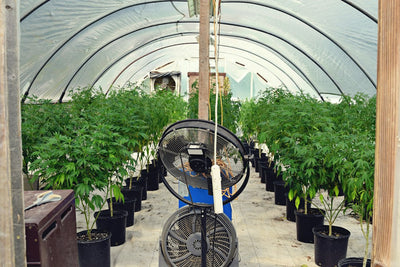
What agents actually carted out of those stores tells you more about the operation's real target than the arrest numbers do. Inventory sheets and evidence logs from Green Merchant raids read like a hardware store manifest: electric timers used to automate light cycles, rolls of aluminum foil for reflecting light back onto canopy, oscillating fans for air circulation, plastic containers for root systems, and high-intensity grow lights engineered to mimic the spectrum of natural sunlight. None of it was illegal to manufacture, stock, or sell on its own. The case against it depended entirely on inferring intent from a sales ledger.
Context matters here. The raids landed almost exactly seven weeks after President George H.W. Bush's September 5, 1989 Oval Office address, where he held up a bag of seized crack cocaine and announced an escalation of the drug war, framing it as the top domestic priority of his administration. Green Merchant wasn't conceived in that speech, but it landed in the political climate that speech created -- a moment when federal agencies had every incentive to show fast, visible, nationwide enforcement numbers, and a scattered network of small hydroponics retailers made an easier target than the actual interstate marijuana trade.
For growers and shop owners, Black Thursday was the moment an entire industry realized it had been under surveillance long before anyone knocked on a door.
Building the Case: Magazines, UPS Records, and an Informant Inside the Seed Trade

Photo by Tima Miroshnichenko via Pexels.
Green Merchant didn't start with a raid -- it started with a subscription. DEA analysts began by working backward from advertising, pulling names and addresses out of the classified and display ad sections of High Times and Sinsemilla Tips, two publications that carried grow-light and hydroponics ads alongside cultivation articles. Anyone running an ad in those pages became a lead worth pulling a thread on.
The bigger leverage point, though, was UPS. Investigators subpoenaed shipping records tied to hydroponics retailers and used them to reconstruct customer lists at a scale that dwarfed anything a magazine subscription could offer -- tens of thousands of names, addresses, and purchase histories, all generated by people who thought they were simply mail-ordering garden equipment. A shipping label meant for a delivery driver became, in DEA hands, a data point in a nationwide trafficking map.
The most consequential piece of the case, though, came from inside the seed trade itself. Anthony Ray Cogo had spent roughly 18 months shipping seeds into the United States on behalf of Nevil Schoenmakers, the Dutch seedbank owner whose operation was, at the time, one of the most prominent sources of cannabis genetics reaching American growers. Cogo's shipping volume was enormous -- more than 11,000 seed packages in that window -- and he kept meticulous records of exactly who received them: names, addresses, order histories. When he was brought into the DEA's orbit in mid-1989, he turned that customer list over.
That single handoff is the clearest illustration of what Green Merchant actually was as an investigative model. It treated an ordinary mail-order customer -- someone who'd simply sent cash for seeds through the postal system, the same way people ordered anything else by mail in 1989 -- as a lead on a distribution network. The surveillance didn't need to prove anyone was trafficking. It just needed a name, an address, and a purchase, and the rest of the case got built around inference.
The Legal Weapon: 21 U.S.C. § 863 and the Paraphernalia Statute

Photo by https://kaboompics.com/ via Pexels.
The legal engine behind Green Merchant was 21 U.S.C. section 863, the federal drug paraphernalia statute -- a law still on the books today, largely unchanged. On its face, the statute targets items primarily designed or marketed for use with controlled substances: bongs, roach clips, scales calibrated for drug weights. Green Merchant stretched it much further, using it to reach ordinary horticultural equipment that had no drug-specific design at all.
That stretch is what made the operation legally distinctive. Timers, box fans, reflective foil, and grow lights are not paraphernalia in any commonsense reading -- they're standard equipment sold to tomato growers, orchid hobbyists, and anyone running a basement seed-starting operation. Section 863 let prosecutors get around that by focusing not on the design of the object but on the circumstances of the sale: what the retailer knew, what the customer said, what other products were sold alongside it, what magazines the store advertised in. A grow light became evidence of intent the moment a prosecutor could argue the seller understood, or should have understood, what it was really being bought for.
That theory shifted legal exposure onto a group that had never really faced it before: retailers themselves. Before Green Merchant, the legal risk of growing marijuana sat overwhelmingly with the grower. After it, a store owner could face federal charges for selling a fan or a light ballast to the wrong customer, even if the sale itself involved nothing but legal merchandise and a legal transaction. Storeowners had no real way to vet buyers' intentions, and the statute didn't require them to be right about intent -- just to have plausibly known.
The practical effect on the industry was immediate and lasting. Stores became far more careful about what they said to customers, what they displayed near the register, and what publications they bought ad space in. Owners who'd built businesses around openly serving indoor cannabis growers had to decide, almost overnight, whether that openness was now a liability serious enough to reshape how they ran their shops -- or worth shutting down entirely.
Counting the Cost: Arrests, Seizures, and Shuttered Businesses

Reported totals for Operation Green Merchant grew sharply between 1991 and 1992, with arrests rising from 1,262 to 1,698 and seized grows nearly quadrupling from 977 to 3,794.
Green Merchant wasn't a single-day event administratively, even though Black Thursday is the date everyone remembers. It ran as a formal DEA Special Enforcement Operation from 1988 through 1992, meaning the October 1989 raids were the most visible spike in a multi-year campaign rather than the whole of it.
The numbers accumulated steadily across that window. By the end of 1991, tallies compiled by cannabisculture.com put the operation at 1,262 arrests, 977 dismantled indoor growing operations, and $17.5 million in seized assets. By the time the operation formally wound down in 1992, Wikipedia's cumulative figures put the final count at 1,698 arrests, 3,794 seized indoor growing operations, and roughly $35 million in confiscated drug-related assets. Whichever set of figures you trust more, the trajectory is the same: this was a sustained, multi-year enforcement campaign that kept escalating well past its opening week.
The human cost showed up in sentencing. Federal mandatory minimums in place at the time meant dozens of defendants caught up in Green Merchant cases received four to 15 year prison terms, with judges given little to no discretion to reduce sentences regardless of the specifics of an individual's operation or history. For people whose actual offense amounted to running a modest indoor garden, sentences in that range were wildly disproportionate to anything resembling the danger the drug war rhetoric of the era claimed to be addressing.
The institutional casualties were just as telling. Tom Alexander's Full Moon garden-supply store, one of the more visible retailers serving the cannabis-growing community, didn't survive the pressure. Sinsemilla Tips, the magazine that had been one of the DEA's original surveillance sources, folded by late 1990 -- a direct casualty of the same investigative model it had unwittingly helped fuel. Worm's Way, a larger horticultural retailer, ended up fighting asset forfeiture proceedings in court rather than simply absorbing the loss, a sign of how aggressively the government pursued seizure even against established, diversified businesses.
How the Trade Adapted: Discretion Becomes Standard Practice

Photo by Cova Software via Unsplash.
The industry that survived Green Merchant didn't look like the one that existed before it. The most visible casualty, Sinsemilla Tips folding in 1990, took with it the primary advertising venue that had let hydroponics retailers speak directly and openly to a cannabis-growing customer base. Stores that wanted to keep operating had to find a way to reach growers without saying, in print, that growers were who they were reaching.
The adaptation that followed was rebranding, not disappearance. Retailers repositioned their inventory and marketing around generic horticulture and hydroponic gardening -- language about vegetable yields, orchid propagation, and general indoor growing rather than anything that named cannabis specifically. The equipment on the shelves barely changed. The language around it changed completely, because language was now the thing that could be subpoenaed and read back in a courtroom.
Buying habits shifted right alongside selling habits. Mail order and magazine ads, the exact channels the DEA had exploited to build Green Merchant's case, fell out of favor with growers who understood, correctly, that a shipping record was a permanent piece of evidence. Cash purchases, informal local networks, and word-of-mouth introductions became the safer path, even though they were less convenient and often more expensive. Discretion stopped being a personal preference and became standard operating procedure across the trade.
None of this was a temporary adjustment that faded once the raids stopped making news. The DEA folded Green Merchant's investigative tactics -- working backward from advertising and shipping data, treating retailers as potential conspirators -- into its ongoing Domestic Cannabis Eradication/Suppression Program, signaling clearly that this wasn't a one-off campaign but a permanent addition to the enforcement toolkit. Growers and retailers absorbed that signal. The habits of caution that Green Merchant forced into existence around 1989 and 1990 persisted for decades, well into the era when individual states began legalizing cannabis outright, because institutional memory of what a customer list could cost someone doesn't disappear just because the law changes in one state.
Strip away the enforcement numbers and Green Merchant is really a story about how far a single statute can be stretched when the political appetite exists for it. Section 863 was written with obvious drug paraphernalia in mind -- bongs, scales, rolling papers -- and prosecutors used it to reach fans, timers, aluminum foil, and grow lights, tools with entirely ordinary horticultural purposes that thousands of people used for entirely legal gardening every day. The statute didn't need to prove the equipment was inherently illicit. It just needed a prosecutor willing to argue that a sale plus a subscriber list added up to intent.
The lasting legacy isn't really the arrest counts or the seizure totals, striking as those numbers are. It's cultural. Green Merchant taught an entire generation of growers and retailers that privacy and discretion weren't optional extras -- they were part of the craft itself, as essential as knowing your light cycle or your feeding schedule. That lesson didn't expire when the operation officially closed in 1992. It shaped how the trade behaved for the next three decades, well past the point where several states had already legalized the plant outright.
It's worth sitting with that when you're browsing seeds or equipment today without a second thought about who's tracking the order. Quality genetics and open equipment markets exist now because that climate of fear eventually broke, state by state, court case by court case. Buying well-bred seeds from a legitimate source and setting up a grow room with a normal invoice and a normal receipt used to be a genuine legal risk for a lot of people who had done nothing more than order a light and a timer through the mail. That it isn't anymore is not a small thing.