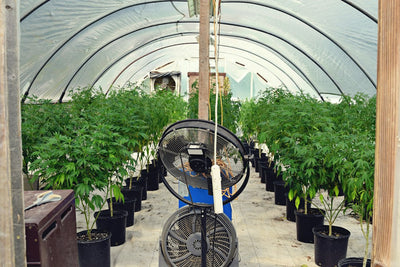
Outdoor vs Greenhouse vs Indoor: How Commercial Farms Decide
Photo by CRYSTALWEED cannabis via Unsplash.
Pick a cultivation method and you've just locked in your cost structure, your quality ceiling, and your harvest calendar for the next five to ten years. It's not a decision you revisit lightly once the concrete is poured or the greenhouse frame is bolted down. Every other operational choice -- genetics, nutrient program, labor model, even your customer base -- gets built on top of whatever you decide here. Get it wrong and you're either bleeding cash on electricity you didn't need or watching competitors undercut you on flower you can't produce cheaply enough to match.
For years the industry ran on a simple assumption: indoor means premium, outdoor means cheap commodity flower, and greenhouse sits somewhere in the middle as a compromise. That math is getting messier. LED fixture efficiency has climbed enough that electricity draw per gram has dropped meaningfully over the past several years, and dedicated solar power is starting to change what an indoor kilowatt-hour actually costs an operator. The gap between indoor's quality ceiling and its cost disadvantage is narrowing in a way it wasn't even three or four years ago.
You can see where institutional money is actually placing its bets. On February 10, 2026, Nature's Miracle Holding entered a memorandum of understanding with CCBP Holding for a $150 million engineering, procurement, and construction deal on an indoor facility in California City -- a project designed from the ground up around cheap, off-grid solar power feeding full artificial-light cultivation at scale. That's not a hobbyist's decision. That's a spreadsheet exercise involving square footage, kilowatt-hour rates, and harvests per year, run by people who have to answer to shareholders about production cost per pound.
The Three Methods, and What Actually Separates Them

Photo by XRP Relic via Unsplash.
Strip away the marketing language and there are really only three structural bets an operator can make, and each one trades capital against speed and consistency in a different way.
Outdoor cultivation is the lowest bar to entry -- startup costs for a commercial-scale outdoor operation typically run $250,000 to $750,000 depending on land, water rights, and fencing/security requirements. You get one harvest a year in most of North America, maybe two in a handful of double-cropping climates, and you're at the mercy of whatever the weather does in September when your colas are fattening up and a rainstorm rolls through with a bloom of botrytis behind it. Yield and quality variability from year to year is the highest of any method, full stop.
Greenhouse, or mixed-light cultivation, splits the difference. Supplemental HPS or LED lighting combined with light deprivation blackout tech lets you manipulate the photoperiod and run four to five cycles a year instead of one. Startup costs for comparable canopy land in the $500,000 to $1.5 million range -- more than outdoor, but you're buying yourself four times the harvest frequency and a lot more control over the finishing environment.
Indoor is the expensive option by every measure that matters upfront: full artificial lighting, sealed-room HVAC, dehumidification, CO2 enrichment, and total climate control. Startup runs $150 to $500 per square foot of canopy, and continuous cycling means you're harvesting essentially year-round on staggered rooms.
Here's the part operators sometimes miss when they're building the pro forma: greenhouse flower typically wholesales at a 15-30% discount to indoor-grown flower, purely on buyer perception of quality and consistency. That price gap has to get factored into the method decision just as heavily as the build cost does -- a cheaper structure that produces flower selling at a third less doesn't automatically win the margin race.
The Real Cost Math: Startup and Per-Pound Production

Startup costs for a 10,000 sq ft cannabis grow operation rise sharply with facility complexity: outdoor cultivation starts at around $250,000, greenhouse setups double that to $500,000, and fully indoor operations can cost up to $1 million.
Startup capital is only half the equation. The number that actually determines whether a facility survives its first three years is cost per pound, and that's where the three methods really separate from each other.
A 10,000 square foot indoor facility -- a modest commercial footprint by today's standards -- generally runs $1 million to $2.5 million to build out with lighting, HVAC, and room infrastructure included. Scale that up to 20,000 square feet and you're looking at $8 to $10 million once you factor in the electrical service upgrades, redundant climate systems, and the room segmentation needed to stagger harvests properly.
Greenhouse production costs, by contrast, typically land in the $200 to $500 per pound range -- a wide band that depends heavily on how much supplemental lighting a given climate requires and how automated the light-dep and irrigation systems are.
What makes the California City project worth watching is the production cost target attached to it: Nature's Miracle's planned facility is projected to come in under $200 per pound, which would put it among the lowest-cost producers in the country if it hits that number at scale -- and that's for an indoor facility, a cost tier historically associated with greenhouse or outdoor production, not full artificial light.
Outdoor still wins on raw entry cost, no argument there. But it has the least pricing power of the three methods and the most exposure to a single bad weather event wiping out a season's revenue in a week.
Worth saying plainly: these are directional industry benchmarks pulled from typical build patterns, not audited government figures. Real numbers move by state, by local labor market, and by utility rate structure -- a facility in a state with $0.06/kWh industrial power looks completely different on a spreadsheet than the same building in a state paying $0.18/kWh.
Inside the $150 Million California City Project

Photo by Mark Stebnicki via Pexels.
The mechanics of the California City deal are worth walking through in detail because they illustrate exactly how the cost math above gets engineered rather than just hoped for.
On February 10, 2026, Nature's Miracle Holding (OTCQB: NMHI) signed a memorandum of understanding with CCBP Holding LLC covering engineering, procurement, and construction services for an indoor cultivation facility in California City, California, with a total project value around $150 million. The site itself spans 88.38 acres, with roughly 660,000 square feet -- about 15 acres -- allocated to indoor and greenhouse growing space, built explicitly for year-round production rather than seasonal cycling.
The detail that makes this project genuinely interesting isn't the acreage, it's the power source. The facility is designed to run off an off-grid 40-megawatt solar array paired with battery storage, feeding both the supplemental lighting systems and the HVAC load at a projected electricity cost of roughly $0.10 per kilowatt-hour. That rate is the whole thesis of the project -- indoor cultivation's biggest recurring cost is electricity, and if you can engineer that cost down through dedicated generation instead of paying grid rates, the traditional indoor-versus-greenhouse cost gap starts to close fast.
Per trade press coverage as of a March 10, 2026 investor update, the expected completion window sits at 12 to 18 months from breaking ground.
One caveat that matters: this is still a memorandum of understanding and a potential contract, not a signed, guaranteed build. MOUs fall apart or get restructured regularly in this industry, and it's worth treating the announced numbers as a stated intention rather than a certainty.
Even with that caveat, the signal is real. Institutional capital is now treating indoor cultivation at scale as investable, provided the energy cost problem gets solved through dedicated generation rather than absorbed at grid rates.
Why Indoor's Cost Disadvantage Is Shrinking

Photo by Petr via Unsplash.
Indoor's cost disadvantage against outdoor and greenhouse has been shrinking for a few concrete, measurable reasons -- not just industry optimism.
The biggest one is fixture efficiency. Horticultural LED output is measured in micromoles per joule, and that number has climbed steadily as manufacturers have improved diode efficiency and driver design. A higher micromoles-per-joule fixture delivers the same PPFD to the canopy while drawing less wattage, which directly cuts electricity draw per gram of finished flower -- the single biggest recurring cost line in an indoor budget.
Modular room design has changed the capital commitment curve too. Rather than building 20,000 square feet of canopy on day one, operators are increasingly phasing construction -- building 5,000 square feet, proving the operation, then scaling in stages as cash flow allows. That spreads the capital outlay and de-risks the build considerably compared to the old model of committing the full budget upfront.
Vertical or stacked canopy is another lever that's changed the per-square-foot math. Stacking two or three tiers of canopy within the same floor footprint multiplies yield per square foot of building without expanding the shell, which directly improves the return on every dollar spent on the roof, walls, and HVAC.
Crop steering has gotten a real boost from automation too. AI-assisted environmental control managing VPD, CO2 levels, and irrigation timing reduces the labor hours needed per pound of output and, just as importantly, cuts crop loss from the kind of human error that used to wipe out a room -- a missed dehumidifier setting during flower, an irrigation line that clogged unnoticed for two days.
And then there's the lever the California City project is built around: cheap, dedicated power. A 40-megawatt solar array with battery storage sidesteps grid rate volatility entirely, and that's arguably a bigger factor in indoor's improving economics than any single piece of lighting or automation technology.
None of this erases indoor's higher upfront capital requirement. What it does is compress the payback timeline, which is a different problem to solve than the one operators faced five years ago.
Matching the Method to Your Market Position

Photo by CRYSTALWEED cannabis via Unsplash.
None of this matters in isolation from your target market. The method that makes financial sense depends entirely on who's buying your flower and at what price point.
If you're competing for extraction-grade biomass or value-tier flower destined for pre-rolls and lower-shelf jars, outdoor and light-dep greenhouse are the correct call. You don't need indoor's quality ceiling to hit that price point, and paying indoor electricity rates to produce flower that sells at commodity prices is a fast way to erode margin.
Greenhouse hits its sweet spot for operators who need four to five harvest cycles a year but can't justify full indoor electricity costs across the whole footprint. It's the method built for volume without the premium price tag -- and without the premium electricity bill.
Indoor still wins, and will keep winning, wherever the buyer is paying specifically for top-shelf smokable flower: dense trichome coverage, tight bud structure, and terpene profiles that stay consistent batch after batch. That consistency is what indoor buys you that greenhouse structurally can't match, since sealed-room control eliminates the seasonal and weather variability that shows up in mixed-light and full-sun grows.
Climate is a bigger factor in this decision than most new operators give it credit for. A grower in a low-humidity, high-sun region like parts of California or New Mexico has outdoor and greenhouse economics simply unavailable to someone trying to run the same model in the humid Midwest or Northeast, where mold pressure and shorter growing seasons change the calculation entirely.
Genetics need to match the structure, too. Some cultivars finish clean outdoors, throwing off mold and pest pressure well enough to make full-sun production viable; others need indoor's total control to express the density and terpene expression they're capable of. Starting with well-bred seeds suited to your specific environment -- genetics selected for your climate and your chosen method, like what Seedtiva offers -- reduces production risk regardless of which structure you end up building. Outcomes still vary widely by climate, build quality, and operator experience, and none of the cost figures above should be read as a guarantee of what any specific facility will achieve.
The outdoor-versus-greenhouse-versus-indoor argument was never really about crowning one objectively superior method. It's about matching available capital, local climate, and your target buyer correctly -- an outdoor build in Humboldt County and an indoor build in California City are both rational decisions, just for completely different operators chasing completely different markets.
What deals like the Nature's Miracle California City project actually show is where the industry is consolidating its thinking: not around a single winning structure, but around engineering the energy cost problem down until the traditional cost gaps between methods stop dictating the decision on their own. A 40-megawatt solar array feeding an indoor facility at $0.10 per kilowatt-hour is a bet that the old indoor-cost-penalty math is negotiable if you control your own power generation.
Whichever structure ends up penciling out for your operation, the building and the lighting only set the environment. The genetics going into the ground still set the ceiling on what that environment can actually produce -- and no amount of engineered-down electricity cost fixes a cultivar that was never suited to the method you built around it.
Sources
- Cost to Start a Cannabis Grow Operation: 2025 Capital Breakdown | Northstar Financial Advisory
- How Much Does it Cost to Grow Cannabis in a Greenhouse? – Business Plan Templates
- Commercial Greenhouse Cost in 2026: $2 to $60/ft²
- Commercial Cannabis Cultivation: Indoor vs. Outdoor vs. Greenhouse – FloraFlex
- Commercial Grow Room Setup Cost