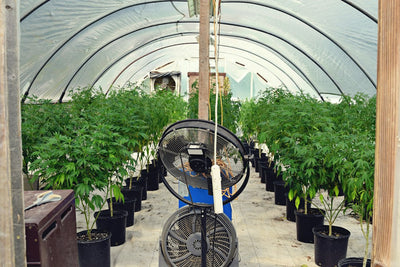
Reading Trichomes: How to Time Your Harvest for Peak Potency
Photo by Diego Barros via Pexels.
Somewhere around week 7 or 8 of flower, every grower faces the same moment of doubt: is it time yet? Cut too early and you're left with a harsh, understimulating smoke that never tasted like what the breeder promised. Cut too late and that same plant turns into something heavy and foggy, all the sharp edges sanded off. Either way, you've spent 12-16 weeks feeding, training, and defending a plant from pests and mold, only to lose the final result in the last 72 hours because of a guess. That's the single most avoidable failure point in an otherwise good grow, and it has nothing to do with genetics, nutrients, or lighting. It's timing.
The problem is that most of the visual cues growers default to are unreliable. Pistil color gets cited constantly in grow forums, but those little hairs are responding to pollination biology, not cannabinoid chemistry, and they'll happily turn orange on a plant that's still weeks away from peak THC. Leaf color and fan leaf yellowing tell you about nitrogen mobilization and senescence, not resin chemistry. The only structure on the plant that's actually manufacturing and storing the compounds you're growing for is the trichome, and reading it correctly is a skill, not a guess.
This guide walks through the biology of what's actually happening inside those glandular heads, the specific color percentages experienced growers chase depending on whether they want an energetic sativa-leaning effect or a heavy sedative one, the tools that make reading them possible, and the emerging tech that's starting to take some of the guesswork out of it entirely.
What Trichomes Actually Are and Why They Matter

Photo by XRP Relic via Unsplash.
Trichomes are small, mushroom-shaped glandular structures that cover the surface of buds and the sugar leaves tucked in around them. Under any real magnification they look almost architectural -- a slender stalk supporting a rounded, translucent head, packed densely enough on a healthy cola that the whole surface takes on a frosted look. That frost isn't decoration. It's the plant's chemical factory, and nearly everything that determines strength, flavor, and effect happens inside that bulbous head at the top of the stalk.
Inside the gland head sits a resin matrix where THC, CBD, CBG, and the full range of minor cannabinoids get synthesized and stored, alongside the terpenes responsible for aroma and flavor. The stalk itself is mostly just plumbing -- structural support and a transport path -- but strip it down under a scope and you'll see that almost all the cannabinoid content you're chasing is concentrated in that head. This is exactly why color-checking the heads specifically, rather than glancing at the bud in general, is the only method that actually works.
Terpenes complicate the picture in a useful way. They're volatile compounds, which means they evaporate readily, especially under heat, light, and physical agitation. A trichome head that's degrading isn't just losing cannabinoid integrity -- it's also cooking off the terpene profile that gives a strain its specific smell and flavor. That's part of why an overripe harvest doesn't just hit differently, it often smells duller and tastes flatter too, even before curing enters the picture.
The mistake most new growers make is watching the pistils instead. Those thin hairs that emerge from the calyx are part of the plant's reproductive system, designed to catch pollen, and they change color and curl inward as flowering progresses regardless of what's happening chemically inside the trichome heads. A plant can have 70% orange, curled pistils and still be running mostly clear trichomes underneath, chemically nowhere near ready. Pistils are a rough timeline indicator at best. Trichomes are the actual clock.
The Three-Stage Color Progression

Photo by Esteban López via Unsplash.
Trichome development runs through a fairly predictable three-stage progression, and each stage has a distinct look once you get a loupe or scope on it. Early in flower, the gland heads are clear -- genuinely transparent, almost like tiny glass beads catching light. At this stage cannabinoid production hasn't ramped up yet; the plant is still building the resin infrastructure. Harvesting here is the classic beginner mistake: buds that look frosty and impressive to the naked eye but are chemically underdeveloped, producing a light, often disappointingly weak effect.
As flowering progresses, those clear heads turn milky or cloudy -- an opaque, almost pearlescent white. This is peak production. THC synthesis is running at full output, and this stage is where the ceiling of a plant's potency lives. If you've ever heard growers talk about hitting the plant at its peak, this cloudy stage is what they mean.
Left longer, those milky heads start picking up amber or brown tones. This isn't a new compound being produced -- it's THC breaking down, oxidizing and degrading enzymatically into CBN, a cannabinoid associated with sedative, couch-lock heavy effects rather than sharp psychoactivity. Amber trichomes aren't a sign of more potency; they're a sign of potency converting into something else.
That degradation is exactly why peak THC content sits right at the milky-to-amber transition, not deep into the amber stage like a lot of beginners assume. The window for maximum raw potency is narrow -- often just a matter of days depending on strain speed and ambient conditions -- which is part of why daily monitoring matters so much once you're in the final stretch. And it's not just cannabinoids shifting during this window. Terpenes keep degrading the longer the plant sits unharvested, so the flavor and effect profile you get from a heavily ambered harvest can be meaningfully different from the same plant cut a week earlier, even though it's genetically identical.
Picking Your Target Ratio: Energetic vs. Sedative

Target amber trichome percentage rises with the desired sedative effect: harvesting at just 5% amber suits energetic, high-THC strains, while sedative, indica-leaning effects call for a much higher 40% amber level.
There's no official government-stamped percentage for peak trichome color -- it doesn't exist, and anyone who tells you there's one fixed number is oversimplifying. Cultivator reports and grower community consensus span a wide range, anywhere from 50% cloudy being called ready by some, up to growers waiting for 90-100% cloudy before they'll touch the trimmers. What actually matters is deciding what effect you're growing for before you decide what percentage to chase.
If you want a sharp, clear-headed, energetic high -- the kind associated with peak-THC sativa-leaning effects -- aim for roughly 70-90% cloudy trichomes with only 0-5% amber. This is the harvest window most growers chasing raw potency and a more cerebral, functional high are targeting. It's also usually the window that preserves the most terpene complexity, since you're cutting before much degradation has set in.
For a more balanced effect -- something with a bit of body relaxation mixed into the head high -- growers typically let 20-30% of the heads go amber while the rest stay cloudy. This is a common target for hybrid strains where the goal is a rounded, all-purpose effect rather than something extreme in either direction.
If sedation is the actual goal -- evening use, sleep support, heavy indica-leaning effects -- growers will deliberately push past that balanced point, letting 40% or more of the trichomes amber up. That's a conscious trade: potency for sedation, since a meaningful chunk of THC has already converted to CBN by that point.
None of these numbers are fixed rules. Outcomes vary by strain, by climate, by how your specific plant was trained and fed, and even by which part of the plant you're sampling. Genetics play a bigger role here than most growers give them credit for -- well-bred seed lines from a reliable source tend to ripen more predictably and evenly, which makes hitting a specific target percentage far less of a guessing game than it is with inconsistent or unstable genetics.
Tools and Technique: How to Actually Check

Photo by Plato Terentev via Pexels.
The naked eye is not equipped for this job, and neither is your phone camera, no matter how good the zoom claims to be. Trichome heads are typically under a millimeter across, and the difference between milky and early amber is subtle enough that you need real magnification to see it reliably. A jeweler's loupe in the 30x-60x range is the standard entry tool -- cheap, pocket-sized, and enough to clearly resolve individual gland heads. A lot of growers step up to a USB digital microscope instead, which plugs into a laptop or phone and gives you a live, larger image that's easier to inspect without squinting one eye shut over a bud for ten minutes.
Wherever you check, check in more than one spot. Ripening isn't uniform across a plant -- the top cola under the most direct light will typically mature faster than mid-canopy buds, and lower buds in shaded, cooler microclimates almost always lag behind. Sample the top cola, a mid-height bud, and a lower calyx separately, and use the average of what you see to make your call, not just the most convenient bud to reach.
Timing-wise, start daily monitoring around week 7-9 of flower, adjusting for strain speed -- faster-finishing indica-dominant strains often wrap up on the earlier end of that window, while long-flowering sativa-dominant lines can run well past it. Lighting matters more than people expect too: direct sunlight tends to wash out amber tones and can make everything look more cloudy than it is, so check under a flashlight or in shade for a more accurate read.
The tools available for this are actually evolving fast. A February 2026 study demonstrated a smartphone-based computer vision system combining Faster R-CNN and YOLOv8 that sorted clear, milky, and amber trichomes with 98.6% accuracy when validated against actual HPLC-measured cannabinoid levels -- a level of precision no human eye is matching consistently. Separately, portable handheld near-infrared spectroscopy devices developed out of 2024 research can now predict THCA content directly on live, unharvested buds. Consumer-facing apps like BudProof AI and Kushy Scanner are starting to bring similar image-based analysis to home growers, though a decent loupe still gets you most of the way there for a fraction of the cost.
Why Harvest Timing Isn't the Final Word

Photo by Terrance Barksdale via Pexels.
Cutting the plant doesn't flip an off switch on trichome chemistry. The enzymatic processes driving the clear-to-milky-to-amber progression keep running for a while after harvest, particularly during a slow, properly humidity-controlled dry. That means the percentages you check under your loupe minutes before the chop aren't the final numbers your cured product will land on -- there's drift built into the process, and experienced growers plan for it.
The standard adjustment is to harvest 2-5% below your actual target amber percentage, banking on the fact that a few more percentage points of amber will develop naturally during the first several days of drying. If you're aiming for that 20-30% amber balanced-effect range, for instance, cutting at 15-25% amber and letting the rest develop during dry often lands you closer to the actual target than cutting at the number itself.
This drift isn't uniform across strains either. Sativa-dominant varieties in particular tend to keep ambering aggressively after the cut, sometimes surprising growers who thought they'd nailed a precise low-amber harvest only to find a noticeably more sedative result two weeks later once it's cured. If you're running a longer-flowering sativa-leaning cultivar and you're chasing that sharp, energetic profile, it pays to err earlier than you think you need to.
How much further degradation happens is also directly shaped by your drying and curing environment. A slow dry at 60°F and 60% relative humidity over 10-14 days behaves very differently than a fast, hot, low-humidity dry that locks chemistry in place quickly but usually at the cost of terpene retention and smoothness. Cure conditions afterward -- jar humidity, burping frequency, total cure time -- continue to shape the final flavor and potency profile for weeks past that.
The practical takeaway is that your loupe check at harvest is the start of the ripening curve, not the finish line. Treat it as a checkpoint you're steering toward a final result, not a stop sign.
If there's one thing worth internalizing from all of this, it's that trichome color is a range tied to what you're growing for, not a single universal number you're supposed to memorize. A grower chasing a clear, energetic daytime high and a grower chasing heavy sedative effect are looking for genuinely different harvest windows on the same plant, and neither one is wrong -- they're just aiming somewhere else on the same curve. Decide what you actually want out of the finished product before you decide what percentage you're chasing, because that decision should come first.
It's also worth saying plainly: a $15 jeweler's loupe still beats guessing by leaf color or by counting calendar days off a seed packet's estimated flowering time. Calendar estimates are averages, not guarantees, and your specific plant, climate, and light schedule will push its actual finish date around that average. The AI-assisted scanning tools coming out of recent research are genuinely impressive and worth watching, and consumer versions will likely get cheaper and more accessible over the next few seasons, but they're additions to good technique, not replacements for actually looking closely at your own plants.
The most useful thing you can do beyond this guide is start keeping notes. Log your harvest date, the trichome percentages you cut at, your dry and cure conditions, and how the finished product actually turned out and felt weeks later. Do that across two or three grows of the same strain, or even across different strains from the same reliable genetic line, and you'll build something more valuable than any percentage guide floating around online: your own calibrated sense of how your specific plants, in your specific setup, actually ripen.
Sources
- When to Harvest Cannabis: Complete Grower's Guide (2026)
- Cannabis Trichome Harvest Timing: Clear, Cloudy & Amber Guide | ZenWeedGuide
- When is the Best Time to Harvest Marijuana Buds? | Grow Weed Easy
- When to Harvest Cannabis: Trichome Color Guide with Photos (2026)
- When to Harvest Cannabis for Maximum Potency (2026)