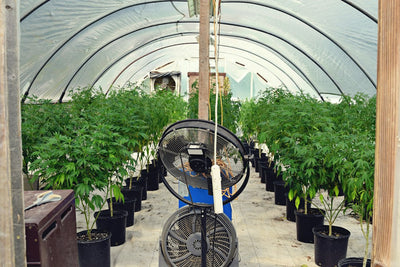
Sea of Green vs. Screen of Green at Commercial Scale
Photo by StuBaileyPhoto via Pixabay.
Sea of Green and Screen of Green both work. That's not in dispute -- either method, run competently, produces dense, marketable flower, and you can find growers who swear by each one. The argument about which is "better" mostly happens in tents and spare bedrooms, where the grower's own hours are free and the only real cost is electricity and a bag of nutrients. Move that same argument into a licensed 20,000 square foot facility with a payroll, a compliance department, and a wholesale buyer squeezing you on price every quarter, and the calculus changes completely.
SOG is a numbers game -- pack the room with plants, veg them barely long enough to root out, flip early, and let plant count do the work that training would otherwise do. ScrOG is a manipulation game -- fewer plants, longer veg, and real hours spent weaving stems through a screen to build a flat, even canopy that can carry more weight per plant. On paper this looks like a yield conversation: grams per square foot, grams per watt. In a commercial building it's actually a labor conversation: grams per labor hour, and how predictably that number holds up across twenty flower rooms and a rotating cast of hourly employees.
That's the question this article is actually answering. Not which method yields more under ideal conditions, but which one protects margin when wholesale prices keep sliding and your crew costs the same whether the market's up or down.
The Core Mechanics: Density, Veg Time, and Training

Photo by Tima Miroshnichenko via Pexels.
Start with plant density, because it's the variable that cascades into everything else. A commercial SOG room typically runs somewhere between 9 and 25-plus plants per square meter, vegged for as little as one week and rarely more than four before the flip to flower. The goal isn't a big plant -- it's a small, uniform plant with a single dominant cola, repeated dozens of times per light. ScrOG runs the opposite math: 1 to 4 plants per square meter, vegged 4 to 8 weeks so there's enough lateral growth to actually fill a screen before flower begins.
Training load follows the same divide. SOG plants get almost no manipulation -- maybe a light defoliation pass, but otherwise they go from clone or seedling straight into flower and rely on sheer plant count rather than shaping. ScrOG demands repeated, hands-on weaving through a trellis net during the entire veg period, tucking and redirecting shoots week after week until the canopy reads as one flat plane instead of a cluster of individual plants. That's not a one-time task -- it's a recurring labor line item that shows up on every timesheet for a month or more before the plant has produced a single flower.
The density gap also rewrites your infrastructure math well before you get to yield. A SOG room at 20 plants per square meter needs an irrigation manifold built for that pot count, that many drippers, that many individual root zones to monitor for runoff and EC drift. It also needs a mother/clone program capable of pumping out that volume of rooted cuttings every single cycle, which is its own labor and space commitment upstream of the flower room. A ScrOG room needs a fraction of the pots and drippers, but it needs screens, screen-anchoring hardware, and a veg room held open for two months instead of two weeks. Neither is free -- they just spend the money in different places, and that's the real decision buried under what looks like a training-technique question.
Yield Numbers: What the Industry Actually Claims

ScrOG shows the highest relative yield index (1.2), followed by SOG (1.1), while untrained plants have the lowest yield potential (1.0), suggesting trained growing methods modestly boost reported yields.
The spec-sheet numbers that get repeated in grow-light marketing put SOG at up to 1 gram per watt of installed light, and ScrOG at up to 1.5 grams per watt. A separate grow-light calculator estimate frames it slightly differently, pegging ScrOG as roughly a 20% yield increase over an untrained control plant, versus about 10% for SOG. Both sets of numbers point the same direction: trained, screen-filled canopies convert light into flower more efficiently on a per-watt basis than a sea of small, minimally trained plants.
Worth saying plainly -- these are industry benchmark figures, not controlled trial data. Nobody ran a replicated study holding genetics, light spectrum, VPD, and CO2 constant across both methods and published a peer-reviewed number. Strain selection alone can swing yield 20-30% in either direction, and light quality, canopy uniformity, and environmental control matter as much as which training method is written on the SOP. Treat 1 g/W and 1.5 g/W as planning ballparks, not guarantees you can hold a facility manager to.
For an actual commercial reference point, look at Flower One's Nevada greenhouse operation, which reported 38.3 grams per square foot per harvest cycle at a production cost of $0.45 per gram back in 2019. That's a real, audited-scale number from a licensed operation, not a marketing calculator -- though it predates the current generation of high-efficiency LEDs and the automation gains a lot of facilities have layered in since. Treat it as a floor for what disciplined commercial cultivation can hit, not a ceiling.
Here's the part that matters for a P&L, though: per-plant yield clearly favors ScrOG -- fewer, bigger plants each carrying more grams. But per-labor-hour yield is an entirely different comparison, and it's the one that actually determines your cost per gram at scale. A SOG room that turns over fast with minimal training hours can post a lower grams-per-plant number and still win on cost, simply because nobody spent three weeks weaving screens to get there.
The Labor Trap: Why ScrOG Gets Harder as You Scale Up

ScrOG's biggest structural weakness doesn't show up until you try to run it at real scale: once the screen is woven and the canopy is set, that layout is locked in for the entire flower cycle. There's no going back and rearranging plant spacing or redirecting growth once flower stretch has finished and the buds are sitting on top of the net. Any planning mistake -- uneven fill, a slow-finishing pheno, a screen woven too tight in one corner -- rides with you for the full 8-9 weeks of flower.
That rigidity becomes a genuine operational problem the moment you're running more than one strain, which almost every commercial license does. Different cultivars fill a screen at different rates and on different timelines -- a vigorous, laterally branching plant might cover 90% of the screen in five weeks, while a more upright pheno leaves gaps that never fill in. Running six strains under six screens means six different veg timelines to manage individually, which is a scheduling and labor-planning headache that SOG simply doesn't have, since short-veg plants going straight to flower are far more interchangeable across strains and rooms.
The static layout also limits physical access to the canopy once plants fill in. Pruning the lower third, scouting for spider mites or powdery mildew, pulling larf off the underside of the screen -- all of it requires reaching through or under a fixed net, which is slower and more awkward than working an open row of SOG pots. That's not a minor inconvenience in a licensed facility, where IPM scouting and defoliation are recurring, scheduled labor tasks, not optional extras.
SOG's advantage at scale is really just its lack of surprises. Minimal training, short and uniform plants, a fast, predictable turnaround from flip to harvest -- that simplicity scales across dozens of plant counts and multiple rooms without each room needing its own individualized management plan. When you're comparing methods across a facility with a few dozen flower rooms running on staggered schedules, labor cost per gram is the number that actually decides margin -- not yield per square foot, and definitely not yield per plant.
Choosing a Method in an Oversupplied Market

Photo by Tony Mrst via Pexels.
Washington State's own tracked data tells the oversupply story bluntly. In 2017, licensed growers produced 121,254 pounds of THC-equivalent product -- nearly double what actually sold that year. Instead of correcting, it got worse: by 2023 production had roughly tripled to over 363,000 pounds, while sales only about doubled over the same stretch. One operator in that market described wholesale-to-retail product movement dropping 60% in a single year. Canada went through a comparable stretch of oversupply and price collapse in its own legal market's early years, for largely the same reason -- licensing outpaced demand, and cultivation capacity kept getting added faster than the market could absorb it.
In a market moving that direction, the technique question stops being about maximizing output per plant and becomes about maximizing throughput per labor dollar. When wholesale price per gram keeps sliding, the grower who can turn rooms faster and cheaper protects margin better than the grower chasing the highest theoretical yield per square foot, because the second dollar of yield is worth less every quarter the glut continues.
The infrastructure trend backs this up. The vertical farming market -- much of it cannabis-adjacent cultivation technology -- is forecast at $4.7 billion in 2026, growing to $19.01 billion by 2035, a 16.80% compound annual growth rate. That growth is being driven by automation, sensor networks, and precision fertigation systems built specifically to pull labor hours out of cultivation. Autonomous irrigation, EC/pH dosing, and canopy-level sensor arrays are all designed around uniform, repeatable plant layouts -- exactly what SOG offers and exactly what ScrOG's per-strain, hand-woven screens resist.
That's the practical link between an oversupplied market and a training decision: automation is where the industry's cost savings are actually coming from, and automation rewards SOG's lower per-plant labor demand far more readily than it rewards ScrOG's manual, individualized screen work. A facility investing in automated fertigation and sensor-driven environmental control gets more out of that investment running SOG at scale than trying to bolt automation onto a technique that's inherently hands-on by design.
Which One Should a Commercial Grow Actually Run?

Photo by Diego Barros via Pexels.
There isn't a universal right answer here, but there is a pattern in how successful commercial operators actually split the decision. Facilities running high-turnover, multi-strain SKUs for a value-tier wholesale shelf generally lean SOG -- speed, predictable labor, and the ability to swap strains between cycles without redesigning a room. If your business model depends on volume and shelf presence across a lot of SKUs, SOG's simplicity is worth more than the extra grams ScrOG might squeeze out of a single plant.
Facilities chasing top-shelf flower -- fewer, larger colas, premium bag appeal, a price point that can absorb extra labor cost -- lean ScrOG, and reasonably so. If your buyer is paying a premium for flower quality and structure rather than sheer volume, the training hours can pencil out, especially on strains that respond well to canopy manipulation with dense, even bud development across the screen.
Plenty of commercial rooms don't pick a pure version of either. A modified SOG with light supercropping -- bending and cracking stems slightly to open the canopy without building a full screen -- captures some of ScrOG's per-plant yield gain without taking on the rigidity or the multi-week veg extension. It's a reasonable middle path for operators who want more than bare SOG numbers but can't justify a full screen-training labor line across dozens of rooms.
Genetics deserve as much weight in this decision as the technique itself. A cultivar bred to finish fast and uniform, with a strong central cola and minimal stretch, suits SOG's short-veg, high-density model. A vigorous, laterally branching cultivar with a longer natural veg habit is going to fill a screen faster and more evenly, which is exactly what ScrOG needs to justify its longer timeline. Starting with well-bred seeds suited to the method you're actually running -- which is part of what we focus on at Seedtiva -- matters more than the training method itself, because no amount of screen-weaving fixes a genetic mismatch between plant habit and room design. Outcomes still depend heavily on strain selection, room design, and crew skill; neither method is a guaranteed fix for a margin problem that starts upstream of the flower room.
Neither method solves an oversupply problem on its own. SOG and ScrOG only control how efficiently a facility converts light and labor into sellable flower -- they don't touch the fact that Washington's market tripled production while sales roughly doubled, or that wholesale prices keep drifting down as more licensed square footage comes online nationally. A perfectly run ScrOG room in a glutted market still sells into the same collapsing price curve as a sloppy SOG room. The technique is a cost lever, not a demand lever.
At real commercial scale, the decision usually comes down to a much narrower question than which method has the higher ceiling on paper: can your labor model actually absorb ScrOG's training hours, week after week, across however many rooms you're running, without that labor line eating the yield advantage it's supposed to deliver? For a lot of multi-room, multi-strain facilities competing on wholesale volume, the honest answer is no -- and SOG's predictability wins by default, not because 1.5 g/W isn't a real number.
If there's one habit worth adopting from an operation like Flower One's, it's tracking dollars per gram of production cost per room, the same way they reported $0.45 per gram back in 2019, rather than chasing grams-per-watt bragging rights that don't survive contact with a payroll. Grams per watt tells you what a plant can theoretically do. Dollars per gram tells you what your facility is actually doing, and it's the number that decides whether you're still in business the next time wholesale prices drop another notch.
Sources
- Sea of Green (SOG) vs Screen of Green (ScrOG) Growing | Weedmaps
- Sea of green: our grower's guide to max cannabis yields
- Screen of Green (SCROG): The Complete CannabScreen of Green (SCROG): The Complete Cannabis Guide (2026)is Guide (2026) – BudTrainer
- Growing Techniques: Sea of Green vs. Screen of Green
- Cannabis Sea of Green (SOG) Method: Maximize Your Yield