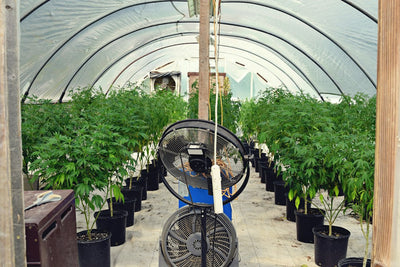
The Core Technologies Every Serious Grow Room Runs On
Photo by Keloke Grow via Pexels.
Walk into a commercial grow that's actually competitive in 2026 and you won't find a room full of mismatched gear bought on separate purchase orders over three years. You'll find a system — lighting, HVAC, sensors, and fertigation talking to each other on a shared control layer, sized and tuned as one unit from the day the facility was designed. That's the real shift in cultivation technology right now. It's not about which fixture puts out the most micromoles. It's about integration.
The LED versus HPS argument, which consumed a decade of grower forum threads and trade show floor debates, is effectively over for anyone running at commercial scale. Modern LEDs win on efficiency, spectrum control, heat management, and their ability to plug into automated systems in ways a 1000W double-ended HPS bulb simply can't. The interesting decisions now happen one layer up — how much heat load you're actually removing from the canopy, how your HVAC is sized against that new load, and whether your sensor network is dense enough to catch a VPD swing before it costs you a crop.
None of this is academic. Indoor cannabis cultivation runs somewhere between 4,400 and 6,100 kWh per kilogram of dried flower — an energy intensity that makes lettuce and tomato greenhouse operations look almost trivial by comparison. Every technology decision in this piece is, underneath it, an operating-cost decision. So let's go through the stack cultivators actually rely on: lighting, HVAC, sensor and AI controls, and the fertigation/automation layer that's increasingly handling everything from feed schedules to trimming.
Lighting: the settled debate and what comes next

Photo by Quynn McDonald via Pexels.
The lighting debate that used to dominate every grower Facebook group has quietly resolved itself. HPS still has defenders among small home growers who already own the ballasts and reflectors and don't want to eat the upfront cost of switching, but at commercial scale, high-output LED fixtures have won on every metric that matters for a business: watts per micromole delivered to canopy, heat generated per unit of light, spectrum flexibility, fixture lifespan, and — critically — how well the fixture integrates into a broader automated control system. HPS doesn't talk to your building management system. Modern LED arrays do.
The architectural innovation that's actually moving the needle now is remote-driver design, an approach pioneered commercially by vendors like TSRgrow. Instead of mounting the driver — the component that converts AC power to the DC the diodes need, and the single biggest heat-generating part of an LED fixture — directly on the light bar inside the canopy, remote-driver systems relocate it to a dedicated server room outside the grow space entirely. Only the diode strip and a data/power cable stay in the room. That one architectural choice pulls a meaningful chunk of waste heat out of the environment the plant actually lives in, and vendors running this configuration report roughly a 20% drop in in-room energy use as a direct result, simply because you're not generating heat you then have to spend HVAC capacity removing.
Spectrum control is the other piece worth understanding, because it changes how you think about fixture inventory. Instead of running one static spectrum from clone to harvest, or physically swapping fixtures between veg and flower rooms, tunable LED arrays let you dial in a blue-heavy 6500K-leaning spectrum during vegetative growth to keep internode spacing tight and canopy structure compact, then shift toward a red-dominant spectrum as you flip to flower, supporting bud development without touching the hardware. It's controlled from the same software stack that's managing your dimming schedule and photoperiod.
For home growers and small commercial operations still running HPS, none of this means your current crop is doomed — HPS still produces perfectly good flower. But the upgrade case has shifted entirely away from sticker price and toward total cost of ownership: electricity, bulb replacement cycles, cooling load, and the labor cost of managing a hotter, less stable room. Run the five-year numbers before you decide the old ballast is still the cheaper option.
HVAC and environmental control: the system LED lighting makes possible

Optimal cultivation ranges show temperatures peaking at 85°F for both vegetative and flowering stages, while target humidity decreases from 65% during vegetative growth to 60% during flowering.
HVAC sizing used to be dictated almost entirely by lighting heat load, and with HPS, that load was brutal. A 1000W HPS fixture throws off enormous radiant heat directly onto the canopy, which means aggressive, oversized ventilation and dehumidification just to keep the room in a survivable range — let alone an optimal one. Switch that same room to high-efficiency LED, especially remote-driver LED, and the heat load drops enough that you can often spec a meaningfully smaller HVAC system from the outset, one that runs more efficiently and holds a tighter, more stable environment because it's not constantly fighting a losing battle against fixture heat.
This is where the integration argument really shows up in the numbers. TSRgrow-style remote-driver setups are cited as delivering something in the range of a 25% reduction in HVAC-related capex and opex — not because the HVAC unit itself got smarter, but because the lighting system stopped dumping heat into the room the HVAC has to remove. That's the compounding effect that separates an integrated build from a piecemeal retrofit: the light change makes the HVAC change possible, and the savings show up on both line items.
Once the heat load problem is under control, the actual environmental targets are well established. During vegetative growth, you want 70-85°F with relative humidity in the 50-65% range, giving young plants enough moisture to support rapid leaf growth without inviting mold in a still-developing canopy. Once you flip to flower, temperature targets stay similar — 72-85°F — but humidity needs to come down, typically into the 45-60% range, specifically to head off botrytis (bud rot) and powdery mildew, which find dense, humid flower clusters to be ideal real estate.
But here's the part that trips up growers who think in temperature and humidity as separate dials: neither number in isolation tells you what the plant is actually experiencing. Vapor pressure deficit — VPD — is the metric that actually governs transpiration rate and, downstream of that, nutrient uptake through the roots. Two rooms can show identical temperature and RH readings and have meaningfully different VPD depending on leaf surface temperature, and a plant under the wrong VPD will either transpire too fast and stress, or too slow and invite disease. Serious HVAC design today is sized against VPD curves across the grow cycle, not static temperature/humidity setpoints — because at 4,400-6,100 kWh per kilogram of output, every inefficient degree of overcooling or overdrying is money leaving the building.
Sensor networks and AI-driven controls

Photo by Ulrick Trappschuh via Pexels.
A decade ago, environmental monitoring in most grow rooms meant a wall-mounted thermostat and a grower walking the room with a handheld hygrometer twice a day. That's gone in any operation trying to compete on cost per gram. IoT sensor arrays now track temperature, humidity, CO2 concentration, root-zone pH, and nutrient concentration (EC/PPM) continuously, room by room, feeding a central dashboard that flags drift before it becomes a problem you can see with your eyes.
Placement matters more than most new growers assume. Compliance-focused monitoring firms have been pushing hard on canopy-level sensor placement rather than ceiling-level, and for good reason: a sensor mounted near the ceiling vents is reading the HVAC's output, not the plant's environment. State licensing frameworks increasingly expect monitoring documentation that reflects conditions at the canopy — where the plant actually lives — not conditions somewhere above it. Get this wrong and you've got clean-looking data that doesn't match reality, which is a problem both for crop outcomes and for an audit.
AI-driven automation platforms sit on top of this sensor layer, and the honest framing here matters: this technology pairs with grower judgment, it doesn't replace it. A platform that's ingesting real-time VPD, EC, and CO2 data across twelve rooms can catch a slow drift in room 7's dehumidifier performance three days before a human doing manual rounds would notice a difference in leaf posture. What it can't do is tell you that a particular cultivar responds better to a slightly drier late flower, or recognize a genetics-specific quirk from three years of running that strain. The goal isn't automation replacing intuition — it's building a repeatable, measurable system so your best grow isn't a fluke you can't reproduce, and your worst grow has a data trail explaining exactly what went wrong.
This is also the layer doing the most for compliance documentation right now, particularly for operations aligning with GACP/GMP-style standards as the industry professionalizes. And notably, per industry commentary from firms like Cannatrol heading into 2026, a lot of this investment is happening as retrofit — operators bolting sensor networks and control layers onto existing facilities rather than waiting for new construction, because the payback period on stabilized yield and reduced crop loss is short enough to justify it immediately.
Fertigation, automation, and robotics

Photo by Youn Seung Jin via Pexels.
Fertigation automation has quietly become one of the highest-leverage investments in the modern stack. Automated drip systems dose nutrient solution against precise EC/PPM targets on a timed schedule, which sounds mundane until you consider what it replaces: a technician mixing reservoirs by hand, on a schedule that drifts with fatigue, staffing turnover, and simple human error. Consistency in feed is consistency in output — plants that get the same EC at the same time every day, adjusted only deliberately as they move through growth stages, don't show the week-to-week variability that shows up when feeding is a manual task on a checklist.
Trimming has followed a similar trajectory, and it's arguably the most visible labor shift in the industry. Automated trimming robots now process hundreds of plants per hour while holding consistent bud shape and size — work that used to require large seasonal crews hand-trimming for weeks after every harvest. That's not a minor efficiency gain; hand-trim labor has historically been one of the largest variable costs in flower production, and it's also one of the hardest to scale predictably, since crew quality and speed vary grower to grower and season to season.
Post-harvest handling is being folded into this same integrated design philosophy rather than treated as a separate problem to solve after the fact. Controlled drying and curing chambers, which manage temperature and humidity precisely enough to preserve terpene profile and prevent microbial issues, are increasingly specified alongside the grow room's own environmental controls at the design stage. Supercritical CO2 extraction lines, for operations producing concentrates, are being planned into facility layout from day one rather than added as an afterthought once flower volume justifies it.
Capital is following this integrated model at real scale. A recent $150 million memorandum of understanding between Nature's Miracle and a major California infrastructure developer is funding new greenhouse construction built specifically around this stack — lighting, HVAC, sensors, and automation designed together rather than assembled piecemeal. That kind of capital commitment is a signal about where the industry believes the margin actually lives.
None of this replaces the plant itself, though. The best automated environment in the world can't compensate for weak seed stock — a genetically inconsistent or low-vigor line will underperform in a perfectly tuned room the same way it underperforms in a garage tent. That's why pairing this hardware investment with well-bred genetics suited to your specific setup, climate, and goals still matters as much as it did before any of this technology existed — it's a foundation, not a variable the tech stack can override.
Look at the facilities actually posting lower cost per gram year over year and a pattern emerges fast: it's rarely the operation that bought the single most expensive light. It's the one where lighting, HVAC, sensors, and fertigation were specified together, against each other's numbers, before construction started — not assembled fixture by fixture as budget allowed.
That's the part that gets missed in a lot of upgrade planning. Swapping in a new light while leaving the old HVAC sizing and manual feed schedule untouched will get you some improvement, but it won't get you the 20-25% efficiency gains vendors are citing for fully integrated remote-driver systems — those numbers depend on the whole stack being designed to work as one system, where the light's heat reduction lets you right-size the HVAC, and the sensor network gives both systems the data they need to actually hit their targets instead of running on fixed setpoints. Piecemeal retrofits capture a fraction of that value because the pieces still aren't talking to each other.
The timing pressure here is real, too. Anticipated federal rescheduling is already pulling institutional capital toward exactly this kind of integrated infrastructure — deals like the Nature's Miracle greenhouse financing aren't outliers, they're a preview. Operators who wait to modernize aren't just missing an efficiency upgrade; they're choosing to compete, eventually, against facilities built from day one with a materially lower cost per gram baked into the concrete and the wiring. Genetics and craft still matter enormously — no control system saves a weak cultivar — but the hardware gap between an integrated build and a legacy room is only going to widen from here.
Sources
- LED vs HPS Grow Lights in 2026: What Large-Scale Cultivators Need to Know
- Cannabis Cultivation Guide: Best Practices for June 2026 - Cannabis News | NUG Magazine
- Top 9 Cannabis Cultivation Technologies to Watch in 2026 | Cannabis Risk Manager
- Top 9 Innovations Driving Cannabis Cultivation in 2026 | Cannabis Risk Manager
- HVAC Requirements: Cannabis Grow Room Essentials | The Cooling Company