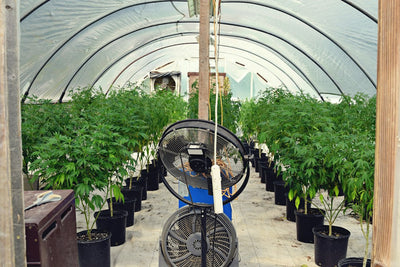
The LED "No Heat" Myth: Why HPS/CMH Still Hold Up
Photo by Erik Mclean via Unsplash.
Walk into any grow shop or scroll through any cannabis cultivation forum and you'll hear the same pitch: switch to LED because it "runs cool." It's become gospel, repeated so often that most growers never bother checking it against basic physics. And basic physics has a problem with it.
A 1000W LED fixture pulls roughly 1000 watts from the wall. A 1000W HPS fixture pulls roughly 1000 watts from the wall. Neither one is exempt from the first law of thermodynamics — energy doesn't vanish because a marketing team calls it efficient. Every watt you feed a light eventually turns into heat somewhere in your tent, whether it left the fixture as visible light, infrared, or waste heat off a driver board. The total heat load an enclosed 4x4 or 10x10 room absorbs from a 1000W fixture running 12-18 hours a day is essentially the same number regardless of which technology made the photons.
What actually differs is where that heat lands and how it moves once it's there. HPS and CMH dump a lot of energy upward as infrared, which a decent air-cooled hood and exhaust fan can pull straight out of the room before it ever touches a leaf. LEDs, mounted close and flat above the canopy, radiate a bigger share of their heat downward from the diode boards, concentrating it right where your plants live. That's a real, practical difference — but it's a distribution problem, not proof that LEDs generate less heat. This piece breaks down the actual physics, gives you real ambient temperature targets for both light types, and makes the case for why HPS and CMH still earn a spot in a lot of grow rooms in 2026.
The Physics: Watts In Equal Heat Out, Period

Photo by Kaffeebart via Unsplash.
Start with the number on your utility bill, because that's the only honest starting point. A 1000W-rated LED fixture, run at full output, draws somewhere in the neighborhood of 1000 watts from the wall — that's what the wattage rating means. Same story for a 1000W double-ended HPS. Both fixtures are converting electrical energy into some mix of photons and heat, and conservation of energy says the total output has to equal the total input. There's no version of this where one fixture is quietly disposing of 300 watts into another dimension. If you're pulling 1000 watts, you're putting roughly 1000 watts worth of heat energy into that room over the course of the session, full stop.
Where LEDs genuinely pull ahead is efficacy — how many usable PAR photons you get per watt drawn. A good modern LED board might hit 2.7-3.0 μmol/J, versus 1.7-2.1 μmol/J for a comparable HPS. That's a real improvement in photon output per watt. But efficacy improvements shift the ratio between light energy and heat energy — they don't reduce the total energy balance. The energy that isn't converted into useful PAR photons doesn't disappear; it shows up as heat off the diodes, the driver, the heatsink, or the aluminum board itself. You've made more light per watt, not less heat per watt of total draw.
The part that trips people up is spectral distribution of that heat. HID bulbs run hot enough to radiate a substantial chunk of their output as infrared, and infrared has a habit of traveling upward and outward through a reflector hood, where an air-cooled duct and exhaust fan can capture and remove it before it accumulates in the tent. LEDs run at lower surface temperatures and push their heat load through the board and driver electronics, radiating downward toward the canopy from a fixture mounted much closer to the plants than a typical HID hood.
That's the actual mechanism behind every grower who's been burned by the 'LED = no heat' myth. They install a 1000W LED board, run it 16 hours a day at full intensity in a sealed tent with the same extraction fan sized for their old HPS setup, and can't figure out why the top two feet of canopy are cooking. The light didn't lie about its efficiency. The marketing lied about what efficiency means for your climate control.
Heat Distribution: Why LEDs Run Warmer Where It Counts

Photo by CRYSTALWEED cannabis via Unsplash.
Picture the two fixtures side by side in identical tents. The HPS sits in an air-cooled hood, glass-sealed, ducted straight to your exhaust fan. A huge share of its radiant heat gets captured in that airstream and pulled out of the tent before it ever reaches the canopy — that's the entire point of an air-cooled reflector, and it's why HID growers have run tight canopy-to-light distances for decades without cooking their plants, provided the ducting was doing its job.
The LED board has no equivalent escape route. It's mounted flat, close to canopy — often 12-18 inches away in flower — and the diodes and driver dump their heat directly downward and outward into the tent's ambient air, with nowhere to duct it except through whatever passive or active airflow you've got moving through the room generally. There's no hood, no reflector, no dedicated vent path pulling that heat away from the plant zone specifically. It just radiates into the space the plant is sitting in.
Industry testing generally shows LED setups running the room's overall ambient air something like 10°F cooler than a comparable HID setup, which is where the 'cooler' claim comes from and why it's not entirely wrong — it's just incomplete. That ambient reduction is largely a function of reduced infrared radiation hitting the leaf surface directly, not a reduction in total heat generated in the room. HID's heavy infrared output raises leaf surface temperature independent of what your thermometer says the air temp is; infrared heats objects it strikes, not the air around them, so you can have a 78°F tent with leaf surfaces running 8-10°F hotter under HPS than the air temp would suggest.
The practical upshot cuts against the popular narrative: growers switching to LED need to raise ambient air temperature to compensate for losing that reduced-but-real leaf heating effect from HID's infrared, not lower it. The canopy under an LED is taking a heat hit from close range and downward angle that a cooler-running ambient air temp setpoint won't offset — you have to work with the physics, not against it, and that means resetting your climate controller rather than assuming the diodes 'feeling cool to the touch' means your plants are cool too.
Resetting Your Thermostat: Real Ambient Targets for LED vs HID

LED-lit grow rooms can run about 10°F warmer than HID/CMH setups, with recommended ambient temperatures of 82°F versus 72°F, reflecting LEDs' lower heat output.
If you've run HID for years, your climate controller setpoints are probably dialed to 70-75°F ambient, and that's a reasonable target for HPS or CMH — it accounts for HID's infrared heating of the leaf surface pushing actual leaf temp several degrees above ambient, landing you in a workable 75-82°F leaf temperature range without cooking anything.
Move to LED with those same setpoints and you'll under-run your plants. LED growers typically need to target 80-85°F ambient air temperature, starting around 80°F and adjusting up or down a couple degrees based on canopy density and strain vigor. Because LEDs aren't hammering the leaf surface with the same infrared load, the air temp and leaf temp track much closer together — meaning a 72°F tent under LED isn't giving you a warm enough leaf temperature to run an aggressive metabolic rate, even though the same 72°F under HPS might have put leaf surfaces in a perfectly reasonable 78-80°F zone.
This is the mistake I see constantly: a grower upgrades from a 1000W HPS to a 1000W LED board, keeps their climate controller at the same 73°F setpoint that worked fine for years, and can't figure out why growth slows, internodal spacing gets weird, and nutrient uptake drags. The diodes feel cool when you hold your hand under them, so the instinct is to assume the room needs less heat management, not more. In reality the root zone and canopy are running colder than the plant's enzymatic processes want, and you're bottlenecking growth by chasing a temperature number that belonged to a different light source.
VPD charts inherit the same problem. A VPD target built around HID-era leaf-to-air temperature relationships doesn't map cleanly onto an LED tent where that relationship has shifted. Recalculate your VPD targets using your actual current leaf temperature and relative humidity under the light you're actually running, rather than copying a chart you built — or downloaded — back when you had HPS overhead. Get an IR thermometer on your actual canopy, not just an ambient sensor hanging at canopy height, and build your setpoints from there.
CMH's Spectral Case: Why Growers Still Reach for Ceramic Metal Halide

Photo by Zulfugar Karimov via Pexels.
Ceramic metal halide bulbs, sold as CMH or LEC depending on the manufacturer, produce one of the most balanced full-spectrum outputs available in horticultural lighting, closely tracking natural daylight's spectral curve — including a meaningful UV-A and some UV-B output that standard HPS bulbs largely lack. HPS spectrum skews heavily orange-red, which is great for stacking bulk flower weight but does little for the plant's own UV-triggered defensive responses.
That UV component is the real story with CMH. Growers running CMH through veg and flower have reported tighter node spacing, sturdier stem structure, and denser trichome development for years — and the mechanism makes botanical sense: UV exposure triggers a plant's protective secondary metabolite production, including the resinous trichomes that store cannabinoids and terpenes. HPS-only setups and a lot of early-generation LEDs skipped UV output entirely, trading spectral completeness for raw PAR-per-watt numbers. Full-spectrum CMH growers were getting a morphological and resin-production benefit that pure PAR measurements don't capture, because PAR only counts photosynthetically active radiation and largely ignores UV's signaling role.
CMH also isn't the energy hog its metal halide ancestors were. Modern CMH/LEC fixtures can run up to 30% more efficient than legacy MH or HPS setups while matching comparable PAR-per-watt output, and they run measurably cooler at the bulb than a comparable HPS — a real efficiency and heat-management upgrade over the previous generation of HID, even if they still can't match LED's raw efficacy numbers.
Here's the part that should tell you something: walk the floor of any lighting trade show in 2026 and you'll find LED manufacturers explicitly marketing new full-spectrum boards as replicating CMH's spectral output — adding UV diodes, tuning color ratios to mimic ceramic metal halide's daylight curve. That's a tacit admission that CMH set the spectral standard rather than lagging behind it. LED caught up on efficiency years ago; on full-spectrum quality including UV, it's still chasing what CMH growers have had dialed in for over a decade. If you've already got a CMH veg or flower room producing tight, resinous plants, there's no obvious reason to abandon that spectrum to chase an LED that's explicitly trying to replicate it.
The 2026 Energy Math: What HID vs LED Actually Costs to Run

Photo by ulleo via Pixabay.
Run the numbers for 2026 and the case for efficiency gets sharper, not softer. U.S. electricity prices climbed 5.9% over the 12 months ending May 2026, driven by AI data center demand pulling on the same grid capacity everyone else is competing for, plus fuel cost pressure tied to the Iran conflict rippling through energy markets. Every watt drawn in your grow room costs more this year than it did last year, and that trend isn't reversing on its own.
Indoor cannabis cultivation is an unusually power-hungry use of square footage to begin with — commercial indoor grows draw something in the range of 50 times the power per square foot of a typical office building, once you account for lighting, HVAC, dehumidification, and CO2 supplementation running around the clock. At that scale, small differences in lighting efficiency compound into real annual dollar figures fast.
Concretely: a 10-light 1000W HPS flower room, with a full climate control stack running alongside it, typically lands somewhere in the $18,000-$30,000/year range in electricity depending on your local rate and how tight your HVAC is dialed. Swap that same room to a comparable LED setup and you're generally looking at a 25-40% reduction in that annual number, purely from the lighting fixtures drawing better efficacy per watt and needing somewhat less supplemental cooling capacity to manage the room.
But don't let that percentage fool you into thinking the LED bill collapses to nothing. HVAC, exhaust, and dehumidification typically account for roughly half of a grow room's total power draw, and unlike your lights — which cycle on a photoperiod schedule, off for six or twelve hours a day — your climate systems are running 24/7, every single day of the cycle. And because LEDs push ambient temps up 8-10°F higher than the HID-era targets growers are used to, some of your lighting electricity savings gets quietly reabsorbed by your dehumidifier and AC compressor working just as hard, or harder, to hold that warmer setpoint at the humidity level your strain needs. The bill doesn't disappear under LED — it moves from one line item to another, and a lot of growers budgeting for LED's efficiency gains forget to model that shift.
So Which Should You Actually Buy?

Photo by Anna Shvets via Pexels.
None of this is an argument against LED — it's an argument against buying LED for the wrong reason. LEDs genuinely win on long-run efficiency, and they win big on fixture lifespan: quality LED boards routinely run 50,000+ hours before meaningful output degradation, compared to 10,000-24,000 hours before an HPS or CMH bulb needs replacing. Over a multi-year commercial run, that lifespan difference alone can justify the higher upfront fixture cost.
But HID still has real, non-marketing reasons to exist in a 2026 grow room. If you're growing in an unheated garage, detached shop, or basement in a cold-winter climate, HID's heat output isn't a bug — it's a supplemental heating system you're getting for free, offsetting what you'd otherwise spend on space heaters or a separate HVAC heat source. That math flips entirely in a hot climate where you're paying to remove every extra degree of heat, which is exactly the scenario where LED's downward-radiated, more contained heat load and lower total cooling burden earns its keep.
HID also just costs less to buy. A quality CMH or HPS fixture is frequently a fraction of the price of an LED board covering the same canopy footprint, and that gap matters if you're working with a tight budget, testing out a new tent or room before committing, or scaling a first commercial build where every dollar of startup capital counts.
If you've already got a dialed-in HID room — good air-cooled hoods, exhaust sized correctly, a climate controller tuned to your leaf temps — there's no good reason to rip it out just because LED is what's being marketed as the current thing. Spectrum quality and heat management determine your results far more than which acronym is printed on the fixture housing.
Whatever light you land on, the fixture is only half the equation — genetics set the ceiling on what that light can actually produce. A strain poorly suited to your climate or canopy density will underperform under the best LED board on the market, and well-bred seeds matched to your setup will outperform mediocre genetics under either light source. Seedtiva breeds with exactly that variation in growing conditions in mind, because the light in your tent is only doing half the job.
Pick your fixture based on your room's actual ability to move heat and hold humidity where your plants need it — not based on which technology this year's marketing has declared the default winner.
Heat is not a spec sheet feature you can select away by choosing the right acronym. Every 1000W fixture you plug in is putting roughly 1000 watts of energy into your room, and nearly all of it ends up as heat one way or another — that part of the equation is fixed by physics, not by engineering. The only variable actually in play is where that heat lands and whether your room's ventilation and climate control can move it before it stacks up in your canopy or your grow room's four corners.
The growers who get the best results year after year aren't the ones chasing whichever lighting technology is dominating this quarter's trade show floor. They're the ones who've actually measured their own leaf temps, sized their exhaust to their fixture's real heat output, and built their VPD targets around what's happening in their specific tent rather than a chart borrowed from someone else's setup. That approach works whether you're running a $200 CMH bulb in a basement in Minnesota or a top-tier LED board in a converted warehouse in Arizona — the fixture is a tool, and the room is the system.
Don't let the "LED is the obvious upgrade" narrative talk you out of a CMH or HPS setup that's already dialed in and producing good flower. In 2026, both technologies remain legitimate choices, each with a real case depending on your climate, your budget, and how well your room actually handles heat. Buy the light that fits your room — not the one the industry has decided everyone should already own.
Sources
- HID vs LED: The Ultimate Battle for the Best Cannabis Grow Lights 2025
- LED vs. HID: Choosing the Best Grow Lights for Growing Indoors - SEED BANK
- Lights for Growing Weed Indoors: A Complete 2026 Guide
- HID vs. LED Grow Light Comparison - California LightWorks
- Best grow light for cannabis: LED vs HID, PAR & PPFD explained