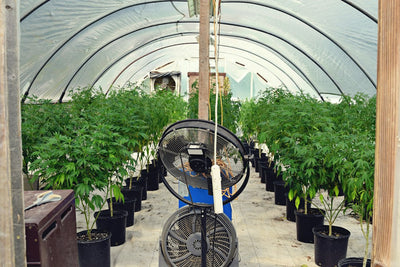
Topping and Training: The Hand Skills Before Grow-Room Automation
Photo by Jonathan Cooper via Pexels.
Fifty years ago a serious grower had none of what we now consider baseline equipment. No moisture sensors, no PPFD meters, no automated germination chambers cycling humidity to the percentage point. What they had was a pair of hands, a length of garden wire, and thousands of hours staring at plants until they learned to read them the way a mechanic reads an engine by sound. Every structural decision a plant made -- where it put its energy, how tall it grew, how evenly it filled a canopy -- got shaped manually, in real time, by someone standing over the pot with scissors or string.
Topping, FIM, and low-stress training weren't invented because they were elegant. They were invented because light was fixed, space was fixed, and the only variable left to manipulate was the plant itself. A single HPS bulb or a patch of outdoor sun doesn't move to follow bud sites -- so growers moved the bud sites to the light instead, bending and cutting until the plant's shape matched the environment rather than the other way around. That's precisely the problem today's movable LED rigs, canopy-mapping software, and adjustable racking now solve electronically.
What's worth asking is whether the old hand-craft became obsolete once the tech arrived, or whether it's still doing work that no sensor can do. This piece walks through where these techniques came from, how they actually function on a plant, and why growers -- even ones running fully automated tents -- still need to know how to top a plant with a clean pair of snips.
The Christmas-Tree Problem: Why Growers Started Training at All

Photo by NASTER via Pixabay.
Left alone, a cannabis plant does something that makes total sense in the wild and almost no sense in a grow tent: it puts nearly all its energy into one dominant central cola and lets everything below it languish as thin, underdeveloped popcorn buds. This is apical dominance -- the plant is racing toward the sky to out-compete neighboring vegetation for sunlight, a strategy that works fine on an open hillside where nothing caps the plant's height. Under a fixed light source with a limited footprint, that same instinct produces a lopsided Christmas-tree silhouette: one thick main cola up top, and a bunch of wasted vertical space and starved lower branches underneath it.
That's a poor use of the square footage under any light source, but it's especially costly under older lighting where intensity dropped off sharply the further you moved from the bulb. A single main cola near the light and six inches of shaded, spindly growth below it meant most of the plant's potential never got expressed as usable flower.
None of this is a cannabis-specific problem, and neither is the fix. Grape growers and orchardists have been bending branches for centuries, training vines along wires and staking fruit tree limbs outward specifically to expose more leaf surface to sun and air. The logic transfers directly: a branch bent horizontal grows differently than one left to shoot straight up, and a canopy spread wide catches more usable light per square foot than one concentrated in a single spike.
Cannabis growers borrowed that logic wholesale, decades before movable LEDs, environmental controllers, or canopy-scanning software existed to do any of this work automatically. Flattening a canopy meant physically pushing branches down and out, tying them in place, and checking back in a day or two to adjust. There was no other option. If you wanted an even canopy, you built it with your hands -- string, stakes, and repeated visits to the tent, long before a single electronic component entered the picture.
High-Stress Training: Topping, FIM, and the Philosophy of Controlled Damage

Photo by CRYSTALWEED cannabis via Unsplash.
High-stress training earns its name honestly -- it works by deliberately wounding the plant. Snap or cut the right tissue at the right growth stage, and the plant's hormonal response does the rest, redirecting energy and producing a stronger, more branched structure than it would have built on its own. It sounds counterintuitive to injure a plant on purpose to get more out of it, but the response is well established and remarkably consistent when timed correctly.
Topping is the workhorse HST method and the easiest to learn. Cut cleanly through the main stalk just above a node, and instead of one apical cola, the plant typically pushes out two colas from the two lower growth points near the cut, each capable of developing into a full-size bud site come flowering. Do this once, early, and you've effectively doubled your top-tier bud sites without adding an inch to the plant's footprint -- which matters enormously under a fixed light source or a limited outdoor plot where you can't just add more space.
FIM -- the acronym stands for a phrase no polite grower says out loud, roughly f-I-missed -- started life as a botched topping cut. Instead of removing the entire growth tip cleanly, an imprecise cut leaves a portion of tissue behind, and that partial damage can trigger four or more new growth tips instead of two. Growers noticed the accident produced more colas than a clean top, and it became a deliberate technique in its own right rather than something to avoid.
Either method puts the plant through visible stress. Leaves droop, growth pauses, and the plant needs real recovery time -- typically several days to a week -- before it resumes vigorous vertical growth. There was no sensor telling old-school growers when a plant had bounced back; they judged it by leaf turgor, color, and how the new growth tips looked under a thumb. Timing mattered as much as technique. The consensus that held up over decades of trial and error: top early, once a plant has developed 5 to 6 nodes, so there's enough vegetative time left afterward for full recovery before the switch to flowering.
Low-Stress Training: Bending Instead of Breaking

Where topping and FIM work through controlled injury, low-stress training works through persuasion. Instead of cutting anything, you tie down, bend, and weigh branches into the position you want them in, coaxing the plant into a flatter, more even shape without ever opening a wound. The tradeoff is speed -- LST results show up over weeks rather than days -- but because there's no cut tissue to heal, the plant barely slows down while you're doing it.
The goal is the same flattened canopy that HST is chasing, just reached by a gentler route. Bend the dominant cola down and to the side, and you expose the bud sites that would otherwise sit shaded underneath it to direct light for the first time. Do this progressively across a plant's vegetative stage and you end up with a canopy that's closer to a tabletop than a spike -- multiple colas sitting at roughly the same height, all getting comparable light rather than one hogging it.
The toolkit was, and still is, almost embarrassingly simple: soft garden wire that won't cut into stems, cloth plant ties, or in a pinch just string tied off to stakes pushed into the substrate or anchored around the pot rim. None of it required power or calibration. It required attention -- checking the plant every few days as it grew, loosening ties that had gotten too tight, adding new ones as branches lengthened and needed redirecting again.
The two techniques stack well, and experienced growers rarely picked just one. Top once early to force the branching structure, then use LST on the resulting colas to keep everything at an even height as they develop -- structure from the cut, evenness from the bend. Outdoor growers with large-footprint plants leaned on LST especially hard, since a six-foot outdoor plant left untrained can grow lopsided or dangerously top-heavy. Bending and staking let them manage height and sun exposure across a much bigger structure without resorting to aggressive topping that could set a large plant back for weeks.
Reading the Plant: The Manual Judgment Grow Tech Now Automates

Photo by Kindel Media via Pexels.
Traditional cultivation ran almost entirely on passive checks and accumulated instinct. The paper towel germination method is the clearest example still in common use: seeds folded into a damp paper towel, checked by eye once or twice a day for a taproot to emerge, no logging, no sensor, just a grower opening a container and looking. It works because it's simple, not because it's precise -- and for decades that was enough.
Watering followed the same logic. Rather than a moisture probe triggering irrigation at a set dryness threshold, growers lifted pots and judged by weight and by the color of the topsoil whether a plant needed water yet. A grower who'd done this a few hundred times could tell a dangerously dry pot from a merely light one just by the way it moved off the tray. That skill lived in the hands of whoever ran the operation, and if that person left, the knowledge often left with them.
For most of cannabis cultivation's modern history, success rode on a small number of experienced people reading leaf color, watching for droop timing, and tracking node spacing as a proxy for how well the plant was responding to its environment. There wasn't a dashboard. There was someone who'd been doing it long enough to notice when something looked off before it became a visible problem.
That's genuinely changed at the operational level. Commercial-scale grows now pair those human instincts with sensor networks tracking VPD, substrate moisture, and canopy temperature in real time, feeding automation platforms and AI-driven controllers that adjust irrigation and climate without a person touching anything. Robotic systems handle planting, trimming, pruning, and harvesting on the largest operations, cutting labor costs and reducing the kind of inconsistency that comes from a tired employee on an overnight shift.
What automation hasn't taken over, even at scale, is the actual shaping cut. The pruning decisions and training bends that determine a plant's structure -- where the topping cut goes, which branch gets tied down and which gets left alone -- are still made by a person, on nearly every craft operation and every home grow running today. Sensors can tell you the environment is dialed. They can't decide where a plant should put its growth.
Why the Old Techniques Still Belong in Every Grower's Toolkit

Photo by GB The Green Brand via Pexels.
Automated irrigation and climate control are genuinely good at what they do: holding VPD in range, keeping substrate moisture inside a target band, preventing the kind of environmental swings that used to wreck a grow overnight. What none of that touches is the structural question -- how a plant's energy gets distributed across its branches -- because that's not an environmental variable. It's a decision, and it still has to be made by someone looking at the plant.
This is exactly why home growers and small-scale operations get the most out of learning to top and train by hand. A commercial facility with a full light array and canopy-scanning software can partially compensate for an untrained plant by brute-forcing even light coverage across a huge footprint. A grower with one four-by-four tent and a single light doesn't have that luxury. For that setup, a plant left untrained is genuinely wasting a third or more of its potential yield to shaded, underdeveloped bud sites -- training isn't optional polish, it's most of the difference between a mediocre harvest and a strong one.
The playbook that's held up across decades of home and small-scale growing hasn't really changed: top once early, in the first few weeks of veg once the plant has enough nodes to recover fully, then keep training the resulting colas with LST as they grow out, tying and adjusting every few days to keep the canopy flat. It's still the most reliable way to maximize usable flower per square foot in a tent or a modest outdoor plot, and it costs nothing but time and a spool of plant tie.
None of it works in a vacuum, though. Genetics set the ceiling on what training can achieve -- a vigorous, well-bred plant responds to a topping cut with fast, strong node development and a quick rebound, while a weak or poorly-suited phenotype may sulk for weeks or never fully recover its vigor. This is where starting with solid seed stock, the kind Seedtiva breeds for, actually matters: training amplifies what the genetics can do, it doesn't manufacture vigor that isn't there. Results will still vary with climate, setup, and how much experience the grower has reading their own plants -- training is a multiplier, not a guarantee, and it only pays off on top of decent genetics and a reasonably dialed environment.
Training techniques didn't survive the automation wave by accident. They survived because they solve a problem no sensor network is built to touch -- the question of where a plant directs its own growth energy. A VPD controller can hold your tent at a perfect 1.0 kPa all through flower and it still won't decide whether your plant builds one dominant cola or eight even ones. That decision happens at the tip of a pair of snips or the end of a piece of plant tie, and it always will.
The most effective grows happening right now aren't choosing between the old craft and the new tech -- they're running both at once. Automated climate and irrigation handle the environmental consistency that used to require someone lifting pots and squinting at soil color every morning, freeing that same grower to spend their attention on the training decisions that actually shape yield. That combination, not either half alone, is what separates a genuinely well-run grow from one that's just well-equipped.
Buy the best sensors and controllers money can afford, dial in a perfect environment, and you'll still walk into flowering with a lopsided plant and a disappointing harvest if nobody ever topped it or bent a single branch. The hand skills aren't a nostalgic add-on to a modern grow. They're still where a meaningful share of the yield actually comes from.