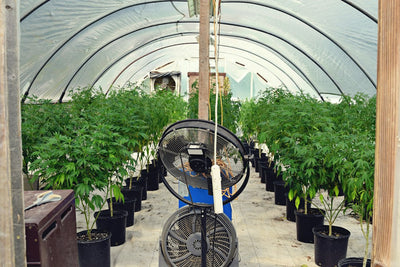
Transitioning Your Grow to Fully Organic Practices
Photo by Jonathan Cooper via Pexels.
Somewhere around week three of the first transition cycle, growers usually start second-guessing themselves. Leaves that used to be uniformly dark green under a synthetic feed schedule go a shade lighter, growth slows, and the instinct is to reach for a bottle of cal-mag or a quick-release nitrogen boost to fix it. That instinct is exactly what you have to resist. Switching an established synthetic grow over to organic inputs isn't a single decision you make on a Tuesday and finish by Friday — it's a multi-cycle rebuild of the entire root zone ecosystem, and it behaves nothing like swapping one bottled nutrient line for another.
It also helps to be clear-eyed about what you're actually working toward. There's no shortcut certification path waiting at the end of this for most cannabis growers — cannabis remains federally illegal, so the USDA Organic label that applies to your neighbor's tomato farm simply isn't on the table for flower, no matter how clean your inputs are. Growers who make this switch are doing it for plant quality, terpene expression, and soil health, not to slap a federal seal on the jar. Once you accept that the certificate isn't the goal, the process itself gets a lot less confusing.
Set your expectations now, before you start pulling synthetic bottles off the shelf: yields and plant vigor typically dip for a cycle or two while organic inputs and microbial populations catch up to what your synthetic program was doing on demand. That dip isn't a sign of failure. It's the cost of admission for a root zone that will eventually run itself.
Why 'Organic' Means Something Different for Cannabis

Photo by Fionn Große via Unsplash.
The word "organic" carries a lot of legal weight in American agriculture, and cannabis sits outside almost all of it. USDA organic certification requires compliance with the National Organic Program, and the NOP simply does not certify a plant that's still a Schedule I controlled substance under federal law. This holds true even for operations in Colorado, California, or Michigan running textbook-clean cultivation with no synthetic pesticides, no prohibited fertilizers, and pristine soil records going back a decade. State legality doesn't override federal scheduling, and the NOP is a federal program administered through federally accredited certifying agents.
That last detail matters more than most growers realize. CCOF — California Certified Organic Farmers — is one of the most respected organic certifiers in the country and a USDA-accredited certifying agent. Because of that accreditation, CCOF is legally bound by USDA rules about what it can and cannot certify. It cannot issue an NOP certificate for a federally illegal crop, full stop, regardless of how a grower's practices measure up. This isn't CCOF being conservative or cautious — it's a hard legal wall.
There is exactly one crack in that wall: hemp. The 2018 Farm Bill removed hemp, defined as cannabis with 0.3% THC or less by dry weight, from the Controlled Substances Act and legalized it federally. That single regulatory change means CCOF and other USDA-accredited certifiers can certify hemp and hemp-derived ingredients as organic, including hemp-derived CBD products. High-THC cannabis flower gets none of that benefit.
For the vast majority of growers reading this, then, "going organic" is a methodology decision, not a paperwork decision. It means switching to organic amendments, building living soil biology, and cutting out synthetic salts — with the payoff being plant quality, not a label on the package. Understanding this distinction before you start saves you from wasting a season chasing a certification pathway that doesn't exist for the crop you're actually growing.
California's OCal Program: What Real Certification Looks Like

Photo by Tim Mossholder via Unsplash.
California didn't leave this gap entirely unaddressed. The Medicinal and Adult-Use Cannabis Regulation and Safety Act (MAUCRSA) directed the California Department of Food and Agriculture to build a program "comparable to" the National Organic Program specifically for cannabis, since the real NOP was off-limits. The result, OCal, launched in 2021 and remains the only government-run cannabis organic certification program anywhere in the country. If you want the closest thing to an official organic label that legally exists for high-THC cannabis, OCal is it.
Getting there isn't fast. Soil has to be documented free of prohibited substances for a minimum of three years before a cultivation site is even eligible for certification, which immediately rules out any operation still running synthetic salts or prohibited pesticides on that ground. Testing requirements go well beyond standard California cannabis lab screens too — OCal-certified product gets tested against 122 additional pesticide screens layered on top of the 66 pesticides already required of every California cannabis lab, for 188 total compounds under scrutiny. That's a serious analytical bar, and it's part of why OCal carries real weight rather than functioning as a marketing sticker.
The state isn't shy about enforcement either. Mislabeling a product as OCal or "Organic" when it hasn't earned that designation can trigger fines up to $17,952 per violation, which puts real financial teeth behind the label. On the administrative side, certifying agents authorized to issue OCal certificates have to renew their registration every January 2, with full accreditation reviewed on a five-year cycle — so the oversight structure itself gets re-checked, not just the farms.
The first cohort of California cultivators to actually make it through this process did so in October 2021, when Sonoma Hills Farm and Sensiboldt Organics became among the first U.S. cannabis operations certified under OCal. Both farms went through roughly a year and a half of documentation, site inspections, and compliance review touching everything from soil amendment records and pest management logs to irrigation sourcing and post-harvest handling procedures. That timeline is a useful reality check for anyone picturing organic certification as a quick paperwork exercise — it's closer to an eighteen-month audit than a form you fill out.
Outside California: Private Certifications Growers Actually Use

Photo by Jess Loiterton via Pexels.
If your farm sits in Oregon, Michigan, Massachusetts, or anywhere else outside California, OCal isn't an option no matter how clean your practices are — it's a California-specific state program. Growers everywhere else rely on private clean-cannabis certifications built to mimic organic standards without the government backing, and several have built real credibility over the past two decades.
Clean Green Certified is the elder statesman of this space, established back in 2004 and modeled directly on organic farming principles from the pre-legalization era when nothing resembling a formal cannabis certification existed. It's still widely used today, particularly among legacy growers who've been running clean practices since long before licensing regimes existed to recognize them.
Certified Kind and Envirocann's Comparable-to-Organic (CTO) designation fill similar roles regionally, each with its own inspection standards and documentation requirements, and each recognized by different retailers depending on the market. Newer to the field is ECCO, founded in late 2024 with financial backing from industry figures including Thomas Martin of Raw Garden, and now operating under Executive Director Jennifer Lujan. ECCO screens for more than 140 contaminants, positioning itself as one of the more rigorous private options currently available.
None of these carry USDA legal weight — they can't, for the same federal scheduling reasons OCal exists as a state workaround rather than the real thing. What they do provide is a documented, third-party-verified standard that a dispensary buyer or an educated consumer can actually check against, rather than taking a grower's word for it. That third-party verification is worth something even without federal backing; it's the difference between a marketing claim and an audited claim.
The practical advice here is simple: pick your certifier based on what actually carries weight in your distribution channel, not based on which one has the cheapest application fee. A certification your state's dispensary buyers have never heard of doesn't move product any better than no certification at all. Call around to the shelves you're targeting before you commit to a program, and let market recognition — not sticker price — drive the decision.
The Real Cost and Timeline of Switching Your Inputs

Soil biology maturity increases steadily with each successive growing cycle, showing that organic soil health builds progressively over time as farms transition from conventional to organic practices.
Nobody should go into this transition expecting it to be cost-neutral. Growing to organic or OCal-comparable standards runs meaningfully more expensive than a synthetic program, and the gap shows up in three places: amendment costs, labor, and turnaround time. Quality compost, worm castings, kelp meal, and rock dusts cost more per application than a jug of concentrated synthetic salts, and you're applying them more frequently in bulkier form. Labor climbs too — top-dressing, brewing teas, and managing cover crops all take hands-on time that a fertigation drip system on synthetics simply doesn't require.
Turnaround time is the other real cost, and it's the one growers underestimate most. Plants in transition tend to take noticeably longer to reach the same developmental milestones — bulking, ripening, finishing — while soil biology is still establishing itself and organic nitrogen is still mineralizing at microbial pace rather than being instantly plant-available like a synthetic salt. That's not a flaw in the system; it's just how biologically-mediated nutrient release works compared to a soluble feed you control by the milliliter.
The upside, and it's a real one, shows up once that biology actually establishes. Growers who've been through a full transition consistently report fewer over- or under-feeding incidents once organic buffering capacity kicks in — the microbial and organic matter component of a living soil moderates nutrient availability in a way a bottled program never does on its own. You stop chasing PPM swings because the soil itself is doing some of that regulatory work for you. It's a different kind of control: less precise on paper, more forgiving in practice.
That buffering capacity doesn't arrive on cycle one, though. Full soil-biology establishment — the point where mycorrhizal networks, bacterial populations, and organic matter are doing real nutrient cycling work — typically takes multiple growing cycles to develop, not one bag of compost and a prayer. Budget for a temporary yield or vigor dip across cycles one and two as a known, expected cost of the transition rather than a signal that something's gone wrong. Growers who panic and reintroduce synthetics mid-transition usually just reset the clock and pay the cost twice.
Cycle 1: Cutting the Cord on Synthetics

Photo by Alicia Christin Gerald via Unsplash.
Cycle one is where the actual cord-cutting happens, and the biggest mistake growers make here is trying to blend synthetics and organics together as a gentler ramp. Don't do it. Running both systems simultaneously confuses the feeding schedule — synthetic salts spike EC in ways that mask what your organic inputs are actually contributing — and it actively slows microbial colonization, since a lot of beneficial soil microbes get suppressed by residual synthetic salt concentrations. Stop synthetics completely at the start of the transition. It's a harder break, but a cleaner one.
In their place, incorporate compost and organic amendments directly into the root zone: worm castings for a mild, steady nitrogen source and beneficial microbial inoculation, aged manure for organic matter and slower-release fertility, kelp meal for micronutrients and natural growth hormones, and rock dusts like glacial rock dust or basalt for trace minerals. If you're running existing containers rather than starting fresh beds, top-dress these amendments into the top few inches of the root zone rather than trying to till established containers apart.
Inoculation is the piece that actually builds the biology doing the future work for you. Mycorrhizal fungi extend root surface area and improve nutrient and water uptake once colonized; Bacillus and Trichoderma strains contribute to nutrient cycling and some disease suppression. None of this happens instantly — colonization takes weeks, not days — but cycle one is when you start it, because every cycle you delay is a cycle you're not building toward self-sufficiency.
Keep a closer eye than usual on pH and runoff EC through this first cycle. Organic buffering capacity hasn't developed yet, so your root zone is more exposed to swings than it will be a few cycles from now — treat this cycle with the same vigilance you'd give a brand-new grow, not a mature one.
Genetics matter more here than growers give them credit for. A finicky, nutrient-sensitive cultivar that's been babied on a dialed-in synthetic program for years can react poorly to a feeding-system overhaul, showing stress symptoms that make it hard to tell what's transition noise and what's a real problem. Vigorous, well-adapted seed lines tolerate that stress far better and give you a cleaner read on how the transition itself is going. Starting cycle one with quality, well-bred genetics — the kind Seedtiva focuses on — gives you a sturdier baseline to judge the whole process against.
Building Toward a Self-Sustaining Living Soil

Photo by Emma Renly via Unsplash.
By cycle three or four, a well-managed organic bed should start asking less of you, not more. If you're still heavily top-dressing every week to keep plants looking healthy at this stage, something in the biology hasn't taken hold yet — worth troubleshooting rather than just pushing through with more inputs. In a properly developing system, microbial and fungal activity increasingly handles nutrient cycling on its own, converting organic matter into plant-available forms without you manually intervening at every stage.
Cover cropping and no-till practices between cycles are what actually get you there. Tilling a bed apart and rebuilding it from scratch every harvest resets fungal networks that took months to establish — you're throwing away exactly the infrastructure you spent cycles one through three building. Cover crops planted between harvests keep roots in the soil, feed the microbial community during the gap, and protect the fungal hyphae networks that no-till systems depend on.
Once that biology is genuinely established, compost teas and top-dresses shift roles entirely. Early on they're rescue feeds, deployed because plants are showing deficiency and the soil biology isn't yet reliable enough to cover the gap. By cycle three or four, the same inputs become maintenance — light, periodic applications that support an already-functioning system rather than propping up a struggling one. That shift in purpose is itself a good signal the transition is working.
Since there's no lab certificate available to most home or small-commercial growers making this switch, your real indicators of success are on the plant itself: leaf color holding steady and dark without synthetic nitrogen spikes, node spacing tightening up as the plant isn't stressed by feast-famine feeding cycles, and trichome development progressing cleanly through late flower. Track these cycle over cycle rather than looking for a single dramatic before-and-after.
And temper your timeline expectations against your actual setup. A grower running large in-ground beds outdoors in a place like Humboldt County, with mature native soil biology and a long growing season, is going to hit self-sufficiency faster than someone running small containers indoors under artificial light with a soil volume that gets replaced or heavily amended every cycle. Climate, container size versus in-ground beds, and genetics all shift the timeline — plan around your actual conditions, not someone else's case study.
Federal rescheduling gets floated every year as the thing that will finally open USDA organic certification to cannabis, and maybe someday it will. But nothing in the current regulatory landscape suggests that's close. Cannabis remains Schedule I federally as of this writing, and until that changes, OCal and the private certifiers remain the only formal paths available — one state-run and rigorously audited, the rest privately run and unevenly recognized depending on where you sell.
For most growers, though, chasing the paperwork was never really the point. The methodology is what pays off: fewer wild feeding swings once organic buffering takes hold, better terpene expression as plants finish under steadier, less spiked nutrient conditions, and a root zone that's actually alive rather than just a growing medium you're force-feeding. Those benefits show up in the jar and in how the plant behaves through flower, certificate or no certificate.
Treat the whole thing as a soil-building project measured in cycles, not a switch you flip on a Monday morning. The growers who transition successfully are the ones who accept the cycle one and two dip as the price of admission, keep good genetics in the ground to give themselves a fair read on progress, and judge success by what the plant tells them rather than by a label they were never going to get anyway.
Sources
- CDFA - IS - OCal Cannabis Certification Program
- Organic Cannabis | NOP Alternative | Clean Green Certified - Organic Certification | Official Clean Green | Compliance
- Certification for Organically Grown Cannabis Organic Cannabis Certification
- OCal Cannabis Certification - CCOF.org
- Elevating Organic Cannabis with New Certifications - 🌱 Max's Harvest