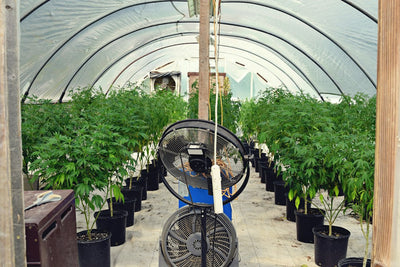
Trellis & Training Robots: What's Actually New for Home Growers
Photo by silas tarus via Pexels.
Every few weeks someone in the comments or the group chat asks the same question: can a robot just do the plant training for me? LST, HST, tucking fan leaves, weaving branches through a trellis screen -- it's tedious work, and it's the kind of task that feels like it should be automatable in 2026. People want to know if they can skip the daily tie-down routine and still walk away with a canopy that looks like it came out of a commercial flower room.
The honest answer is that the space hasn't exploded the way a lot of tech coverage implies. There's no wave of fresh startups flooding the market with training robots this year. What you actually have is a small, established cast -- Annaboto and its parent company Boundless Robotics chief among them -- refining products that have been around in one form or another since 2022. That's not a knock on the tech. It just means the story in 2026 is evolution, not revolution.
It's also worth drawing a hard line between two categories that get lumped together in headlines. On one side you've got true autonomous training robots -- machines with sensors and actuators that physically bend and secure your plant. On the other you've got semi-automated tooling, like the updated trellis-netting applicators shipping this year, which speed up manual work without any onboard intelligence. Both are legitimate upgrades. They just solve different problems at very different price points.
Then there's the commercial tier, which is where things get genuinely interesting to watch. Neatleaf's Spyder platform is doing AI-driven canopy monitoring at industrial scale in facilities most home growers will never set foot in. It's not coming to your tent this year, but it's a solid preview of where the home-scale tech eventually heads.
The Annaboto System: A Floor Lamp That Trains Your Plant

Photo by Max Vakhtbovych via Pexels.
Annaboto is the product most people picture when they hear plant training robot. Made by Boundless Robotics, it looks less like industrial equipment and more like a floor lamp -- a slim vertical stand with a hydroponic base at the bottom and a mechanical arm system that reaches up into the canopy. It's built to sit next to a single plant in a bedroom, closet, or grow tent corner rather than sprawl across rows.
The company sells it in three tiers. The Lite model runs $695, Premium sits at $995, and the Custom configuration tops out at $1,295. That spread mostly reflects sensor density and the number of training points the arm can manage, not a fundamentally different machine underneath.
What sets Annaboto apart from a glorified stake-and-tie system is what Boundless Robotics calls Robotanist tech -- a proprietary sensor package that tracks stalk strength in real time and logs phenotypic data as the plant develops. Instead of a grower eyeballing whether a branch is ready to be bent or tied down, the system is reading mechanical stress on the stalk and adjusting its approach accordingly. As far as at-home hydroponic systems go, this is currently the only one built specifically around that kind of sensor-driven, continuous plant management rather than scheduled or manual intervention.
Boundless Robotics CEO Carl Palme has been fairly consistent in interviews about framing the company's mission around accessibility -- the idea that sensor-driven cultivation shouldn't be locked behind commercial facility budgets. He's also talked about eventual industrial-scale applications, suggesting the home unit is as much a proof of concept and revenue base as it is the end goal.
One caveat worth stating plainly: a good chunk of the pricing and spec details circulating about Annaboto trace back to coverage from 2022 through 2025. Hardware companies at this stage tend to adjust tiers, specs, and pricing as they scale production, so if you're seriously considering one, confirm current numbers directly with Boundless Robotics before you buy rather than trusting a two-year-old writeup.
The Armoire: Combining High-Stress and Low-Stress Training

Photo by Kindel Media via Pexels.
The Armoire is Boundless Robotics' companion piece to Annaboto, and it's aimed at a different problem. Where Annaboto handles ongoing sensor-driven training, the Armoire is built specifically to combine high-stress training and low-stress training inside one automated cabinet, priced just under $1,900. That's a meaningful step up in cost, and it's a step up in what the machine is actually attempting to do -- HST and LST require different timing and different mechanical actions, and running both through one automated system is a harder engineering problem than steady LST alone.
Genetics matter enormously here. The Armoire performs best paired with autoflower strains rather than photoperiod plants, largely because autoflowers run on a fixed, short timeline. The automation doesn't have to guess when to switch from vegetative-style LST to more aggressive HST moves -- it can work off a set schedule tied to a known flowering trigger point instead of waiting on a light-cycle change a grower controls manually.
Boundless Robotics has reported yields up to 13 ounces per plant under ideal conditions using the Armoire. That number deserves some skepticism -- not because it's necessarily fabricated, but because ideal conditions is doing a lot of work in that sentence. Treat it as a ceiling figure from a best-case setup, not a realistic average across grower skill levels, tent sizes, and climates.
What actually determines whether you get anywhere near that number has less to do with the robot and more to do with everything around it: genetics, root zone size, and how dialed-in your lighting and nutrient program are alongside the automated training. A cabinet full of automated arms can't compensate for a cramped root zone or a light that's underpowered for the canopy it's training.
Because of the timing sensitivity, this is one of the clearer cases where starting with well-bred autoflower seeds actually matters -- Seedtiva's genetics are built with that kind of consistent, predictable timeline in mind, which is exactly what a training window this short needs.
What Commercial Growers Already Have: Spyder and AI Canopy Monitoring

Photo by CRYSTALWEED cannabis via Unsplash.
While home growers are debating whether a $1,900 cabinet is worth it, commercial operations are already running a tier of technology that makes the Armoire look modest by comparison. Neatleaf's Spyder platform is deployed at PurpleFarm, a Canadian producer running an 86,000-square-foot indoor facility -- a scale where a single grower physically walking every row to check plant health simply isn't feasible.
Spyder continuously scans the canopy 24 hours a day, tracking plant height, leaf color shifts, microclimate variation across different zones of the facility, and early signs of pest presence before an infestation becomes visible to the naked eye. It's not training plants directly -- it's not bending stalks or tying branches -- but it's solving the sensing half of the problem at a scale and consistency no human crew could match doing manual scouting.
This matters for home growers because it shows where the ceiling actually is. Today's home units, Annaboto included, are largely built around single-plant stalk monitoring -- one sensor package reading one plant's mechanical stress. Always-on, camera-based canopy sensing across an entire grow space is the logical next layer on top of that, and Spyder is essentially a working demonstration of what that layer looks like when cost isn't the limiting factor.
Right now, cost and scale keep this tier firmly in commercial territory. A facility running tens of thousands of square feet can justify the infrastructure and data pipeline behind continuous AI monitoring in a way a single grow tent never will, at least at current pricing. Nobody's shrinking a Spyder-grade system down to a home-friendly price point in 2026.
But it's worth watching closely anyway. The realistic path forward for home training robots isn't a bigger mechanical arm -- it's adding camera-based canopy scanning on top of the mechanical training that already exists, borrowing the sensing logic from facilities like PurpleFarm and shrinking it down once the cost curve allows it.
The Middle Tier: Semi-Automated Trellis Tools Are Getting Better Too

Photo by XRP Relic via Unsplash.
Not everything worth buying this year is a robot, and it's easy to overlook the more modest upgrades happening in manual trellis equipment. EZ Trim's adjustable trellis netting applicator is a good example -- it's not automated at all, but the 2026 version is a real upgrade over older manual trellising methods, and it solves a genuine labor problem without any electronics involved.
The tool extends to 8 feet, which lets a single person roll out netting across a full row without needing a second set of hands to hold the far end. It works with standard 4-foot or 6-foot netting rolls, and the design lets you feed the material out steadily instead of dragging it across the row and snagging it on branches -- which is the part of manual trellising that eats the most time and patience when you're doing it solo.
Height adjustment runs through two marked knobs on the frame, which sounds minor but actually solves a consistency problem a lot of growers don't think about until they hit it. Getting netting height standardized batch to batch matters if you're running a perpetual harvest setup with plants at different stages side by side -- you want your screen height reproducible, not eyeballed each time from memory.
For a tent grower or someone running a small perpetual-harvest room, a tool like this closes most of the labor gap that a robot is theoretically solving, at a fraction of the cost. You're still doing the physical work of tucking and weaving branches, but the setup and netting-placement portion -- which is where a lot of the time actually goes -- gets meaningfully faster.
This is really the point worth internalizing before you shop: a $100-200 tool solves the trellis-labor problem for most multi-plant setups just as effectively as a robot costing ten times as much. Automation makes sense for a specific use case, not as a blanket upgrade over better manual equipment.
Is a Training Robot Worth It for Your Grow?

Photo by CRYSTALWEED cannabis via Unsplash.
Run the math before you buy. A $1,900 Armoire only starts to make financial sense if you're running it across multiple cycles a year -- amortized over four or five autoflower runs, the per-cycle cost starts looking reasonable. Buy one, run it once, and you've spent a small fortune on what amounts to an expensive learning experience.
It's also worth being honest about what the robot actually buys you. Manual LST and HST -- stakes, ties, screens, a bit of patience -- gets comparable yields in skilled hands. Growers have been producing excellent canopies with nothing but garden wire and trellis netting for decades. What automation buys you is consistency and time, not necessarily bigger colas. If your manual technique is already solid, a training robot is convenience, not a yield upgrade.
Autoflowers remain the natural match for this kind of automated training, and that's a genetics conversation as much as a hardware one. Photoperiod plants give you flexibility -- you can extend veg, delay the flip, adjust your training window based on how the plant's actually developing. Autoflowers don't give you that luxury, which is exactly why a fixed automated schedule pairs well with them: the timeline is already locked in, so a machine working off a set schedule isn't fighting against a grower's judgment calls.
None of this changes the fact that genetics set the ceiling. No amount of sensor-driven training fixes a plant with weak stalk structure or lazy branching from mediocre seed stock -- the robot can only work with the plant it's given. That's where starting with quality genetics actually pays off, since a well-bred plant gives the automation something worth training in the first place.
Space is the last practical constraint, and it's an easy one to overlook when you're excited about new hardware. These units are built around single plants or very small footprints, not full multi-plant tents. If you're running four or six plants under one light, a training robot isn't scaling with you -- you'd need multiple units, at which point the semi-automated tools from Section 4 start looking like the smarter buy.
Strip away the headlines and what's actually happening in 2026 is an evolution story, not a wave of new entrants. Annaboto and Boundless Robotics are refining sensor tech and pricing tiers they've had in market since 2022. Neatleaf is scaling Spyder across more commercial facilities. It's the same core players getting better at what they already do, which is a perfectly good thing -- it just isn't the flood of startup activity the breaking-tech framing suggests.
The practical takeaway for home growers is to match the automation tier to your actual scale rather than chasing the shiniest option. A single showcase plant in a bedroom or small tent is a legitimate use case for a full robot like Annaboto or the Armoire, especially if you're running autoflowers on a repeatable cycle. A multi-plant tent is much better served by the semi-automated tools -- adjustable netting applicators and similar gear -- that close most of the labor gap for a fraction of the price.
Keep an eye on the trade show circuit -- MJBizCon, CES -- for where this actually goes next. The real leap won't be a bigger mechanical arm. It'll be canopy-scanning cameras and early pest detection making their way down from facilities like PurpleFarm's 86,000-square-foot operation into something priced for a home grow tent. That's the gap between commercial and home tech that's actually worth watching close.