VPD Charts Explained: Dial In Temp & Humidity for Bigger Buds
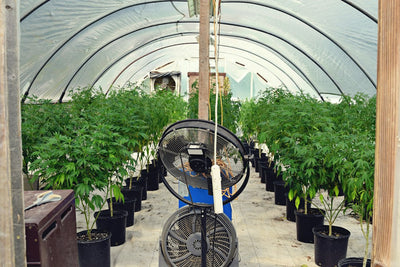
Photo by bhossfeld via Pixabay.
Walk into any grow room and you'll find a thermometer and a hygrometer, sometimes even mounted on the same wall bracket, and a grower who checks both numbers separately and calls it climate control. That's the mistake. Temperature and relative humidity in isolation tell you almost nothing about what your plant is actually experiencing. What matters is the relationship between them, expressed as vapor pressure deficit, or VPD -- the actual driving force behind transpiration, stomatal behavior, and how efficiently your roots pull water and nutrients up through the plant. Get the VPD wrong and it doesn't matter how dialed-in your feed schedule is, because the plant can't move what it can't transpire for.
For years this was mostly grower folklore backed by trial and error -- run your tent a little drier in flower, watch for clawing, adjust and hope. That changed in November 2025, when a study out of Colorado State University-Pueblo's Institute of Cannabis Research, published in Frontiers in Plant Science, put hard numbers behind what a lot of experienced cultivators had long suspected: sloppy humidity control doesn't just invite bud rot, it torches yield and cannabinoid content directly. We're talking biomass losses over 70% under sustained low-VPD conditions during flower. That's not a mold risk anymore, that's a documented cause-and-effect relationship.
This piece breaks down the actual VPD numbers by growth stage, walks through what that new research found when VPD collapses in flower, and covers a correction most charts skip entirely -- adjusting for leaf temperature instead of just the air temp your sensor happens to be sitting in.
What VPD Actually Measures (and Why Growers Obsess Over It)

Photo by Jarosław Kwoczała via Unsplash.
VPD is a measure of atmospheric thirst. At any given temperature, air can hold a maximum amount of water vapor before it hits saturation -- that's the vapor pressure at saturation. VPD is the gap between that theoretical maximum and the amount of moisture actually present in the air right now. That gap is what creates the pressure differential pulling water out of the leaf's stomata and, by extension, up through the xylem from the roots. No gap, no pull. Too big a gap, and the plant is losing water faster than the root system can resupply it.
This is exactly why measuring temp and humidity as separate numbers misses the story. Air at 75F and 50% RH and air at 80F and 50% RH look nearly identical on a basic hygrometer readout, but they produce meaningfully different VPD values and meaningfully different plant behavior, because warmer air has a higher saturation ceiling even at the same relative humidity. A grower chasing '50% RH' as a fixed target across a temperature swing is actually letting VPD drift all over the place without realizing it.
Low VPD means the air is already nearly saturated, so there's little pull on the plant -- transpiration slows to a crawl, stomata stay mostly closed, and nutrient movement that depends on that transpiration stream (particularly calcium and magnesium, which move almost exclusively via the transpiration stream rather than active transport) starts to lag. High VPD does the opposite: the air is so dry relative to its capacity that the plant is forced into rapid water loss, and if root uptake can't keep pace, you get stress closure, wilting, and tip burn.
Athena's cultivation research team has put rough boundaries on this for cannabis specifically: VPD below 0.8 kPa measurably cuts xylem suction pressure, hitting calcium and magnesium uptake hardest since those elements have no active transport mechanism to fall back on. VPD above 1.6 kPa pushes transpiration into overdrive, and plants start concentrating salts in leaf tissue faster than they can process them, showing up as tip burn or leaf margin necrosis. This is the whole reason generic advice like 'just mist more' or 'just crank the AC' backfires so often -- neither instruction references where you actually sit on the VPD curve, so you can easily push a marginal environment further in the wrong direction.
The VPD Chart: Targets by Growth Stage

Target VPD steadily increases as plants mature, rising from 0.6 kPa for seedlings/clones to 1.75 kPa during late flower finish, reflecting the need for drier air conditions as flowering progresses. This guide highlights how growers should adjust humidity and temperature settings at each growth stage to optimize plant health and yield.
Once you're thinking in VPD instead of raw temp and humidity, the targets by stage get pretty specific, and the ranges aren't arbitrary -- they track how much cuticle development and root mass the plant has at each point.
Seedlings and freshly cut clones want 0.4-0.8 kPa. At this stage there's essentially no waxy cuticle on the leaf surface and the root system is minimal or nonexistent, so the plant has almost no ability to regulate its own water loss. High humidity tolerance isn't optional here, it's the only thing keeping cuttings from desiccating before roots form.
Move into vegetative growth and the target shifts up to 0.8-1.2 kPa. Now you want to actively push transpiration, because that pull through the plant is what builds stem thickness and drives root mass development. A veg tent running too wet -- sitting below 0.8 kPa for weeks -- tends to produce leggy, soft growth that struggles once you flip to flower and the environment gets more demanding.
Flowering runs 1.0-1.6 kPa overall, but a lot of commercial operations run the tighter 1.2-1.6 kPa band through peak flower specifically, because that higher end correlates with denser bud structure and heavier resin production -- the plant is under just enough water stress to prioritize secondary metabolite production without tipping into drought stress.
Then there's the finishing move a lot of experienced growers use in the last two weeks: an intentional dry-down to 1.5-2.0 kPa by dropping RH down to 35-40%. This isn't just about knocking down mold risk in dense colas right before harvest, though it does that too. The added water stress in that final window is used deliberately to concentrate trichome production as the plant shifts into a final defensive/reproductive push.
One caveat that applies to every number above: these ranges assume you're calculating VPD off leaf temperature, not just the air temperature your sensor is reading. That distinction matters enough that it gets its own section below, but keep it in mind as you're mapping these targets to your own controller.
The New Data: What Happens When VPD Collapses in Flower

Photo by SeaweedJeezus via Pixabay.
The numbers above stopped being just grower consensus in November 2025. A study published November 17 in Frontiers in Plant Science (DOI: 10.3389/fpls.2025.1678142), led by Corredor-Perilla and Kwon at Colorado State University-Pueblo's Institute of Cannabis Research, with Sang-Hyuck Park of the Chuncheon Bioindustry Foundation in South Korea contributing, ran controlled flowering trials specifically to quantify what happens when VPD collapses and stays collapsed.
Under their high-RH treatment conditions, VPD dropped to just 0.25-0.62 kPa throughout flowering -- well below even the low end of the 1.0-1.6 kPa target range most cultivators aim for. This wasn't a brief dip during a humid afternoon; it was sustained low-VPD conditions held through the entire flowering cycle, which is closer to what actually happens in a poorly dehumidified grow room than most people want to admit.
The results were not subtle. Total plant biomass came in 75.3% lower than controls grown at proper VPD. Flower biomass specifically -- the part you're actually selling or smoking -- dropped 71.0%. On top of that, the low-VPD plants showed reduced trunk diameter and fewer nodes, meaning the structural framework for bud sites was smaller from the start. Flowering itself was delayed a full three weeks under high-RH conditions, pushing back harvest timing and tying up room space and light-electricity costs for that much longer per cycle.
The cannabinoid data is where this gets genuinely alarming for anyone growing for potency. CBD-A accumulation dropped roughly 4.9-fold compared to properly managed VPD conditions. CBD itself fell about 3.2-fold. CBC-A dropped a striking 13-fold. These aren't small percentage shifts -- they represent a near-total suppression of several cannabinoid pathways under conditions that, on a hygrometer alone, might just read as 'a bit humid.'
What makes this study significant isn't that low VPD is bad news -- growers have suspected that for years. It's that this is one of the first controlled, quantified demonstrations connecting sustained low VPD directly to biomass and cannabinoid outcomes, independent of the mold and pathogen risk that usually gets cited as the reason to avoid high humidity. Low VPD is a direct yield and potency killer on its own, mold risk aside.
Air Temp Isn't Leaf Temp: Fixing the Blind Spot in Your Readings

Photo by AI25.Studio Studio via Pexels.
Here's the blind spot that trips up even careful growers: nearly every consumer VPD chart and most commercial environmental controllers calculate off ambient air temperature, because that's what a standard sensor measures. But the leaf surface under an active grow light is not the same temperature as the air around it. Under high-intensity LEDs in particular, canopy leaves typically run 1-3C cooler than the surrounding air, due to transpirational cooling combined with how LED spectra interact with leaf tissue compared to older HPS setups.
That gap sounds small, but it's enough to shift your actual VPD meaningfully away from what your controller thinks it is. Because saturation vapor pressure is temperature-dependent, a 2-3C difference between air temp and leaf temp changes the real VPD the plant is experiencing at its transpiring surface -- often lower and less favorable than the chart-derived number your controller is reporting. You can be staring at a reading that says you're comfortably in the 1.2-1.6 kPa flowering sweet spot while the leaf itself is sitting in conditions closer to 0.9-1.0 kPa, quietly limiting calcium and magnesium uptake the whole time.
The fix isn't complicated, just a habit most growers haven't built yet: get a handheld IR thermometer, or better, a dedicated leaf temperature probe, and take direct readings off actual canopy leaves rather than relying on a sensor dangling near the canopy but not in contact with it. Do this at a few points across the canopy, not just one leaf near the tent wall, since light intensity and airflow both vary leaf to leaf.
Once you have a real leaf temp number, recalculate your VPD using that figure instead of air temp -- most VPD calculator apps let you enter leaf temp as a separate input specifically for this reason. This correction matters most in dense canopies and SCROG setups, where airflow gets uneven and light penetration varies dramatically between top-of-canopy leaves getting full-intensity light and lower leaves that are shaded and running warmer, more humid microclimates of their own. A single tent-average VPD reading can genuinely mask real trouble at the leaf level in exactly these setups.
Nighttime VPD Collapse: The Cal-Mag Deficiency That Isn't

Photo by Keloke Grow via Pexels.
Here's a diagnostic scenario that plays out in grow rooms constantly: lights go off, temperature drops several degrees as expected, but humidity control doesn't get adjusted to match. Relative humidity climbs as the room cools, VPD collapses overnight, and by morning the plants are showing rusty bronze spotting on lower leaves and a slight upward clawing at the leaf tips and edges.
Nine times out of ten, a grower seeing that symptom pattern reaches for Cal-Mag. It looks exactly like a calcium or magnesium deficiency -- and to be fair, the underlying mechanism is related, since low VPD genuinely does suppress calcium and magnesium transport through the xylem. But the deficiency isn't in the feed. It's in the environment. The plant has calcium and magnesium available in the root zone; it just can't move enough of it because the driving force for transpiration disappeared overnight.
Dumping additional Cal-Mag into the feed in response to a VPD-driven symptom doesn't fix anything and can create a second problem. Push calcium and magnesium concentration up in a reservoir that's already delivering adequate levels, and you risk nutrient lockout -- excess cations competing with other elements for uptake, throwing off your EC balance, and potentially causing a different deficiency further down the line. You end up chasing a phantom problem while creating a real one.
The actual fix is almost embarrassingly simple: check your nighttime VPD reading before you touch the feed at all. If it's collapsed well below your daytime target -- dropping under 0.8 kPa in flower, for instance -- the fix is lowering nighttime RH a few points, or adding gentle air movement across the canopy with an oscillating fan to keep the leaf boundary layer from stagnating. Either adjustment restores enough of a vapor pressure gradient to get transpiration moving again without touching your nutrient program at all.
This is a five-minute check that saves real money and avoids weeks of overcorrecting a feed that was never broken. A basic VPD chart taped next to your controller, or better, a controller with separate day and night setpoints, prevents this cycle from starting in the first place -- you simply never let VPD collapse far enough overnight to trigger the false symptoms.
Where the Science Is Headed: Strain-Specific VPD

Photo by XRP Relic via Unsplash.
Every VPD range discussed so far comes from research and grower experience aggregated across cannabis broadly, not tuned to any specific cultivar. That's a reasonable starting point, but it's not the end of the story, and researchers are increasingly saying so directly. Hannia Mendoza-Dickey and Zacariah Hildenbrand at UT El Paso, writing in Cannabis Science and Technology, have argued that treating a single standard VPD chart as universal law across all cannabis genetics overstates what the current science actually supports.
The reasoning holds up agronomically even before you get to cannabis-specific data. Different cultivars carry different stomatal density per unit leaf area, different leaf cuticle thickness, and different inherent drought tolerance -- traits that in other crops are well documented to shift the ideal VPD window meaningfully. A landrace sativa with thinner leaves and different stomatal architecture than a dense indica hybrid has no strong reason to share an identical optimal VPD range, even if both currently get managed off the same generic chart.
The practical takeaway for growers right now isn't to throw out the published ranges -- they're still the right starting framework, and deviating wildly from 1.0-1.6 kPa in flower without a specific reason is still a bad idea. It's to treat those numbers as a baseline you fine-tune against, not a fixed target you assume is correct for every plant in your room. Your plants are giving you feedback constantly: leaf droop under conditions that should be fine on paper, slower-than-expected nutrient uptake, or clawing that persists even after you've corrected obvious environmental swings. Those are signals worth adjusting to rather than ignoring in favor of the chart.
This dialing-in process gets a lot more predictable when you're starting from stable, quality genetics rather than inconsistent or unknown seed stock. Genetic variability between plants of uncertain lineage adds noise into your environmental troubleshooting that you can't separate from actual climate response -- you end up unsure whether a plant's odd reaction is genetics or environment. Starting with well-bred seeds from a reliable source, like the genetics Seedtiva carries, at least gives you a consistent baseline to read your VPD adjustments against, plant to plant and cycle to cycle.
The Frontiers study matters less for the specific percentages -- 75% biomass loss, a 13-fold cannabinoid drop -- than for what it converts those numbers into: proof rather than suspicion. "Keep your flower room from getting too humid" used to be a best practice passed around forums and grower Discords, backed mostly by anecdote about bud rot. Now it's a documented cause-and-effect relationship between sustained low VPD and both harvest weight and cannabinoid content, independent of mold risk entirely. That changes how seriously a sloppy dehumidifier schedule should be taken in your operation.
But a chart taped to the wall doesn't fix anything on its own if the sensor behind it isn't telling you the truth. Before you troubleshoot a deficiency, chase a mystery clawing pattern, or adjust your feed EC, get an actual leaf temperature reading and check what your VPD is doing overnight -- not just during lights-on hours. Most of the "problems" that send growers reaching for Cal-Mag or a new nutrient line trace back to an environmental reading that never accounted for leaf temp or night setpoints in the first place.
Use the published ranges as your starting framework, because they're grounded in real research and real production data now. Then let your own plants, in your own room, with your own genetics, tell you where to nudge from there. Outcomes still vary by climate, setup, and cultivar, and no chart replaces watching how your specific crop actually responds season over season -- but at least now you're adjusting from numbers with real weight behind them, not guesswork.