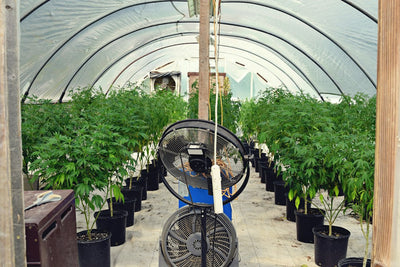
Watering Deeply: Hydrating Big Outdoor Root Zones the Right Way
Photo by benjamin lehman via Unsplash.
The plants that end up ten feet tall with colas the size of forearms don't get there because someone was out with a hose every evening after work. They get there because someone figured out how to manage the root zone -- and root zone management has almost nothing to do with how often you show up with water in hand. It's about how much, how deep, and how you read the soil in between.
Here's the habit that quietly sabotages a lot of outdoor giants: daily sprinkling. It's fine for a patio tomato in a 5-gallon pot with a root ball the size of a soccer ball. On a plant that's trying to drive roots three or four feet down into native soil, that same habit is actively counterproductive. A light daily splash wets the top couple inches and stops there, so the roots that already exist near the surface get all the moisture they need and never bother going deeper. You end up with a huge canopy sitting on a shallow, timid root system -- structurally underbuilt and drought-fragile right when it needs to be neither.
Deep, infrequent watering is the consensus approach in serious outdoor grow guides for a reason that has nothing to do with tradition and everything to do with root physiology: roots grow toward moisture. Saturate deeply, let the surface dry out, and the only way for the plant to keep finding water is to send roots down after the retreating moisture front. That's exactly the architecture you want under a plant carrying heavy fall colas through wind and rain. This piece is about actually executing that rhythm on a plant that, at peak season, is pulling several gallons of water a day -- how to size the water, choose the delivery system, and tell the difference between a thirsty plant and a genuinely sick one.
Why Deep and Infrequent Beats Little and Often

Photo by Lisa Fotios via Pexels.
The mechanics of deep watering are simple to state and easy to get wrong in practice. You saturate the entire root zone until you see a little runoff at the base of the plant or the drainage holes of the pot, then you stop watering completely and wait until the top 1-2 inches of soil have gone fully dry before you do it again. That runoff is your signal that water reached the bottom of the root mass, not just the top few inches. Skip that step and you're back to surface watering with extra steps.
The reason this matters so much for big outdoor plants comes down to root architecture. Shallow, daily watering keeps the moisture concentrated near the surface, so roots have no incentive to explore deeper soil -- they stay lazy and shallow because that's where the water is. That's precisely the wrong setup for a plant that, come September, is going to be supporting colas that add real weight and catch real wind. A shallow root system on a six-foot plant is a plant waiting to topple or snap at the base during the first fall storm.
Deep watering flips that incentive. When you saturate heavily and then let the surface dry, the moisture front retreats downward, and roots follow it because that's where the water now sits. Over a season this builds a root system that's both deeper and more branched, which gives you two things at once: better anchorage for a heavy plant and better drought resilience, since a deep root system can access moisture reserves a shallow one simply can't reach.
Timing matters too, especially once summer heat waves hit. Water in the cool morning hours, before the sun is really working on the soil surface. Watering at midday during a heat wave means you're fighting rapid evaporation and hitting the plant with cool water right as transpiration demand is climbing toward its peak -- that thermal shock adds stress the plant doesn't need. Morning watering lets the root zone absorb and equilibrate before the heat of the day arrives.
None of this fits neatly into a fixed schedule, and that's the point. Forget watering on Tuesdays and Fridays. Read the soil. Push a finger or a moisture probe down 1-2 inches, and when it comes back dry, that's your cue -- not the calendar.
Containers vs. In-Ground: Two Very Different Watering Rhythms

Photo by Indorgro via Unsplash.
A lot of watering advice assumes one growing medium, and that's where it goes wrong for outdoor giants, because container growers and in-ground growers are running two fundamentally different water budgets. Fabric pots -- the smart pots and grow bags that have become standard for big outdoor plants -- breathe. Air moves through the fabric walls, which prunes roots naturally and keeps the root zone oxygenated, but it also means the growing medium dries out fast. In a genuine hot week, a large plant in a 100-gallon fabric pot can legitimately need watering once a day just to keep pace with evaporation and root uptake.
In-ground plants are playing an entirely different game. Even a plant the same size as that container specimen is drawing moisture from a much larger surrounding soil mass -- there's no fabric wall cutting off lateral water movement, so the root zone can pull from soil well beyond the plant's own footprint. That's why in-ground giants often need irrigation far less frequently than a container plant of equal size, even in the same climate on the same day.
Container geometry itself changes the calculus further. Tall, deep pots are useful early in a plant's life because they push roots vertically and build a deeper moisture reserve before the canopy gets demanding. The tradeoff is that the bottom few inches of a deep container can stay saturated and low on oxygen for longer than you'd expect, especially if the medium doesn't drain freely -- overwater a tall pot and you're setting up an anaerobic zone at the bottom that roots will avoid or rot in.
Wide, shallow containers solve that particular problem by spreading the root mass laterally instead of stacking it vertically, which gives more even oxygen access across the whole root system and reduces the risk of a stagnant, saturated bottom layer. Neither shape is universally correct -- it depends on what you're growing in and what stage the plant's at.
The practical takeaway: match your watering frequency to the actual container geometry sitting in your yard, not a generic number pulled from a grow guide written for a different setup. A schedule built for in-ground giants will drown nothing and starve a fabric pot; a schedule built for fabric pots will waterlog in-ground roots.
How Much Water a Big Outdoor Plant Actually Drinks

During its late-summer peak, a mature outdoor plant can use roughly 5 to 6 gallons of water per day, highlighting the substantial daily water demands of outdoor cultivation at this stage.
Numbers help here, within reason. Late-summer demand data reported by Weather.com in April 2026 put mature outdoor cannabis water use at roughly 5-6 gallons per plant per day when heat and active growth both peak -- typically the stretch from mid-July through August when canopies are fully filled in and transpiration is running at maximum. That's a useful planning figure, not a rule to water by.
That number doesn't apply evenly across a season. A spring seedling with a handful of true leaves might need a cup of water every few days. By the time that same plant has built a full canopy in high summer, water demand climbs steadily and then jumps hard once the plant hits peak vegetative size and full sun exposure -- the jump from seedling to mature canopy water use isn't linear, it accelerates.
Weather and canopy size push that daily figure around in both directions. A big canopy on a hot, windy day pushes water use toward the top of that 5-6 gallon range or beyond it, since wind strips humidity off leaf surfaces and accelerates transpiration on top of the heat load. A cooler, overcast stretch -- even in the middle of summer -- can drop daily demand noticeably, sometimes by half, because the plant simply isn't losing water through the leaves as fast.
The smarter approach is to track actual soil dry-down time on your own plants rather than assuming a fixed gallon count translates directly to your climate and genetics. A plant in low-humidity high-desert conditions is going to dry out differently than the same genetics grown in a humid coastal valley, and vigorous, fast-growing phenotypes will simply drink more than slower ones regardless of what a general figure suggests.
Use 5-6 gallons per day as a baseline for sizing your infrastructure -- how big a storage tank you need, how long your drip lines need to run -- not as a rigid daily quota you're obligated to hit. The soil, not the number, tells you when to water.
Drip and Emitter Systems for Even, Deep-Root Coverage

Photo by Dmytro Glazunov via Unsplash.
Once you're managing plants that need several gallons a day, hand-watering with a hose stops being practical and starts being a liability -- it's slow, it's uneven, and it's easy to either underdo it or blast so much water that you get runoff before the root zone is actually saturated evenly. This is why drip and emitter tubing have become the standard for large outdoor root zones: they deliver a low, steady volume of water directly to where the roots are, instead of dumping it on the surface and hoping it soaks in evenly.
The efficiency gain is real. Because drip delivery is targeted and slow, far less water is lost to evaporation off the soil surface or lost to runoff running past the root zone entirely -- both of which happen constantly with overhead sprinklers or a hose held over the base of the plant. In a season where you're tracking gallons per plant per day, that efficiency difference adds up to a meaningful amount of saved water and saved trips hauling tanks.
Commercial-grade setups built for large outdoor plants have converged on a fairly consistent architecture: a high-flow 3/4-inch mainline running from the water source, feeding out to 1/2-inch emitter tubing at each plant, fitted with pressure-compensating emitters rated around 0.5 gallons per hour and spaced roughly every 9 inches along the line. Pressure compensation matters more than it sounds like it should -- it keeps flow consistent across emitters even when there's elevation change or distance variance along the mainline, so the plant at the end of the row isn't getting starved compared to the one closest to the tank.
Rather than running a single line straight past the stem, spiral the emitter tubing in a loose ring or coil around the root base. That spreads water delivery across the whole root diameter instead of concentrating it in one wet spot near the stalk, which encourages the kind of even, deep root development you're actually trying to build.
Add a timer and the whole system runs itself through the exact early-morning window that's ideal anyway -- water goes out before sunrise or right at first light, root zones get saturated before heat and evaporation ramp up, and you're not stuck manually watering a dozen giant plants on a schedule dictated by your own alarm clock. Once you're past two or three large plants, a timer isn't a convenience, it's what makes the deep-and-infrequent approach actually sustainable.
Reading the Plant: Root Stress vs. Nutrient Problems

Photo by minka2507 via Pixabay.
The hardest skill in outdoor giant cultivation isn't watering correctly -- it's diagnosing correctly when something looks wrong. A droop is the most common symptom growers panic over, and the key diagnostic question is simple: does it persist after you've clearly corrected the watering, whether that means you gave it a deep soak because it was underwatered or you backed off because it was sitting wet? If the droop sticks around after you've fixed the obvious watering issue, that's the signal pointing toward root zone trouble rather than something you can fix by adjusting how much water you're giving.
Discoloration is the more deceptive one. Yellowing, browning, or mottled leaves that look exactly like a textbook nutrient deficiency will send most growers straight to the feed schedule, but if that discoloration keeps spreading even after you've adjusted nutrients, the actual cause is very often a waterlogged or oxygen-starved root zone rather than an actual nutrient shortage. Roots sitting in saturated, low-oxygen soil can't take up nutrients efficiently even when those nutrients are present in the soil at adequate levels -- so you see deficiency symptoms while dumping more nutrients into a root zone that can't absorb them, which usually makes things worse, not better.
This is exactly why checking the bottom of deep containers should be a first step, not a last resort. That's where saturated, low-oxygen layers quietly build up, especially in tall pots, and it's the part of the root zone nobody looks at until the plant is already in visible distress.
Worth remembering too: not every symptom that looks like plant stress is actually about water or nutrients at all. Heavy fall colas on an unstaked branch can cause a droop, a lean, or even a snapped limb that looks a lot like wilting from a distance -- but it's a mechanical failure, not a physiological one. Get stakes or a trellis frame under those colas well before they're fully swollen, not after you notice the branch already sagging.
When you're genuinely unsure what you're looking at, skip the guessing. Gently pull the plant slightly at the base to check root color -- healthy roots are white to light tan, not brown or gray -- and give them a smell. Sour, rotten, or ammonia-like odors point to root rot from overwatering, not a nutrient problem, and no amount of additional feeding is going to fix that.
Water Rights and Timing for Permitted California Grows

Photo by Magda Ehlers via Pexels.
If you're growing outdoors in California at any real scale, water rights aren't a footnote -- they directly determine when you can and can't legally pull water for exactly the deep-watering strategy this whole approach depends on. The State Water Resources Control Board's Cannabis Policy imposes a dry season forbearance period running April 1 through October 31 each year, during which surface water diversion for cultivation is prohibited outright. That window covers essentially the entire active growing season for an outdoor plant -- germination through harvest.
Compounding that, cannabis cultivators generally hold a junior water right under California's water rights framework, which means that when supplies tighten and curtailment orders go out, cannabis operations are first in line to get cut off, ahead of senior rights holders. It's a genuinely precarious position to be in if your watering plan assumes a live stream or well diversion will be available whenever you need it.
2026 reporting on Central Valley water allocations, with some growers seeing allocations near just 15% of their normal entitlement, illustrates how tight this picture has actually gotten in dry years. That's not a hypothetical regulatory detail -- it's a real supply constraint that's already forcing growers to rethink how they source water for the season.
The workaround that makes deep, disciplined watering viable through the forbearance period is storage, not live diversion: filling tanks during the wet season, from roughly November through March when surface diversion is legal, and drawing from stored water through the dry months rather than trying to pull directly from a stream or river during the exact window it's prohibited. This is also, conveniently, good practice independent of the regulation -- a filled tank gives you consistent water pressure and temperature for a drip system regardless of stream flow variability.
Growers outside California shouldn't assume this doesn't apply to them just because the specific forbearance dates don't. Local diversion rules, well-permitting requirements, and seasonal water restrictions vary widely by state and even by county, and they matter a lot more once you're scaling up to plants that need several gallons a day rather than the modest needs of a small backyard grow. Check before you plan your season around a specific water source.
Walk any patch of genuinely large outdoor plants and you'll notice the grower isn't the one hovering with a watering can every evening. They're the one who saturates deeply, walks away, checks the soil a few days later, and repeats -- a rhythm matched specifically to their pot geometry, their climate, and what the plant is actually doing at that point in the season. That discipline, more than any single product or trick, is what separates a plant that tops out modest from one that ends up genuinely enormous by October.
It's worth saying plainly that no watering strategy fixes weak genetics. A plant bred for a shallow, timid root system isn't going to develop the deep architecture this whole approach is built around no matter how well you execute the saturate-and-wait rhythm. Starting with seeds bred for vigorous root development gives you a plant that actually responds to deep watering the way it's supposed to -- Seedtiva breeds with that kind of root vigor and outdoor performance in mind, which matters more once a plant is scaling toward the size and water demand this piece has been describing. That said, outcomes still depend heavily on your specific climate, container setup, and season -- there's no genetics that overrides a badly matched watering system.
Once a plant is pulling several gallons a day at peak season, water infrastructure stops being an afterthought and becomes a real planning category, the same way lighting or soil selection already is for most growers. That means sizing storage tanks for your actual number of plants and peak-season demand, running proper drip and emitter lines instead of hand-watering, and putting a timer on the system so early-morning cycles happen reliably without you having to be there at 5 a.m. every day. Get that infrastructure right once at the start of the season, and the deep-and-infrequent rhythm essentially runs itself for the rest of the year.
Sources
- How To Grow Cannabis Outdoors in 2026 - RQS USA - RQS Blog
- Growing Cannabis Outdoors: The 2026 Beginner's Guide - WSE
- Watering Techniques for Outdoor Cannabis: Dos and Don'ts – FloraFlex
- Cannabis Roots: Root Development & Root Zone Science (2026) – BudTrainer
- Growing Cannabis Outdoors: The Complete Grow Guide (2026) – BudTrainer