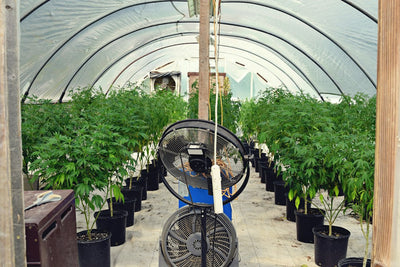
What an Indoor Cannabis Grow Really Costs to Run in 2026
Photo by peterweideman via Pixabay.
Somewhere in the last three years, the power bill quietly moved from a line item nobody thought much about to the number that decides whether a cultivation facility turns a profit. And it just got worse. U.S. electricity costs rose 5.9% over the twelve months ending May 31, 2026, according to MJBizDaily's reporting on utility trends, pushed up by a combination of AI data center demand pulling gigawatts off the grid and higher fuel costs rippling through the energy market. Growers who've been tracking their utility invoices already know this isn't an abstract macroeconomic story.
Indoor cannabis cultivation uses something on the order of 50 times more electricity per square foot than a typical office building. That's not a typo or an exaggeration for effect -- it's what happens when you run 600-1,000+ watts per square meter of lighting, plus the HVAC tonnage needed to remove that heat, plus dehumidification running around the clock. Most industries facing a 5-6% jump in input costs simply raise prices. Cannabis operators mostly can't, because the illicit market sets a price ceiling that legal, taxed, compliance-burdened cultivators have to compete under regardless of what their utility charges them. That squeeze is exactly why this piece exists: to lay out, with real numbers, what an indoor grow actually costs to run per pound of flower, where every kilowatt-hour goes, and which levers genuinely move the needle when the power company's bill lands on your desk.
Why Power Prices Are Spiking Again in 2026

Photo by Matthew Henry via Unsplash.
The Bureau of Labor Statistics' national energy index climbed 3.9% in May 2026, following a 3.8% increase in April and a much sharper 10.9% spike in March. Stack those months together and you get a pricing trend that isn't a blip -- it's a sustained repricing of electricity across the country, and cultivation facilities are feeling it directly on their meters. Two forces are doing most of the work here. The first is data center load growth tied to the AI buildout, which is adding new demand to regional grids faster than utilities can bring on new generation or transmission capacity. The second is higher fuel costs connected to the conflict in Iran, which has pushed up natural gas and oil prices that feed directly into electricity generation costs in much of the country.
Paul Shagawat, an energy analyst at Transparent Energy, put it bluntly: we haven't seen this much new load coming onto the grid since the Industrial Revolution. That's a striking historical comparison, and it explains why utilities in data-center-heavy regions -- Virginia, Texas, parts of the Midwest -- are requesting rate increases to fund grid upgrades, with those costs passed straight through to every other ratepayer on the system, cannabis cultivators included.
Standard Wellness, a multistate operator running facilities in Missouri, Ohio, and Utah, is a useful real-world case. According to VP Tiana Arriaga, the company has watched its electricity bills climb by tens of thousands of dollars a month across its footprint -- not a one-time jump, but a steady upward creep that's forced the company to treat energy management as an operational priority rather than a back-office accounting task. What makes cannabis operators particularly exposed is structural: a coffee roaster or a bakery facing a similar cost increase adjusts its retail price and moves on. A licensed cultivator selling into a market where illicit product undercuts legal pricing by 30-50% in many states doesn't have that option. The power bill goes up; the sale price mostly can't.
The Real Number: kWh Per Pound of Flower

Updated 2025 estimates show indoor cannabis cultivation can consume up to 5,000 kWh per pound of flower, nearly double the previous NPCC high estimate of 3,000 kWh, while low-end energy use remains unchanged at 2,000 kWh.
The National Cannabis Industry Association and various energy consultants have circulated a benchmark for years: a well-run indoor facility uses somewhere between 2,000 and 3,000 kWh of electricity per pound of dried flower produced, with energy representing 20-40% of total production cost. That range held up reasonably well through the mid-2020s. It doesn't anymore, at least not as an upper bound.
An updated figure from MJBizDaily in December 2025 widened that range to 2,000-5,000 kWh per pound, depending heavily on facility efficiency and regional climate. A facility in a hot, humid state fighting to hold VPD and temperature will burn through the top end of that range; a well-insulated, LED-lit facility in a temperate climate with dry outside air to work with can sit near the bottom. That's more than a rounding difference -- it's the gap between an efficient operation and one that's bleeding money on every harvest.
Zoom out to the national level and the scale gets genuinely large: cannabis cultivation may account for up to 1% of all electricity consumed in the United States, translating to roughly $11 billion spent annually on power just to grow the plant. That's an industry-wide number worth sitting with, because it means energy isn't a niche cost center for a handful of inefficient operators -- it's baked into the economics of the entire indoor segment.
Translate that into dollars per pound and the picture gets sharper still. In high electricity-rate states -- think California outside of municipal utility territory, or parts of the Northeast -- energy costs alone can run $300 to $500 per pound produced, before labor, nutrients, packaging, taxes, or compliance costs enter the equation. And here's the catch: most of the benchmark figures still in circulation predate the 2025-2026 rate surge. If your cost model is built on 2023 or 2024 electricity pricing, it's very likely understating what your grow actually costs to run today.
Where the Electricity Actually Goes

Photo by Chris F via Pexels.
Break down where the electricity in a typical indoor grow actually goes and the split is fairly consistent across well-documented facilities. Lighting eats roughly 40% of total electricity use -- unsurprising given that a flowering room running at 800-1,000 PPFD across a full canopy needs serious wattage delivered for 12 hours a day, every day, for eight to nine weeks per cycle. Climate control and air filtration together account for another 40%, covering the chillers, air handlers, dehumidifiers, and carbon filtration needed to keep temperature, humidity, and odor under control in a sealed room. The remaining roughly 20% goes to everything else: circulation and irrigation pumps, environmental controllers, standalone dehumidifiers, CO2 injection and burner systems, and the miscellaneous loads that never show up in a simple lighting-versus-HVAC comparison.
What that 40/40/20 split misses if you look at it as three separate buckets is that lighting and climate control aren't actually independent costs -- they're mechanically coupled. Every watt of light energy your canopy and room surfaces absorb eventually converts to heat, and every bit of that heat has to be removed by your HVAC system to hold target temperature and VPD. Run inefficient lighting -- older double-ended HPS fixtures, say, at 1.6-1.9 μmol/J efficacy -- and you're not just paying for wasteful photons. You're paying twice: once for the electricity that produced the excess heat, and again for the tonnage of cooling required to pull that heat back out of the room.
This is the real argument for LED retrofits, and it's a stronger one than the light bill alone suggests. Modern LED fixtures running at 2.7-3.0+ μmol/J cut the electricity going into the light itself, and because they run cooler and shed a smaller fraction of their input as radiant and convective heat, they also shrink the tonnage of air conditioning needed to hold room temperature. A facility that swaps HPS for efficient LED isn't trimming one line item -- it's trimming two simultaneously, and the HVAC savings compound over the life of the equipment in a way that's easy to underestimate if you only look at the wattage printed on the fixture.
Why the Same Grow Costs Different Amounts in Different States

Photo by - Manouar via Pexels.
Two facilities running identical genetics, identical canopy size, and identical lighting can post wildly different power costs purely because of where they're plugged in. Consider Sacramento Municipal Utility District, which charges roughly 12.7 cents per kWh, against Pacific Gas & Electric or Southern California Edison territory, where commercial rates can run close to 45 cents per kWh. That's not a marginal difference -- it's closer to a 3.5x multiplier on the single largest variable cost in the operation, and it applies to every kilowatt-hour consumed, month after month, cycle after cycle.
Efficiency and scale compound that advantage rather than offset it. Consider a facility that converted to all-LED lighting roughly six years ago and now produces on the order of 70,000 dry pounds a year. That kind of output didn't come from lighting efficiency alone -- it reflects years of process refinement stacked on top of a lower energy baseline. But the lesson generalizes: a facility sitting in a low-rate utility territory that also invests in efficient lighting and tight environmental control isn't just saving twice, it's saving on a compounding basis, because every efficiency gain gets multiplied by a lower per-kWh cost.
Rate class is a factor that gets far less attention than the headline rate, and it probably should get more. Many cultivation facilities get lumped into small commercial rate schedules by default -- the same classification a retail storefront or a small office might carry -- when they actually qualify for agricultural or manufacturing rate classes that carry meaningfully lower per-kWh charges and different demand-charge structures. Operators stuck on the wrong rate class can be overpaying by a significant margin every single month without any obvious signal that something's wrong, because the bill still arrives, gets paid, and looks unremarkable in isolation.
All of this argues for treating utility territory and rate structure as a genuine site-selection criterion for any commercial indoor grow -- not a detail to sort out after signing a lease, but a factor weighed alongside real estate cost, labor market, and local licensing rules. A cheaper building in an expensive utility territory can easily cost more over a five-year lease than a pricier building sitting on favorable agricultural rates.
Practical Levers That Actually Cut the Bill

Photo by Daniel Ponomarev via Pexels.
The most immediately actionable lever, and the one most operators haven't touched, is a straightforward audit of utility rate classification. Some cultivation clients have saved tens of thousands of dollars a year simply by getting reclassified from a generic small commercial rate to an agricultural or industrial rate that better fits what a grow facility actually is. Others have gone further and identified past overbilling errors substantial enough to trigger refunds in the $200,000-$300,000 range. That's not a growth strategy or a genetics upgrade -- it's a paperwork correction, and it's sitting unclaimed in a lot of utility accounts right now.
Scheduling and dimming strategies are the next lever, and they work because most utilities charge peak-demand premiums during specific windows of the day. One Massachusetts facility saved more than $250,000 a year through targeted light-dimming and scheduling -- shifting when lights ramp to full intensity, staggering room start times so the whole facility doesn't hit peak draw simultaneously, and trimming intensity during utility peak pricing windows without meaningfully sacrificing DLI targets over the full photoperiod.
Working with an energy broker rather than accepting a utility's default commercial contract has cut bills by 10-20% for some operators, mostly through better rate shopping, demand-charge negotiation, and locking in favorable terms before rates climb further. For a facility spending $40,000-$80,000 a month on power, a 15% reduction pays for the broker's fee many times over in the first year alone.
Home and small-scale growers face the same physics on a smaller scale, and the same fixes apply. Efficient LEDs cut the biggest single draw in a tent or small room. Tight VPD control -- holding the 0.8-1.2 kPa range appropriate to growth stage -- reduces how hard a dehumidifier or AC unit has to run to hold that environment, which matters more than most home growers realize since a single portable dehumidifier can pull 500-700 watts continuously. Staggering high-draw equipment -- not running the AC compressor, the dehumidifier, and the light ballast's peak draw all at once -- avoids demand spikes that can trip breakers or, at commercial scale, trigger demand charges.
One lever that's easy to overlook: genetics. A plant that finishes reliably in 8 weeks instead of stretching to 10, that doesn't demand an extended veg period to reach a workable canopy, and that doesn't require rescue interventions for pests or deficiencies along the way, is a plant that consumes fewer cumulative kilowatt-hours per pound produced. This is one area where choosing vigorous, well-bred genetics -- the kind Seedtiva focuses on producing -- pays off in ways that don't show up as a separate line item but show up unmistakably in the grams-per-watt number at harvest.
Electricity used to be the utility bill you paid without much thought, filed somewhere below rent and payroll on the list of things that actually determine whether a grow survives. That's over. At 20-40% of total production cost, and climbing as 2026's rate increases work their way through the system, power now sits alongside labor and rent as a genuine make-or-break line item -- the kind of cost that separates operations that are quietly profitable from ones that are quietly bleeding cash every harvest cycle.
The operations that come through this price cycle intact will be the ones that stopped treating electricity as a fixed bill and started treating it like any other crop input -- something to be measured, audited, and optimized with the same rigor applied to nutrient schedules or IPM programs. That means checking your rate class, shopping your contract, rethinking your lighting schedule against peak-demand windows, and choosing genetics that don't waste weeks and kilowatt-hours on plants that stretch, stall, or need rescuing. None of that is glamorous work. All of it shows up on the bottom line.
None of these fixes work identically everywhere, and it's worth saying plainly: your climate, your facility's build quality, your local utility rate structure, and the genetics you're running all interact in ways that make one operation's 20% savings another operation's 5% savings. There's no universal number to promise here -- only a clear direction. The grows treating energy as a variable to manage, rather than a bill to absorb, are the ones still standing when the next rate increase lands.
Sources
- The Cultivator's Guide to Controlling Energy Costs
- How Much Does Growing Medical Marijuana Indoors Cost? - CostHelper
- Power Consumption for Cannabis Growers - ElectricityPlans®
- How Much Does It Cost to Grow Cannabis Indoor? – Business Plan Templates
- Indoor Cannabis Cost Calculator: Per Plant, Per lb/kg + Profit