Why Giant Outdoor Colas Lean South (And How to Fix It)
Photo via Pexels.
Every August I get some version of the same message: a grower sends a photo of an outdoor monster, ten or twelve feet tall, every major cola arcing south like it's trying to walk away from the plant. They want to know what they did wrong. Usually the answer is nothing — the plant is doing exactly what auxin evolved to do. But on a plant that size, a growth response that's cosmetic on a two-foot houseplant becomes a structural liability on a nine-foot outdoor giant carrying twenty pounds of wet flower.
The lean gets misread constantly because people conflate it with the sun-tracking behavior everyone's seen in young sunflowers — that slow daily swivel from east to west and back overnight. That's a different mechanism entirely, and mistaking one for the other leads to bad decisions: growers wait for the lean to correct itself the way a sunflower head resets each morning, and it never does, because it isn't that kind of movement.
What follows is the actual mechanism behind the southward lean, why a plant trained into a single dominant Christmas-tree cola makes the problem measurably worse, and where the real thresholds are for staking before a branch snaps instead of after. This is a physics-and-biology problem with a training solution, not a genetic flaw, and treating it that way is what separates growers who lose their best cola in a September windstorm from growers who don't.
Phototropism vs. Heliotropism: Why the Lean Doesn't Reverse Itself
Phototropism is a one-way growth response, and that's the part people miss. When light hits a stem asymmetrically, auxin — the plant hormone that drives cell elongation — migrates to the shaded side. Cells on that shaded side elongate faster than cells on the lit side, and the stem physically curves toward the light source. Those cells don't shrink back once they've elongated. The bend is now part of the stem's permanent architecture, built into the tissue the same way a scar is built into skin. There's no overnight reset.
Heliotropism, the daily sun-tracking you see in young sunflower heads, is a completely different process. It's hydraulic, not structural — a pulvinus-like mechanism where turgor pressure shifts between cells on opposite sides of the stem, pushing the stem to pivot east to west during the day and drift back east overnight to reset for sunrise. No new cell growth is involved, which is exactly why it's reversible and phototropic bending isn't.
This isn't just a semantic distinction. A 2023 peer-reviewed sunflower study published in PMC found that the transcriptional regulation underlying heliotropism is genuinely distinct from phototropin-mediated phototropism — the two responses likely run on different, only partially overlapping light-signaling pathways rather than being the same mechanism scaled up or down. In other words, you can't assume a plant showing one behavior will behave like it's showing the other just because both involve a plant orienting toward light.
For a cannabis grower, the practical consequence is straightforward: a cola that has leaned 30 to 45 degrees south has grown into that position structurally. It will not straighten out as the sun swings from east to west through the day the way a young sunflower does. The bend is locked into the woody tissue at the base of that lean, and it will keep compounding in the same direction as the stem continues elongating through veg and into flower. Once you understand that, staking and training stop being optional cosmetic touch-ups and become the only real tool you have for managing what is otherwise a permanent structural fact about that branch.
Why a Tall Christmas-Tree Cola Makes the Lean Worse

Photo by GB The Green Brand via Pexels.
Left untrained, cannabis defaults to apical dominance — one central leader shoots upward and outward-competes everything beneath it, leaving a skirt of stunted, shaded branches underneath in the classic Christmas-tree shape. That central cola isn't just aesthetically dominant, it's also where the plant is funneling the most auxin, which means it's the part of the plant most susceptible to phototropic bending in the first place. You end up with the single largest, heaviest, most valuable cola on the plant also being the one most likely to arc hard toward the south.
That tall central stem is also the worst-shaped structure for wind. A single vertical leader acts like a mast with a sail attached once it fills out with fall buds — it catches gusts a wide, flat canopy would simply shed. It's also the branch most likely to snap, because it's carrying more weight per unit of stem diameter than anything else on the plant.
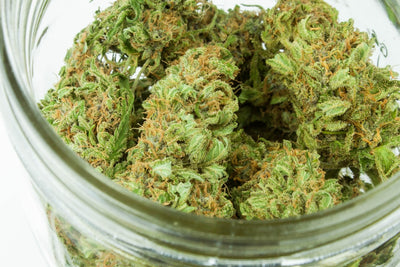
The numbers get ugly fast. A 100-gram cola sitting at the tip of a pencil-thick branch can pull that branch 30 to 60 degrees out of vertical by week 6 of flower, and that's not a minor cosmetic droop. It physically relocates the cola out of the canopy's even light zone and drops it down into the still-air shadow underneath the canopy — exactly the humid, low-airflow pocket where bud rot and powdery mildew take hold.
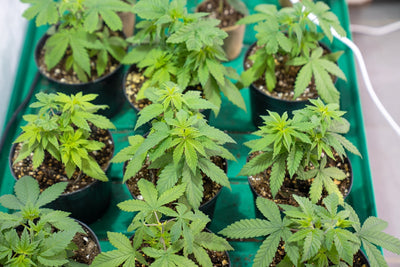
Here's the part that trips people up: bending a branch sideways with low-stress training doesn't remove the auxin gradient, it just shifts it. The branch you tied down will keep trying to grow back upward and back toward the south, chasing the strongest available light, because the hormonal driver behind that behavior is still active. A single tie-down early in veg is not a permanent fix — it needs follow-up adjustments as the branch continues its growth response. The better long-term fix is training for a level, wide canopy from early veg, topping or FIMing the main leader and tying down competing tips so auxin distributes across many bud sites instead of concentrating in one dominant, sail-shaped leader.
The 45-Degree Rule: When to Stake Before It's Too Late

By week 6, heavier colas cause dramatically more branch bend—branches with ~100g colas bent about 45 degrees, roughly 4.5 times more than those with light ~25g colas, showing a clear correlation between bud weight and branch stress.
There's a usable diagnostic line here, and it's worth committing to memory: if a cola is leaning more than roughly 45 degrees off vertical, or the branch visibly flexes when you fan the plant with an open hand, it needs support now — not on your next trip out to the garden. That flex test matters because it tells you the branch is already past the point where its own woody tissue can carry the coming weight of a filled-out flower on its own.
Waiting until the bend is obvious to the eye means you're no longer managing one problem, you're managing two at once: bud weight pulling the branch down and outward wind loading it sideways at the same time. Once both are working against a stem simultaneously, the margin for error before a clean snap gets thin.
Timing matters as much as the threshold does. Training clips and LST bending only work while the plant is vegetative and the stem tissue is still pliable enough to reshape without cracking. Once flower sets bud sites, that structure is locked in — you can still relocate existing bud sites with careful bending, but you can't add new ones, and aggressive bending on lignified flowering stems is far more likely to snap the branch outright than reshape it.
For a genuinely giant outdoor plant, the right move is staking ahead of the lean, not in response to it. That means driving stakes and tying support to the heaviest branches while they're still upright, and — this is the part people skip — placing the stake and tie point where that cola will physically sit once it's carrying full flower weight, not where it happens to be sitting today. A branch that's vertical in week 3 of flower may be sitting a foot lower and a foot further south by week 7.
If a branch does snap despite all that, treat it like any broken limb: splint it immediately with grafting or repair tape, wrapping snugly enough to hold the break in alignment without cutting off vascular flow. Speed matters far more than finesse in that moment — a branch splinted within minutes of breaking has a real shot at healing through; one left hanging for a day usually doesn't.
Sun-Mapping Your Site Before the Plant Ever Goes in the Ground

Photo via Pexels.
Plenty of leans that get blamed on the plant actually start with the site. A spot that looks flooded with sun at noon can be shaded for two or three hours in the morning by a neighbor's fence, and shaded again in late afternoon by a roofline or a stand of trees you didn't account for when you picked the spot in April. That kind of uneven daily light exposure is one of the most common, most overlooked causes of an exaggerated southward lean — the plant isn't broken, the site is asymmetric.
Before committing a giant outdoor specimen to a permanent hole in the ground, it's worth spending a day actually charting the site: note when direct sun first hits the spot, when it's interrupted, and when it finally clears for the evening. Do this across a few points in the yard before you plant, not after you've already got a nine-foot plant you can't move.
The mechanism here is straightforward once you connect it back to phototropism. A plant getting even light exposure across the day distributes its auxin gradient more symmetrically, which produces a milder, more manageable lean. A plant getting strong light from one direction and shade from the other concentrates that auxin shift far more heavily on the shaded side, and the resulting bend is more severe than a plant growing in even light would ever show — even at the same total daily light integral.
Growers working with large containers have an option in-ground growers don't: dollies or wheeled platforms that let you physically reposition the pot toward the strongest sun as the season's angle shifts. That lets you correct asymmetric exposure proactively, before it turns into a structural lean baked into the stem, rather than fighting a bend after the fact.
Genetics play a role too, though a smaller one than site selection. Starting with quality, well-bred seeds — the kind Seedtiva selects for — gives you more predictable branch structure and internode spacing to work with, which makes training and staking decisions easier to plan around. But even excellent genetics won't fix a site with three hours of unaccounted-for morning shade. The sun map still does most of the real work.
The southward lean isn't something to breed out or worry your genetics are flawed over — it's a physics problem, driven by an auxin response that's been working exactly the same way in plants for a very long time. The fix was never going to be genetic. It's canopy training, timely staking, and an honest look at where the sun actually falls on your site across the whole day, not just at noon when you happened to walk outside and check.
Giant outdoor plants reward growers who plan a season ahead instead of reacting to what's in front of them right now. Map the light before you plant. Train wide and level in veg so auxin spreads across dozens of tips instead of piling into one dominant leader. Stake for the plant your cola is going to be at full flower weight in October, not the plant it is in July.
Outcomes still vary — wind exposure, local climate, and the genetics you started with all move the numbers around. But a plant trained for a level canopy and staked before it needed it almost never snaps, no matter how big it eventually gets. That's the whole game with outdoor giants: get ahead of the bend before it becomes a break.
Sources
- Want Giant Outdoor Cannabis Plants? Start With More Sunlight | Cannabis Training University — Ed Rosenthal
- Cannabis Flowering Stage: Week-by-Week Guide (2026) – BudTrainer
- How to Top Cannabis Plants (2026 Guide) – BudTrainer
- Growing Cannabis Outdoors: The Complete Grow Guide (2026) – BudTrainer
- Cannabis Training: Every Plant Method and How to Use Each (2026 Guide) – BudTrainer