Bipartisan Bill Aims to Save—and Tax—Hemp THC Products
Photo by Fabnel LDN via Pexels.
Mark your calendar for November 12, 2026. That's the date a provision buried in last year's agriculture funding bill would effectively wipe most of the hemp-derived THC products off convenience store shelves, dispensary coolers and grocery aisles across the country. The delta-8 gummies, THCA flower, and hemp seltzers that have quietly built themselves into a multibillion-dollar retail category would either have to reformulate into near-nothing doses or disappear entirely.
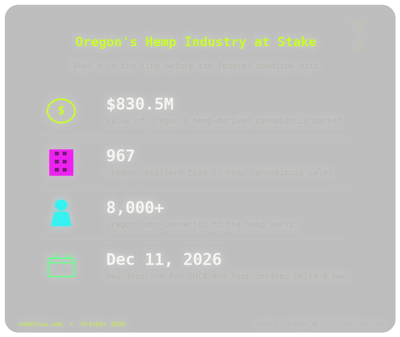
Congress has a fix in motion, and it's arriving with an unusual amount of bipartisan cover. On July 22, 2026, Reps. Angie Craig (D-Minn.) and Andy Barr (R-Ky.) introduced the Lawful Hemp Protection Act, a bill that reportedly has the backing of the White House and aims to replace a blanket ban with an actual regulatory framework — one that taxes hemp THC products rather than eliminating them outright. The dollar figures involved explain the urgency: industry estimates put the hemp-derived cannabinoid market somewhere between $28 billion and $30 billion, supporting thousands of jobs across farming, manufacturing, beverage production and retail. Whether that industry survives in recognizable form now hinges on what happens in the next few months on Capitol Hill.
Why Congress Is Racing the Clock

Photo by Brett Sayles via Pexels.
The root of this mess traces back to the 2018 Farm Bill, which legalized hemp defined as cannabis containing less than 0.3% THC by dry weight. Lawmakers at the time were thinking about fiber, grain and CBD oil. What they didn't anticipate was chemists figuring out how to convert cheap, abundant CBD into delta-8 THC, HHC, THCA and a growing menu of other psychoactive cannabinoids — all technically compliant with that 0.3% dry-weight threshold because the math is measured differently than in state-licensed marijuana markets. That loophole became the legal foundation for an entire intoxicating hemp industry that now operates largely outside the tighter licensing, testing and dosage rules that regulated cannabis programs impose.
Federal lawmakers finally moved to close that loophole last November, when President Trump signed the 2026 agriculture appropriations law to end a government shutdown. Tucked into that legislation was Section 781, a provision that redefines hemp in a way that would sweep almost all intoxicating hemp products out of legal commerce starting November 12, 2026. The replacement rules are strict by design: 5 milligrams of THC per serving and 50 milligrams per container for edibles, and just 10 milligrams per container for beverages. Those caps aren't a tweak — they're a near-total ban on the potency levels that currently define the market. A typical hemp seltzer today might carry 5 to 10 milligrams per can already, but many gummies and tinctures on shelves blow past those numbers several times over.
That timeline is what's forcing Congress to move fast. Section 781 became law in November 2025, and lawmakers introduced their fix in July 2026 — leaving less than four months to draft, negotiate, and pass a replacement framework before the ban automatically kicks in. For an industry that's spent years building brand recognition and retail shelf space, that's not a lot of runway.
What the Lawful Hemp Protection Act Actually Does

Photo by Elsa Olofsson via Pexels.
The Lawful Hemp Protection Act runs about 60 pages, and it does a lot more than just raise a THC limit. The headline change redefines hemp to allow up to 1% THC by dry weight — more than triple the current 0.3% ceiling. That's a meaningful expansion, and it's designed to give manufacturers enough room to keep making products with noticeable psychoactive effects without falling back into a legal gray zone.
Beyond potency, the bill builds out guardrails that intoxicating hemp products have largely lacked at the federal level. It sets a nationwide purchase age of 21, bans marketing aimed at children, and mandates third-party lab testing along with standardized packaging and labeling requirements — the kind of consumer protections that state-licensed cannabis programs already require but that hemp-derived products have often skipped. The bill also draws a hard line against synthetic conversion products, specifically naming and prohibiting HHC, THC-O-acetate and THCP. That's a notable distinction: it's not trying to legitimize every cannabinoid chemists can cook up in a lab, only the ones closer to naturally occurring compounds.
On the regulatory plumbing side, the bill creates an entirely new permitting and registration system through the Treasury Department's Alcohol and Tobacco Tax and Trade Bureau (TTB) for manufacturers of hemp-derived cannabinoid products and for beverage wholesalers. Hemp beverages specifically would be regulated more like alcohol, falling under TTB oversight rather than treated as a novel food category. Edibles, meanwhile, would stay under the FDA's existing food safety framework. That split reflects how these products are actually sold today — beverages competing for cooler space next to beer and wine, edibles competing with snack foods and supplements — and it hands oversight to whichever federal agency already has infrastructure built for that kind of product.
The Tax Structure and the Highway Funding Stick

The proposed federal bill would tax hemp-derived THC beverages at 5 cents per milligram of THC, while other consumable products and manufacturer sales would each face a 5% tax rate.
None of this regulatory framework comes free, and the bill's tax structure is where a lot of the real negotiating is happening. Under the Lawful Hemp Protection Act, the Treasury would collect 5 cents per milligram of THC in hemp-derived beverages, plus a 5% retail tax on other THC consumables like gummies and tinctures. On top of that, manufacturers would face an additional 5% tax on their sales revenue — a layer that applies before the product even reaches a retail shelf.
There's also a highway funding stick attached to the carrot. Starting in fiscal year 2027, any state that doesn't have a qualifying hemp-impaired-driving law on its books would lose 10% of its core federal highway apportionments. That's the exact playbook Congress used decades ago to pressure states into adopting a uniform drinking age and blood-alcohol limits for drunk driving — withhold highway money until states fall in line. It's a proven lever, and it signals Congress isn't just regulating the product; it's trying to force states to address impaired driving tied to hemp THC before money starts getting cut.
Not everyone agrees the tax math is right, though. A competing industry-backed proposal, the Goodness of Hemp Act, offers a simpler structure: a flat $0.03-per-milligram excise tax on intoxicating cannabinoids, without the layered retail-and-manufacturer taxes baked into Craig and Barr's bill. The existence of a rival framework shows the rate itself — how much this industry should actually be taxed, and at what point in the supply chain — is still genuinely contested, even among people who agree hemp THC products should survive in some legal form.
Who's Backing It—and Who's Still Wary

Photo by Mark Stebnicki via Pexels.
Rep. Andy Barr has been vocal about why he sees regulation, not prohibition, as the right path — and he points to his home state as proof it can work. Kentucky farmers grew roughly 4,700 acres of industrial hemp in 2025, and Barr has argued that a workable federal framework lets those farmers keep a legitimate crop in rotation while giving consumers safer, tested products instead of driving the market underground.
The coalition behind the bill is broader than you'd expect for a hemp measure. The U.S. Hemp Roundtable and the Hemp Beverage Alliance — trade groups with obvious skin in the game — are on board, but so are retail names like Total Wine & More and the Wine & Spirits Wholesalers of America (WSWA), whose members would gain a new, TTB-regulated product category to sell alongside beer, wine and spirits. That's a meaningful signal: traditional alcohol retailers see hemp beverages as a category worth protecting and integrating, not fighting off.
That said, support isn't unconditional. WSWA has indicated it wants further negotiation on the exact tax rate before fully committing, which lines up with the broader industry split over whether Craig and Barr's layered tax structure or the simpler Goodness of Hemp Act rate makes more sense. And then there's the White House factor — Barr's office has pointed to administration backing as a reason this bill has real momentum, which is notable given how late in a congressional session it's landing and how crowded the fall legislative calendar tends to get.
Nobody serious in this fight is arguing hemp THC products should simply vanish — even the drunk-driving-style highway penalty is designed to keep the industry alive under tighter rules, not kill it. The real argument is over price and paperwork: how many cents per milligram, which agency signs off on what, and how much compliance overhead a small hemp beverage maker or gummy manufacturer can absorb before margins disappear. With the Lawful Hemp Protection Act's layered tax structure sitting next to the Goodness of Hemp Act's flatter alternative, that argument is far from settled.
Whatever Congress lands on, it won't erase the patchwork of state rules that already governs hemp THC products. Some states have banned intoxicating hemp cannabinoids outright, others have built their own licensing and testing regimes, and plenty remain in a legal gray area that predates any of this federal maneuvering. A federal framework would sit on top of that patchwork, not replace it — so anyone buying, selling or manufacturing these products should keep checking state and local law regardless of what happens in Washington. This isn't legal advice, just a practical reality of how federal and state cannabis policy currently overlap.
What's certain is that the clock is louder than the policy details right now. With Section 781's ban set to take effect November 12, 2026, expect an aggressive lobbying push through the fall from beverage makers, hemp farmers and convenience retailers, all trying to shape the final tax rate and rulebook before their shelf space — and in some cases their entire business — disappears by federal default.
Sources
- Bipartisan Bill Would Tax And Regulate Hemp THC Products - Law360 Tax Authority
- Bipartisan Bill Would Tax And Regulate Hemp THC Products - Law360
- Bipartisan effort to save (and tax) hemp THC products introduced in Congress
- Bipartisan Federal Bill Would Preserve Hemp-Derived THC Products Under New Regulatory Framework
- New Bipartisan Bill In Congress Would Keep Hemp THC Products Legal, With New Taxes And Regulations - Marijuana Moment