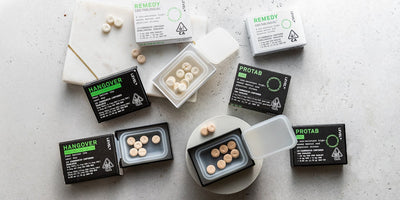
Hemp THC Businesses Face a Federal Cliff in November 2026
Photo by Erin_Hinterland via Pixabay.
For about seven years, hemp-derived THC businesses operated on what felt like solid legal ground. A dispensary in a dry county, a gas station cooler stocked with THC seltzer, a gummy jar shipped straight to a customer's door in a state with no adult-use program at all — all of it traced back to a single sentence in the 2018 Farm Bill. That sentence is no longer doing the work people thought it was doing, and the industry now has a hard date circled on the calendar.
This isn't a fight over rescheduling marijuana, the kind of debate that's dragged on for years with no resolution in sight. It's a fight over definitions — over what Congress decides counts as hemp versus what gets treated as Schedule 1 marijuana under the Controlled Substances Act. Change the definition, and you change which products are legal overnight, no DEA rulemaking required.
That's exactly what happened. A single provision tucked into the spending bill that ended the record-length government shutdown rewrote the federal hemp definition, and it did so with almost no public debate about the products it would affect. A multibillion-dollar market built on delta-8 vapes, THCA flower, and hemp seltzer now has a federally mandated expiration date. Unless something changes in Washington or in state capitols between now and then, November 12, 2026 is the day a huge share of what's currently sitting on store shelves becomes, legally speaking, marijuana.
From the 2018 Farm Bill to the 2025 Reversal

Photo by Mark Stebnicki via Pexels.
From 1970 until 2018, the federal government drew no legal distinction between hemp and marijuana. Both fell under the Controlled Substances Act's Schedule 1 definition of cannabis, meaning a hemp rope manufacturer and a marijuana grower were technically operating under the same prohibited category, at least on paper. That changed with the 2018 Farm Bill, which carved hemp out of Schedule 1 entirely by defining it as cannabis containing no more than 0.3% delta-9 THC by dry weight.
The 0.3% threshold was written with fiber and grain crops in mind, not intoxicating products. But it created an opening nobody in Congress seemed to anticipate: it only restricted delta-9 THC, not the dozens of other cannabinoids and isomers that can be extracted or synthesized from hemp biomass. Chemists and product developers moved quickly, converting CBD into delta-8 THC, isolating THCA, and formulating vapes, gummies, and beverages that delivered a real high while staying technically compliant with the delta-9 limit.
That loophole didn't stay small. It became the foundation for a hemp-derived cannabinoid market now worth billions of dollars annually, selling through gas stations, smoke shops, and online retailers in states that never legalized recreational marijuana. Regulation of that market was thin to nonexistent in most states, which is part of what made it attractive to operators and alarming to public health officials and licensed cannabis operators alike.
The reversal came fast and with little warning. On November 12, 2025, President Trump signed P.L. 119-37, a full-year fiscal 2026 Agriculture appropriations act, as part of the broader deal that ended the record government shutdown. Buried in that bill as Section 781 was language rewriting the federal definition of hemp — closing the loophole that had let the industry flourish for the better part of a decade.
What the New Hemp Definition Actually Requires

The new 2025 law replaces the old dry-weight threshold with a fixed 0.4mg total THC limit per container, meaning even legal hemp products face stricter, absolute THC caps rather than a percentage-based measure.
The new definition attacks the loophole at its root by switching the measurement standard from delta-9 THC alone to total THC. That single change matters more than it might sound like it does, because it eliminates the workaround that made products like THCA flower and delta-8 vapes technically legal in the first place — you can no longer engineer a product around one THC isomer while ignoring the rest.
In practical terms, the law caps legal hemp products at less than 0.4 milligrams of total THC per container. That's a container limit, not a percentage-by-weight limit, and it's a dramatically lower bar than what most current hemp THC products contain. A typical hemp seltzer or gummy sold today often carries several milligrams of THC per serving, let alone per container — orders of magnitude above the new threshold.
The law also closes off another avenue manufacturers had been using: it excludes any cannabinoid that Cannabis sativa L. can't naturally produce, and it excludes anything manufactured synthetically outside the plant itself. That knocks out a range of lab-converted and novel cannabinoids that had been marketed as hemp-derived even though their connection to the actual plant was mostly chemical rather than botanical.
The trade group U.S. Hemp Roundtable has estimated that roughly 95% of hemp-derived cannabinoid products currently on shelves would fail to meet this new standard. That's not a marginal disruption — it's close to the entire existing product category.
Congress did build in a runway. Enforcement doesn't begin at signing; it's deferred 365 days from enactment. That gives the industry until November 12, 2026 before non-compliant hemp products are treated, under federal law, as Schedule 1 marijuana rather than as hemp.
The Legislative Scramble to Push Back the Deadline

Photo by Samuel Schroth via Unsplash.
The industry didn't wait long to push back. Rep. Jim Baird (R-IN), joined by Reps. James Comer and Angie Craig, introduced the Hemp Planting Predictability Act, H.R. 7024, on January 13, 2026. The bill would stretch the compliance window from 365 days to three years, moving the effective deadline from November 2026 to November 12, 2028. A companion bill in the Senate, backed by an unusual coalition of Amy Klobuchar, Rand Paul, and Jeff Merkley, mirrors that same three-year extension.
Neither bill has moved with any urgency. As of July 20, 2026, both remain stuck at the committee stage — H.R. 7010, a related House measure, has sat in the House Agriculture Committee without action since January 12. Momentum for a straightforward delay hasn't materialized the way the hemp industry hoped it would.
The broader farm bill process delivered a partial answer, and it wasn't the one hemp operators wanted. The House passed the Farm, Food, and National Security Act of 2026 on April 30, 2026, by a 224-200 vote. But the House Agriculture Committee had already stripped out a proposed two-year delay on the hemp THC ban before the bill reached the floor. Committee Chairman Glenn Thompson argued that farm bill policy should govern agricultural production, not finished consumer products sold at retail — a distinction that effectively separated the fate of hemp farmers from the fate of hemp THC product manufacturers. A subsequent amendment from Rep. Comer proposing a one-year delay also failed to survive into the final House-passed version.
That leaves the question sitting with the Senate, where no clear resolution has emerged yet. Whether a delay gets attached to a Senate farm bill, passed as standalone legislation, or dies on the vine entirely is still an open question, and it's one the industry is watching closely.
States Are Already Choosing Sides

Photo by Andrew Patrick Photo via Pexels.
Washington isn't the only venue where this fight is happening, and businesses that focus exclusively on the federal timeline are missing half the picture. Federal hemp law functions as a floor, not a ceiling — states remain free to regulate hemp THC products more strictly than federal law requires, or to ban them outright, regardless of whatever Congress eventually decides.
Ohio has already shown what that looks like in practice. Senate Bill 56, enacted in December 2025, imposes a categorical statewide ban on intoxicating hemp products, arriving well ahead of the federal enforcement date and independent of how the congressional delay fight resolves. It's a preview of what other legislatures may do rather than wait on Washington.
The reaction in Ohio has been immediate. A coalition calling itself Ohioans for Cannabis Choice has organized to pursue a repeal of the ban, arguing it goes too far and threatens legitimate small businesses along with the products regulators actually intended to target. Whether that effort succeeds or not, it signals that this fight is going to play out state by state as much as it plays out in congressional committee rooms.
That has real consequences for how business owners should think about risk. A Senate bill delaying federal enforcement to 2028 would do nothing to unban products in a state that has already prohibited them outright — and conversely, a state that currently allows hemp THC sales could tighten its own rules well before the federal deadline arrives. Neither level of government is waiting for the other to move first.
Given how quickly this landscape is shifting, operators, investors, and retailers need to check current state and local rules before making any decision involving inventory purchases, licensing applications, or new capital investment. What was compliant six months ago in a given state may not be compliant today, and what's compliant today may not survive the next legislative session.
Strip away the uncertainty over exact dates and vote counts, and one thing is now clear: Congress has decided the 2018 loophole was a mistake, and it isn't going back. Whether the enforcement deadline lands in 2026 or gets pushed to 2028, the destination is the same — a total THC cap measured in fractions of a milligram, and a legal definition of hemp narrow enough to exclude nearly everything currently marketed as a hemp-derived high.
Businesses whose entire model depends on the old delta-9-only definition should treat a further delay as a possibility worth watching, not a plan worth building around. Reformulating toward genuinely low-THC products, pursuing state cannabis licensure where it's available, or diversifying into CBD and other non-intoxicating hemp categories are the kinds of moves that make sense regardless of how the Senate votes. Betting the business on another last-minute legislative rescue is a bet against a trend that's been moving in one direction since November 2025.
Keep an eye on two tracks at once. The Senate's handling of the farm bill and any standalone delay legislation will set the federal baseline, but state legislatures — as Ohio just demonstrated — can move faster and hit harder than Congress. Either one could redraw this market before the other finishes debating it, and the businesses that survive this transition will be the ones tracking both.
Sources
- The Farm Bill Loophole Is Closing: What It Means for Hemp-Derived THC | Herb
- Changes to “Hemp” Definition Set to Close the Farm Bill Loophole
- Hemp loophole
- The Redefinition of “Hemp” Under Federal Law: Regulatory Status, Legislative Developments, and Pending Industry Challenges - Frier Levitt Federal Redefinition of Hemp: New THC Limits, GLP-1 Industry Impact & 2026 Compliance Risks
- PAGE | 1 CLOSING THE HEMP LOOPHOLE: