The Botany of a Bad Law: How CBD-to-THC Conversion Broke Cannabis
Photo by DavidCardinez via Pixabay.
Walk into any gas station in a state with no cannabis program and you can still buy something that gets you high. Not synthetic marijuana from a decade ago, not something smuggled across a border — a product derived from federally legal hemp, sold openly, taxed lightly if at all, and regulated by almost nobody. This didn't happen because prohibition failed to suppress demand. It happened because prohibition succeeded in distorting the market so badly that chemists found a loophole wide enough to drive a tanker truck through.
The loophole has a precise dimension: 0.3%. That's the delta-9 THC threshold separating legal hemp from a Schedule I narcotic under federal law. On one side of that line sits an agricultural commodity you can ship across state lines without a second thought. On the other sits a felony in many jurisdictions. The gap between what that plant costs to grow and what the intoxicating product it can become sells for is where this entire crisis lives. Understanding how that gap got there — and how badly it's been exploited — starts with a number that was never supposed to carry this much weight.
Part I: The Botany of a Bad Law

Photo by Budding . via Unsplash.
Start with the taxonomy, because it's the part almost nobody gets right. Hemp and marijuana are not different plants, not different subspecies, not even different chemotypes in any rigorous botanical sense. Both are Cannabis sativa L. The seed you plant to grow fiber-and-grain hemp and the seed you plant to grow a THC-heavy cultivar can, genetically, be remarkably close. What separates them in the eyes of the law is a single cannabinoid percentage, and that percentage has a surprisingly thin scientific pedigree.
The 0.3% figure traces back to a 1976 paper in the journal Taxon, written by botanists Ernest Small and Arthur Cronquist, who were trying to build a workable classification system for distinguishing drug-type and fiber-type cannabis. Small and Cronquist picked 0.3% as a convenient cutoff for young leaf tissue — not flower, not the finished product anyone would actually consume — and said plainly that the number was an arbitrary quantitative distinction. Small has repeated that admission for decades since, including in a 2016 paper in the journal Agronomy, and he's gone on record advocating that the legal threshold be raised to 1% to better reflect how the plant actually behaves in the field.
None of that stopped Congress. When lawmakers wrote the 2018 Farm Bill, they lifted the 0.3% delta-9 THC figure wholesale and turned a botanist's classroom shorthand into binding federal law, with no pharmacological research, no toxicology, no health-outcomes data attached to it. The practical result is absurd on its face: a flower testing at 0.29% THC is a legal hemp product you can mail across state lines, while a nearly identical flower from the same plant testing at 0.31% is a Schedule I controlled substance. That 0.02% gap is smaller than the margin of error in routine lab testing. And because the 2018 bill defined hemp only by delta-9 THC concentration, it left every other psychoactive cannabinoid — delta-8, delta-10, THC-O, and whatever chemists dream up next — sitting outside the definition entirely, unregulated by default rather than by design.
Part II: The Economics of Oversupply

Photo by Mark Stebnicki via Pexels.
Farmers didn't need much convincing. After years of collapsing soybean prices and a trade war that gutted export markets, the 2018 Farm Bill's legalization of hemp cultivation looked like salvation. Tens of thousands of new acres went into CBD-rich hemp varieties in 2018 and 2019, planted at a pace one agricultural economist described as frenzied, chasing prices that seemed too good to pass up.
The boom lasted about two growing seasons. CBD isolate that sold for more than $10,000 per kilogram in 2018 was trading under $1,000 per kilogram by 2020, as supply overran a market that simply didn't have enough buyers for that much raw cannabinoid. Hemp biomass followed the same curve, falling from a high of $40 per pound to somewhere between $10 and $15 per pound by early 2021. Some growers, by their own accounts, couldn't even give the stuff away.
The bottom hasn't really recovered since. Current wholesale pricing for CBD isolate sits around $900 to $950 per kilogram for smaller purchases, but drops to somewhere between $280 and $375 per kilogram for commercial buyers taking 51 to 100 kilograms at a time. Anything priced below $250 per kilogram deserves real suspicion — that's usually a sign the material has been synthetically altered and isn't the clean, plant-derived isolate it's marketed as. What this pricing history left behind was a glut of cheap, structurally intact cannabinoid with no legitimate outlet and a market fully primed to look for one.
Part III: The Chemistry of Transformation

Photo by Mikhail Nilov via Pexels.
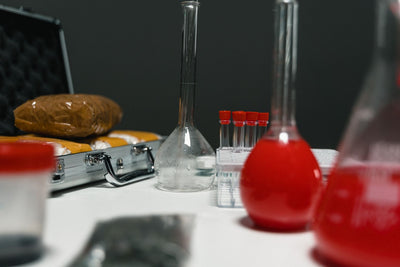
The chemistry that turned that glut into a business isn't exotic. Converting CBD into a psychoactive THC isomer requires an acid catalyst and heat to close the molecule's ring structure — a transformation documented in academic literature since the 1940s, long treated as a chemistry-class curiosity rather than a commercial process.
The typical method refluxes CBD in an organic solvent like toluene or heptane, combined with a strong acid such as p-toluenesulfonic acid, run for roughly 60 to 90 minutes. Which catalyst you choose determines what comes out the other end — steer the reaction one way and you get delta-8-THC, steer it another and you get delta-9-THC. On paper, in a controlled lab with proper purification steps, this is legitimate synthetic chemistry, no different in principle from plenty of pharmaceutical processes.
In practice, it's being run by people who picked up the recipe from online forums rather than a chemistry degree. Kyle Boyar, a research associate at UC San Diego's Center for Medicinal Cannabis Research, put it bluntly: a lot of the production happening right now is irresponsible, because the people doing it aren't trained chemists and are working from forum posts instead of standard operating procedures. That distinction — trained chemist with proper purification versus hobbyist with a hot plate and a forum thread — is the difference between a controlled reaction and a batch of unknown contamination heading straight for a vape cartridge.
Part IV: The Profits That Drive the Machine

Photo by Sierra Alpha Juliet via Unsplash.
Money explains why this keeps happening. Cheap hemp flower, whether sourced domestically from low-grade CBD and CBG crops or imported from countries with minimal production costs, can be sprayed with concentrated cannabinoid oil and sold at prices that mimic premium cannabis — margins that dwarf almost anything else in agriculture.
Look at what legitimate cannabis actually costs. In Colorado, one of the country's most mature legal markets, wholesale bud prices fell below $607 per pound in 2026, down from $1,414 per pound in 2021 — nearly a 60% drop in five years. Yet top-shelf flower still retails for $200 to $300 an ounce or more in dispensaries, and a gram of quality concentrate can run $30 to $60. Meanwhile smokable CBD flower averaged about $144 per pound wholesale in 2023, and by 2026 some hemp biomass was trading for as little as $0.22 per percentage point of CBD per pound — essentially given away. Spray that biomass with converted THC distillate and sell it at cannabis-adjacent prices, and the arbitrage writes itself. Delta-8 vape cartridges retail for $15 to $35, with some brands undercutting even that at $9.99, built on converted isolate that costs a fraction of what legitimately cultivated distillate runs.
Colorado regulators have a name for the version of this that infiltrates the licensed market: inversion, meaning hemp-derived THC gets laundered into regulated marijuana sales channels. One Colorado cultivator has sued, alleging regulators failed to stop what he called a blueprint for laundering marijuana into the legal system, costing the state millions in tax revenue. Industry analysts expect that once federal oversight tightens, net wholesale margins on these derivative products could shrink 30% to 50% over the next 18 months — a number that tells you plainly how much of today's profit is regulatory arbitrage rather than real value creation.
Part V: The Chemical Soup and the Guinea Pigs

Photo by Pavel Danilyuk via Pexels.
Run a lab test on a random delta-8-THC product and you'll often find up to 30 chromatographic peaks nobody can identify. Peaks that correlate with delta-9 and delta-10 THC show up too, regardless of what the label claims. This isn't a minor labeling inconsistency — it's evidence that a lot of finished product coming off these production lines is chemically undefined.
Michael Coffin, chief scientist at Elevation Distro, says his concern isn't really the THC isomers themselves. Delta-8, delta-9, and delta-10 don't appear to carry unique risks on their own, as far as anyone currently knows. What worries him is what he calls the ubiquitous unknowns — the byproducts left behind when someone doesn't bother cleaning up their reaction properly, producing what he describes as a chemical soup of unwanted compounds riding along with the THC.
Christopher Hudalla, president and chief scientific officer of ProVerde Laboratories, is more direct about what that means for the person buying the product: nobody really knows what these things are, and consumers are effectively being used as guinea pigs, which he calls horrific. The reactions themselves use aggressive synthetic conditions — strong acids, sometimes bases to neutralize them, occasionally metal catalysts — the kind of chemistry that in a pharmaceutical setting would come with PhD-level oversight, residual solvent testing, and pH verification. None of that oversight exists here as a matter of routine. Olivetol, a THC precursor that turns up regularly as a byproduct in delta-8 products, illustrates the gap well: there's a patent describing oral olivetol formulations, but as Boyar notes, nobody actually knows what a safe inhalation dose looks like, because nobody has studied it.
Part VI: The Counterfeit Flower Epidemic

Photo by Terrance Barksdale via Pexels.
The isomerization chemistry created cheap isolated cannabinoids looking for a use. What emerged next was worse in some ways, because it targets the part of the market people trust most: the flower itself.
The process is almost industrial in its simplicity. Producers start with cheap hemp biomass that already has the right structure, look, and terpene profile — it just lacks the THC. They warm a spray oil, which can range from converted cannabinoids to fully synthetic blends of extreme potency, to reduce its viscosity, then apply it to the flower using a specialized distillate gun that works essentially like a paint sprayer. Once coated, the flower gets rolled in kief to fake the appearance of natural trichomes, then cured — often in a freeze dryer — so it doesn't brown and keeps that frosty, top-shelf look.
The finished product is frequently impossible to distinguish from natural high-THC cannabis, even for experienced consumers who think they know what they're looking at and smelling. That's precisely what makes it dangerous: nothing about the product's appearance tips off the buyer to what's actually been applied to it.
And what's applied can be genuinely severe. Some synthetic cannabinoids used in these sprays are 30 to 40 times more potent than natural THC, and uneven application means a consumer might take one hit expecting a normal cannabis experience and get something far stronger than anticipated. European researchers investigating synthetic cannabinoids sprayed onto industrial hemp have linked the practice to psychosis, seizures, cardiac arrhythmias, and deaths — outcomes that have essentially no precedent in the history of natural cannabis use.
Part VII: The Health Toll

Photo by Pavel Danilyuk via Pexels.
Nobody has a full picture of what chronic exposure to these compounds actually does, but the fragments of research that do exist aren't reassuring. Delta-8-THC products have been associated with hallucinations, sedation, tremor, anxiety, dizziness, confusion, visual distortions, and in some reported cases loss of consciousness — symptoms well outside what most people associate with a cannabis high.
Laboratory work adds another layer of concern. Studies using mouse models and human cell cultures have found that cannabinoid vaping products can alter immune response and cause severe lung damage, raising the same category of question that surrounded the vaping-related lung injuries of a few years back, this time with a different set of unregulated inputs.
Heavy, high-potency use carries its own separate risk profile. Chronic exposure to THC-rich products has been linked to cannabinoid hyperemesis syndrome, a condition marked by cyclic, severe vomiting and abdominal pain that can be difficult to diagnose because it mimics other gastrointestinal disorders. Adolescent exposure appears particularly consequential — research has tied frequent cannabis use during that developmental window to lower hippocampal volume and impaired neural connectivity, the kind of finding that should give pause to anyone treating these products as harmless novelties.
The FDA itself has weighed in, warning that hemp chemically converted into THC may carry harmful byproducts left over from whatever chemicals were used in the conversion process. A review of the agency's adverse event data from 2018 through 2021 found roughly triple the number of reported incidents tied to delta-8 THC compared to delta-9 THC — a striking gap given that delta-9 is the more heavily used and better-studied cannabinoid of the two.
Part VIII: The Regulatory Chaos

Photo by ale.studio_17 . via Pexels.
Federal law finally caught up, at least on paper. On November 12, 2025, the Continuing Appropriations Act, 2026 was signed into law, and Section 781 rewrote the legal definition of hemp. Instead of measuring only delta-9 THC, the new standard counts total THC — including THCA — capped at 0.3% on a dry-weight basis, and it excludes cannabinoids that aren't naturally produced by the cannabis plant, directly closing the delta-8 loophole that the 2018 bill left open. The law also sets a 0.4 milligram total THC ceiling per finished container, a provision set to take effect November 12, 2026.
The politics behind the change are notable. Rep. Andy Harris and Sen. Mitch McConnell backed it, and McConnell's involvement is the more striking detail — he was the chief architect of hemp legalization in the 2018 Farm Bill, and he's now describing the intoxicating hemp market that grew out of it as an exploited loophole rather than the outcome he intended.
None of this is settled yet. The Senate Agriculture Committee's markup failed by a vote of 10-11 on August 6, and two days later the full Senate passed a 90-6 stopgap delaying the ban until December 11, 2026 — conveniently past the midterm elections. Rep. Andy Barr is meanwhile circulating a competing bill, the Lawful Hemp Protection Act, which would raise the threshold to 1% and add FDA and TTB oversight rather than banning intoxicating hemp products outright. With the intoxicating hemp sector valued somewhere around $28.4 to $28.8 billion and supporting an estimated 300,000 jobs, it's not hard to see why lawmakers are reluctant to pull the plug abruptly. What's harder to justify is the ongoing turf war between the hemp and cannabis industries over banking access and lobbying priorities — a fight that mostly benefits prohibitionists and does nothing for either side.
Part IX: A Reflection on What We've Lost

Photo by Kym via Pexels.
Step back and the whole episode reads like a case study in what happens when a promising agricultural product collides with confused regulation and an industry willing to exploit every inch of ambiguity. The fallout is concrete: a market saturated with chemically undefined products, a therapeutic industry that spent years building consumer trust now associated with mystery vape carts and sprayed flower, and a legitimate hemp farming sector that got wrecked by oversupply before it ever had the chance to mature.
None of this had to happen because the underlying chemistry is dangerous. Isomerization, run properly in a regulated pharmaceutical or research setting, could be a legitimate tool for producing medicines or studying cannabinoid pharmacology in ways that actually benefit patients. What made it dangerous was the setting it got run in instead — a regulatory void with no purification standards, no chemist oversight, and no consequence for cutting corners.
The plant hasn't changed. Cannabis in its natural form remains what it has always been: a substance with an extraordinarily low risk profile, used safely across cultures for thousands of years, with no recorded overdose deaths in that natural form. What changed is a legal framework that insists one plant is actually two substances, based on a threshold nobody who created it ever claimed was scientifically meaningful.
Congress has now acknowledged, in writing, that the 2018 loophole was real — closing it through the total-THC redefinition and the per-container THC cap is proof of that. But acknowledgment isn't resolution. The ban keeps getting delayed, a competing bill wants to raise the threshold instead of tightening it, and an industry worth close to $29 billion has every incentive to keep the fight going through the next election cycle and beyond.
Until that standoff actually resolves, into either a coherent single framework for the whole cannabis plant or at minimum a hemp definition with real testing and purification standards behind it, the person buying a vape cartridge at a gas station or a jar of frosty flower at a smoke shop is still the one absorbing the risk. Not the manufacturer, who's pocketing margins built on a loophole rather than on quality. Not the lawmakers, who get to look tough on drugs while punting the actual decision past the midterms. The consumer. As always with this plant's regulatory history, whichever state or country you're in will have its own rules governing what's legal to buy and possess, and those rules are shifting fast enough right now that it's worth checking the current status before you assume anything — but no matter where you live, it's worth asking exactly what's in the product before you assume the label is telling you the truth.
Sources
- Congress Narrows Federal Definition of 'Hemp,' Effectively Banning Most Intoxicating Hemp Products | Regulatory Oversight
- 2026 Federal Hemp Ban: What It Means for the Future of Consumable Hemp Products • Vicente LLP
- The Redefinition of “Hemp” Under Federal Law: Regulatory Status, Legislative Developments, and Pending Industry Challenges - Frier Levitt Federal Redefinition of Hemp: New THC Limits, GLP-1 Industry Impact & 2026 Compliance Risks
- Changes to the Statutory Definition of Hemp and Implications for Agricultural Policy | Congress.gov | Library of Congress
- Changes to the Federal Definition of Hemp: Legal Considerations Under the Controlled Substances Act | Congress.gov | Library of Congress