Treatment Admissions for Marijuana Highest in States Where It's Illegal
Photo by sergeitokmakov via Pixabay.
Paul Armentano, deputy director of NORML, published an op-ed last month taking direct aim at a wave of news coverage warning that cannabis addiction is on the rise. His argument rests on a simple but underreported fact: federal treatment data actually shows the opposite trend. According to the Substance Abuse and Mental Health Services Administration, the share of Americans entering treatment programs for marijuana has dropped by roughly 20 percent between 2020 and 2024. And when you break that data down by state, the places sending the most people into cannabis treatment aren't the states where weed is legal and widely used -- they're the states where it's still against the law.
That inversion is the whole story here. If cannabis were becoming more addictive, or if more people were struggling with problematic use, you'd expect treatment admissions to track with consumption -- rising in states with mature legal markets and high usage rates. Instead, the states topping the list for marijuana treatment admissions are Alabama, Florida, Georgia, Iowa, Indiana, and Texas, none of which allow adult-use sales. That's not a coincidence, and it points to a much messier relationship between arrest policy, court mandates, and what actually gets counted as an addiction statistic. The question worth sitting with is whether rising diagnosis rates in one dataset and falling treatment numbers in another are actually measuring the same thing at all.
What the New SAMHSA Data Actually Shows

Photo by SHVETS production via Pexels.
The report driving this conversation comes from SAMHSA's Treatment Episode Data Set, or TEDS, which tracks admissions to publicly funded substance abuse treatment facilities nationwide. Released last month, the newest figures confirm a pattern that's been building for half a decade: the percentage of treatment admissions where marijuana is listed as the primary substance has fallen steadily since 2020, landing about 20 percent lower by 2024. For context, TEDS data also shows that more than four times as many people are admitted annually for alcohol use disorder as for marijuana, which puts the relative scale of the two substances in perspective even as alcohol remains fully legal everywhere in the country.
What makes TEDS tricky to interpret is that it counts treatment episodes, not diagnosed addiction cases and certainly not self-identified ones. Someone shows up as a marijuana treatment admission whether they walked in voluntarily because they felt their use had become unmanageable, or whether a judge ordered them into a program as a condition of probation. The dataset doesn't distinguish motive, only outcome. This isn't a new wrinkle either -- a similar TEDS dataset from 2021 and a separate CDC report on adolescent treatment admissions from 2020 both documented the same downward trend in states with legal markets, suggesting this isn't a one-year blip but a consistent, multi-year signal that something structural is going on beneath the topline numbers.
Why Illegal States Have More 'Addicts' on Paper

Photo via Unsplash.
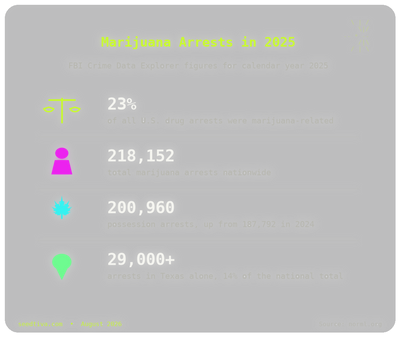
Here's the part that rarely makes it into headlines: cannabis treatment admissions in the United States are driven overwhelmingly by the criminal justice system, not by people seeking help on their own initiative. Look at where admissions are highest -- Alabama, Florida, Georgia, Iowa, Indiana, and Texas -- and you're looking at a list of states where simple possession remains a criminal offense. In 2025, police in those six states alone made more than 70,000 marijuana possession arrests, accounting for roughly 65 percent of all such arrests nationwide. That's a staggering concentration in a country where a majority of states have legalized cannabis in some form.
Those arrests don't just disappear into court dockets. In many of these jurisdictions, judges routinely offer defendants a choice between enrolling in a treatment program or facing jail time, regardless of whether the person shows any clinical signs of problematic cannabis use. Someone caught with a small amount of marijuana who has never had a substance use problem in their life can end up mandated into the exact same treatment pipeline as someone genuinely struggling with dependency. Both get logged identically in the TEDS system as a marijuana treatment admission.
That distinction matters enormously for how we read the data. It means the states with the highest admission numbers aren't necessarily the states with the worst cannabis use disorder rates -- they're the states with the most aggressive possession enforcement and the most court diversion programs built around a treatment-or-jail ultimatum. The treatment count, in other words, is functioning as a downstream measurement of policing priorities more than a measurement of public health.
Legal States Tell a Different Story

Alabama, Florida, Georgia, Iowa, Indiana, and Texas each recorded an identical 70,000 marijuana possession arrests in 2025, showing no state stood out despite differing marijuana laws.
Flip the picture around and look at states with established legal markets and minimal cannabis possession enforcement, and the numbers tell a very different story. Massachusetts and Washington, both long-running legal adult-use states, show among the lowest marijuana treatment admission rates in the country. If legalization simply unleashed a wave of heavier use and more addiction, as some critics predicted it would, you'd expect these states to be near the top of the list. They're not.
The more plausible explanation is that legalization eliminates the very pipeline that inflates admission numbers elsewhere. Without criminal possession charges, there's no arrest, no court date, and no judge offering a treatment-or-jail bargain. People who use cannabis in these states and never run into legal trouble simply never enter the TEDS dataset at all, whether or not their use would technically meet clinical criteria for a use disorder. Meanwhile, people who do seek voluntary treatment in legal states are presumably doing so because they actually want help, which arguably makes for a cleaner, more honest signal, even if it's a smaller one.
This raises an uncomfortable question for anyone trying to use treatment admission statistics as evidence in the legalization debate: what exactly are these numbers capable of telling us? They can tell you a lot about how aggressively a state polices marijuana and how its courts handle diversion. They can't tell you, on their own, how many people in that state are actually struggling with cannabis use disorder, because the population getting counted was selected by police and prosecutors, not by clinicians or by the individuals themselves.
The JAMA Study Behind the Headlines

Photo via Pexels.
None of this happens in a vacuum. A study published in JAMA Psychiatry on August 19, 2026, analyzed National Survey on Drug Use and Health data from 2021 through 2024 and found real increases in cannabis use disorder prevalence alongside rising overall use. Among men, CUD prevalence climbed from 7.3 percent to 9.3 percent as the share reporting cannabis use rose from 22.2 percent to 25.7 percent. Among women, the increase was smaller but still notable, moving from 4.5 percent to 5.6 percent over the same stretch. Those figures aren't nothing, and they're the numbers that outlets like the New York Times leaned on in coverage warning that legalization is quietly driving up addiction rates nationwide.
Armentano's op-ed doesn't dispute that the JAMA numbers are real or that cannabis use disorder exists as a clinical phenomenon -- it clearly does, and more people using cannabis will mathematically produce more people who develop problematic patterns of use. His argument is narrower and, frankly, harder to dismiss: the SAMHSA treatment data complicates any simple story about that rise translating into more people needing or seeking help. If use disorder prevalence is genuinely climbing per the NSDUH survey data, but actual treatment admissions are falling and are concentrated almost entirely in prohibition states with aggressive enforcement, then something other than a straightforward addiction crisis is shaping who ends up in a treatment chair. The two datasets aren't necessarily contradicting each other so much as measuring completely different populations for completely different reasons.
The Rescheduling Backdrop

Photo via Pexels.
This debate is landing at a politically loaded moment. President Trump signed Executive Order 14370 on December 18, 2025, directing federal agencies to expedite the process of moving cannabis from Schedule I to Schedule III. As of April 2026, that rescheduling still hadn't been finalized, and Rep. Steve Cohen has been pressing federal officials publicly for a concrete timeline on when it might actually happen. A hearing scheduled to begin in June 2026 could turn out to be the moment that determines whether marijuana finally gets reclassified.
Data like the SAMHSA treatment figures and the JAMA use disorder findings isn't just academic in this environment -- it's ammunition. Advocates for rescheduling and broader reform can point to falling treatment admissions and the concentration of those admissions in prohibition states as evidence that continued criminalization, not the drug itself, is generating a lot of the harm currently attributed to cannabis. Opponents of loosening restrictions can point to the JAMA study's rising use disorder prevalence as evidence that legalization is quietly worsening public health outcomes. Expect both datasets to keep getting cited selectively as this plays out over the coming months.
Worth remembering here: cannabis possession laws and enforcement intensity vary enormously from state to state, and in some cases county to county, regardless of what happens at the federal scheduling level. Anyone reading this in a state with strict possession laws still on the books should check current local statutes before assuming rescheduling changes anything about personal legal exposure where they live.
Treatment admission counts make for a lousy proxy of addiction prevalence when the people filling out the intake forms are frequently there because a judge told them to be, not because they diagnosed themselves. That's the uncomfortable truth sitting underneath this whole dataset. A number that looks like a public health metric is, in a meaningful chunk of cases, actually a policing metric wearing a public health metric's clothing.
The real debate isn't whether cannabis use disorder is a genuine clinical condition -- the JAMA data makes clear it is, and its prevalence appears to be rising alongside broader use. The real debate is whether prohibition itself, through arrest-to-court-to-treatment pipelines concentrated in a handful of states, is artificially inflating the very statistics that get cited to justify keeping cannabis illegal in the first place. That's a circular argument if there ever was one: criminalize the drug, funnel arrestees into mandated treatment, then point to treatment admission numbers as proof the drug is dangerous enough to keep criminalizing.
As rescheduling deliberations grind forward through 2026, expect this pattern to repeat -- both sides citing datasets that are technically accurate but measuring fundamentally different things. The useful habit for readers to build isn't skepticism toward every statistic, it's the simple discipline of asking who got counted, how they ended up in the count, and whether that population actually represents what the headline claims it does.
Sources
- Drug Treatment Admissions For Marijuana Are Highest In States Where It Remains Illegal, New Federal Report Shows (Op-Ed) - Marijuana Moment
- States Where Marijuana Is Illegal Typically See Higher Rates Of Treatment Admissions, Federal Study Says - Marijuana Moment
- How do marijuana laws differ between states? | USAFacts
- Marijuana Moment - All your cannabis news, in one place
- The Federal Status of Marijuana and the Policy Gap with States | Congress.gov | Library of Congress