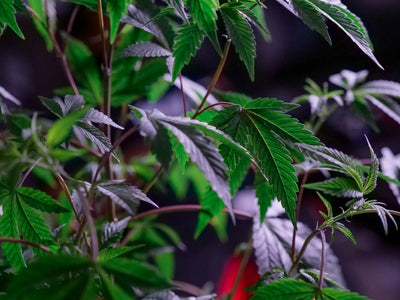
Minor Cannabinoids and the Rise of Precision Dosing
Photo by Dad Grass via Pexels.
Walk into a dispensary in Denver or Sacramento right now and the shelf logic has quietly changed. Six years ago you were shopping by strain name and THC percentage -- Gorilla Glue at 28%, some sativa-leaning cross promising energy because a budtender said so. Today there's a growing shelf of products that don't mention a strain at all. They say Sleep. Calm. Focus. Recover. The cannabinoid list on the label has gotten longer -- CBN, CBG, THCV, CBDa -- and the THC number has quietly moved to the fine print.
The dollars still tell an old story for now. THC-only edibles hold roughly 68% of edible dollar share, about $1.95 billion, according to BDSA data reported via Cannabis Science and Technology. That's not a category in decline. But the growth is happening at the edges: CBD-containing edibles grew 25.8% to $149.3 million, CBG-containing edibles grew 18.4% to $89.5 million, and niche formats built around CBN for sleep have expanded even faster in specific state markets. Industry analysts are increasingly calling 2026 the pivot year -- the point where effect-based shopping starts outpacing strain-based and potency-first shopping as the primary way consumers navigate the shelf.
Here's the tension worth sitting with before getting excited about any of this: consumers are already shopping as if precise, cannabinoid-specific dosing for sleep or focus is a settled science. It isn't. The clinical research trying to justify those claims is younger than the marketing built on top of it, and in places it's barely a year old.
The Sales Data Behind the Shift

CBN edibles saw the most dramatic surge, jumping 525% from 2020 to 2025, far outpacing growth in CBD (25.8%) and CBG (18.4%) edibles, though THC-only products still command 68% of dollar share.
Start with what the receipts actually say, because the receipts are the least speculative part of this story. BDSA's data, as reported through Cannabis Science and Technology, puts THC-only edibles at $1,954.6 million in dollar sales -- 68% of the edibles category. That's still the dominant format by a wide margin, and it isn't going anywhere soon; most cannabis consumers, most of the time, are still buying a gummy or chocolate bar for the THC.
But look at where the growth curve is steepest. CBD-containing edibles grew 25.8% to $149.3 million. CBG-containing edibles, a much newer and smaller category, grew 18.4% to $89.5 million. Neither is close to challenging THC-only products on total dollars, but both are growing faster than the category average, which is the more telling number for anyone trying to spot where demand is heading rather than where it currently sits.
Sleep products are the clearest signal inside this trend. BDSA analyst data cited by Stahura shows sleep-focused products grew 18% in sales year-over-year, with unit sales up 27% -- meaning people are buying more individual units, not just paying more per unit -- and the number of distinct sleep SKUs on shelves up 25%. Retailers are stocking more sleep options because shoppers are actively seeking them out by name.
The most dramatic single data point comes out of California's regulated market, where CBN edibles grew from about 4% of the edibles category in 2020 to roughly 25% by 2025, per SFGate reporting -- a 525% jump in category share over five years. CBN has essentially no strong controlled-trial evidence in humans specifically proving sedative superiority over other cannabinoids at typical consumer doses, yet it went from a rounding error to a quarter of an entire product category on the strength of consumer word-of-mouth and marketing framing it as the sleep cannabinoid.
Put together, this is a market voting with dollars for function over the old flower-and-potency hierarchy. Nobody is asking these buyers to file a clinical trial first. They're asking whether the gummy worked last night, and enough of them are answering yes to move real market share in five years.
From Strain Names to Effect Labels

Photo by Elsa Olofsson via Pexels.
The language on packaging has shifted faster than most people tracking this industry expected. Go North Hemp's market analysis and Mordor Intelligence's cannabis-sector research both describe 2026 as the year effect-based shopping displaces strain-based shopping as the dominant purchase logic -- not a prediction decades out, but a call about the shelf you're standing in front of this year.
What that looks like in practice: brands are blending CBG, CBC, CBDa, and THCV alongside specific terpenes -- myrcene for sedation, limonene for uplift, pinene for alertness -- into named daytime and nighttime formulas. The pitch isn't 22% THC anymore. It's a stated combination engineered for a stated outcome, sold with the confidence of a supplement stack rather than a recreational product.
Mordor Intelligence frames this as a shift from broad cannabinoid branding -- essentially, more cannabinoids as a generic premium signal -- toward a segmented strategy tied to specific patient or consumer needs and an expectation of precise, repeatable dosing. That's a meaningful distinction. Broad branding says this product has more compounds in it. Segmented branding says this product does this specific thing to your nervous system, at this dose, reliably.
The counter-case matters here too, and it's not small. Strain names haven't disappeared, and they won't. Consumers still use them as a mental shortcut built over years of trial and error -- Blue Dream means something to a regular buyer that no ingredient panel replaces overnight. And the terpene and cannabinoid labeling itself is inconsistent across state-regulated markets; a CBG milligram count tested and labeled in Michigan isn't guaranteed to mean the same thing as one tested in California, given differing state testing protocols and potency-testing tolerances. Effect labels are aspirational marketing riding ahead of any standardized testing infrastructure that would make those labels reliably comparable.
This pattern isn't unique to cannabis. The supplement industry and functional beverage market went through nearly identical maturation -- from single-ingredient vitamin C tablets to targeted stacks like pre-workout and nootropic blends -- once ingredient-level science and consumer sophistication both advanced enough to support it. Minor cannabinoids appear to be tracing that same arc, just compressed into a shorter timeline because the retail and brand infrastructure already exists from the THC-dominant years.
Microdosing Beverages and the 2.5mg Tier

Photo by Elsa Olofsson via Pexels.
Beverages are the smallest meaningful subcategory in this story and arguably the most instructive one. Cannabis beverages grew 15% year-over-year in Q1 2025 per BDSA, yet they still account for under 1% of total regulated cannabis sales nationally. That's a category still searching for its footing in absolute terms -- but the internal composition of that small category is where the real signal sits.
Low-dose formats of 5mg THC or less are growing at a 33.7% compound annual growth rate, dramatically outpacing the beverage category average and the broader cannabis market. Within that, a microdose tier of 2.5-5mg THC per serving is gaining ground fast, with some retail reporting suggesting 2.5mg formats are outselling the traditional 10mg format in certain markets. That's a real inversion of the old assumption that more potency always wins on the shelf.
The delivery technology enabling this is nano-emulsification -- breaking THC and other cannabinoids into particles small enough to disperse in water rather than relying on the fat-binding absorption that traditional baked edibles require. In plain terms, that means faster onset (often 15-30 minutes rather than 60-90) and more consistent, per-serving dosing than a gummy where potency can vary batch to batch depending on how evenly the oil was distributed through the mix. For a consumer trying to titrate a precise, mild effect -- say, a 2.5mg beverage with a glass of wine at dinner rather than a full edible -- that consistency is the actual product being sold, arguably more than the cannabinoid blend itself.
There's a real near-term hurdle sitting right in the middle of this growth story: hemp-derived THC beverages face a regulatory transition deadline in November 2026. That deadline is a concrete, dated event -- not speculation -- and it matters because a meaningful share of the low-dose beverage category currently operates under hemp-derived THC frameworks rather than state-licensed cannabis programs. How that transition gets enforced, and whether products reformulate, relabel, or disappear from shelves, will tell us a lot about how much runway this fast-growing but still tiny category actually has.
The Science Trying to Catch Up: Pharmacological Switching

Photo by Mikhail Nilov via Pexels.
The clinical side of this story got a genuinely new data point in August 2026. A peer-reviewed review published in the journal Pharmaceuticals on August 4, 2026 introduces a framework its authors call pharmacological switching -- describing situations where the dominant determinant of a compound's net effect shifts depending on dose, physiological state, or which biological model is being studied, in a way that can reverse the direction of the effect entirely, not just change its intensity.
That's worth sitting with, because it's a different claim than more equals stronger. A compound that calms the nervous system at a low dose could, under this framework, plausibly do something functionally different -- not just more intense, but differently directed -- at a higher dose, or in a different physiological context like a fasted stomach versus a fed one, or a stressed nervous system versus a resting one. The literature search underlying this review covered studies through April 10, 2026, meaning this is a genuinely current synthesis of recent pharmacology, not a rehash of the CBD research boom from 2018-2019 that most consumer-facing cannabinoid science still leans on.
The framework is specifically being proposed as a better way to match minor cannabinoids like THCV or CBN to particular central nervous system indications, replacing the simpler and more marketable assumption that one cannabinoid reliably does one thing regardless of dose. THCV, for instance, has been discussed in some contexts as appetite-suppressing and in others as having different effects depending on dose range -- exactly the kind of dose-dependent behavior pharmacological switching is trying to formally describe and predict.
Here's the plain-language stakes for anyone buying a formulated for sleep gummy: if a cannabinoid's effect can flip direction depending on dose or personal physiological state, then a single milligram number on a label -- 5mg CBN, say -- doesn't guarantee the same directional effect for every buyer every time. This is exactly why the framing matters so much for precision dosing claims.
It needs to be said plainly: this is an emerging theoretical framework published in one review, not an approved clinical dosing standard, and not something the FDA or any regulatory body has adopted as a basis for labeling. Brands making formulated for sleep or formulated for focus claims right now are running well ahead of what this science can currently certify -- the framework explains why such claims are plausible in principle, not that any specific commercial formula has been validated by it.
Reading the Market-Size Numbers with Skepticism

Photo by Ivan S via Pexels.
Ask three market-research firms how big the minor cannabinoid market is and you'll get three different answers that don't obviously reconcile. One firm pegs it at $1.5 billion in 2024, growing to $5 billion by 2033. Another puts current size at $3.2 billion in 2025, growing to $9.8 billion by 2034. Different base years, different starting sizes, different growth multiples -- and no obvious methodological note explaining why one firm's estimate for essentially overlapping years is more than double another's.
That divergence is itself the finding worth reporting. It doesn't mean the category isn't growing -- the sales data in the earlier sections is real and independently sourced from BDSA and state-level reporting. It means the market-size projections floating around in press releases and pitch decks are built on inconsistent methodology across the industry, likely different definitions of what counts as a minor cannabinoid product in the first place. Treat any single headline market-size figure in this space as a rough directional estimate, not a number to build a business plan around.
On the regulatory side, the picture is thinner than the marketing suggests. As of this writing, there is no federal FDA or DEA rulemaking specific to minor cannabinoid dosing standards. No agency has set a standard milligram threshold for what constitutes a calming versus stimulating dose of CBG, CBN, or THCV. The most concrete regulatory hook in the entire category remains that November 2026 hemp beverage transition deadline discussed earlier -- a real date, tied to real products, rather than an abstract standard-setting process still years from resolution.
Practically, that regulatory vacuum cuts both ways. It means brands can currently make functional claims -- sleep, focus, calm, recover -- with comparatively little standardized substantiation required, which is both the opportunity driving this entire category's growth and the risk sitting underneath it. It also opens real white space for businesses that aren't selling the cannabinoid product itself: third-party testing and certification services that can verify cannabinoid content and consistency batch to batch, and formulation consulting for brands trying to get ahead of the rigor that retailers and regulators will eventually demand. History suggests that demand arrives -- often abruptly -- once a category gets big enough to draw regulatory attention, which is exactly the pattern the next section takes up.
Where This Plausibly Goes Next

Photo by Surprising_Media via Pixabay.
If the sleep-product growth pattern holds -- 18% sales growth, 27% unit growth, 25% more distinct SKUs on shelves -- the most plausible near-term retail shift is dispensaries building out dedicated functional-effect sections, the way a drugstore separates sleep aids from pain relievers from allergy medication. That's a low-risk prediction because it's already happening in pockets of the California and Colorado markets; the open question is how fast it becomes the default layout rather than the exception.
The clearest historical precedent for where this goes is the supplement industry's own maturation. Vitamins moved from single-ingredient products -- a bottle of vitamin C, a bottle of fish oil -- to targeted, multi-ingredient stacks like pre-workout blends and nootropic formulas, a shift that took roughly a decade once ingredient-level science and consumer sophistication caught up with each other. Minor cannabinoids look like they're tracing a similar arc, but likely compressed into a faster timeline, because the retail footprint, brand infrastructure, and consumer trust already exist from more than a decade of THC-dominant legal cannabis sales. The scaffolding is already built; only the ingredient-level science needs to catch up.
The skeptical counter-case deserves equal weight, though, because it has its own precedent. CBD went through almost exactly this hype cycle between 2018 and 2020 -- explosive retail growth, sweeping wellness claims, minimal standardized science -- and it ended with a wave of FTC warning letters targeting companies for unsubstantiated health claims about treating anxiety, pain, and other conditions. Nothing about minor cannabinoids like CBN, CBG, or THCV structurally protects this current wave of sleep and focus branding from the same correction, especially once formulated for sleep claims attract the kind of scrutiny CBD claims eventually did.
Which is why the November 2026 hemp beverage transition deadline is worth actually watching rather than skimming past. It's a concrete, dated regulatory event happening in a fast-growing, low-dose corner of this market, and how regulators handle it -- strict enforcement, a soft transition period, reformulation requirements -- will function as a real signal for how much latitude functional minor-cannabinoid products get going forward, well before any broader federal dosing standard is likely to materialize.
Everything in the sales data points the same direction: consumers want cannabis products that do a specific job, and they're increasingly willing to pay a premium for a label that names that job instead of a strain that implies it. That shift from potency-first to function-first shopping is real, it's measurable, and it's happening faster in some subcategories -- sleep products, low-dose beverages, CBN edibles in California -- than the broader cannabis market is growing overall.
What isn't real yet, or at least isn't finished, is the clinical and regulatory scaffolding that would let a brand honestly claim a specific milligram dose of a specific minor cannabinoid does a specific thing to your nervous system, reliably, for most people. Pharmacological switching is a genuinely useful and current framework for thinking about why a cannabinoid's effect might depend on dose and physiological state rather than being fixed -- but it's a framework published in one 2026 review, not a certified dosing rulebook any agency has adopted.
For anyone actually building or investing in this space, the two signals worth tracking closely aren't the inflated and inconsistent market-size projections circulating in press releases. They're the November 2026 hemp beverage transition deadline, which will show how regulators handle a fast-growing low-dose category in real time, and whether FTC-style claims scrutiny -- the same correction CBD faced in 2018-2020 -- eventually arrives for sleep and focus branding built on thin substantiation. Those two events will tell you more about this category's next five years than any CAGR chart will.
The honest read: effect-based cannabis is a real and fast-growing trend off a genuinely small base, and it's worth taking seriously as where consumption habits are heading. But right now, anyone marketing a specific milligram-and-cannabinoid formula as scientifically dialed-in for sleep or focus is selling ahead of what the peer-reviewed evidence can currently back up. That gap will close -- these gaps generally do, once enough dollars and enough scrutiny arrive at the same time -- but it hasn't closed yet.
Sources
- Pharmacological Switching in Minor Phytocannabinoids: A Mechanistic Framework for Compound–Indication Matching and Precision Neurotherapeutic Development
- Beyond THC: The Benefits of Minor Cannabinoids in 2026
- Method of precision dosing
- Microdosing Cannabinoids: Benefits & Low-Dose Guide 2026 – Genesis
- Vaporizers pods