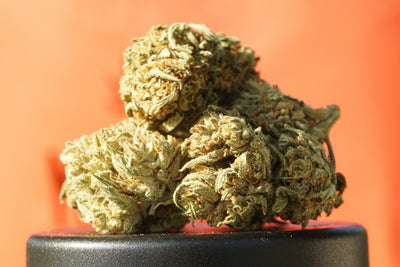
Who Owns Linalool Biosynthesis? The Terpene Patent Map
Linalool turns up in lavender, coriander, basil and a long list of cannabis chemovars. It is among the most widespread terpenes on the planet, which makes any claim to own it look strange. What can be owned is narrower: specific engineered routes to making it.
The map that follows is organized by claim type rather than by company: isolated genes, engineered enzymes, host strains, processes and blends. Each layer has a different owner profile and a different durability.
The stakes in the next one to three years are practical. Precision-fermentation terpenes and cannabis-specific terpene blends are moving toward commercial scale, and licensing questions tend to arrive before the products do. Brands that ask early will be better placed than those that find out from a demand letter.
Why Linalool Is the Test Case

Photo by İrem Çevik via Pexels.
Linalool is a monoterpene alcohol. It gives lavender much of its floral note, it is abundant in coriander, and it shows up in many cannabis chemovars, which makes it a common target for both plant extraction and microbial fermentation.
Terpene profiles shape aroma and how consumers perceive a product. Distillation strips volatile terpenes out of cannabis extracts, and brands increasingly add terpene blends back to restore the character of the original plant.
Fermentation-derived terpenes compete with two incumbents, plant extraction and petrochemical synthesis. Cost per kilogram decides whether biosynthesis wins, and a yeast strain that works at bench scale can still lose on economics once feedstock, yield and purification are counted.
The closer terpene biosynthesis gets to production, the less intellectual property is an academic curiosity and the more it becomes a line item in a budget. Someone has to pay for access to the strain, the enzyme or the process.
Linalool is already cheap and widely available, so the commercial edge will not sit in linalool alone. The value lies in cannabis-authentic enantiomer ratios and in full blends that reproduce a specific chemovar.
What Can Actually Be Patented in a Pathway
A biosynthetic pathway is not one patentable thing. It is a stack of layers, from isolated gene sequences and engineered enzyme variants through modified yeast or bacterial host strains, full multi-enzyme pathways, fermentation conditions, purification methods and finished blends. Each layer carries a different kind of claim and a different level of risk.
US case law sorts these layers fairly clearly. Diamond v. Chakrabarty (1980) allowed patents on engineered organisms. AMP v. Myriad (2013) held that naturally occurring DNA sequences are not eligible, although cDNA can be. A plant linalool synthase gene lifted straight from lavender is therefore a weak candidate, while a modified construct is stronger.
Mayo v. Prometheus (2012) and Alice (2014) narrow claims that amount to a natural law or an abstract idea. That matters for a claim to a bare enzyme activity, the plain fact that a protein converts one molecule into another.
Amgen v. Sanofi (2023) tightened enablement for broad functional genus claims. A claim to any enzyme that makes linalool is the kind of claim that decision puts on shaky ground, because the patent would have to teach the full range of enzymes it covers.
The net result: durable claims cover specific engineered sequences, strain constructs and process conditions, not linalool synthesis as a concept. Anyone who tells you a single party owns linalool biosynthesis in the abstract should be asked to show the claim language.
Who Holds What Today
The ownership picture is best read by claim type, since no single assignee holds the whole pathway.
Plant linalool synthases were characterized in academic work as early as the 1990s, and the cannabis terpene synthase family has since been mapped in published research.
US patent term runs 20 years from the earliest filing date. Foundational filings from the 1990s on plant linalool synthases have therefore run out of term.
The live filings sit in the later layers. Searching Google Patents and USPTO Patent Public Search for linalool synthase, filtered by CPC classes C12N 9/88 and C12P 5/00, surfaces the enzyme and microbial-production families, and each hit's continuation links show how far its protection extends.
Expiry dates mislead for a simple reason. Continuations can keep a family alive past the original discovery's timeline, improvement patents can cover specific enzyme variants, and process claims can protect a method long after the base gene is free to use.
The practical thicket, in other words, can outlast the foundational patent. A dead 1990s filing tells you little about whether a 2020s strain construct is open.
How Licensing Would Actually Work
Licensing has its own vocabulary, and the terms drive the price. An exclusive license keeps everyone else out, a non-exclusive one lets the owner license many parties, and field-of-use limits carve the market into slices. Royalties may be a percentage of sales or a fixed fee per unit, and sublicensing rights decide whether a licensee can pass access downstream.
A patent holder with a flavor-and-fragrance business can license the cannabis field separately. The same enzyme then carries different prices depending on whether it ends up in a perfume or a vape cartridge.
The cannabis wrinkle is federal illegality. Marijuana's status complicates enforcement, partnerships and investor comfort, whereas hemp-derived terpene products sit on firmer ground. The rules have changed before and can again.
University origins matter too. Plant enzyme discoveries often start in academic labs, and university tech-transfer offices tend to license non-exclusively or by field. That keeps access broader than a corporate-origin patent would.
Defensive tactics work through general mechanisms: cross-licensing, where two firms trade access to each other's patents; patent pools, where several owners bundle rights for a shared fee; and inter partes review, where a challenger asks the PTAB to invalidate a patent on prior-art grounds.
Forecast: Where Disputes Will Surface
As fermentation-made terpenes reach scale, claims on specific yeast strains and process steps will be the friction points, with contests centering on strains and processes rather than the molecule itself.
Linalool is old chemistry with cheap alternatives, so owners will often find enforcement not worth the cost, and challengers can win on obviousness. A weak claim on a cheap molecule is a poor litigation bet.
Broad functional claims are the ones most exposed to invalidation, while narrower strain and process patents are the ones that constrain. Expect friction to be local and technical rather than industry-wide.
Blends defined by cannabis-authentic terpene ratios will more likely draw trade-secret protection or trademark-style branding than patents. A ratio is hard to patent and easy to copy once published, but a recipe kept in-house and a brand tied to a chemovar identity can last.
A published court ruling on a terpene synthase claim, a visible licensing announcement or a large buyer demanding indemnification from suppliers would be the first signs of a real dispute.
A Practical Playbook for Brands and Startups
For brands and startups, the sensible order of operations looks like this:
- Define the exact molecule and enantiomer you need, since a claim may cover one form and not the other.
- Run a freedom-to-operate search by host organism and enzyme sequence, not just by the word linalool.
- Map expiry and legal status for every relevant hit, including continuations.
- Ask fermentation-terpene suppliers for IP warranties and indemnification in writing, because downstream brands can be dragged into disputes.
- Negotiate field-of-use terms early, so a license covering flavors does not leave the cannabis field uncovered.
- Budget for patent counsel before scaling.
A pre-launch search costs far less than redesigning a strain or recalling a product.
Field-of-use deserves extra attention. A supplier who holds a license for food and fragrance may not be allowed to sell into cannabis, and you would not necessarily learn that until a dispute.
Finally, confirm expiry and legal status for each hit in the primary patent records, since families and continuations differ.
The useful question is not who owns linalool. It is who owns a particular engineered route to it, and that answer lives in the claims.
Cannabis authenticity, meaning specific blends, ratios and sourcing, will prove a more defensible moat than any single enzyme claim.
Sources
- TPS-g structural divergence drives high-purity linalool accumulation in Cinnamomum camphora var. linaloolifera - PubMed
- Haplotype-specific expression of a terpene synthase underlies linalool variation in the grapevine cultivar Riesling
- WO2020225820A1 - Terpene synthases and transporters - Google Patents
- VvTPS14 is a linalool synthase activated by VvbZIP3 and repressed by VvMADS4 - PubMed
- Terpene synthases for biofuel production and methods thereof
- De novo generation of functional terpene synthases using TpsGPT