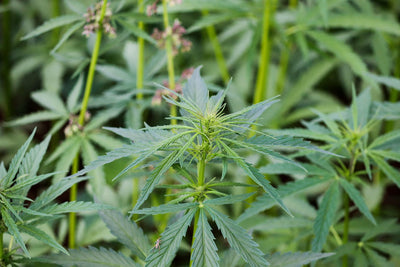
Taiwan's Highland Weavers and the Deep Roots of Hemp
Photo by Pexels via Pixabay.
Walk through the textile galleries at a museum in Puli or Hualien and you'll see the same pattern repeat: tight, even rows of fiber cloth, dyed in ochres and indigo, worked into ceremonial garments that highland families once wore to mark a girl's first successful weaving or a man's first hunt. What most visitors don't realize is how close this entire craft tradition came to disappearing in the span of a single century, and how its revival today runs directly into a legal wall that has nothing to do with culture and everything to do with modern drug policy.
Cannabis fiber shows up in Taiwan's archaeological record thousands of years before anyone on the island was thinking about intoxication. The plant was rope, net, and cloth long before it was anything else. But raw cannabis cultivation in Taiwan today is flatly illegal, full stop, with no carve-out for the Indigenous communities whose ancestors worked the fiber into everyday life. That tension -- deep historical use, near-total 20th century loss, an active craft revival, and a legal code that still treats the living plant as contraband -- is the real story here, and it's worth tracing from the ground up.
Cordage on Clay: What the Archaeology Shows

Photo by Trnava University via Unsplash.
The oldest physical evidence for cannabis in Taiwan isn't a seed or a stem -- it's an impression. At several Neolithic sites on the island, archaeologists have identified the faint negative imprints of twisted cordage pressed into wet clay before pottery shards were fired. Once the clay hardened and the original fiber rotted away, what remained was a precise record of how that cord was spun, how many plies it had, and in several cases, strong indications that the fiber came from cannabis plants. Dating on these impressions runs to roughly 8000 BCE, which places organized fiber use on Taiwan well within the early Neolithic window for the broader region.
Some broader surveys of hemp's global history push the Taiwan figure back even further, toward 10,000 years, though that higher estimate tends to come from general hemp-history literature rather than site-specific archaeological reports, so it's worth treating as a looser upper bound rather than a settled date. Either way, the timeline matters for a specific reason: it predates Han Chinese settlement of Taiwan by several thousand years. The people working this fiber were the ancestors of today's Austronesian-speaking Indigenous communities, not later arrivals from the mainland. That makes Taiwan one of the more interesting data points in the broader Austronesian expansion story, since cordage and net-making skills traveled with these populations as they later spread across the Pacific.
None of this early evidence points toward drug use. There's no indication in the archaeological record of cannabis being grown or processed for its psychoactive properties at this stage -- the entire orientation was practical. Twisted cord held fishing nets together, bound tools, and eventually got spun fine enough to work into cloth. That utilitarian starting point set the template for how Taiwan's highland communities would relate to plant fiber for thousands of years afterward: as material culture, not intoxicant.
From Bark Cloth to Hemp and Ramie

Photo by https://kaboompics.com/ via Pexels.
Long before hemp or ramie processing became standardized, highland communities clothed themselves in beaten bark cloth -- tree bark pounded, soaked, and worked into a coarse but wearable fabric. It's a technique found across much of Austronesian Southeast Asia and the Pacific, and in Taiwan it served as the practical baseline before fiber crops took over. By the early 20th century, that baseline had shifted. Ramie, a fibrous plant in the nettle family processed in much the same way as hemp, had become the dominant raw material for clothing across several highland groups, used alongside tanned hide for garments that needed more durability.
The production chain was genuinely labor-intensive, and none of it was optional if a household wanted clothing. Growers cultivated the plant, gathered the stalks, peeled the outer bark away from the inner fiber, dried it, spun it into usable thread, wound it onto spools, boiled it to soften and bleach it, warped it onto a loom frame, and only then began the actual weaving. Each stage required different tools and different skills, and a single garment could represent weeks of cumulative labor across a household.
Weaving reached its most developed form among the Atayal, where fiber work was treated as a core marker of a woman's competence and social standing. Atayal girls began stripping and spinning fiber while still young, building up the dexterity needed for finer work, and by age 16 or 17 many could weave independently without supervision -- a benchmark that carried real social weight within the community.
Taiwan recognizes 16 distinct Indigenous tribes, and fiber traditions varied meaningfully among them. The Bunun, for instance, didn't specialize narrowly in hemp weaving the way the Atayal did. Instead they folded fiber work into a broader material practice that also included bamboo and rattan basketry, fishnet construction, and hide tanning -- a more diversified skill set suited to their particular highland environment and subsistence patterns.
Heritage Status: Gaya Tminun and Banana-Fiber Weaving

Photo by Guido Coppa via Unsplash.
For decades, much of this knowledge survived only in the hands of a shrinking number of elder weavers, passed down informally and at real risk of dying out entirely. That changed in a formal, legal sense in 2020, when Taiwan's Cultural Heritage Preservation Act was used to designate two specific weaving traditions as protected heritage -- the first time fiber craft had received that status on the island, and a meaningful marker of institutional recognition after generations of neglect.
The first was Gaya tminun, the Seediq people's weaving tradition, which encompasses not just technique but the cultural rules and social obligations tied to who weaves, when, and for what purpose. The second was ni tenunan tu benina, a Kavalan technique built around banana fiber rather than hemp or ramie -- stripped, dried, and spun from the trunk of the banana plant into a cloth distinct from anything else on the island. Both designations were granted specifically to the communities that originated them, an acknowledgment that these aren't generic folk crafts but techniques rooted in particular peoples with particular histories.
Behind each designation are named individuals doing the actual work of keeping it alive. Chang Feng-ying, a Seediq weaver who learned the craft from both her mother and grandmother, was named an official keeper of the tradition after demonstrating mastery of puniri, a notoriously difficult patterning technique that few contemporary weavers can execute cleanly. On the Kavalan side, Yu-En Yen was recognized by Taiwan's Ministry of Culture in 2021 as a preserver of banana fiber weaving -- a recognition that led, a few years later, to her involvement in designing uniform elements for Taiwanese athletes at the 2024 Olympics, carrying a highland fiber tradition onto a global stage most of its originators never could have imagined.
A 2026 Revival in the Highlands

Photo by Emman Marcial via Pexels.
Heritage designation on paper is one thing; keeping the full production chain alive on the ground is another, and that's where several community-level projects have picked up the work in recent years. In Tawsay, also known as Shanli, a Sediq/Toda community has built an annual Ramie Festival around reviving the entire plant-fiber process -- not just the weaving at the end, but cultivation, harvesting, peeling, and spinning that lead up to it. The effort is documented in the book Echoes of Tawsay: Weaving Stories and Catalogue from the Shanli Community, which pairs oral history with a visual record of the techniques being recovered.
A similar project unfolded in Cyakang, a Truku community, where researchers and weavers produced Cyakang Weaving Landscape, a book that does something slightly different: it maps local weaving traditions directly onto the physical landscape, tying particular patterns and techniques to ancestral stories and specific geographic features. The effect is to treat weaving not as an isolated craft but as something embedded in how a community understands its own territory.
Institutionally, the National Taiwan Craft Research and Development Institute has taken on an ongoing role through its Genius Weavers program, which spotlights what the institute frames as Taiwan's Textiles and Basketry of Indigenous Peoples more broadly, documenting practitioners across multiple tribes rather than focusing on a single tradition.
What stands out among the weavers featured through these projects is how many insist on doing the whole process themselves. Rather than buying pre-processed commercial fiber, some still cultivate or harvest their own plant material and build their own tools -- spindles, looms, beaters -- by hand. That commitment to the full chain, not just the finished cloth, is arguably the clearest sign that this is a genuine revival rather than a curated performance of one.
The Legal Reality Today

Photo by Alan Wang via Pexels.
All of this cultural momentum runs up against a legal framework that hasn't moved to accommodate it. Under current Taiwanese drug law, cannabis is classified as a Category 2 narcotic, placing it in a tier of controlled substances subject to strict criminal penalties. Possession, use, cultivation, sale, transport, and import of cannabis are all illegal under this classification, and Taiwan has not adopted any decriminalization framework for the plant, unlike jurisdictions elsewhere that have carved out exceptions for low-level possession or industrial hemp cultivation.
There is no special exemption in Taiwanese law for cultural, ceremonial, or craft-related cultivation of raw cannabis by Indigenous communities. The legal code doesn't distinguish between someone growing cannabis for its psychoactive compounds and a weaver attempting to grow a small plot for fiber consistent with Neolithic-era practice on the island -- both fall under the same prohibition, with the same potential criminal exposure.
That's a significant part of why the contemporary revival described in the sections above leans so heavily on ramie and banana fiber rather than cultivated hemp. It's not that these materials were simply more convenient historically, though by the early 20th century that was already largely true. It's that today, reviving hemp cultivation specifically would mean growing a plant that Taiwanese law currently prohibits outright, regardless of intended use. Weavers working to preserve Gaya tminun, the Shanli ramie tradition, or Bunun fiber practices are, by necessity, working around that restriction rather than through it.
Drug classifications and enforcement policy are not static, and Taiwan's narcotics regulations could shift in ways that change this picture. Readers with a specific interest in the current legal status of cannabis cultivation in Taiwan, for craft purposes or otherwise, should consult current Taiwanese narcotics law directly rather than relying on a historical summary, since the relevant statutes and their enforcement can change over time.
Set side by side, the two halves of this story don't quite resolve into a single narrative, and that's the point. Taiwan's Cultural Heritage Preservation Act has done real, concrete work protecting Gaya tminun, Kavalan banana-fiber weaving, and the broader fiber traditions of the Atayal, Bunun, Truku, and Seediq -- naming individual keepers, funding documentation projects, and giving centuries-old technique institutional standing it never had before. At the same time, the Category 2 narcotic classification that governs cannabis in Taiwan today draws no line between a cultivation plot grown for fiber and one grown for anything else, which means the plant whose twisted cordage shows up in 8,000-year-old pottery impressions remains off limits to the very communities descended from the people who first worked it.
That gap doesn't reflect anything about how Atayal or Seediq weavers historically regarded cannabis -- it was rope and cloth material to them, full stop, with no more cultural charge than ramie or bark carried. The gap is a product of a 20th and 21st century drug policy framework layered on top of a much older material culture, and the two were never designed to talk to each other. Heritage law can protect memory, technique, and named practitioners like Chang Feng-ying and Yu-En Yen. It can't, on its own, resolve a question that belongs to narcotics policy rather than cultural preservation -- and until or unless that changes, Taiwan's highland weavers will keep doing what they've already proven they're good at: adapting the craft to whatever fiber the moment allows.
Sources