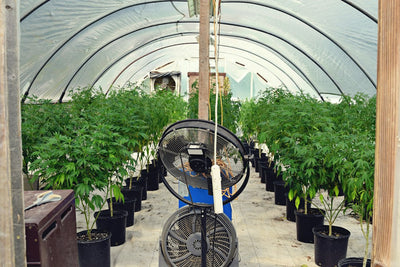
Breeding for Bigger Yields Under 1000W LED Grow Lights
Photo by Drew Taylor via Unsplash.
Walk into a grow room running one of today's 1000W LED fixtures and you're looking at 2900 to 4600+ µmol/s of photon output — a number that would have sounded absurd a decade ago on that same wattage. The diodes, the drivers, the spectrum tuning have all moved fast. What hasn't kept pace is the plant. Most of the genetics still circulating in seed banks and grower rooms were selected under HPS systems putting out a fraction of that flux, or under first-generation LEDs that throttled well below what a modern board can deliver. You can hand two growers the exact same fixture, the same room, the same feed schedule, and watch one pull 2 ounces per plant while the other pulls 4 or more under identical PPFD. That gap isn't the light's fault — it's genetics and training, plain and simple. Some cultivars have the enzymatic and structural capacity to actually use high-intensity light; others hit a photosynthetic ceiling, bleach, or stall out well before the fixture is working hard.
There's a rough framework worth keeping in mind here: 0.5 grams per watt is a solid, achievable benchmark for most setups, and 1 gram per watt is excellent — but only certain plants can metabolize that much light without wasting it or damaging themselves in the process. This article is about that mismatch, and about what breeding for it actually looks like.
Why Your Genetics Are the Bottleneck, Not the Light

Photo by experimentMR via Pixabay.
Run the numbers on a modern 1000W LED fixture and you'll see why so many grows stall out around the same yield ceiling regardless of how dialed-in the environment is. A good high-efficiency 1000W board is putting out somewhere around 2900 µmol/s at roughly 2.9 µmol/J. Push into flagship territory -- something like HLG's Diablo X -- and you're looking at close to 4615 µmol/s at 3.07 µmol/J. That's not a marginal step up from what growers were working with a decade ago. That's a different universe of photon availability sitting directly over your canopy.
The genetics most people are still running were never selected under that kind of light. HPS-era cultivars were bred and stabilized under fixtures that rarely broke 1700-1900 µmol/s of usable output at the canopy, with a spectrum heavy in orange-red and thin on the blue and far-red wavelengths that LEDs now deliver efficiently. Breeders selecting mother plants in the 1990s and 2000s were optimizing for vigor, resin, and structure under that ceiling -- not for a plant's ability to keep pushing photosynthetic rate linearly past 1500 PPFD. You can't retroactively give an old cultivar a trait nobody selected for.
So when you drop that genetic line under 4600 µmol/s of modern photon flux, you get a mismatch that shows up as very specific, very recognizable symptoms. Bleached, washed-out colas near the top of the canopy are the most obvious tell -- the plant is absorbing more light energy than its photosynthetic machinery and carbon supply can actually use, and the excess is degrading chlorophyll and stressing the flower sites instead of building biomass. Trichome development stalls or goes patchy because the plant is spending its limited resources on stress response rather than cannabinoid and terpene synthesis. Leaf clawing under high PPFD, especially when CO2 and temperature aren't scaled up to match, is the plant physically signaling that photon delivery has outrun its metabolic capacity -- this isn't a nutrient problem, and dumping cal-mag at it won't fix it.
This is where yield-per-watt benchmarks become useful as a reality check rather than a bragging number. Under a genuine 1000W-class LED draw, 0.5 g/W is a solid, repeatable result with decent genetics and clean execution. Pushing toward 1 g/W is excellent territory, and it's achievable, but only with cultivars bred to actually use that flux -- the swing between cultivars at identical PPFD, DLI, and VPD can be enormous, sometimes double, simply because one plant's genetics cap out photosynthetically well below the light saturation point the fixture is capable of and the other doesn't. This is exactly the kind of gap Seedtiva pays attention to when selecting which genetics are worth offering, since well-bred seed lines close that gap far more reliably than luck ever will.
The practical takeaway is simple even if it's underappreciated: dialing in your PPFD ramp and DLI curve gets you nowhere if the genetics sitting under that light were never built to metabolize what you're feeding them. Matching cultivar to fixture output matters just as much as matching fixture output to growth stage.
What to Actually Select For When Breeding Toward High-PPFD Environments

Photo by qimono via Pixabay.
Running a 1000W LED at canopy will push you into the 800-1000+ PPFD range if you're dialing it in properly, and most cannabis genetics on the market were never bred to handle that kind of photon load. They were bred under 600W HPS setups pulling maybe 500-600 PPFD, sometimes less once you account for real-world hanging height and reflector losses. So the first thing to understand is that selecting for high-PPFD tolerance isn't cosmetic tweaking -- you're selecting against traits that simply don't show up as problems until you cross a light intensity threshold most breeders never tested at.
Start with structure. Under intense light, a lot of plants respond by stretching internodes to get leaf surface away from each other, or by folding leaves downward (the taco-leaf response) to reduce exposed surface area and dump excess energy. Both are stress responses, not vigor. The plants you want are the ones holding tight internode spacing -- 1.5 to 3 inches between nodes in veg under your test light -- and keeping leaves flat or only slightly angled upward toward the source. That flat, confident leaf posture under 900+ PPFD tells you the plant's photosynthetic machinery is actually using the light rather than defending against it.
Flowering behavior is where you separate good candidates from great ones. Most strains hit a trichome and calyx swell plateau around week 6-7 of flower regardless of light input, because their genetics simply stop responding to additional photons past a certain point. Under high PPFD you want individuals that keep swelling calyxes and laying down trichome density into week 8, 9, sometimes later. Track this weekly with a loupe and photos, not just a final harvest weight -- a phenotype that plateaus early but finishes heavy might just be a fast, average producer, not a true high-light performer.
Chlorophyll retention matters more than growers give it credit for. Watch canopy color, not just at harvest but through the whole stretch and into mid-flower. Leaves that stay a deep, saturated green under 800-1000+ PPFD -- rather than yellowing, bleaching, or bronzing at the margins -- are telling you the plant has enough photosynthetic capacity and nutrient uptake to actually use the light you're throwing at it. Bleaching under high PPFD is a proxy for a plant that's absorbing more energy than it can process, which is wasted light and wasted electricity.
None of this is real until you've bred it in over multiple generations. Backcross or self your best individuals for 3-5 generations, reselecting each round for the same tight-node, late-swelling, color-stable traits, before you call a line stable. A single standout plant under your lights could be a fluke of that particular seed's epigenetics, not a fixed trait. Alongside that, run a basic germination check -- anything below 85% germ rate on a line means you've got instability worth fixing before you sink more selection time into it. And don't ignore the roots: a plant pulling in enough light to be assimilating something like 4600 µmol/s of photons at the canopy needs a root mass and vigor to match that carbon demand, or you'll get a plant that photosynthesizes hard for three weeks and then stalls. Seedtiva's genetics get evaluated with this kind of high-light performance in mind, though as always, results depend on your specific setup, climate, and how well the line has been stabilized before it reaches you.
Marker-Assisted Selection: Skipping the Guesswork

Photo by kennethr via Pixabay.
Most home breeders still select the old-fashioned way: pop a hundred seeds, veg them out, flower them under the lights they actually own, and cull based on what shows up. That works, but it's slow and it burns a lot of tent space on plants that were never going to make the cut. The commercial side of the industry has largely moved past this. Big breeding programs now genotype seedlings within days of germination, using DNA-based molecular markers to flag which individuals carry the alleles worth keeping, long before those plants have grown a single fan leaf big enough to judge by eye.
The tools doing this work go by acronyms that sound more intimidating than they are. SNPs (single nucleotide polymorphisms) are single-letter differences in the DNA sequence that correlate with a trait like resin production or internode spacing. SSRs (simple sequence repeats) are short repeating chunks of DNA that vary in length between individuals and act like a genetic barcode for tracking lineage and heterozygosity. InDels are insertions or deletions in the sequence, often used the same way SNPs are, to tag a specific gene region tied to a trait. None of these markers cause the trait directly in most cases -- they're just reliably linked to it, close enough on the chromosome that inheriting the marker means you almost certainly inherited the trait alongside it. Run a cheek-swab-style tissue sample through a genotyping panel, and you get a readout on hundreds of these markers at once.
What this buys a breeding program is speed and consistency that phenotype-only selection can't match. Traditional breeding for a stable trait across generations can take three, four, five years of grow-outs, because you're waiting for full life cycles to confirm every generation actually bred true. Marker-assisted selection collapses a lot of that waiting. If you know which markers track with the trait you want, you can screen an entire seedling batch in the first two weeks of life, keep only the genotypes carrying the right alleles, and skip straight to crossing those individuals. Timelines that used to run in years start running in months, and because you're selecting on the DNA itself rather than on phenotype expression that can be muddied by environment, the outcomes are far more repeatable from one generation to the next.
For anyone specifically breeding toward better performance under 1000-watt LED fixtures, this matters in a very practical way. High-output diodes push PPFD levels well above what HPS growers were working with, often into the 900-1200 μmol/m²/s range at canopy in flower, and not every genotype handles that kind of photon flux without bleaching, tip burn, or stalled resin production. Instead of vegging out a full population and finding the light-intolerant individuals the hard way, deep into a flower cycle, breeders can screen seedlings for markers associated with light-stress tolerance and early vigor and cut the field down before committing tent space and twelve weeks of electricity to plants that were destined to struggle.
None of this replaces actually growing the plants out. Markers narrow the field and tell you which individuals are worth your time, but they don't tell you how a given phenotype actually finishes under your specific fixture, your VPD, your feed schedule. You still need to run the finalists through a real flower cycle under the lights you intend to use, because gene expression under a 1000W LED in a 4x4 tent with tight climate control doesn't always read out the same as it does on a spreadsheet. Think of MAS as a filter that gets you from a thousand candidates to twenty worth flowering, not a replacement for flowering them.
This is also, frankly, ahead of where most home and craft breeders are operating right now. Genotyping panels and marker libraries for cannabis are still concentrated in university programs and a handful of well-funded commercial breeding operations, not on the average grower's bench. But the direction is clear enough that it's worth understanding even if you're years away from running one yourself -- it's shaping which genetics show up as finished seed lines, including the kind of well-bred, vigor-tested genetics companies like Seedtiva work with, and it's worth knowing why a given line was selected the way it was before you build a breeding project on top of it.
Polyploidy: A Real Tool, But Don't Bet the Whole Line on It

Photo by Leolo212 via Pixabay.
Every couple of years someone rediscovers colchicine or oryzalin, doubles a plant's chromosome count, and announces the next big leap in cannabis genetics. Tetraploid and polyploid breeding is real, it's not snake oil, and it has produced measurable changes in cannabinoid and trichome expression. But the actual data set behind the hype is thinner and messier than the forum threads suggest, and if you're trying to squeeze more grams and more potency out of a 1000W LED footprint, you need to know exactly what these studies did and didn't show before you spend a season chasing chromosome doubling instead of just running a tighter VPD curve.
The paper everyone cites is the 2019 Frontiers study out of Canopy Growth, which treated seedlings with colchicine to induce tetraploidy in drug-type cannabis. The headline numbers are genuinely interesting: roughly 40% higher trichome density on the sugar leaves and about a 9% bump in CBD content in the tetraploid plants compared to their diploid siblings. That's the number that gets screenshotted and passed around breeder Discords. What gets left out almost every time is the second half of that same paper's findings: no statistically significant increase in dried bud yield, and no significant increase in THC content. More trichomes and more CBD on sugar leaf tissue is a real effect, but it didn't translate into more flower weight or more of the cannabinoid most growers are actually optimizing for. If your business case for polyploidy is bigger, more potent buds off the same light footprint, this baseline paper doesn't actually support that claim -- it supports a narrower, more modest one.
A 2023 study across four different cultivars muddies the water further, finding essentially the opposite pattern: total cannabinoid content, along with THCA, CBDA, and CBGA specifically, dropped significantly in the higher-ploidy plants. Same general technique, different cultivars, opposite direction of effect. That's not a contradiction so much as a warning label -- ploidy manipulation doesn't have one universal outcome, it interacts with whatever genetic background you start with.
On the technical side, things are improving. A 2025 study using a machine-learning-optimized oryzalin protocol achieved a 93.75% tetraploid recovery rate, which is a serious jump in induction reliability compared to older colchicine methods that often produced messy chimeras and low survival rates. The process of making tetraploids is getting more precise. What it produces once you've made them is still a coin flip.
Francesco Tonolo, a plant biologist at Leiden University who's worked on cannabis polyploidy, sums it up about as plainly as a researcher can: the technique is powerful, but its effect on quality compounds is unpredictable and depends heavily on the specific genetic background of the cultivar you're working with. There's no polyploidy shortcut that reliably stacks on top of your existing genetics.
Our stance at Seedtiva is straightforward: treat polyploidy as an experimental side project, not a plug-and-play upgrade to your yield or potency numbers. If you've got the space and patience to run a proper cultivar-specific trial -- diploid controls next to your induced tetraploids, same 1000W LED, same feed schedule, same room -- go for it, it's genuinely interesting work. Just don't retool your whole breeding line around it before you've generated your own data, because right now the published literature can't tell you which way it'll break for your particular plant.
The Narrow Gene Pool Problem Nobody's Breeding Around

Photo by sarajuggernaut via Pixabay.
Trace the pedigree of almost any elite clone circulating right now — the ones everyone's mother room seems to have a cut of — and you'll hit the same bottleneck within four or five generations. A handful of cultivars, crossed and backcrossed and re-crossed with each other for two decades, make up the working genetic base for most of what's sold as premium flower. That's not paranoia about inbreeding depression as an abstract concept; it's a measurable reality in the pedigrees. Ask a breeder to draw you a family tree for a popular modern cultivar and you'll see the same handful of ancestor names appear on both sides of the cross, sometimes three or four times.
The reason traces back further than the dispensary era. Much of the germplasm underlying today's commercial flower runs through a lineage shaped by HortaPharm in the Netherlands starting in the late 1980s, and later refined by GW Pharmaceuticals for pharmaceutical development — programs built to stabilize specific cannabinoid ratios and produce consistent, reproducible chemotypes for drug development, not to maximize biomass under 1000 watts of full-spectrum LED. Selection pressure in that era was about cannabinoid uniformity and regulatory predictability, not canopy architecture or light-use efficiency. That template got absorbed into recreational breeding programs as prohibition eased, because it was the available, working genetic stock — reliable, well-documented, already stabilized for potency. It became the foundation almost by default, not because anyone selected it for horticultural performance under intense modern lighting.
So now we're asking that same narrow pool to do two things it was never built for simultaneously: hold pharmaceutical-grade consistency batch to batch, and perform under light intensities — 800 to 1000+ PPFD sustained canopy-wide, DLI pushing 45-50 mol/m²/day — that didn't exist when the foundational crosses were made. Grow lighting in the HortaPharm era topped out around 600-1000 PPFD from HPS with terrible spectral efficiency and massive heat load limiting how close you could actually run it. Modern LED arrays deliver that intensity with a fraction of the radiant heat, which means the plant's the limiting factor now, not the fixture. And a genome selected under 1990s light ceilings doesn't automatically have the alleles for photosynthetic saturation point, canopy penetration, or heat/light stress tolerance that you need to fully exploit today's diode output.
This is exactly why phenotype hunting within the same three or four elite lines keeps producing diminishing returns — you're recombining the same limited allele set, not introducing new variation for high-light traits to select from. Landrace lines and novel crosses widen that pool; they carry adaptations from equatorial and high-altitude environments that never went through the pharma-consistency bottleneck at all. That's the practical case for sourcing seed from breeders actively maintaining diverse stock rather than leaning on one or two popular clone lines — it's part of why we keep a range of genetics at Seedtiva bred with that variation in mind, since a wider gene pool gives you something real to select from when you're breeding toward higher light tolerance, not just another recombination of the usual suspects.
Stabilizing and Testing a High-Yield Line Under Your Own Lights

The HLG Diablo X-class 1000W LED delivers roughly 59% more photon output than a standard 1000W LED fixture, producing 4,615 µmol/s compared to 2,900 µmol/s.
Finding a standout plant in an F2 population is the easy part. The hard part is proving it wasn't a fluke, then locking it down so the traits you liked actually show up again next season. This is where a lot of home breeding programs quietly fall apart -- someone runs a single killer phenotype once, names it, starts handing out clones, and two years later nobody can explain why the line has drifted or gone soft. Stability isn't a vibe, it's a track record.
Once you've picked your finalists out of the pheno-hunt, put them through 3 to 5 generations of backcrossing to a stable parent, or straight selfing (S1/S2/S3) if you're chasing a true-breeding autogamous line. Each generation, you're watching for segregation -- if the offspring keep throwing wildly different structures, resin profiles, or flowering times, you're not stable yet, you're still sorting alleles. A line worth calling finished should reproduce its key traits -- bud density, node spacing, terpene expression, that specific yield-per-watt response -- in something like 90%+ of offspring before you trust it as a keeper. Anything less and you're still gambling.
Once a line proves itself, get your elite mother into tissue culture rather than leaning on a cut sitting in a veg tray for the next three years. Clone lineages accumulate viroids and latent pathogens generation after generation -- hop latent viroid being the big one growers are still cleaning up from across the industry -- and by the time you notice stunted growth or reduced resin output, you've often been propagating a slowly degrading version of your own genetics for months. A clean tissue culture bank, ideally verified through PCR testing for HLVd and other common pathogens, is cheap insurance against losing years of selection work to something you can't even see.
The yield testing itself needs to be specific to your actual fixture, not a number you read on a forum. A phenotype that pulls 1 g/W under a 2900 µmol/s output board is operating in a completely different light environment than one under a 4600 µmol/s Diablo X-class unit -- different canopy PPFD, different heat load, different CO2 draw-down rate. Grams-per-watt as a metric only means something when you state the actual photon output driving it, so log your fixture's real µmol/s at canopy height (not the nameplate wattage) and treat that as part of the strain's data sheet, not an afterthought.
Run every serious candidate through at least two full cycles before drawing conclusions. One great harvest tells you a plant can do it once, under one set of conditions, with whatever margin of luck was in the room that week. Keep real logs -- feed schedule, EC, VPD by week, defoliation timing, final wet and dry weight -- and compare cycle to cycle. If yield-per-watt holds within a reasonable band both times, you've got something. If it swings 30%, you're still looking at noise, not genetics.
And temper your expectations about portability. A line that crushes it in your 4x4 with CO2 enrichment to 1200 ppm and aggressive LST won't necessarily repeat that under someone else's untrained, ambient-CO2 setup in a different climate. Seedtiva breeds and selects with this variability in mind, but every grower still needs to retune feed and training to their own room -- genetics set the ceiling, your setup decides how close you get to it.
Here's the honest state of things: LED technology sprinted ahead of cannabis genetics. A 1000W-equivalent fixture can now pour 1,700-1,900 PPFD-capable output into a small footprint, but most of the strains people run under them descend from lines bred decades ago under HPS, at far lower intensities, by growers selecting for smell and bag appeal rather than photon-use efficiency. That mismatch is exactly why two plants under identical light can finish with wildly different yields.
Closing that gap isn't a single trait you can breed in. It's years of selection, backcrossing stable parents, and running real yield-per-watt trials under your own fixture, at your own canopy height, in your own room -- not trusting a number from someone else's setup. A plant that thrives at 1,600 PPFD in a breeder's optimized tent can stretch, bleach, or stall in yours.
So take every yield figure you read, including ours, as a starting point tied to a specific cultivar and setup, not a guarantee. Start with quality genetics, track your own numbers, and let your tent tell you what actually works.
Sources
- How Many Plants Can a 1000W LED Light Grow? – TheOneGrow
- 5 Best LED Grow Lights 2026 (Cannabis Yields, Speed, & LED Bud Quality) | Grow Weed Easy
- What Are the Top 4 High-Power LED Grow Lights Over 1000 Watts in 2026? — Grow Light Central
- High-Quality Flower LED Yield Rivals A 1000 Watt HPS Yield
- Buying a 1000w LED Grow Light: All You Need to Know | Cultiuana