Full Spectrum LED Grow Lights: What Spectrum Really Does
Photo by CRYSTALWEED cannabis via Unsplash.
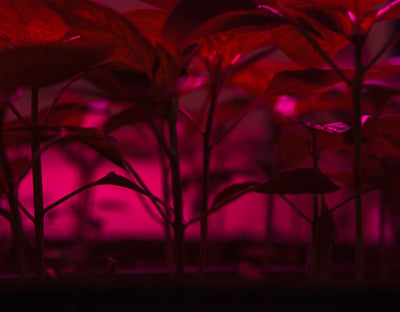
Walk into any hydro shop or scroll through ten grow light listings on a seed-to-sale supplier's site and you'll see the same two words plastered on everything: full spectrum. It's on a $60 blurple panel with three diode bins and it's on a $2,400 commercial fixture with independently addressable channels. That's a problem, because the term used to mean something specific, and vendors have spent the last several years stretching it until it means almost nothing at all.
The actual 2026 industry definition is narrower than the marketing copy suggests: sunlight-mimicking white light spread across roughly 400-750nm, with UV below 400nm and far-red from 700-750nm treated as optional supplemental channels layered on top, not baseline output. And critically, spectrum was never meant to be judged in isolation. It's one variable inside a control loop that also includes PPFD, DLI, photoperiod, CO2 ppm, irrigation EC, and how well your HVAC is holding VPD steady. Change the spectrum without moving the rest of that system, and you often won't see the effect you were hoping for.
There's also a more uncomfortable finding buried in the recent peer-reviewed literature: more spectrum manipulation doesn't uniformly mean more potency or more yield. In fact, published research shows spectrum can push cannabinoid concentration and total cannabinoid yield in opposite directions, depending on which wavelengths you lean into. This piece goes through what the actual studies say, not what's printed on a spec sheet, so you can make lighting decisions based on data instead of a glossy marketing claim.
What "Full Spectrum" Actually Means in 2026

Photo by Laura Geror via Unsplash.
Full spectrum has a real technical meaning, even if half the industry ignores it. It describes a white light output that approximates the broad, continuous curve of natural sunlight across roughly 400 to 750 nanometers -- blues, greens, reds, and everything between, rather than a fixture built around two or three narrow diode peaks. That distinction matters because a lot of "full spectrum" panels on the market are really just red-and-blue LEDs with a thin white phosphor layer thrown in to make the light look less purple to the human eye. The label got applied to the marketing, not the photon output.
Modern commercial fixtures build on that white base by adding UV and far-red as separate, optional diode channels rather than folding them into the core spectrum. That's an important architectural shift -- it means growers can dial UV or far-red up or down independently instead of getting whatever fixed ratio a manufacturer baked into a single diode type. It's also why fixture pricing has spread out so much: a basic full spectrum panel and a full spectrum panel with tunable UVA and far-red channels can differ by hundreds of dollars for what looks like the same core light on paper.
The market data backs up why full spectrum won this argument commercially, even before the science caught up. Grand View Research put full spectrum lamps at 62.0% of grow light market revenue in 2024, and the reason is practical rather than scientific: a full spectrum fixture performs reasonably well at every growth stage, so a grower doesn't need to swap fixtures between veg and flower. That's a real operational win, especially for anyone running a single-tent or single-room setup.
But here's the part that gets skipped in most buying guides: spectrum is now correctly treated as one input into a much larger control loop. PPFD ramp, DLI targets, photoperiod, CO2 enrichment, irrigation EC, and HVAC-driven VPD all have to move together. Tune your spectrum toward a blue-heavy finish without also managing your feed EC and leaf temperature, and you likely won't see the cannabinoid shift you were expecting show up in the jar. This is also why legalization-driven commercial buyers are pushing toward tunable-channel fixtures -- one light programmed for a vegetative recipe, then reprogrammed for flower, without a hardware swap in between.
The McGill Study: Why Spectrum Splits Yield and Potency

In the 2022 McGill study, plants grown under the HPS control light produced nearly double the fresh inflorescence mass (133.59 g/plant) compared to those under blue spectrum LED (76.39 g/plant), highlighting HPS's yield advantage in this trial.
If you want to understand why spectrum claims deserve skepticism, the 2022 study from Morello and colleagues, published in Plants (DOI 10.3310/plants11212982), is the single most useful dataset available. The team ran six lighting treatments on the Babbas Erkle Cookies cultivar: monochromatic blue at 430nm, monochromatic red at 630nm, a rose blend (430+630nm at a 1:10 ratio), a purple blend (430+630nm at 2:1), amber at 595nm, and a legacy HPS control. This wasn't a marketing test -- it was designed to isolate spectrum as the variable and measure both yield and cannabinoid output with real rigor.
The headline result should worry anyone who assumes LEDs automatically beat old HPS technology: every single LED treatment underperformed the HPS control on fresh inflorescence mass. HPS produced 133.59 grams per plant. Monochromatic blue, the worst performer in the group, produced just 76.39 grams per plant -- a massive gap, and a reminder that narrow-spectrum blue light starves the plant of the broader photosynthetic drive it needs to build biomass.
Here's where it gets genuinely counterintuitive. That same underperforming blue treatment produced the highest THC concentration of any treatment in the study, at 10.17% m/m. If you were only looking at percentage THC on a lab report, blue light would look like the winner. But because total flower mass was so low under blue light, that high concentration translated into the lowest total THC yield per plant in the entire study -- just 1.44 grams.
HPS, despite being decades-old technology and lacking any spectrum tuning at all, produced the highest THC yield per plant overall: 2.54 grams. Nearly double the blue treatment's output, purely because it had the photosynthetic horsepower to build a much larger flower mass to carry that cannabinoid load.
The practical lesson here is one every serious grower needs to internalize: percent THC and total THC yield are not the same target, and they don't move together. Chasing a spectrum recipe that boosts lab-reported potency can quietly gut your total harvest weight if the underlying photosynthetic drive isn't there to support it. Before you tune spectrum for concentration, decide honestly which number you're actually trying to maximize.
Blue Light, CBD, and Gene Expression -- Not Just Stress Response

Photo by ulleo via Pixabay.
For years, the working assumption in cultivation circles was that elevated cannabinoid levels under stressful light conditions -- like narrow-band blue -- were essentially a defensive stress response, similar to how UV exposure triggers protective pigment production in a lot of plant species. A 2025 study from Malik and colleagues, published on ScienceDirect, complicates that story in a way growers should pay attention to.
The researchers found that blue light percentage correlated positively with CBD concentration, with photosynthetic parameters, and with chlorophyll fluorescence measurements -- and the correlation wasn't weak. Pearson coefficients ranged between 0.589 and 0.830, which is a meaningfully strong relationship for a biological system with this much natural variability. That's a real signal, not statistical noise.
What makes this study different from earlier work is that it specifically tested and ruled out the stress-response explanation. Instead of cannabinoid increases tracking with markers of plant stress, the increases tracked with measurable upregulation of the genes responsible for cannabinoid biosynthesis. In plain terms: blue light isn't just making the plant panic and produce defensive compounds. It's turning up the genetic machinery that builds cannabinoids in the first place.
The specific ratio that stood out in the study was a roughly even blue-to-red split -- referred to as B5:R5, meaning equal parts blue and red at the tested wavelengths. That balanced ratio enhanced expression of every cannabinoid biosynthesis gene the researchers tracked, which is a more comprehensive genetic response than you'd expect from a simple stress trigger.
This reframes what spectrum tuning actually is. It's not just a photosynthesis lever or a stress lever -- it's a genetic expression lever. Two plants can end up with identical yield numbers and totally different chemotype expression depending on the spectrum they were finished under, and yield data alone won't show you that difference. For growers working with CBD-leaning cultivars specifically, this suggests it's worth experimentally testing a blue-leaning spectrum shift during late flower, treated as a distinct strategy from whatever you're doing for THC-dominant plants in the same room.
UV and Far-Red: The Supplemental Channels Worth Understanding

Photo by XRP Relic via Unsplash.
UV and far-red get talked about constantly on product pages, but they're genuinely different tools solving different problems, and neither one is a base spectrum replacement -- they're supplemental channels, typically run under 5% of a fixture's total wattage.
Danziger and Bernstein's 2021 work found that UV radiation shows real potential for stimulating cannabinoid biosynthesis specifically in trichomes, tested across three distinct cannabis chemotypes. Visible LED light in their findings could boost both THC and terpene accumulation -- but notably, it didn't move CBD the same way. That's worth sitting with: UV supplementation appears to be a THC and terpene tool more than a broad cannabinoid tool, which matters if you're deciding whether it's worth adding a UV channel to your fixture at all depending on what your cultivar is bred to express.
Manufacturer testing adds a useful practical layer here. Valoya's work on UVA chips in the 315-400nm range found that 385nm specifically optimized floral and leaf cannabinoid concentration, without the plant damage risk that comes with UVB exposure. That distinction between UVA and UVB is one growers frequently blur together, and it shouldn't be blurred -- UVB is meaningfully higher energy and much more likely to cause leaf bleaching, cuticle damage, or photoinhibition if it's dosed carelessly or run too close to canopy. UVA at low supplemental intensity is the safer lever, and it's the one most modern fixtures actually expose as an adjustable channel for exactly that reason.
Far-red operates on a completely different mechanism. Run at the end of the photoperiod, far-red in the 700-750nm range triggers what's known as the shade-avoidance response combined with the Emerson enhancement effect -- essentially convincing the plant it's in a shaded, crowded canopy, encouraging internode stretch and a faster transition into flowering behavior. This is more established general horticultural practice than a cannabis-specific cannabinoid finding, so don't expect far-red supplementation to move your THC or CBD numbers the way UVA or a blue-red ratio shift might. It's a structural and timing tool, not a chemotype tool.
Both channels are best understood as fine-tuning layered onto a solid full spectrum foundation -- not a replacement for it, and not something to run at meaningful intensity without a specific reason.
Building a Spectrum Strategy Instead of Chasing a Recipe

Photo by Esteban López via Unsplash.
The most useful shift a grower can make is to stop treating spectrum as an isolated dial and start treating it as one input inside a larger system that includes PPFD ramp and DLI targets. A reasonable PPFD progression runs roughly 300-600 umol/m2/s during veg and climbs to 800-1000+ umol/m2/s in flower for high-output setups with supplemental CO2 -- and spectrum changes made without adjusting PPFD and DLI to match rarely show up as a measurable effect in the final harvest.
It's also worth being blunt about vendor claims. Spectrum-ratio percentages printed on product pages from brands like Spider Farmer, Mammoth, or GrowRay generally aren't backed by anything close to the rigor of the McGill study or the gene-expression research covered above. A specific blue-to-red ratio quoted in marketing copy is not the same as a specific ratio tested in a peer-reviewed trial with a documented cultivar and controlled conditions. Treat those numbers as directional at best.
A practical framework, grounded in what the research actually supports: run a genuine full spectrum base through vegetative growth, since that's where broad photosynthetic drive matters most for building the plant structure that will carry your final flower mass. Shift toward supplemental far-red early in flower to encourage the stretch response as the plant transitions. Then, in the final two to three weeks, consider layering in low-level UVA and a blue-leaning nudge -- but decide that nudge based on whether the cultivar is THC-dominant or CBD-dominant, since the research suggests those chemotypes respond differently to a blue-heavy finish.
None of this works as a fixed recipe, though. Outcomes vary heavily by cultivar, room conditions, CO2 enrichment, and canopy management -- spectrum is a multiplier sitting on top of a foundation, not a substitute for dialing in VPD and feeding correctly in the first place. A perfectly tuned spectrum recipe run over an underfed, poorly climate-controlled canopy will still underperform.
Genetics matter just as much as fixture choice here, maybe more. Running a spectrum experiment across inconsistent, unstable phenotypes makes it nearly impossible to tell whether a yield or potency shift came from your lighting change or from natural plant-to-plant variation. Seedtiva's seed selection is built to give growers a stable genetic baseline specifically so that spectrum experiments produce a measurable, repeatable effect instead of getting buried in phenotype noise.
Spectrum is a real, measurable lever -- the gene-expression data on blue light and CBD makes that hard to argue with. But it's not a shortcut around basic photosynthetic drive, and the McGill study is the cleanest proof of that available right now: an old, spectrum-crude HPS fixture still out-produced every LED treatment on raw THC yield per plant, spectrum tricks aside. No amount of clever diode tuning fixes a plant that isn't building enough flower mass in the first place.
The mental model worth carrying forward is separating two questions that keep getting treated as one: are you optimizing for concentration -- percent THC or CBD on a lab report -- or for total cannabinoid yield per plant? The current published data show these can move in opposite directions under the same lighting change, sometimes dramatically. Decide which one actually matters for your grow before you touch a spectrum dial, because chasing both at once with the wrong strategy can leave you worse off on both.
Expect commercial fixtures to keep adding tunable UV and far-red channels as this research matures -- that trend isn't slowing down, and it's a genuinely useful direction for the technology. Just keep the skepticism intact when you're reading a spec sheet. A specific ratio claim printed on a product page is not the same thing as a specific ratio validated in a peer-reviewed trial with a named cultivar and controlled conditions. Until a manufacturer's claim is backed by something closer to the McGill methodology or the gene-expression work discussed here, treat it as a starting point for your own testing, not a verified result.