Dialing in VPD at Every Growth Stage
Photo by Richard T via Unsplash.
Walk into any serious grow room in 2025 and ask the person running it what their humidity target is, and you'll probably get a blank stare followed by a correction: "I don't run humidity, I run VPD." That shift didn't happen overnight, but it's happened almost completely. The old shorthand of "keep RH around 50%" has been quietly retired by growers who actually track their numbers, replaced by a single dial that does a better job of predicting plant behavior than humidity ever did on its own.
Vapor pressure deficit isn't new. Horticultural researchers were using it to manage greenhouse crops back in the 1920s, long before anyone was growing cannabis under LEDs in a converted closet. What's new is that it's finally showing up on the display of a $150 controller instead of buried in a plant physiology textbook. VPD is the pressure gradient that pulls water out of the leaf and into the surrounding air -- and that gradient, not the humidity reading by itself, is what actually governs transpiration rate, nutrient uptake through the roots, and ultimately how fast your plant grows and how well it finishes.
This piece gets specific: exact kPa ranges for every stage from clone to cure, the leaf-temperature measurement trick that most home growers skip entirely (and shouldn't), what actually goes wrong when you drift too far in either direction, and a look at where controller hardware is headed going into 2026.
What VPD Actually Measures (and Why RH Alone Lies to You)

Photo by Peter Klauss via Pexels.
VPD measures the difference between how much water vapor the air is currently holding and how much it could hold if it were fully saturated at that same temperature. Expressed in kilopascals (kPa), it's a single number that captures something humidity alone can't: how hard the air is 'pulling' moisture out of a leaf. Air doesn't just have a humidity level -- it has a capacity, and that capacity changes with temperature. A humidity-only target treats 55% RH as one fixed thing, when in reality it describes wildly different conditions depending on what the thermometer says.
Here's the problem in practice. A room sitting at 55% RH and 70°F produces a VPD of roughly 0.85 kPa -- comfortable, moderate transpiration pull. Bump that same room to 80°F while holding humidity steady at 55%, and VPD jumps to around 1.4 kPa, pushing the plant into a noticeably higher-stress zone. The humidity gauge never moved. The plant's experience changed dramatically. This is exactly why two grows running 'the same RH' can produce completely different results -- one operator's tent runs warm, the other's runs cool, and RH alone was never going to reveal that.
Horticultural science has known this since at least the 1920s, when researchers studying greenhouse crops needed a metric that actually predicted transpiration and stomatal behavior rather than one that just described ambient air. Cannabis cultivation was slow to catch up, mostly because consumer-grade tools capable of calculating VPD in real time didn't exist until fairly recently. Now that combined temp/humidity sensors can do the math instantly and display kPa directly, there's no good reason left to fly blind on humidity alone.
The practical rule worth memorizing: once VPD climbs past roughly 1.6 kPa, the plant is in a stress zone regardless of what the humidity percentage says. Stomata start closing to conserve water, CO2 uptake drops, and growth rate suffers -- even if your hygrometer is reading a number that used to make you feel fine.
Stage-by-Stage VPD Targets
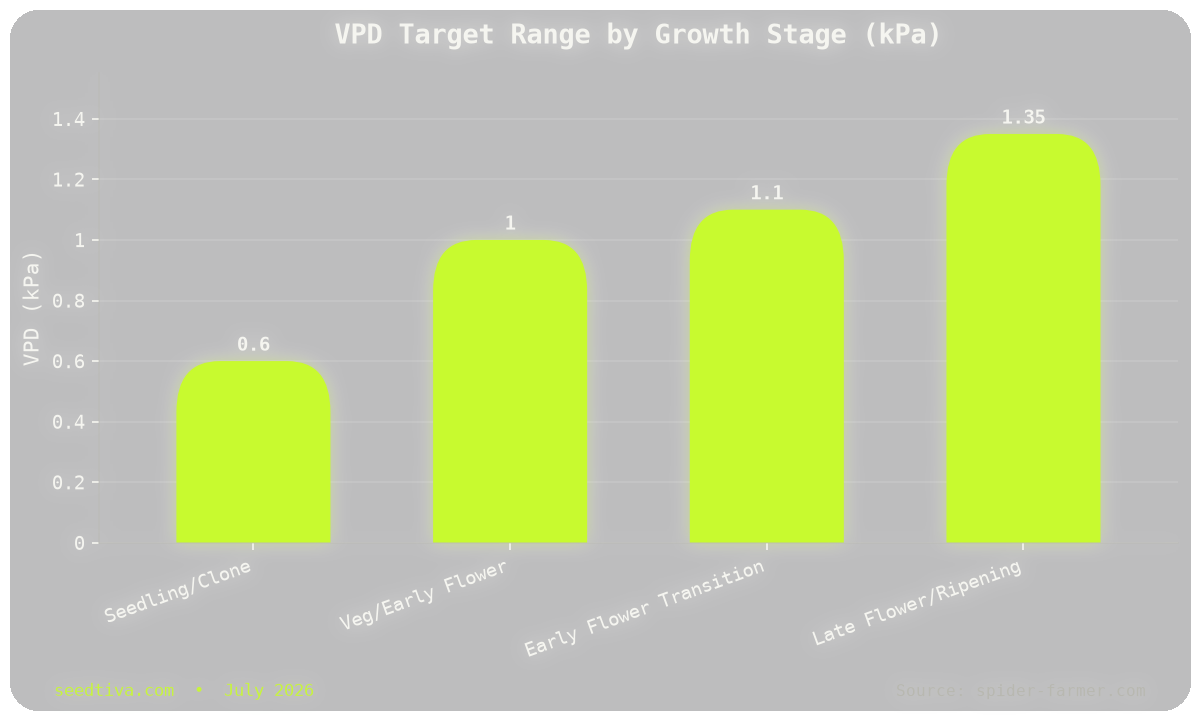
VPD targets aren't static -- they shift as the plant's root mass, cuticle thickness, and canopy density change across the grow. Treating the whole cycle with one fixed number is one of the more common mistakes growers make once they've adopted VPD but haven't yet learned to move it with the plant.
Seedlings and fresh clones need the gentlest pull of all: 0.4-0.8 kPa. At this stage the root system is minimal and there's essentially no waxy cuticle on the leaf surface to regulate water loss, so any aggressive transpiration demand will outpace what the plant can actually replace through its roots. This is why clone domes and humidity tents exist -- they're keeping VPD low on purpose, not just humidity high.
Moving into vegetative growth and early flower, the target widens to 0.8-1.2 kPa as roots expand and the cuticle thickens enough to handle more demand. Within that window, the early flower and stretch transition specifically wants 1.0-1.2 kPa, paired with 70-80°F air temp and 50-60% RH. This is the stage where plants are growing fastest and building the internal plumbing that will support flower development, so you want steady, moderate pull -- not stress, not stagnation.
Late flower and ripening call for a deliberate shift upward: 1.2-1.5 kPa, with temps trimmed to 70-75°F and RH brought down to 40-55%. This isn't arbitrary -- slightly higher VPD in late flower hardens plant tissue and, critically, keeps humidity low enough inside dense colas to discourage botrytis and other mold issues that ruin harvests in the final weeks.
Lights-off periods deserve their own target: 0.8-1.2 kPa, letting RH creep up somewhat since stomata are mostly closed and transpiration demand naturally drops. Even so, never let flowering-room RH cross 60% during dark hours -- that's exactly the window where mold gets a foothold unnoticed.
The Leaf Temperature Trick Most Growers Skip
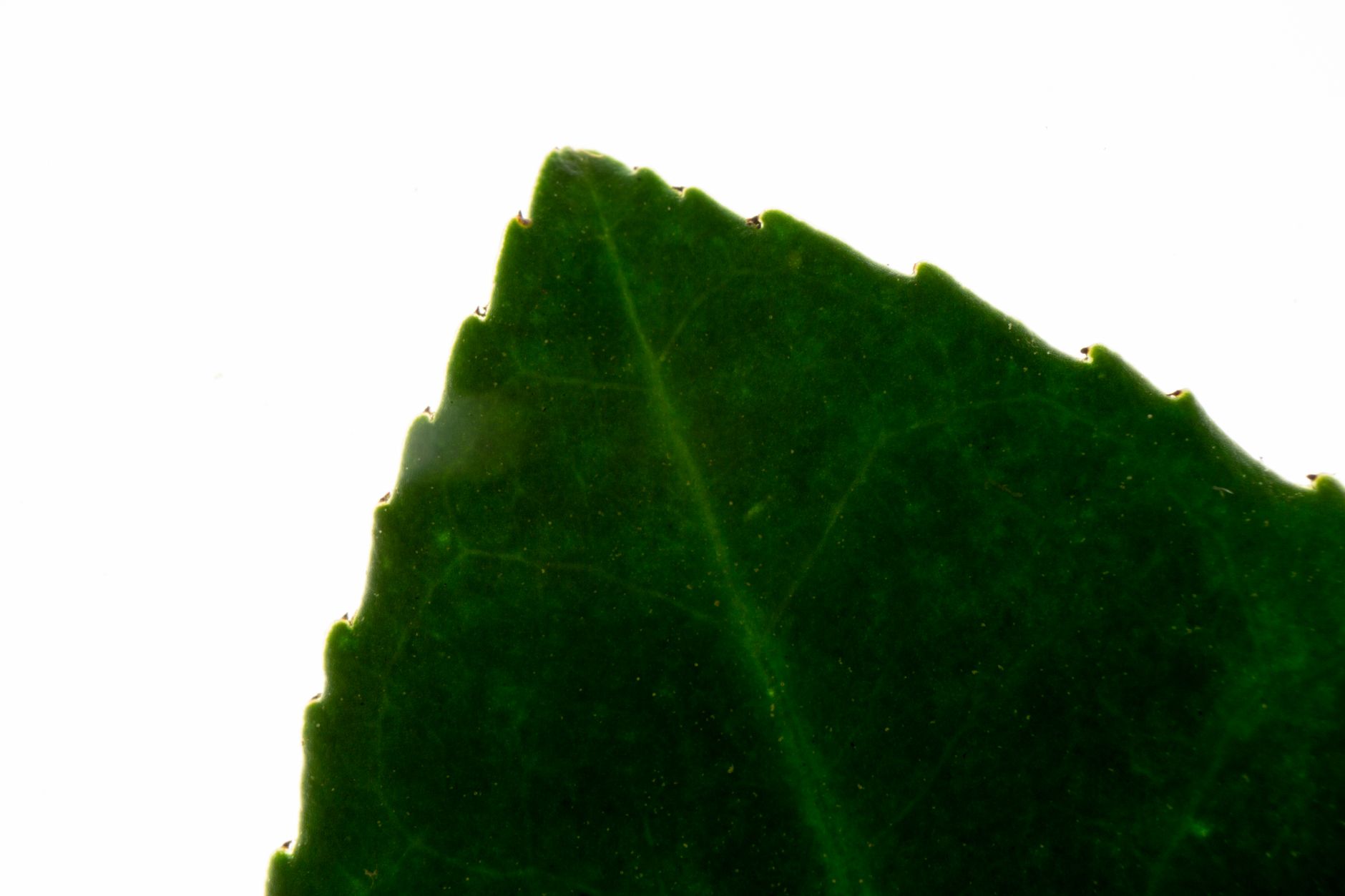
Photo by K via Pexels.
Every VPD chart you've ever seen calculates the number from air temperature. That's a shortcut, and it's often wrong -- because the number that actually matters is leaf temperature, since that's the surface where the moisture gradient is actually happening.
Under LED lighting, canopy leaf temperature typically runs 2-4°F cooler than the surrounding air temperature. That's a well-documented quirk of how LEDs radiate heat compared to older lighting -- less radiant heat hitting the leaf surface directly, more heat dumped into the air around the fixture. Under HPS, the relationship often flips: leaves can run warmer than air temp because of the intense radiant heat coming off the bulb. If you're plugging air temperature into a VPD calculator without accounting for this, you're not measuring what the plant is actually experiencing -- you're measuring the room, not the leaf.
The fix costs about $20. A basic infrared thermometer, pointed at a fan leaf in the upper canopy, gives you an actual leaf-surface reading in about two seconds. No app, no sensor calibration, no guesswork -- just point, click, and read. Do this at a few spots across the canopy, since leaves near the edges of your light footprint will run cooler than ones directly under the diodes.
The real danger of skipping this step shows up specifically in LED rooms. If your air temp reads 78°F and your hygrometer shows 55% RH, a standard chart tells you you're sitting at a comfortable 1.1 kPa. But if your actual leaf temperature is running 3°F cooler at 75°F, the real VPD experienced by the plant is meaningfully different -- and depending on which direction the gap runs, you could be sitting closer to stress territory than your dashboard suggests. Growers who never check this end up chasing symptoms -- tip burn, curling, stalled growth -- without realizing their control number was off from day one.
What Goes Wrong at the Extremes
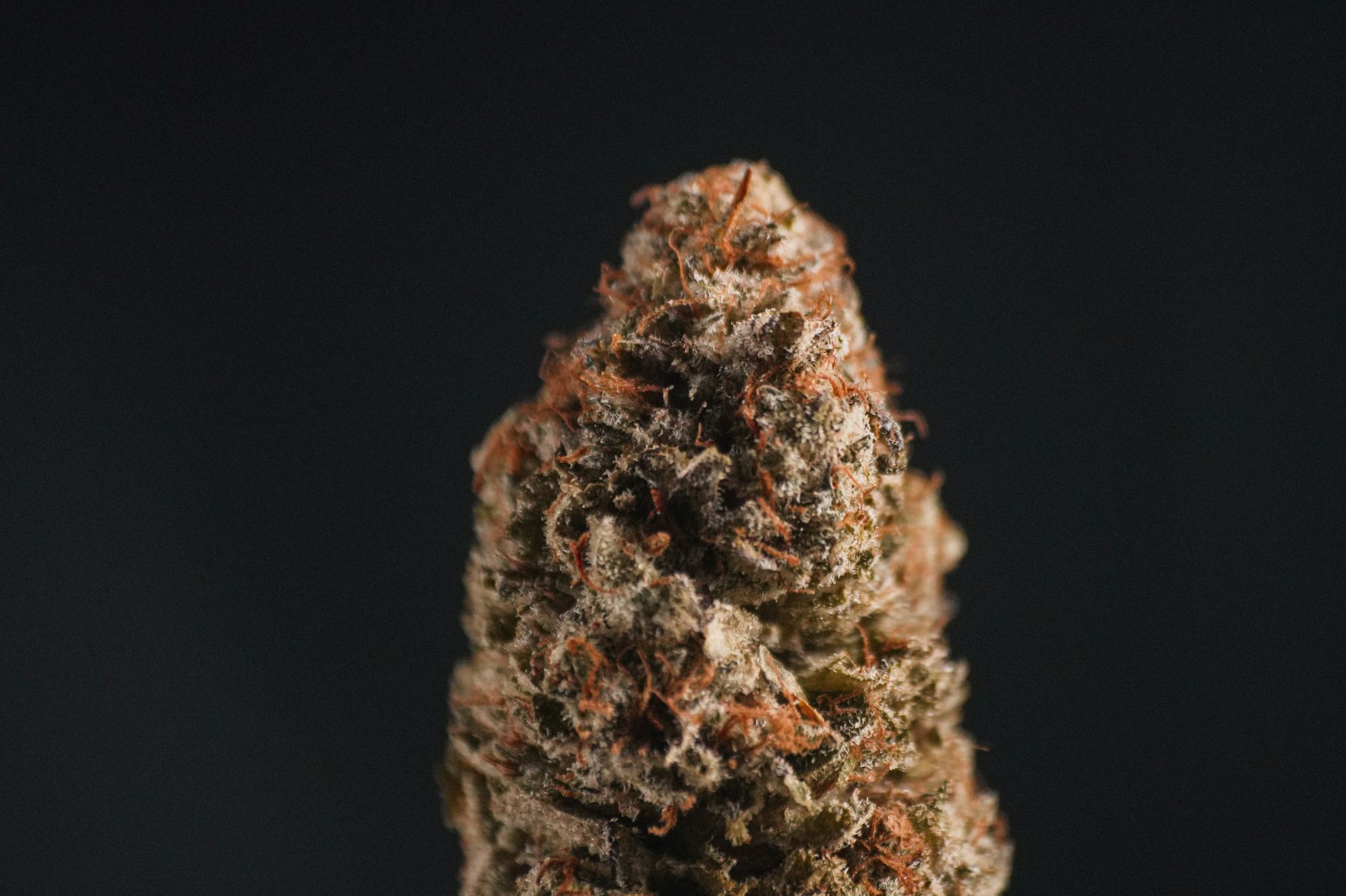
Photo by Diego Barros via Pexels.
VPD problems rarely announce themselves clearly. They show up as one of two failure patterns, and both are more common than growers like to admit.
Low VPD -- RH sitting above 60-70% combined with cool temperatures -- is the primary driver of bud rot. When the air can't pull moisture off the plant efficiently, water lingers on and inside dense flower structures, and botrytis needs almost nothing else to get started. This is especially dangerous in tight, dense colas where airflow inside the bud itself is already limited; by the time you spot the telltale gray, fuzzy patch or the sudden brown collapse of an inner cola, the infection has usually been developing for days. Low VPD late in flower is the single most preventable cause of losing a harvest at the finish line.
High VPD does the opposite kind of damage, and it's quieter. When the air's pull on moisture gets too aggressive, stomata slam shut as a defense mechanism -- which sounds protective, but it also cuts off CO2 uptake, since CO2 enters through the same stomatal pores that regulate water loss. The visible signs are leaf curl (often described as 'canoeing' or 'taco-ing'), crispy tip burn on the outer leaf margins, and stunted node spacing.
What's more insidious is chronic, moderate high-VPD stress that never crosses into obviously visible damage. A room running at 1.7-1.8 kPa for weeks won't necessarily show dramatic symptoms, but stomata are partially closed more often than they should be, photosynthesis is running below potential, and the plant is quietly building less biomass than it would under proper conditions. You won't see it in a daily walkthrough. You'll see it on the scale at harvest.
The most common real-world failure point is the canopy stretch during early flower, when leaf area and transpiration demand increase fast -- sometimes within days. Climate control that was dialed in perfectly during veg suddenly can't keep up, and VPD swings hard in either direction until the grower notices and readjusts. This is exactly the window to watch most closely.
The 2025-2026 Controller Landscape

Photo by User_Pascal via Unsplash.
Controller manufacturers have stopped competing primarily on fan speed curves and outlet timers -- automated VPD control is now the feature that actually separates product lines, and 2025 made that split obvious.
AC Infinity's Controller AI+ is the clearest example of where the category is headed. It's the company's first product built around universal AI device control, and instead of reacting to climate readings after they drift out of range, it's designed to read patterns in your room's climate behavior and adjust connected devices preemptively -- ramping exhaust or humidification before a spike actually happens rather than after your sensor flags it. That shift from reactive to predictive control is a meaningful jump for anyone who's ever watched their VPD swing hard during lights-on transition faster than their controller could respond.
TrolMaster's Hydro-X line takes a different but equally serious approach, coordinating temperature, humidity, CO2, and lighting from a single central hub rather than treating each device as its own island. Reviewers consistently note that Hydro-X's sensor accuracy for CO2 and VPD readings edges out AC Infinity's hardware, which matters more than it might sound -- a controller's automation is only as good as the sensor feeding it data, and a slightly-off VPD reading upstream means every automated adjustment downstream is chasing the wrong number.
Mars Hydro's 2026 iControl system is leaning into a different problem entirely: the fact that VPD targets need to shift across the grow, which most automation historically ignored. iControl adds stage-based automation that auto-switches climate strategy on a preset timeline, moving from seedling-appropriate low VPD through veg, transition, and into the tighter late-flower ranges without the grower manually reprogramming setpoints every couple weeks.
Not everyone needs or wants a full control ecosystem tied to specific brand hardware. Standalone environmental loggers like Pulse Grow remain genuinely popular among growers who want dedicated, accurate VPD tracking and historical data logging without committing to one manufacturer's entire device lineup -- a reasonable choice if you'd rather keep manual control over your fans and dehumidifiers but still want the real number in front of you at all times.
Building a VPD Strategy That Fits Your Room

Photo by Terre di Cannabis via Unsplash.
You don't need a smart hub to start managing VPD correctly. A decent digital hygrometer with a temperature readout, paired with a $20 infrared thermometer for leaf temp, gets most home growers about 90% of the way to a properly dialed room. The remaining 10% is automation convenience, not accuracy -- worth having eventually, not required to get real results.
Genetics matter here more than most VPD guides admit. Strains that pack on dense, tight bud structure -- the kind that looks impressive at harvest -- are also the ones most prone to trapping moisture inside the cola, which means they need more conservative late-flower humidity targets than a strain with looser, airier flower formation. If you're running something known for dense colas, err toward the low end of the 40-55% RH late-flower range rather than the high end, and don't be shy about pushing VPD toward 1.5 kPa in the final couple weeks if your genetics run dense.
Treat every range in this piece as a starting point, not a rulebook carved in stone. Room size changes how fast VPD drifts between adjustments. Local climate affects how hard your dehumidifier or humidifier has to work to hold a setpoint. Airflow design -- how evenly your oscillating fans move air through the canopy -- determines whether your sensor's reading even represents what's happening at the far corners of your tent. Two growers following identical numbers on paper can get different results because their rooms simply behave differently. That's exactly why starting with quality genetics matters as much as the climate strategy itself. A well-bred plant responds to good environmental control in a predictable, consistent way -- put it in the right VPD window and it does what it's supposed to do. Seedtiva's seed lines are bred with that predictability in mind, which takes some of the guesswork out of the equation before you've even set up your first hygrometer. No controller, however smart, fixes genetics that respond erratically to a well-managed environment.
The biggest mental shift in all of this is realizing VPD isn't a number you set once and forget -- it's a feedback loop that needs to move as your canopy changes. A target that was perfect during week 3 of veg is wrong by week 3 of flower, and a controller or grower that treats VPD as a fixed setpoint for the entire grow is going to fight the plant more than help it. The good growers aren't the ones who found the "right" VPD number. They're the ones who know which direction to move it and when.
If you take one thing away from all this, make it the leaf temperature measurement. It costs less than a bag of nutrients, takes five seconds per reading, and it's the difference between managing the number your sensor shows you and managing the number your plant is actually experiencing. Most of the "why is my VPD-dialed room still having problems" frustration traces back to exactly this gap.
As controllers get genuinely smarter -- reading patterns, adjusting preemptively, shifting strategy by growth stage on their own -- the grower's job doesn't disappear, it just moves. Less time turning dials manually, more time watching the canopy and deciding whether what the automation just did actually makes sense for the plant in front of you, or whether it's time to override it. The tech is catching up to the science from the 1920s. The judgment part is still yours.