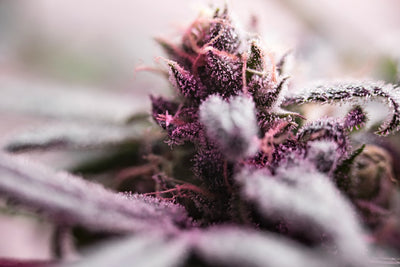
Fixing pH Swings Before They Wreck Your Nutrient Uptake
Photo by CRYSTALWEED cannabis via Unsplash.
You've seen this progression a hundred times if you've grown for more than a season: leaves start clawing downward, or the lower canopy goes yellow between the veins, and the instinct kicks in immediately. Something's missing. So you mix up a stronger batch of nutrient solution, maybe bump the feed strength up 20%, and dose the pot or reservoir like you're compensating for a shortfall. Three days later it's worse. The tips are burning now, the claw has spread up into the mid-canopy, and you're standing there wondering how feeding a hungry plant more food made things fall apart faster.
It made things worse because the plant was never hungry. It was locked out. Athena Ag's more recent framing on this, which has become the standard way serious cultivators now talk about root-zone problems, is that lockout almost never has one dramatic cause. It's not usually a single mineral crashing to zero. It's several small stressors stacking on top of each other in the root zone at once: EC creeping up, oxygen dropping, dryback going too long or too short, and pH sliding around underneath all of it. Any one of those alone your plant probably shrugs off. Stack three or four together and uptake shuts down even though the nutrient solution sitting in your reservoir or saturating your medium is chemically full of everything the plant needs.
That distinction matters because the fix is completely different depending on which problem you actually have. True deficiency needs more food. Lockout needs restored uptake conditions — and pH instability sits at the center of that more often than any other single factor, because pH governs whether the nutrients already present in solution are even in a form the roots can absorb. Dump more fertilizer into a lockout situation and you're adding salt to a root zone that already can't process what's there. This piece walks through why pH swings happen in the first place, what the real target ranges look like depending on your medium, and the actual step-by-step protocol for pulling a reservoir or root zone back into stability once it's drifted.
Why Lockout Is Rarely About One Thing

Photo by Keloke Grow via Pexels.
When a grower brings me a plant with clawed, yellowing, or spotting leaves, the first question I ask isn't what's wrong with the leaf — it's what's happened in the root zone over the last five to seven days. Lockout is a systems failure, not a single-point failure. The usual suspects showing up together are elevated substrate EC from repeated top-feeding without enough runoff, dryback that's either too aggressive (root hairs desiccating and dying between waterings) or too shallow (roots sitting in soggy, low-oxygen medium), poor root zone oxygenation generally, nutrient antagonism where an excess of one cation crowds out uptake of another — calcium in particular loves to overwhelm magnesium and potassium receptor sites when it's oversupplied — plus water quality issues like high source-water alkalinity, and pH that's been quietly sliding outside a workable window for days without anyone noticing.
Here's the diagnostic rule that saves the most plants: if you increase feed strength and the symptoms get worse rather than better within 48-72 hours, you are looking at lockout, full stop. A genuine deficiency responds to correction. A lockout responds to more feed by getting angrier, because you've just raised EC on a root zone that was already struggling to process the ions it had.
So before you touch the nutrient reservoir or bump your feed ratio, do the boring audit first. Pull a runoff sample and check its EC against what you're feeding in — a big gap tells you salts are accumulating rather than being taken up. Look back at your last several dryback cycles rather than just today's moisture reading. And pull up your pH log, if you're keeping one (you should be), and look at the trend across the last three to five days rather than the single number in front of you right now. A pH reading of 6.1 today means very little in isolation. A pH reading of 6.1 today after five days of erratic swings from 5.4 to 6.8 tells you exactly where your problem lives, and it isn't in your fertilizer bottle.
Stability Beats Chasing a Perfect Number

Photo by Shedrack Salami via Unsplash.
One of the more counterintuitive things I've had to unlearn over years of running grows is that a perfectly dialed pH number checked once a day isn't actually the goal. Stability is the goal. Plants are remarkably adaptable to pH conditions outside the textbook ideal window as long as the change happens gradually and the root zone has time to acclimate — what actually damages tissue is speed and amplitude of swing, not modest deviation from the number printed on a feed chart.
In any active, healthy system, you should expect to see pH drift somewhere in the range of 0.3 to 0.5 units over the course of a day. That's normal biology at work: roots are pulling nutrient ions selectively, exuding organic acids as part of normal metabolism, and slightly shifting the chemistry of whatever solution or medium surrounds them. That drift isn't a problem to be eliminated. It's the plant doing its job. What actually tears up root hairs and throws nutrient ion availability into chaos is drift that's larger or faster than that — a reservoir that swings from 5.6 to 7.2 overnight, or a coco slab that's bounced through a two-point range in six hours because someone kept dumping pH-down in small increments and overcorrecting each time.
The practical shift here is simple to describe and takes some discipline to actually do: log your pH at the same time every day, and pay attention to the trend line across a week, not the single spot-check reading you take right before you walk out of the tent. A single number tells you almost nothing about the stability of the environment the roots are actually living in.
This is also why I've watched growers chasing exactly 6.0 with constant micro-dosing throughout the day end up with worse plant health than growers who let their system settle at a steady 6.3 and leave it alone. The constant chasing itself introduces the instability that causes the damage. A stable number slightly outside ideal beats a chaotic number that's technically correct half the time.
Medium-Specific pH Targets and Why They Differ

Ideal pH targets vary by growing medium, ranging from about 5.8 in DWC/hydro systems up to 6.5 in soil, so growers should adjust their pH range based on the medium used to avoid nutrient lockout.
The right pH target isn't a universal constant — it changes with your medium, because different media buffer (or fail to buffer) pH shifts in completely different ways, and that changes how much tolerance you actually have.
Soil is the most forgiving medium by a wide margin. Organic matter and an active microbial population buffer pH swings naturally, which is why soil growers can run a comparatively wide 6.0-7.0 range with a 6.2-6.8 sweet spot and rarely see acute lockout from pH alone. The biology in a living soil system is doing chemistry work for you around the clock.
Coco coir is a different animal entirely. It's nearly inert, with almost no cation exchange buffering capacity of its own, which means the window tightens considerably to 5.8-6.3. There's no biological cushion absorbing your mistakes — a swing that soil would shrug off hits nutrient availability in coco almost immediately, which is exactly why coco growers who came up on soil and carry over the same loose habits toward pH monitoring tend to run into chronic, low-grade lockout they can't quite explain.
Hydro and DWC systems behave differently still, and usually in the opposite direction from what people expect. As roots consume nitrate and potassium heavily, they release hydroxyl ions back into solution, which pushes reservoir pH upward over time — it's common to see documented mid-cycle spikes climbing above 7.0 during heavy uptake periods in flower, even in a reservoir that started the week dialed in perfectly. A soil or coco grower's instinct is usually to correct downward occasionally and otherwise leave it; a DWC reservoir left unchecked for even 24-48 hours during peak uptake can drift out of range entirely on its own.
Across all of these, the underlying cation chemistry doesn't change: iron and manganese start locking out above roughly 6.5-7.0, while phosphorus and most micronutrients start locking out below about 5.5. Your medium just determines how much margin you have before you hit those walls, and how fast you'll get there.
What's Actually Causing Reservoir Swings in Hydro and DWC
Reservoir pH problems in hydro and DWC almost always trace back to something physically happening in the water that nobody's looked at closely. Decaying organic matter is the biggest culprit — algae blooming on any light-exposed surface, dead root tissue sloughing off and settling at the bottom of the bucket, a stray fallen leaf that landed in the reservoir and started breaking down. All of it feeds bacterial populations, and bacterial metabolic activity is a direct driver of pH instability. A reservoir that looks visually fine on day one can be hosting a slow bacterial bloom by day four that's actively fighting your pH corrections.
Heavy nutrient and water uptake during flower compounds this. Plants in peak flower are drinking large volumes of water daily and pulling nutrients unevenly rather than in the exact ratio they were mixed in solution — which shifts the ionic balance of what's left behind, and pH moves along with it. This is why a reservoir that held steady through vegetative growth can suddenly start swinging hard in weeks 4-6 of flower even though nothing about your feeding schedule changed.
The warning signs are fairly consistent once you know to look for them: pH creeping upward day after day no matter how much pH-down you dose in, water that's gone cloudy or developed a slimy film on the reservoir walls or air stone, and root tips that were bright white a week ago now showing brown discoloration. If you're seeing that combination, stop treating it as a dosing problem and start treating it as a contamination problem.
Go inspect three things specifically: whether any light is reaching the reservoir or the root mass (light plus nutrient solution is exactly what algae needs to establish), whether reservoir temperature has crept above 68-70°F (warmer water holds less dissolved oxygen and speeds bacterial growth), and whether your air stone or oxygenation setup is actually still moving enough air through the solution. In most cases this is fundamentally a maintenance failure wearing a chemistry costume — clean equipment, light-proofed reservoirs, and controlled water temperature prevent the large majority of what growers experience as mysterious pH drift.
The Correction Protocol: Reservoir Drain-and-Refill Method

Photo by Pavel Danilyuk via Pexels.
When you find an unstable reservoir, the instinct is to reach for the pH-up or pH-down bottle and dose it back into range immediately. Resist that. Dumping a large correction dose into an already-unstable reservoir shocks the roots sitting in it and typically produces a rebound swing in the opposite direction within a day or two — you end up chasing your own correction back and forth instead of actually stabilizing anything.
The protocol that actually works is a full drain-and-refill, not a top-off. Draining completely matters because topping off an unstable, possibly bacterially-contaminated reservoir just dilutes the problem temporarily rather than removing it. Once it's drained and the reservoir itself has been rinsed, mix a fresh nutrient solution, pH-balanced from the start, at roughly 75% of your previous feed strength. That reduced strength matters — it lowers osmotic stress on roots that have likely already been struggling to take up water and nutrients normally, giving them a few days to recover function before you ask them to process a full-strength feed again.
Resist checking pH the moment you refill. Give it 4-6 hours to equilibrate with the root mass before you take a reading — checking immediately after refill will show you the pH of your fresh mix, not the pH of the actual root zone environment, and correcting off that number will just introduce a new instability.
From there, recheck both EC and pH daily for the following week. You're looking for a flattening trend line — smaller day-to-day movement, staying within a normal 0.3-0.5 daily drift rather than the wild swings that got you here. Once you've seen five to seven consecutive stable days, you can step back up to full feed strength.
Run this alongside sensible EC targets so you're not solving a pH problem while quietly creating a salt buildup problem: 1.8-2.8 mS/cm through veg, climbing to as much as 3.5 mS/cm in late flower for vigorous, heavy-feeding genetics. Watching EC and pH together, rather than pH in isolation, is what actually keeps a recovering root zone from sliding right back into the same lockout a week later.
Monitoring Tools Worth Using
What you use to measure pH matters more than most growers give it credit for, mainly because the tool determines what kind of problem you're even capable of catching. A decent manual handheld meter is accurate to roughly ±0.1 pH, which is fine for a spot check, but it only tells you the truth at the exact moment you dip the probe. It has no idea what happened at 3 a.m. when your reservoir spiked half a point during peak dark-cycle uptake — by the time you check it in the morning, the swing already happened and the damage, if any, is already done.
Continuous digital inline pH meters solve that blind spot. Modern units hit ±0.01 pH precision and log continuously, which means you catch drift as a trend forming in real time rather than reconstructing it after the fact from stressed leaves. For anyone running DWC or coco at any real scale, this is the single highest-leverage upgrade you can make to your monitoring setup, because it converts pH management from reactive guesswork into an actual data stream.
Automated inline dosing systems take it a step further, correcting drift as it happens rather than waiting for a human to notice a reading and respond. This matters most precisely in the media with the thinnest buffering margin — coco and DWC — where a swing that would take days to matter in soil can meaningfully affect uptake within hours.
None of this works, though, if the probe itself is lying to you. Calibrate probes weekly with fresh calibration solution, not whatever's been sitting open on the shelf for six months. A drifted, under-calibrated probe is one of the most common hidden causes I see behind growers chasing a false reading for weeks, endlessly dosing pH-down to hit a target that their meter is reporting incorrectly in the first place.
If you're running a smaller home setup and automation isn't in the budget, don't worry — a disciplined daily log with a well-calibrated handheld meter, combined with genuinely clean reservoir maintenance, gets you most of the way to the same stability without spending on hardware.
If there's one habit that separates growers who consistently pull strong harvests from those who fight lockout every cycle, it's this: they stopped worshipping the number on the meter and started paying attention to the shape of the trend line underneath it. A well-buffered, consistent root zone sitting slightly outside the textbook range will outperform a chaotic one that's technically correct half the time, every time, because roots adapt to conditions — they don't adapt to chaos.
It's also worth saying plainly that genetics set a real ceiling on how much of this instability a plant can absorb without showing it. Vigorous, well-bred plants with strong root vigor tolerate a bit of pH drift and recover from an off week far better than genetics that were weak or stressed to begin with — one more argument for starting a grow with quality seed stock rather than trying to troubleshoot your way out of a plant that was never especially robust to begin with. That said, even the best genetics won't out-tolerate a genuinely neglected root zone, and results will always vary somewhat with your specific climate, medium, and setup regardless of what you're growing.
The real job, season after season, is pattern-watching. Track trends across days rather than reacting to a single reading. Treat every claw, every yellowing leaf, every burnt tip as an invitation to audit the root zone — EC, dryback, oxygen, and pH history together — before you ever reach for a stronger feed. Nine times out of ten, the plant wasn't asking for more. It was asking for stability.
Sources
- Cannabis Nutrient Lockout: What It Is and How to Fix
- Understanding pH and Cannabis: The Key to Healthy Growth | PLNTRK
- Cannabis pH Guide 2026 — Ideal pH for Soil, Coco & Hydro by Stage | GrowAI
- Cannabis pH & Nutrients Guide: Avoid Nutrient Lockout
- Master Your Cannabis PH: Expert Tips For Perfect Growing - SeedsHereNow