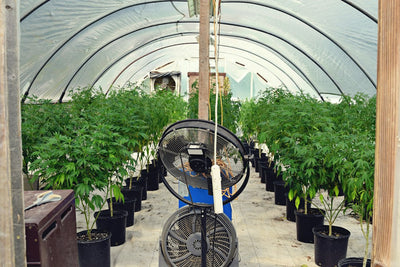
No-Till Organic Cannabis: Building Soil That Lasts
Photo by Damian Apanasowicz via Pexels.
Introduction
Pull a plant at the end of a synthetic hydro cycle and the medium underneath it is basically spent, salt buildup, dead root fragments, zero biological activity worth mentioning. No-till flips that entirely. Instead of ripping out the root ball and starting over with fresh coco or a bagged mix every cycle, you leave the container or bed intact and just cut the stalk at the soil line, leaving the roots to decompose in place. The next plant goes into that same soil, roots and all, and the whole ecosystem underneath just keeps running. You are not replacing soil between plantings, you are maintaining one continuous, aging system that gets more stable and more productive the longer you leave it alone. The techniques that make this work all point at the same goal: protect the biology that is already doing the work. Tillage physically shreds fungal hyphae networks, the thread-like mycorrhizal structures that can stretch for yards through a bed, trading sugars from the plant's roots for phosphorus and micronutrients pulled from soil particles the roots themselves cannot reach. Every time you till, you are severing that network and killing off the micro-arthropods that keep organic matter cycling into plant-available nutrients. So step one is simply minimizing disturbance. Feeding changes just as much as the tillage habit does. High-dose soluble synthetics deliver a nutrient spike the plant absorbs directly, but they also spike EC, disrupt osmotic balance for soil microbes, and do nothing to build soil structure over time. No-till systems run on steady, moderate organic inputs instead, things like alfalfa meal, kelp, crab meal, worm castings, fed in modest amounts the microbial population can actually process and convert on its own timeline. The mental shift matters more than any single technique: you stop farming the plant and start farming the soil food web underneath it.
What No-Till Actually Means in a Cannabis Garden

Photo by Pexels via Pixabay.
Pull a plant at the end of a synthetic hydro cycle and the medium underneath it is basically spent -- salt buildup, dead root fragments, zero biological activity worth mentioning. No-till flips that entirely. Instead of ripping out the root ball and starting over with fresh coco or a bagged mix every cycle, you leave the container or bed intact and just cut the stalk at the soil line, leaving the roots to decompose in place. The next plant goes into that same soil, roots and all, and the whole ecosystem underneath just keeps running. You're not replacing soil between plantings -- you're maintaining one continuous, aging system that gets more stable and more productive the longer you leave it alone.
The techniques that make this work all point at the same goal: protect the biology that's already doing the work. Tillage physically shreds fungal hyphae networks -- the thread-like mycorrhizal structures that can stretch for yards through a bed, trading sugars from the plant's roots for phosphorus and micronutrients pulled from soil particles the roots themselves can't reach. Every time you till, you're severing that network and killing off the micro-arthropods -- springtails, mites, the whole cast of decomposers -- that keep organic matter cycling into plant-available nutrients. So step one is simply minimizing disturbance. No double-digging, no aggressive mixing, just gentle top surface work at most.
Feeding changes just as much as the tillage habit does. High-dose soluble synthetics deliver a nutrient spike the plant absorbs directly, but they also spike EC, disrupt osmotic balance for soil microbes, and do nothing to build soil structure over time. No-till systems run on steady, moderate organic inputs instead -- things like alfalfa meal, kelp, crab meal, worm castings -- fed in modest amounts the microbial population can actually process and convert on its own timeline. A layer of surface mulch, whether that's straw, rice hulls, or a living cover crop, buffers topsoil temperature swings and moisture loss, which keeps that biology from stressing out and dying back between waterings.
The mental shift matters more than any single technique: you stop farming the plant and start farming the soil food web underneath it. Your bottled nutrient line becomes top-dress amendments and compost teas or extracts brewed to reinoculate biology after a rough patch. This approach works fine in raised beds, in fabric pots left in place season after season, or straight in-ground outdoors, but it really hits its stride in perennial-style outdoor plots or greenhouse beds that never get disturbed between years. Genetics still matter enormously here -- a vigorous, well-bred plant from Seedtiva can actually exploit a thriving root zone and the nutrient exchange it offers, rather than needing constant correction to perform.
The Research: What Living Soil Does to Cannabinoids and Terpenes

Photo by Excellentcc via Pixabay.
Most of what gets said about living soil and bud quality is anecdote dressed up as fact -- growers swearing their third-year no-till bed produces something a synthetic-fed plant never could, without much to point to besides taste and a hunch. That's starting to change. A 2025 USDA-funded study out of the group led by Chacon, published in the Journal of Medicinally Active Plants and picked up by The Cannigma in May 2026, actually put numbers behind the claim, and the numbers are worth sitting with.
The researchers grew hemp side by side in two conditions: no-till plots maintained with cover crops and living roots year-round, versus conventionally tilled soil that had been biologically degraded through repeated disturbance. Same genetics, same climate, different soil biology. CBG concentrations came in 3.7 times higher in the no-till, cover-cropped plots. That's not a rounding error -- that's the kind of gap that should make anyone growing for minor cannabinoid content pay attention to what's happening below the soil line, not just what's in the feed schedule.
The THC side of the data cuts the other way, and it's the part that tends to get glossed over. Plants in the degraded, tilled soil ran up to six times higher in THC than their no-till counterparts. Terpene profiles diverged measurably between the two groups as well -- not just in total terpene content but in which compounds dominated. So the plant under biological stress in depleted soil wasn't producing less of everything; it was reallocating its chemistry, pushing harder into THC production while building a different terpene signature than the plant growing in a stable, microbially rich root zone.
This tracks with older work on cannabis-associated endophytes -- the bacteria and fungi that don't just live around the roots but actually colonize internal plant tissue. A 2020 review in Microorganisms laid out the case that these internal microbial communities interact directly with the plant's secondary metabolite pathways, the same pathways responsible for cannabinoid and terpene synthesis. Endophytes aren't passengers. They're metabolically active tenants that appear to nudge how the plant partitions its resources between growth and chemical defense compounds.
None of this proves living soil makes better weed in some absolute sense, and it's worth resisting the urge to oversell it that way. What the Chacon study shows is that soil microbiology can shift cannabinoid and terpene expression under controlled research conditions -- a real, measurable effect, but one study, one crop type, one set of cultivars. Claiming definitive superiority for living soil gets ahead of what the evidence currently supports, and growers who repeat it as settled science are overstating their hand.
The practical takeaway is sharper than the marketing version anyway: chasing raw THC percentage as your only quality metric may actually reward degraded, stressed soil, not healthy soil. If you're building toward balanced cannabinoid ratios and a fuller terpene profile, the current research points toward biological stability in the root zone as the more relevant lever -- and that's exactly the kind of outcome no-till systems are built to sustain season after season.
Building the System: Cover Crops, Compost, and Microbial Inoculants

Photo by Jeffry Surianto via Pexels.
Once the beds are built, the real work is what happens between crops, not during them. A no-till bed that just sits bare after chop day is losing biology every week it's exposed -- UV breaks down fungal hyphae, wind and rain compact the surface, and the mycorrhizal network starts dying back for lack of a living root to trade sugars with. The fix is a cover crop planted within a few days of harvest, not weeks later. A mix of crimson clover, hairy vetch, and oats covers three jobs at once: the vetch and clover fix atmospheric nitrogen through rhizobia nodules and hand it off slowly as they decompose, the oats throw down a fast fibrous root mass that adds organic matter and physically holds the soil structure together, and all three keep a living root in the ground feeding exudates to the mycorrhizae so the fungal network never goes dormant. Broadcast at roughly 1-2 lbs of seed per 25 square feet, water in, and let it run 3-4 weeks before your next transplant. Chop it at the base rather than pulling it, and let the roots rot in place -- that's where the real organic matter contribution happens, not in the top growth.
Feeding a living soil bed long-term looks nothing like feeding in a bottle-fed system. Instead of chasing an EC number every watering, you're top-dressing on a calendar: a half-inch layer of finished compost every 2-3 weeks through veg, worked in around the base of the plant, plus a light dusting of worm castings every week to ten days. This isn't precision dosing -- it's slow-release fuel for a microbial population that mineralizes nutrients on the plant's own timeline. Growers coming from synthetic programs tend to over-worry about ppm here; in a mature bed, the soil food web buffers nutrient availability far more than a jug of bottled nutrients ever could, and chasing runoff numbers on a living bed is usually a waste of a pH pen.
Mulch is the piece people skip and shouldn't. A 2-3 inch layer of straw or shredded leaf litter over the entire surface does three things simultaneously: it suppresses weed pressure without cultivation, it buffers root-zone temperature swings by several degrees during hot afternoons, and as it slowly breaks down it feeds the fungal-dominant side of the soil food web that cannabis roots prefer over a bacterial-dominant profile. Leaf litter especially, being higher in lignin, breaks down slower and favors fungi over bacteria -- exactly the ratio you want in a perennial bed.
Compost teas and microbial inoculants aren't a one-time inoculation you do at bed-building and forget. Any real disturbance -- a hard till pass you didn't mean to make, a period of drought stress, a pest treatment that wasn't fully selective -- knocks the biology back, and a reintroduction of aerated compost tea or a mycorrhizal/Trichoderma drench afterward is cheap insurance against a slow recovery. Treat it as maintenance, applied every few weeks and after any disruption, not a single fix-all dose.
None of this clicks into place immediately. A freshly built living soil bed usually takes 2-3 full cycles -- six to nine months of real growing time -- before the biology, organic matter, and nutrient cycling reach a self-sustaining equilibrium. The first run often looks unremarkable; by the third, growers running quality genetics on a mature bed typically see noticeably better vigor and resilience for less input effort than season one.
Certification and Why 'Lasts Season After Season' Is Becoming a Selling Point

Photo by Gustavo Fring via Pexels.
Trust in cannabis testing took a real hit in June 2024, when the Los Angeles Times published its investigation into pesticide contamination in California dispensary product. Their lab testing found fungicides, miticides, and other banned or restricted compounds at levels that in some cases exceeded legal thresholds by orders of magnitude, in flower carrying a passed test result on the label. For growers who've spent years building soil food webs instead of spraying, this was infuriating on two fronts: it confirmed what a lot of no-till and regenerative farmers had suspected about lab shopping and inconsistent enforcement, and it dumped a huge trust deficit on everyone in the industry, including the operations doing things right. That story is a big reason third-party certification has moved from a nice-to-have marketing badge to something that serious cultivators are actively pursuing as proof, not just a claim.
Sun+Earth Certified, headquartered in California's Emerald Triangle, is probably the most rigorous option built specifically for cannabis. The process starts with an online application, moves to an actual farm inspection rather than a paperwork review, and includes a soil test screening for more than 300 pesticide compounds. What sets it apart from USDA organic, which cannabis is federally barred from carrying anyway since it's still a Schedule I substance, is that Sun+Earth also mandates fair labor standards for farmworkers. That's not a small addition. It means the certification is vouching for the people doing the work, not just the chemistry of the soil, which matters a great deal in an industry that has had real problems with labor practices on both licensed and unlicensed farms.
CCOF's Regenerative Organic Certified track went permanent on January 1, 2024, after a 2022-2023 pilot that ran with more than 60 participating operations. It's available as its own standalone certification or bundled with CCOF's other organic certifications, and its soil-health pillar is where no-till growers will feel most at home. The standard explicitly gives credit for cover cropping, crop rotation, and conservation tillage practices that build organic matter and support biological diversity, all without synthetic inputs. Soil-less and hydroponic systems are excluded from this pillar entirely by design. That's a direct match for what a living-soil, no-till bed is doing anyway, which means growers who've already put in the work of building a permanent bed system aren't retrofitting their practice to chase a certificate, they're documenting what they were already doing.
Clean Green Certified has the longest track record of any of these, verifying organic cannabis cultivation practices since 2004, which predates recreational legalization in every state and even predates most medical markets in their current form. That history counts for something with buyers who remember when there was no framework at all.
Requirements, fees, and inspection cycles vary by program and by state, and they change. Anyone considering certification should go straight to the certifying body's current documentation before applying rather than relying on secondhand summaries, including this one.
Common Mistakes That Break a No-Till System

Photo by Walter Cunha via Pexels.
Most no-till failures aren't biological, they're behavioral. The soil food web is remarkably forgiving of small chemistry swings but brutally unforgiving of physical disturbance and impatience, and the mistakes I see most often trace back to growers still thinking like bottle-feeders even after they've switched to a living bed.
Compaction is the quiet killer. Every time you step into a bed to prune, train, or check runoff, you're pressing down on a fungal network that may have taken two or three cycles to build real density. Mycorrhizal hyphae and the aggregate structure they help create need pore space to move oxygen and water through the root zone. Walk the same path across a 4x8 bed a dozen times a cycle and you'll flatten that structure into something closer to a hydro-store bagged mix with dirt on top. Same goes for overwatering: waterlogged beds push out oxygen-loving micro-arthropods like springtails and predatory mites, and anaerobic pockets favor the wrong microbial populations entirely. Lay down permanent walkways or stepping pads outside the bed footprint on day one, and irrigate to field capacity rather than flooding on a schedule -- check with a moisture meter or just your finger before every watering rather than defaulting to a calendar.
The phrase no-till gets misread as no work, and that's how beds stall out by cycle three. If you're not top-dressing worm castings, compost, and amendments between cycles, or throwing down a cover crop like crimson clover or a mixed vetch-oat blend during a rest period, you're pulling nutrients out of the system without ever putting new organic matter back in. The bed doesn't need to be tilled, but it absolutely needs to be fed. Skipping cover crops in particular costs you the living roots that keep exudate flowing to soil microbes during the gap between harvest and the next transplant -- that gap is exactly when populations crash if there's nothing green growing.
Then there's the mistake that does the most damage in the least time: reaching for a bottle. A single application of a high-salt synthetic nutrient or a systemic pesticide can knock back microbial populations that took multiple full cycles to establish. Salts spike the soil's EC and osmotic pressure, which stresses or kills off bacteria and fungi that evolved to function in a narrow, low-salt range. Systemic pesticides are worse, because they're designed to move through plant tissue and root exudates, meaning they don't just kill the pest -- they poison the exact biological pathways you built the bed to support. If a pest or disease problem shows up mid-cycle, treat it organically: neem or karanja oil, beneficial insect releases, Bt for caterpillars, insecticidal soap for soft-bodied pests. It's slower than a systemic spray, but a systemic spray can undo a year of soil-building in one application.
Last, expect a ramp, not an instant result. First-cycle no-till plants often finish smaller or slightly slower than a dialed-in bottle-fed hydro run, because the biology hasn't reached full nutrient-cycling capacity yet -- mineralization rates, fungal colonization, and nutrient exchange all improve with each successive cycle. Growers who bail after one underwhelming harvest, or who panic-dose synthetics to compensate, never get to see the payoff that shows up around cycle three or four, when the bed starts outperforming anything from a bag. Genetics matter too here -- starting with well-bred seeds suited to organic, living-soil conditions gives the system less to fight against while it matures. Patience is the actual input you're missing if the yield feels flat.
Conclusion
No-till is not a shortcut. It is a different way of growing that rewards patience and punishes the habits growers bring from bottle-fed systems. A freshly built living soil bed usually takes two to three full cycles, six to nine months of real growing time, before the biology, organic matter, and nutrient cycling reach a self-sustaining equilibrium. The first run often looks unremarkable. By the third, growers running quality genetics on a mature bed typically see noticeably better vigor and resilience for less input effort than season one. The research from Chacon and colleagues, showing CBG concentrations 3.7 times higher in no-till plots and distinct terpene profiles compared to degraded soil, suggests that biological stability in the root zone is a real lever for cannabinoid and terpene expression, not just a marketing talking point. But the THC side of the data cuts the other way, with plants in stressed, tilled soil running up to six times higher in THC than their no-till counterparts. That finding should give any grower chasing raw THC percentage as their only quality metric reason to pause, because it suggests that metric may actually reward degraded soil, not healthy soil. The common mistakes that break a no-till system, compaction, skipping cover crops, reaching for a synthetic bottle, and giving up before the biology matures, are all behavioral rather than biological. The soil food web is forgiving of small chemistry swings but brutally unforgiving of physical disturbance and impatience. Certification programs like Sun+Earth, CCOF's Regenerative Organic Certified track, and Clean Green Certified are increasingly important as trust in lab testing has taken hits, and they align naturally with what no-till growers are already doing, documenting practices rather than retrofitting to chase a certificate. The shift from farming the plant to farming the soil food web is the real work, and the payoff shows up not in a single harvest but in a system that gets better with each cycle, season after season.
Sources
- How to Prepare Organic Living Soil for Cannabis in 2026: Compost, Soil Food Web, and Companion Plants | The Cannigma
- Living Soil Cannabis: Why Top Cultivators Are Ditching Synthetic Nutrients | The Cannigma
- No-Till Cannabis Growing: A Complete Organic Soil Guide - Kind Green Buds
- What is Living Soil and Why It Matters - 210 Cannabis Co | Arlington's Best Dispensary | Native Owned | Arlington, WA
- Organic Cannabis Cultivation - Living Soil No Till - KNF culture - THCFarmer