Nutrient Burn or Light Stress? Fixing Tip Curl on Autos Under 1000W LEDs
Photo by Philipp via Unsplash.
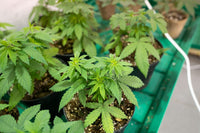
Walk into any grow forum right now and you'll find the same photo posted a dozen different ways: an autoflower under a 1000W LED, tips curled like tiny claws, and a caption asking what's wrong with the nutrients. The fixture itself is almost never mentioned, even though it's sitting 14 inches above the canopy at 100% output in a 2x4 tent built for a plant that tops out at 30 inches. These lights have gotten cheap enough and powerful enough that they've landed in spaces they were never really scaled for, and the symptoms that show up — tip curl, clawing, dark brittle edges — get diagnosed as a feeding problem almost by reflex.
That reflex causes real damage. A grower sees curled tips, assumes burn, and starts cutting EC or flushing a plant that didn't need it, while the actual stressor — raw light intensity or canopy heat — keeps cooking the top of the plant every single day the light stays where it is. Autoflowers don't have the luxury of a photoperiod plant's recovery window; there's no extended veg to make up for a rough week 2. Every day of stress during that short vegetative stretch shows up directly in final yield.
Fixing this isn't complicated, but it does require doing things in the right order. Check the light first. Check the heat second. Only then look at the nutrient solution. This article walks through how to actually tell these stresses apart on the leaf itself, and the specific height, dimmer, and EC corrections that resolve each one — so you stop chasing a feeding problem that was never there.
Why 1000W LEDs Are the Common Thread
1000W LED fixtures (meaning actual draw, not the inflated "equivalent wattage" marketing numbers) have become the default recommendation for a lot of small tents, and that's part of the problem. A fixture built to deliver real coverage and intensity across a 4x4 or 5x5 footprint gets dropped into a 2x2 or 2x4 space where it's drastically oversized for the canopy height an autoflower actually reaches. These plants rarely clear 30-36 inches, which means the canopy sits much closer to the diodes than the fixture was designed for, and at full output that's a lot of photon flux hitting a short plant with nowhere to go.
Running one of these lights at 100% from the day the seedling breaks soil is the single most common beginner mistake with this class of fixture. It's an easy mistake to make, too — the light came with one knob setting (full) as the default, and dimming feels like you're wasting the equipment you paid for. But a seedling with two sets of true leaves has no business sitting under 600+ µmol/m²/s.
The consequences don't stay cosmetic. Roots slow down when the plant is busy defending leaf tissue instead of building structure below ground. Leaves start tacoing — curling downward along the midrib — as a defensive response to reduce surface exposure. Calcium and magnesium uptake gets disrupted even when the feed itself is correct, because the stress response pulls resources away from normal transport, and growers read that as a cal-mag deficiency and add more of something the plant didn't need. Stretch gets stunted, and flower formation that should be vigorous instead comes in sparse and uneven.
Autoflowers don't get a second chance at this. A photoperiod plant stressed in week 2 of veg can be given an extra week or two to recover before flipping to bloom. An autoflower is on a fixed internal clock regardless of what you do to it, so lost time in the first two to three weeks doesn't get made up later — it just shows up as a smaller final plant. Starting with vigorous, well-bred seed stock, which is something we focus on at Seedtiva, gives you more margin when light management isn't perfect. But good genetics buys you tolerance, not immunity — it doesn't replace getting the fixture dialed in correctly.
Reading the Leaf: Burn vs. Light Stress vs. Nitrogen Excess
The fastest way to stop misdiagnosing these plants is to stop looking at color first and start with texture. Bleached tissue from light stress turns papery, dry, and brittle almost immediately — it crumbles if you fold it between two fingers. Nutrient burn on tips, by contrast, looks scorched and curled but stays flexible and somewhat supple for days longer before it dries out completely. If you can still gently bend a curled tip without it snapping, you're more likely looking at a feeding-related issue; if it crumbles, light intensity is the prime suspect.
Location on the plant tells you almost as much as texture does. Symptoms that start at the very top of the canopy and stay confined to the leaves closest to the fixture should be treated as a lighting issue until you've actually ruled it out — nutrient-related problems from the root zone tend to show up more uniformly across the plant, or start in older fan leaves first, not exclusively on the leaves nearest the diodes.
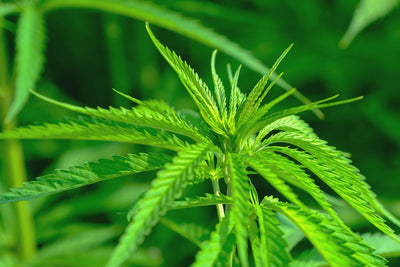
Curl direction is one of the more reliable tells once you know to look for it. Tips curling downward — what growers call clawing — is the classic signature of nitrogen excess, especially when it's paired with leaves that look unusually dark, almost glossy green. Tips curling upward, toward the light, is more characteristic of a classic burn or heat response, where the plant is trying to reduce the leaf surface facing the intensity overhead.
It's worth saying plainly: these two stresses stack. A plant under high-intensity LED exposure that's also getting a completely normal feeding schedule can still show lightly burnt, curled tips even when a runoff EC test comes back exactly where it should be. That's not a nutrient problem hiding in your numbers — it's a VPD and DLI problem, caused by total light energy and transpiration demand outpacing what the plant can handle, regardless of what's in the reservoir. If you see clawing combined with dark, overly glossy foliage and the light situation checks out otherwise, that combination does point back toward nutrient levels running generally high, not a lighting issue in isolation — which is exactly why you check both in sequence rather than guessing from one symptom alone.
The Diagnostic Sequence: PPFD, Leaf Temp, Then Runoff

Target light intensity (PPFD) should increase progressively as plants mature, rising from about 300 µmol/m²/s during the seedling stage to 900 µmol/m²/s at flowering.
The diagnostic order matters more than any single measurement, and it starts with light, not the nutrient reservoir. Step one is a PPFD reading taken at canopy height, directly under the center of the fixture — not at the tent's edge, where readings read artificially low and will trick you into thinking your light is weaker than it actually is at the spot where the plant's main cola is sitting. A $40-$80 quantum PAR meter pays for itself the first time it keeps you from dimming a light that was already fine, or raising one that genuinely needed it.
Step two, once you have a real PPFD number, is leaf-surface temperature with an infrared thermometer, measured directly on the leaf tissue nearest the light source. If that reading runs noticeably above your ambient air temperature — more than 4-6°F higher is worth paying attention to — heat is contributing to what you're seeing even if the PPFD number looked acceptable on paper. LEDs run cooler than HPS overall, but at close range under a 1000W fixture, radiant heat at the leaf surface can still run well ahead of what your tent thermometer reports from across the room.
Only after those two checks come back clean do you move to step three: testing runoff EC and pH to rule out a lockout hiding behind what looks like a light symptom. Testing nutrients first, before light and heat, is the single most common diagnostic error growers make with these fixtures — it sends you chasing feed adjustments on a plant whose real problem is sitting 14 inches overhead.
For reference, autoflowers want roughly 100-300 µmol/m²/s at the seedling stage, 400-600 through vegetative growth, and 600-900 once they're established in flower. Pushing much past 900 doesn't buy you more yield — it risks foxtailing, where the plant produces wispy, elongated growth at the cola tips as a stress response rather than dense, resinous bud structure.
Correcting It: Height, Dimming, and Feed Adjustments

Photo by Masood Aslami via Pexels.
Once you've confirmed light or heat is the driver, the fix is mechanical before it's nutritional. Raise the fixture 6 to 12 inches and dim output by 10-30%, and recheck PPFD at canopy height afterward rather than assuming the adjustment worked. Which correction to lean on depends on what your readings showed: if the center reading under the fixture was too hot but the edges of the canopy were still getting adequate light, dim first — raising the light in that case just starves the edges further. If both center and edge readings were running high, raise the fixture, since dimming alone won't fix an evenly oversized footprint.
Nutrients come last, and when you do get there, autoflowers need a lighter hand than most growers expect. Feed at 25-50% of the label's recommended dose, because autos are meaningfully more nutrient-sensitive than photoperiod strains, partly due to their compressed life cycle and smaller root systems. A grower running full photoperiod-strength doses on an auto in weeks 1-3 is often feeding 1.2-1.6 EC when the plant is actually asking for something closer to 0.4-0.8 EC. That gap is enough on its own to cause tip burn, and in some lines it can trigger a stress response that pushes the plant toward premature flowering before it's built the structure to support a real yield.
After you've corrected the light and dialed the EC back down, give the root zone a reset: flush with plain, pH'd water for one full feeding cycle before reintroducing any nutrient solution. This clears accumulated salts that built up during the overfeeding period and lets uptake normalize before you ask the roots to process a feed again.
Recovery from here is gradual, not instant, and that's worth setting your expectations around. New growth should look normal — flat, proper color, no curl — within 5 to 7 days if the correction actually addressed the real cause. The tips that were already damaged won't heal; that tissue is done. But if the fix worked, the damage won't spread to new leaves, and that's the actual marker of success, not whether the existing scarred tips somehow recover their original shape.
Preventing the Cycle on Your Next Grow
The cheapest fix for all of this is never needing to diagnose it in the first place, and that starts with dimmer settings from day one rather than running 100% output through seedling and early veg and only backing off once you see a problem. Most 1000W fixtures have a dial or app control for exactly this reason — use it on a schedule tied to growth stage, not just when something already looks wrong.
Keep a simple weekly log: PPFD at canopy height, leaf-surface temperature, and runoff EC and pH. It takes maybe five minutes a week and it's the difference between catching drift early — a fixture that's crept too close as the plant stretches, or an EC that's climbed higher than intended over several feedings — and discovering it only once tips have already curled. By the time you can see a symptom, the underlying number has usually been off for days.
It's also worth accounting for the fact that autoflower lines aren't uniform in how they handle any of this. Vigor and nutrient sensitivity vary meaningfully between genetics, which is exactly why starting with quality, stable seed stock matters — it narrows the range of surprises you have to troubleshoot for in the first place, even though it doesn't eliminate the need to manage light and feed correctly.
None of the PPFD or EC numbers here should be treated as guarantees. They're a calibrated starting point, and your actual results will shift with tent airflow, ambient humidity and temperature control, fixture quality and spectrum, and the specific genetics you're running. Treat this as the range to start dialing in from, then adjust based on what your own meter and your own plant are telling you each week.
Most of the tip curl cases that show up under 1000W fixtures trace back to the same root cause: the light running at full intensity without height or dimmer matched to what stage the plant is actually in. It's rarely a feeding mistake, even though feeding is almost always the first thing growers change when they see the symptom.
The discipline that actually protects a grow is sequence, not intuition. Check PPFD at canopy height. Check leaf-surface temperature. Check runoff EC and pH. In that order, every time, before you touch the nutrient schedule at all. Skipping ahead to the reservoir because it feels like the more obvious fix is how a light problem turns into weeks of unnecessary flushing and re-feeding on a plant that was never malnourished to begin with.
Autoflowers are less forgiving of indecision than they are of any single mistake. A grower who picks one correction, commits to it, and waits 5-7 days to read the new growth will end up with a healthier plant than one who adjusts height, dimmer, and feed all in the same afternoon and never finds out which change actually worked. Pick the variable the diagnosis points to, make the change, and let the new growth tell you if you were right.