Nutrient Timing in Flowering: The Science of Maximizing Resin
Photo by Diego Barros via Pexels.
Walk into any grow forum and you'll find a dozen feeding charts, all confidently different, all presented as gospel. Most of them trace back to some combination of fertilizer marketing copy and grower folklore passed down through generations of trial and error. That's not necessarily wrong, but it's not science either — and for a plant where the entire commercial value sits in a resin layer a few hundred microns thick, "probably fine" isn't a great standard to build a feeding program around.
Over the last few years, that's started to change. Controlled-environment research out of the University of Guelph and the University of Hohenheim has actually measured how cannabis responds to nitrogen, phosphorus, and potassium across the flowering window, using hydroponic dose-response trials instead of anecdote. The findings don't just fill in gaps — in a few places they directly contradict what's printed on the back of popular bloom nutrient bottles. This isn't about growing bigger plants for the sake of it. The real question this research answers is narrower and more useful: how do you time N, P, and K specifically to push cannabinoid and resin concentration, given that flower yield and potency don't always move together — and sometimes move in opposite directions.
What the Guelph Study Actually Found
Photo by Richard T via Pexels.
The most rigorous dataset we have on flowering macronutrients comes from a research group at the University of Guelph — Lewys Bevan, Max Jones, and Youbin Zheng — working out of a Health Canada-licensed research facility in Southern Ontario. They ran 'Gelato,' a high-THC, low-CBD cultivar familiar to most growers, through a deep-water culture hydroponic system using a central composite design. That's a statistical trial structure built specifically for mapping curved dose-response relationships rather than just comparing a handful of fixed treatments, which matters because plant nutrient response is rarely a straight line.
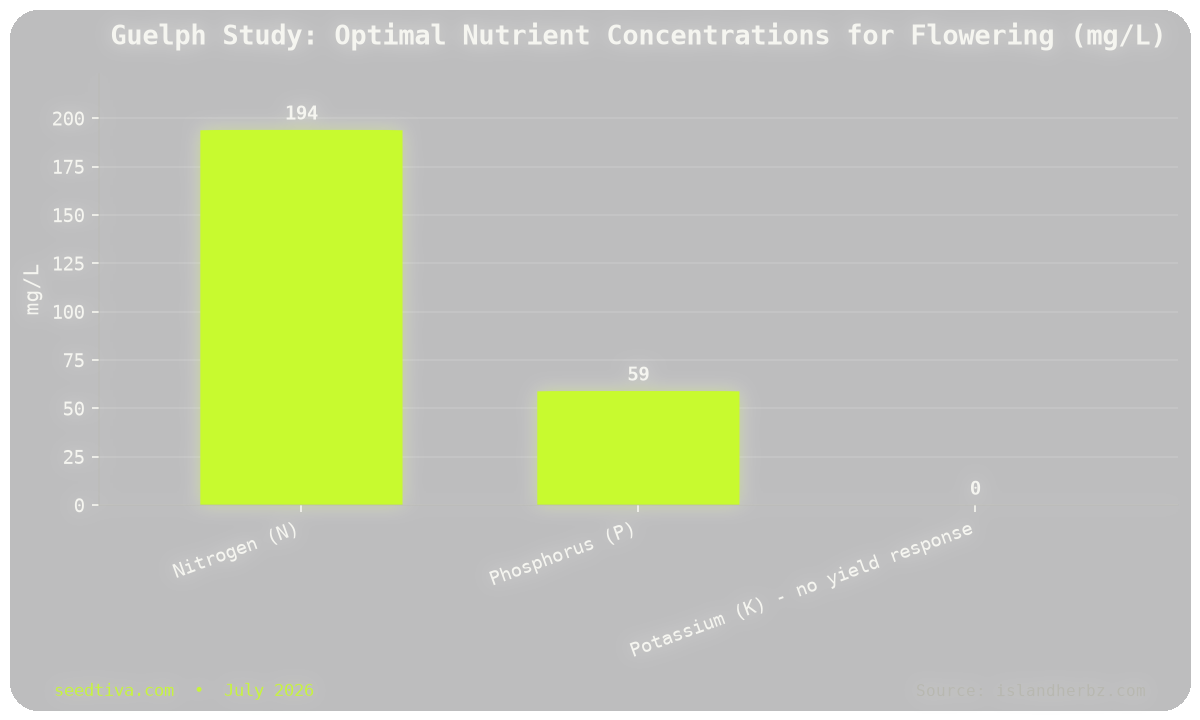
They tested nitrogen from 70 to 290 mg/L, phosphorus from 20 to 100 mg/L, and potassium across a wide 60 to 340 mg/L range — wide enough to cover everything from a lean vegetative feed to the aggressive end of commercial bloom formulas. Inflorescence yield responded quadratically to both nitrogen and phosphorus, meaning yield rose with increasing rates, peaked, and then declined — the classic bell-shaped nutrient response curve. Their model put the predicted optimum at 194 mg/L N and 59 mg/L P for maximizing flower yield in this hydroponic system.
The finding that should reset a lot of assumptions is potassium. Across the entire 60-340 mg/L range tested, yield simply did not respond to K. Not a plateau after a certain point — no measurable response at all, in either direction. That's a direct contradiction of the widespread belief that heavy potassium feeding during bloom is what drives flower development and density. This trial was published in Frontiers in Plant Science in November 2021, and its implication is blunt: dumping high-K 'bloom booster' into your reservoir in weeks 5 and 6 may be doing a lot less than most of us assume, at least for yield.
]Nitrogen: Less Is More Once Flowers Set
Nitrogen gets treated by a lot of growers as something to slam early and taper reluctantly, if at all. The data says the taper should be more aggressive than most feed charts recommend. Earlier work from the same Guelph group pegged the optimal nitrogen rate at roughly 160 mg/L across both vegetative and flowering stages — notably lower than what a lot of commercial 'grow' and 'bloom' formulas deliver when mixed at label strength.
Here's where it gets genuinely interesting, and where growers need to make a real decision rather than just following a chart. Cannabinoid concentration — the percentage packed into each gram of flower, not the total cannabinoid yield across the whole plant — was actually higher at very low nitrogen rates. Nitrogen-stressed plants produced less flower overall, but what they did produce was denser with cannabinoids. That's a tradeoff, not a bonus: you're choosing between maximizing total resin output from the plant and maximizing concentration per gram. You can't have both maxed out simultaneously, at least not based on what this data shows.
For most home and small commercial growers chasing potency for personal use or a premium market, the practical move is tapering nitrogen down through weeks 3 and 4 of flower rather than holding vegetative-level feeding all the way to harvest — which is what happens by default if you're just running one 'flower' formula at a fixed dilution from flip to flush. Start closer to your vegetative N rate as flowers are setting, then pull back toward that 160-194 mg/L range as bulking really kicks in around week 3-4.
This actually lines up with something growers arrived at empirically long before anyone ran a central composite design on it. The common NPK ratio used in flowering formulas, somewhere around 1-3-2, already reflects pulling nitrogen back relative to phosphorus and potassium. The instinct was right. The research just tells us how far to pull it back and when.
]Phosphorus: The Bloom Nutrient That's Often Overfed

Photo by Diego Barros via Pexels.
Phosphorus has the strongest 'more must be better' mythology of the three macronutrients, mostly because it's marketed as the bloom nutrient — bat guano, bone meal, and every 'PK 13-14' style bloom booster on the shelf leans on the idea that pouring on phosphorus is what makes flowers swell and resin flow. A 2020 study published in Applied Sciences (MDPI) tested this directly by tracking phosphorus response across vegetative, pre-flower, and flowering stages in acid-pool greenhouse conditions.
The result: pushing phosphorus above 11.25 mg/L did not increase cannabinoid concentration. More P did not translate into more potency, full stop. Where phosphorus did earn its keep was structural — plants fed the higher 30.0 mg/L rate developed greater width and, likely as a consequence, more bud sites, which is a real yield argument. It's just not a potency argument, and those are two different goals that a lot of growers conflate.
Put that next to the Guelph hydroponic optimum of 59 mg/L P for maximizing yield, and you've got two studies using different growing methods landing on different absolute numbers — no surprise, since nutrient availability and uptake efficiency shift substantially between soil, coco, and hydro. But the pattern holds across both: cannabinoid production plateaus at a phosphorus level well below where yield keeps climbing. Once you're past that threshold, additional P is buying you plant structure and bud sites, not resin.
The practical read for anyone running a heavy 'PK boost' additive in weeks 5 and 6, on top of an already phosphorus-rich bloom base nutrient, is that you're likely making a yield and structure play, not a potency play. There's nothing wrong with that if bulk weight is your priority. Just don't expect it to be the thing that pushes your lab test numbers up, because the evidence so far says it won't.
]The 'Hunger Games' Strategy: Controlled Stress for Efficiency

Photo by Sasha Kim via Pexels.
If the Guelph work established that nitrogen and phosphorus have a ceiling, a 2023 study out of the University of Hohenheim's Institute of Crop Science in Stuttgart asked a sharper follow-up question: what if you deliberately feed below that ceiling? The trial picked up an unofficial nickname among people following it — the 'Cannabis Hunger Games' — and it's a fitting description of the design. Published in Frontiers in Plant Science on September 19, 2023, the study compared mineral versus organic fertilizer across three nitrogen dilutions: 80, 160, and 240 mg N/L.
The nutrient-stressed plants, unsurprisingly, produced less flower by harvest weight than the well-fed ones. But they concentrated CBD more efficiently — hitting 95% of the total CBD yield of the highest-fed plants while using roughly a third less fertilizer overall. That's a genuinely useful number for anyone thinking about input costs relative to potency output, not just chasing maximum bud weight regardless of what it costs to get there.
The efficiency numbers are where this study really separates itself. Agronomic nutrient use efficiency for CBD yield — essentially, how much cannabinoid you get per unit of nitrogen applied — rose 34% with organic fertilizer and a striking 72% with mineral fertilizer when dropping the nitrogen rate from 240 down to 160 mg N/L. That's not a rounding error. That's a substantial efficiency gain from simply not overfeeding.
This dovetails directly with the potency-versus-yield tradeoff Guelph identified. Both research groups, working independently with different cultivars and different methods, converge on the same shape of answer: deliberate mid-range nutrient stress — not starvation, and not maximum feed — looks like the efficiency sweet spot. Starving plants tanks total output. Overfeeding wastes fertilizer on biomass the cannabinoid pathway doesn't care about. The middle ground is where growers optimizing for potency per dollar of nutrient input, rather than raw flower weight off the scale, should be aiming.
]Building a Practical Flowering Feed Schedule

Photo by Tima Miroshnichenko via Pexels.
Pulling this together into something you can actually run in a tent or a greenhouse: start flower at roughly your vegetative nitrogen level as buds are setting, then step it down toward that 160-194 mg/L range by weeks 3-4 as the plant shifts into bulking. Holding vegetative-strength N all the way through week 6 or 7, which is what a lot of single-formula 'bloom' nutrients default you into, is working against the plant's own cannabinoid pathway during exactly the window you want it firing efficiently.
Keep phosphorus in a moderate 40-60 mg/L range instead of maxing out a bloom booster on top of an already P-heavy base nutrient. That range roughly straddles the Guelph hydroponic optimum, and pushing well beyond it buys you plant width and bud sites at best — not the potency bump the marketing implies.
Potassium is where you can genuinely relax. Fertilizer labels push growers toward 300-400 mg/L K in late flower on the assumption that it's driving flower development, but the Guelph trial found no yield response anywhere across 60-340 mg/L. That doesn't mean cut potassium to zero — plants still need it for basic physiological function — but it does mean you don't need to chase the aggressive rates most bloom lines recommend, and the money saved there is better spent elsewhere in your operation.
- Weeks 1-2 of flower: N near vegetative levels, P moderate, K mid-range
- Weeks 3-4: taper N toward 160-194 mg/L, hold P at 40-60 mg/L
- Weeks 5-6: continue N taper, introduce environmental stress
- Final 1-2 weeks: layer in a 10-15°F night temperature drop and trim humidity alongside the nutrient taper to encourage a trichome response, a combination experienced growers have leaned on for years and that pairs naturally with what this nutrient research suggests
None of this overrides genetics. Quality seed stock bred for strong resin expression responds to dialed-in feeding far more visibly than average or unstable genetics — starting with well-bred seeds gives you a ceiling worth chasing in the first place. And track runoff EC/PPM weekly through flower rather than following the calendar blindly; every setup, water source, and strain shifts uptake enough that you should be adjusting off what your plant is actually telling you, not off a printed schedule. Results here will still vary by climate, setup, and genetics — this is a framework to dial in, not a guarantee.
If there's one mindset shift worth taking from this research, it's that more nutrients rarely means more resin. Past a fairly modest threshold — 194 mg/L N, somewhere in the 40-60 mg/L range for P depending on your growing method — nitrogen and phosphorus keep building biomass while cannabinoid concentration plateaus or, in nitrogen's case, actually declines from its peak. Growth and potency are related but not the same lever, and feeding harder past that threshold is mostly just growing a bigger plant, not a more potent one.
Potassium deserves the hardest look of the three. There is currently no peer-reviewed evidence justifying the aggressive K rates most bloom nutrient lines push on growers as essential for flower development. The Guelph data found zero yield response across a range wide enough to cover nearly every commercial formula on the market. Until better evidence says otherwise, treat high-K bloom boosters with real skepticism.
The bigger takeaway is that feeding is a lever you get to choose how to pull, not a dial you crank to maximum and hope for the best. You can optimize for total flower weight, or you can optimize for cannabinoid concentration per gram, or you can land somewhere in the efficient middle the Hohenheim data pointed toward. What you shouldn't do is default to "more feed, better flower" and assume the outcome will sort itself out — because at this point, the data says it won't.
Sources
- Maximizing Resin Production in Cannabis: Techniques and Tips - Island Herbz
- Best Cannabis Nutrients 2025: Complete Feeding Schedule Guide
- Cannabis Flowering Stage: Buds, VPD & Harvest
- Nutrient Needs During the Flowering Phase of Cannabis – FloraFlex
- Optimisation of Nitrogen, Phosphorus, and Potassium for Soilless Production of Cannabis sativa in the Flowering Stage Using Response Surface Analysis - PMC