Scaling a Cannabis Grow: What the 2026 Economics Actually Look Like
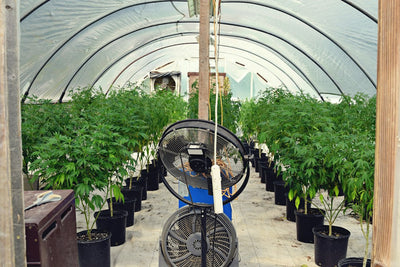
Photo by Terre di Cannabis via Unsplash.
Every operator I've ever talked into (or out of) a scale-up has done the same napkin math: double the canopy, double the pounds, double the revenue. It's clean arithmetic and it's almost never how it plays out. The wholesale market over the last three years has punished exactly this kind of thinking, taking down operators who added square footage without first fixing what it actually cost them to grow a pound. Scaling isn't a growth strategy on its own — it's a magnifier, and it magnifies whatever cost structure you already have, good or bad.
Here's the part that's genuinely changed: wholesale prices have stabilized in 2026 after bottoming out badly in early 2025. That's real, and it matters. But "stabilized" is doing a lot of work in that sentence, because the national number hides state markets that couldn't be more different from each other — one state running near $4,500 a pound, another sitting under $700. The question worth asking isn't whether you can grow more product. It's whether you can grow it cheaply enough to survive in a legal market that, by one credible estimate, has built out production capacity equal to roughly 600% of legal demand. And just to complicate the timing, a major regulatory shift landed in April 2026 — rescheduling to Schedule III — that changes the economics meaningfully for some license types and not at all for others. Getting this wrong isn't a rounding error. It's the difference between a business and a very expensive greenhouse.
The Wholesale Price Picture You're Actually Scaling Into

U.S. cannabis spot prices climbed from $888/lb in January 2025 to over $1,050/lb by mid-2026, with a projected rise to $1,077/lb by August 2026, marking a roughly 20% increase over the period.
The U.S. Cannabis Spot Index sat at roughly $1,056 a pound as of May 8, 2026. That's a meaningful recovery from the $888/lb low it hit on January 3, 2025, and it tracks with a 2025 that closed at $1,078/lb — about a 15% rebound off the bottom. Analysts covering the spot index are projecting the price to hold in a fairly tight $1,070-$1,085/lb band through August 2026. So if your mental model of this market is still "prices are in free fall and will never stop," that story is out of date. What's replaced it is arguably less comfortable: prices have found a floor, but it's a historically thin floor, and there's no indication of a return to the $2,000+/lb wholesale environment some operators built their original business plans around.
None of that national number tells you much about the market you're actually operating in, though. Michigan, one of the largest and most mature markets in the country, is averaging $656.96/lb for flower, $343.91/lb for shake and trim, and $2,140.61/lb for concentrate — flower prices well below the national spot index, a sign of a market that's been oversupplied for a while and has priced accordingly. Minnesota tells the opposite story. Its adult-use market only launched in August 2024, and wholesale flower there has held above $4,500 a pound, more than four times the Michigan number, with just 96 licensed retail sites active as of early 2026. That's not a fluke — it's what a market looks like before supply has caught up to demand.
The practical takeaway is blunt: the state you're scaling into matters more than how ambitious your plans are. A grower adding 10,000 square feet in a mature, saturated market and a grower adding the same footprint in a new, undersupplied state are running two entirely different businesses, even if their build costs and genetics are identical. Any scaling decision that doesn't start with an honest read of your specific state's wholesale trendline is starting from the wrong number.
Why Production Costs, Not Price, Decide Who Survives Scaling

Photo by CRYSTALWEED cannabis via Unsplash.
Price gets all the attention because it's the number everyone can see. Cost per pound is the number that actually decides who's still in business in two years, and it's far more within your control. Efficient operators — usually large-scale greenhouse or well-optimized indoor operations in favorable climates — are producing a pound of finished cannabis for around $150 or less. Inefficient operations, often burdened by high energy costs, restrictive local rules, or poor facility design, can run as high as $1,000 a pound. That's not a small spread. It's the difference between a business with room to survive a downturn and one that's technically insolvent every time it sells.
Run the math at today's roughly $1,056/lb spot price. The $150/lb grower is clearing something in the neighborhood of $900 a pound before overhead and taxes — real, durable margin. The $1,000/lb grower is losing money on essentially every sale before you even get to debt service or SG&A. Scaling doesn't fix that gap; it multiplies it. Ten thousand square feet of a broken cost structure loses ten times what one thousand square feet loses. This is the part that gets skipped in a lot of investor decks, where growth is treated as inherently additive to value.
Setup costs compound the risk. A commercial indoor build typically runs $75 to $100 per square foot once you account for HVAC, lighting, electrical service upgrades, and buildout. A modest 20,000-square-foot indoor facility can mean $1.5 to $2 million in capital before you've planted a single seed — and that's before you know if your operating costs will land you on the $150 or the $1,000 side of the ledger. Climate and building type explain most of that spread. Sun-assisted greenhouses and light-deprivation outdoor operations in the right climate routinely beat sealed indoor rooms on cost per pound, because they're not paying for artificial light and full climate control around the clock. Scaling should mean scaling a cost advantage you've already proven, not betting that volume alone will rescue a facility type that was never going to be cheap to run.
The Oversupply Problem Nobody's Business Plan Accounts For

Photo by Giant Asparagus via Pexels.
Beau Whitney of Whitney Economics has been tracking this more rigorously than most, and his number is worth sitting with: legal U.S. cannabis production capacity is currently enough to satisfy roughly 600% of legal demand. That's not a typo or a rounding exaggeration — it's a structural oversupply that no amount of individual operator discipline fully escapes, because it sets the market price everyone sells into. Whitney's own framing is direct: the industry is "oversaturated with supply, leading to price compression," and for a lot of operators, prices now sit below the actual cost of production. That's the environment layered underneath the state-by-state variation covered above — even the healthier states are competing inside a national and increasingly global glut.
The oversupply story isn't confined to the U.S. anymore. More than 110 countries now allow some form of cannabis access, and a good number of newer markets are ramping cultivation capacity faster than their legal consumer bases can grow into it — the same mistake U.S. states made a few years earlier, now playing out on a bigger stage. That matters for anyone thinking about scaling for export opportunities down the road; the runway may be shorter than it looks.
The consequences of this are no longer theoretical. The industry logged its first-ever jobs contraction, with roughly 412,500 legal cannabis jobs in early 2026 — down 2.7% year over year. That's an industry that grew headcount every single year of its existence, until it didn't. Annual retail revenue told the same story from the other direction: $29.1 billion in 2025, the first year-over-year decline since 2014. Put those two numbers together and the picture is unambiguous. Scaling into an industry that's shrinking in aggregate revenue and shedding jobs is a fundamentally different bet than scaling into the growth-at-any-cost environment of 2018 through 2021, and it needs to be underwritten that way.
Where the Growth Actually Is: Mature vs. Emerging Markets

Photo by Cova Software via Unsplash.
National contraction doesn't mean every market is contracting equally, and the state-level job data makes that split obvious. California and Michigan remain the industry's two largest employers, with roughly 57,500 and 42,500 cannabis jobs respectively — but both markets shrank over the past year. These are mature markets that scaled hard early, hit oversupply, and are now shedding capacity and labor as prices compress. Being the biggest market doesn't protect you from being a saturated one.
New York is the standout counterexample. The state added 16,160 jobs — 129% growth — to reach 28,660 total, by far the strongest growth story in the industry over 2025-2026. That's what a market still building out its legal retail and cultivation infrastructure looks like when demand is genuinely outrunning licensed supply, rather than the other way around. Maryland and Ohio show smaller versions of the same pattern: Maryland gained 3,500 jobs and Ohio added 2,596, both markets still early enough in their build-out that new capacity is being absorbed rather than crushing wholesale prices.
Minnesota belongs in this same conversation, even though its job numbers are smaller in absolute terms. A tight retail footprint of just 96 licensed stores, paired with wholesale flower prices above $4,500 a pound, is close to a textbook picture of a market before oversupply sets in — retail access is the binding constraint, not cultivation capacity, which is the opposite of where Michigan or California sit today.
The read for anyone deploying capital into expansion is straightforward: chase market maturity stage, not population size or a state's legalization headline. A state with 20 million people and a five-year-old, fully licensed, saturated supply chain is a worse bet for new canopy than a state a fraction of the size that's still under-licensed on the retail side. The job and wholesale-price data are lagging indicators of exactly that maturity curve, and they're publicly available before you sign a lease or break ground.
Rescheduling Just Rewrote Half the Tax Equation

Photo by Tara Winstead via Pexels.
On April 22, 2026, Acting Attorney General Todd Blanche signed the final order moving FDA-approved marijuana products and state-licensed medical marijuana from Schedule I to Schedule III, effective April 28, 2026. This is the most consequential regulatory change the industry has seen in years, and it landed with less industry-wide impact than a lot of operators assumed it would when rescheduling talk first started circulating.
The reason is Section 280E. That's the federal tax code provision that has forced cannabis businesses to pay tax on gross profit rather than net income, since Schedule I status barred them from deducting ordinary business expenses like rent, payroll, and marketing the way any other legal business could. With medical marijuana moved to Schedule III, 280E no longer applies to state-licensed medical operators going forward — a direct, immediate improvement to their effective tax rate and, by extension, their real margin at any given wholesale price.
Here's the catch that's tripping people up: adult-use and recreational marijuana remains Schedule I. Nothing about the April order changes that. If your business is licensed for adult-use sales — which is the majority of volume in states like Michigan, California, and increasingly Minnesota and New York — you're still fully subject to 280E and get none of this tax relief. Two operators growing the same plant in the same state, one under a medical license and one under adult-use, are now looking at materially different effective tax burdens for what is, physically, an identical product.
There's a broader process still unresolved. A separate DEA administrative hearing addressing rescheduling of marijuana more generally is set to begin June 29, 2026 in Arlington, Virginia, with a mandated conclusion by July 15, 2026. Attorneys following the proceeding are cautious about reading too much into it — a final rule extending Schedule III treatment, or something further, to adult-use marijuana isn't guaranteed, and even if it comes, implementation won't be instantaneous. For anyone building a scaling plan right now, the honest starting point is figuring out which license type you actually hold, because that answer determines whether this regulatory shift touches your margins at all — not the market's mood, and not what the headlines implied.
Building a Scaling Plan That Survives This Market

Photo by Vitaly Gariev via Unsplash.
A pro forma built on $2,000-plus-per-pound wholesale pricing — the kind of number that made sense in 2018 through 2020 — belongs in a filing cabinet, not a bank presentation. Model against the market you're actually selling into: $1,050-$1,080/lb as the realistic national range right now, adjusted down or up hard for your specific state's actual wholesale trendline, whether that's Michigan's sub-$700 flower price or Minnesota's $4,500-plus environment.
Before adding a square foot, get an honest cost-per-pound audit of your current operation. Know, with real numbers, whether you're closer to the $150/lb efficient end of the spectrum or the $1,000/lb end. This is not a number to estimate from memory or from what your build contractor told you two years ago — energy costs, labor, compliance overhead, and crop loss rates all move that number, and they move it in your specific facility, not the industry average.
Genetics matter more at scale than most business plans give them credit for. Inconsistent phenotypes, weak disease resistance, or genetics not suited to your specific light and climate setup translate directly into crop loss, and crop loss at scale is what turns a break-even quarter into a loss quarter. Starting with well-bred, consistent seed stock — which is a lot of what we focus on at Seedtiva — won't fix a bad cost structure, but it removes one of the more controllable sources of margin risk before you've committed capital to more canopy.
Phase any expansion in stages tied to actual sell-through and cash flow, not a single day-one build to full capacity. Building out 40,000 square feet on the assumption that wholesale demand will be there to absorb it is exactly the bet that's wrecked operators over the past two years. Finally, track your specific state's market maturity signals on an ongoing basis — retail license counts, wholesale price trendlines, and job growth data are all public and updated regularly. Committing capital to more canopy without checking those numbers first is no longer a defensible way to run this business.
Walk through any list of operators who are actually profitable right now and the pattern isn't square footage, brand recognition, or even genetics — it's cost discipline that existed before they scaled. The $150/lb grower who added canopy carefully is thriving in a market running at 600% of legal demand. The $1,000/lb grower who added canopy anyway is not, no matter how good their marketing or their retail relationships are. Scale was never the strategy. It was always just a multiplier on whatever was already true about the business.
Rescheduling to Schedule III is real relief, and for state-licensed medical operators it shows up immediately on the bottom line through the end of 280E. But it's not the industry-wide reset that a lot of operators were quietly hoping for when rescheduling chatter started years ago. Adult-use licensees — the majority of the market's volume — are still taxed as if they're selling a Schedule I substance, and whether that changes depends on a DEA hearing process that concludes in July 2026 with no guaranteed outcome attached to it. Plan around the law as it exists today, not the law you expect might exist in a year.
If there's one filter worth applying to every expansion decision from here forward, it's this: you're not betting on the cannabis industry's national growth story, because right now there isn't much of one to bet on. You're betting on one specific state's supply-demand curve, at one specific point in its maturity, against your own specific cost structure. Get any one of those three wrong and the other two won't save you.
Sources
- How Much for a Pound of Weed: 2026 Cannabis Price Breakdown
- How Much Does It Cost to Grow Cannabis Indoor? – Business Plan Templates
- Commercial Cannabis Production Costs: What’s Included in the Cost to Produce a Pound of Flower? | Next Big Crop
- How Much Is a Pound of Weed: Wholesale vs. Retail in 2026
- Cannabis Cost Per Pound: The Number That Determines Survival ...