Supercropping: The High-Stress Technique for Bigger Colas
Photo by Kindel Media via Pexels.
Walk into any serious grow room during week 4 of veg and you'll probably see someone with two fingers wrapped around a stem, squeezing and rolling it like they're trying to start a fire. That's supercropping, and despite looking like plant abuse, it's one of the more reliable structural training techniques available to home growers. The idea is simple: you deliberately crush the inner tissue of a stem while leaving the outer skin intact, then bend the branch over until it droops. No tissue removed, no cutting, no scissors involved at all.
That's the key difference from topping or FIM, where you're slicing off growing tips to force branching. Supercropping doesn't remove anything -- it injures the stem internally so the plant is forced to rebuild it thicker and stronger at that exact point. The visible result over the following days is a canopy that flattens out instead of growing into a single dominant spire, with light reaching bud sites that would otherwise sit in permanent shade under the main cola.
The mechanical payoff is real and easy to explain: thicker, reinforced stems that can carry heavier colas into late flower without snapping, often without needing a single stake or trellis line. The potency payoff is where growers tend to oversell things. There's a popular belief that the stress itself triggers a defensive surge in resin or THC production. It's a plausible story, but it hasn't held up to rigorous testing. What has held up is the light penetration argument, and that's where we'll spend most of this piece.
What Supercropping Actually Does to the Stem
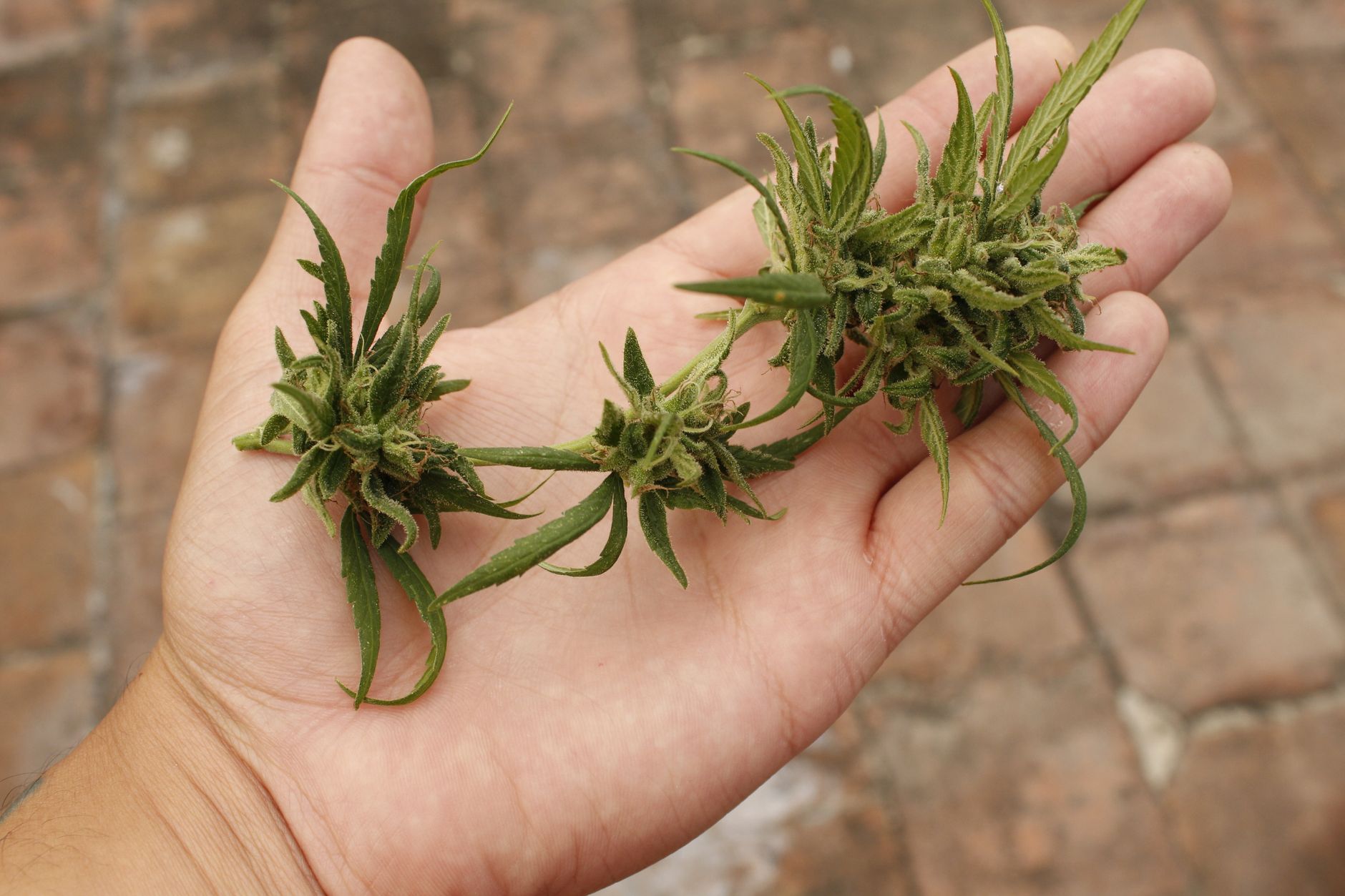
Photo by Alexis Cervantes via Pexels.
Supercropping works on the inner stem, not the tough fibrous shell that gives the branch its shape. You pinch a section of branch between your thumb and forefinger, usually a few inches below a node, and roll it gently back and forth. You're not trying to crush it flat in one motion -- you're working the tissue until it goes from rigid to soft and pliable, the same way you'd work a stiff joint loose. This usually takes somewhere between 10 and 20 seconds of steady pressure, and you'll actually feel the change happen. The stem stops feeling brittle and starts feeling almost rubbery.
Once it's pliable, you bend it slowly, aiming for roughly a 90-degree angle, until the branch droops over instead of standing upright. The skin -- the outer green layer -- should stay intact through this whole process. What's happened underneath is that the xylem and inner fibers have ruptured while the epidermis holds everything together like a cast.
This is fundamentally different from topping or FIM, where you're cutting off the apical meristem to force the plant into producing two colas instead of one. Topping removes growing tips and changes where new growth happens. Supercropping reshapes branches that already exist, bending the plant's existing architecture into something flatter and more even. The goal isn't more colas -- it's better light distribution to the colas you've already got, especially the lower and mid-canopy bud sites that spend most of veg living in the shadow of whichever branch won the race to the top.
Sometimes you'll misjudge the pressure or the bend and the skin splits open. It's not a disaster, but it does need attention -- wrap the site loosely with plant tape or splint it with a straw or soft tie so the branch can heal in position rather than flopping over and tearing further. Keep an eye on it over the next few days rather than walking away and hoping for the best.
When to Supercrop: Timing and Recovery Windows

Photo by Juan Miguel Restrepo Barrera via Pexels.
Timing is where most first-time supercroppers get impatient. The plant needs to actually be established before you start bending it around -- most growers wait until there are at least 3 nodes of solid growth, and plenty prefer to hold off until 4 or 5 nodes with clear, vigorous vertical growth showing. That vertical push is a sign the plant has a strong enough root system and stem structure to handle the injury and rebuild from it.
Seedlings and clones that are still rooting in are off-limits entirely. A young plant that hasn't developed real stem rigidity yet doesn't have the structural reserves to callus over a crush injury -- you're more likely to snap it clean through or stunt it for a week than to get any useful reshaping out of it. Let it get its legs under it first.
Once you start, don't treat it as a one-time event. Repeat sessions should be spaced 5 to 7 days apart, giving each bend time to callus and stabilize before you introduce the next round of stress. Stacking bends too close together on the same branch, or hitting a plant that's still visibly stressed from the last session, just compounds the damage without giving it time to convert that damage into useful reinforcement.
The hard stop is the flip to flowering. Once a plant shifts into bud production, its energy budget reorganizes entirely around that process, and structural stress at that point competes directly with flower development instead of feeding into better canopy architecture. Supercropping during flower doesn't build a stronger plant -- it just costs you yield you were otherwise going to collect. Treat late veg and the very early pre-flip period as your last safe window, and plan your final bend a week or two before you switch the lights to 12/12, so everything has time to callus and settle before the plant's priorities change.
The Knuckle: How Damaged Stems Become Stronger Stems

Photo by Jave Lr via Pexels.
What heals at the bend site isn't a clean repair -- it's a callused ridge, often visibly thickened and sometimes discolored, that growers refer to as the knuckle. It looks a little rough, occasionally almost woody, and it's permanent. That's not cosmetic damage you need to worry about; it's exactly what you were aiming for.
That knuckle functions like a scar, and scar tissue in plant stems, much like in other biological tissue, tends to be denser and more reinforced than the material it replaced. A branch that's been properly supercropped and calloused at the bend point can often carry more weight at that spot than the original round stem ever could, because the plant has laid down extra fibrous material specifically in response to the injury.
This matters most in late flower, when colas swell and dense buds start putting real weight on branches that were never designed to hold that much mass while flowering. Untrained plants frequently need stakes, trellis netting, or a full scrog setup just to keep the heaviest colas from bending over or snapping outright under their own weight, sometimes taking the whole branch down with them a week before harvest. A well-timed supercropping schedule earlier in veg builds a lot of that support directly into the plant's own structure, which means fewer branches need external staking by the time buds are heavy and dense.
You don't have to wait long to know whether a bend worked. Within 24 to 48 hours, a properly supercropped branch will visibly stand back up on its own, but at a new, flatter angle than before -- that's the plant redistributing growth hormone to the bend site and beginning the repair process in real time. If a branch is still hanging limp after two or three days with no sign of recovery, check it for a full snap through the skin and consider splinting it rather than assuming it's just taking longer.
Bigger Colas: Separating Light Penetration From the Potency Myth
The stress-triggers-more-resin theory is everywhere in grower forums, and it's not an unreasonable hypothesis on its face -- plants under attack from insects or pathogens do ramp up certain defensive compounds, and cannabinoids and terpenes do have documented roles in plant defense. But 'plausible mechanism' isn't the same as 'proven outcome,' and nobody has produced controlled trial data showing that supercropping specifically drives up THC content. Treat that part of the technique's reputation as folklore until better evidence shows up.
What does hold up under controlled research is much simpler and, honestly, more useful: light distribution. In an untrained plant, one or two dominant colas race ahead of everything else and shade the bud sites underneath them for the entire flowering cycle. Supercropping physically removes that competitive advantage by bending the tallest branches down to canopy height, so light that used to hit only the top now reaches bud sites that were previously sitting in permanent shadow.
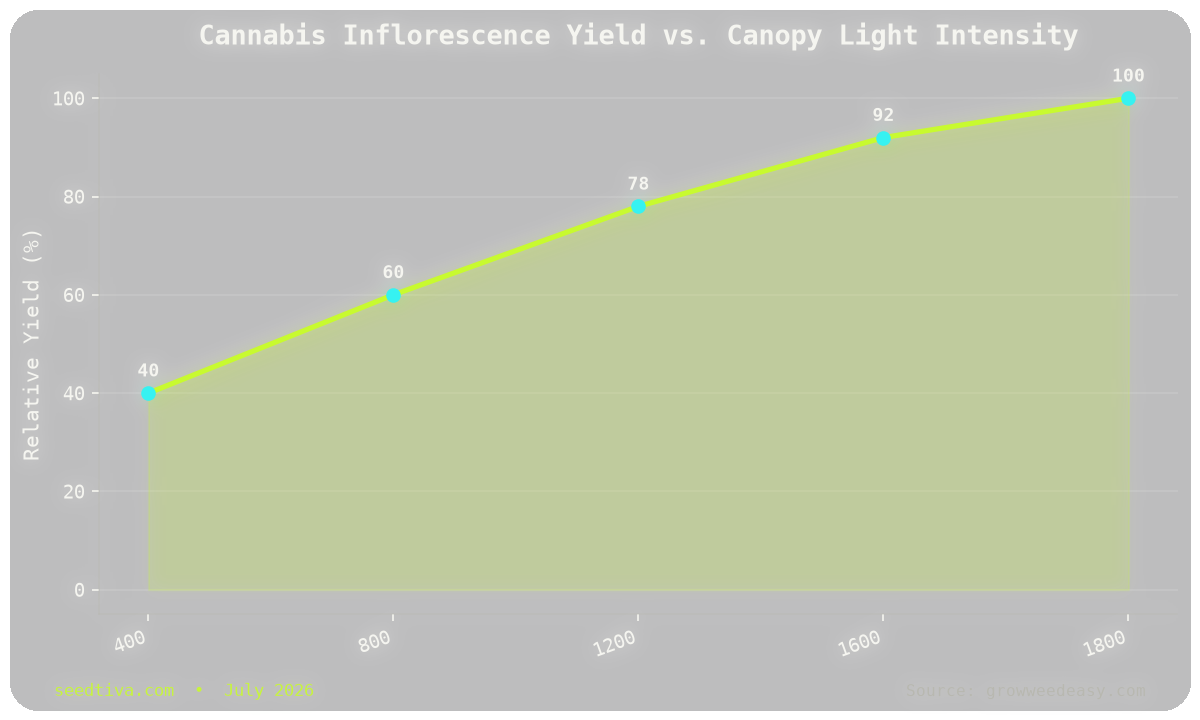
Peer-reviewed indoor cannabis research backs up why that matters so much. Studies looking at inflorescence yield against canopy-level light intensity found yield increasing in a roughly linear relationship with light up to around 1,800 µmol/m²/s of PPFD, with only minor shifts in secondary metabolites and essentially no measurable effect on CBD content. In plain terms: more usable light hitting bud sites reliably produces more flower, and the cannabinoid profile doesn't swing wildly just because you changed the light environment.
Put those two facts together and the real driver behind bigger colas after supercropping isn't the injury itself, it's the redistribution of light that the injury makes possible. A flatter canopy simply captures and uses more of your available PPFD instead of letting the top third of the plant hog it. If you're chasing bigger colas, think of supercropping as a light-management tool first and a stress-response gamble a distant second.
Step-by-Step: How to Supercrop Without Killing a Branch

Photo by Kindel Media via Pexels.
Start by scanning the canopy for branches that are clearly winning the race -- the main stem and usually the top 2 or 3 colas that have pulled ahead of everything else and are casting shade on growth below them. Those are your targets. Leave weaker, lower branches alone; they need every bit of light they can get, not more stress.
Pick your spot on the chosen branch, usually a few inches below the node, and use your thumb and forefinger to squeeze and roll it steadily for about 10 to 20 seconds. You're feeling for a transition from rigid to soft and pliable -- brittle resistance means you're not there yet, and pushing through brittle resistance is how you get an ugly, uncontrolled snap instead of a clean bend.
Once it's pliable, bend slowly to roughly 90 degrees. The moment you feel the resistance change from stiff pushback to a soft droop, stop. That droop is your signal the inner tissue has given way while the skin held. If instead you feel a sharp give and the skin tears open, don't panic -- tape it loosely or splint it with a straw or a soft plant tie, keep the plant well watered over the next few days, and check back daily until it calluses.
Water and feed the plant normally afterward. Resist the urge to combine supercropping with other major stress events on the same day -- a transplant, a heavy defoliation pass, a nutrient change -- since stacking multiple stressors gives the plant too much to recover from at once and slows down every part of the process.
One thing worth saying plainly: genetics matter here more than most growers expect. Vigorous, well-bred plants callus faster, bounce back within that 24-48 hour window more reliably, and tolerate a slightly aggressive bend without sulking for a week. Starting with quality seeds pays off directly when you're planning on training plants this hard through veg.
It's worth being blunt about what supercropping actually is: a structural fix dressed up with a dramatic name. You're managing canopy shape and building mechanical strength into the plant's frame, and the fact that it happens to look like a stress technique doesn't mean the stress is doing the heavy lifting. Think of it as canopy management with a strength-training side effect, not a shortcut to higher THC numbers.
The technique punishes impatience on both ends. Bend a plant before it's established enough nodes and you risk snapping a branch that had no business being trained yet. Bend it too close to the flip, or worse, into early flowering, and you're pulling energy away from bud development at exactly the point the plant needs it most. The growers who get the most out of supercropping are the ones who treat the 5-7 day recovery windows as non-negotiable and stop a week or two before 12/12, not the ones who push for one more session because the top cola still looks a little tall.
Used well, supercropping pairs naturally with topping and low-stress training, and all three techniques are ultimately solving the same problem from different angles: getting more of your canopy into direct, usable light. If you're running supplemental lighting, that research ceiling around 1,800 µmol/m²/s of PPFD is a genuinely useful target to build a schedule around, since yield tracked upward with intensity right up to that point in controlled studies. Get your canopy flat, get your light intensity into range, and let the genetics do the rest -- outcomes will still shift with your strain, climate, and setup, but that combination is where the real, repeatable gains actually come from.
Sources
- Super Cropping Marijuana: Simple Secret to Bigger Yields | Grow Weed Easy
- Grow Tips : Super Cropping | THC Design
- Super crop your way to bigger weed yields: A complete guide - CannaConnection
- Super Cropping Cannabis: How to Supercrop for Bigger Yields | Seed Supreme
- Cannabis Super Cropping: How, When, And Why To Do It - RQS Blog