The Fake Farm Playbook: How Illegal Grows Hide in Plain Sight
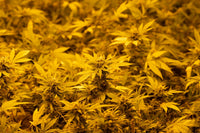
Photo by Gio Bartlett via Unsplash.
Picture a chain-link fence, a gravel drive, a handful of workers moving irrigation line at dawn, and a sign out front referencing an LLC nobody's ever heard of. That's not a scene from some Prohibition-era mountain hollow in the 1980s. That's a working template in 2026, and enforcement agencies from New Jersey to the Navajo Nation are still chasing it.
The trick is old, but it hasn't aged out of usefulness: build something that looks like a licensed farm, keep the paperwork current, pay the local taxes on time, and let the appearance of compliance carry the operation past the people who'd otherwise ask questions. Two recent cases show how differently this plays out depending on scale and jurisdiction. One involves a state-licensed New Jersey cannabis company running an unauthorized outdoor grow that regulators say was deliberately disguised to look like an approved cultivation site. The other involves a sprawling operation near the Navajo Nation that used hemp-growing claims and tribal jurisdictional ambiguity to mask what turned into a multimillion-dollar illegal marijuana enterprise.
Different scale, different legal terrain, same underlying logic. In both cases, the paper trail said one thing while the crop behind the fence said another. Understanding how that gap gets created -- and how it eventually gets exposed -- matters whether you're running a licensed grow trying to stay clean or just trying to understand why the legal market keeps getting more heavily audited every year.
Why a Legitimate Front Works So Well

Photo by Stephen Leonardi via Pexels.
A legitimate agricultural license is one of the most effective camouflage tools available to an illegal grower, because it doesn't just provide a legal excuse -- it provides an entire operational alibi. Large outdoor acreage, high water draw, tall security fencing, generators, greenhouses, heavy equipment rolling in and out on a schedule: all of that reads as suspicious on an unpermitted property, and completely unremarkable on a licensed hemp or cannabis farm. The license doesn't just authorize the activity, it explains it to everyone who might otherwise look twice.
That's the real value of the front. Neighbors expect a working farm to have workers, irrigation, and greenhouses, so nobody calls it in. Regulators doing routine drive-bys see the visual signature they're trained to associate with normal cultivation and move on. The disguise isn't really about fooling a forensic inspection -- it's about not triggering the casual scrutiny that would lead to one in the first place.
Paperwork does the rest of the work. Business registrations, local tax payments, permit renewals -- these create a documentary record that looks exactly like compliance, because in a narrow sense it is. A company can be scrupulously current on its township tax bill while running product that has nothing to do with what it's licensed to grow. Auditors and municipal clerks aren't crop inspectors; they see a paid invoice and check a box. That gap between administrative compliance and agricultural reality is precisely where these operations live.
Then there's the plant itself. Industrial hemp and drug-type cannabis are genetically close enough that in early vegetative growth, they're effectively indistinguishable to the naked eye -- same leaf structure, same growth habit, same green rows from a road or a low-altitude flyover. Telling them apart requires either flowering-stage trichome and bud development or an actual lab test for THC content. That built-in ambiguity means a hemp license can cover a lot of ground, literally, before anyone has grounds to demand a sample.
Case Study: Mollitiam NJ and the Disguised Cultivation Site

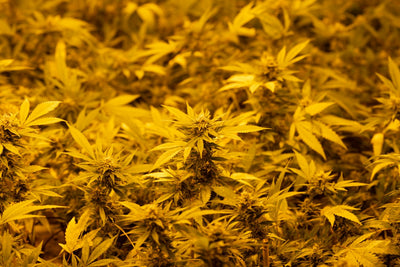
Photo by CRYSTALWEED cannabis via Unsplash.
Mollitiam NJ, LLC held a state cannabis cultivation license, which should have meant its outdoor growing was confined to an approved footprint under New Jersey Cannabis Regulatory Commission oversight. Instead, state regulators say the company operated an unauthorized outdoor grow site that had been deliberately made to resemble an approved cultivation area -- the kind of visual matching, right down to layout and fencing, that only makes sense if you're trying to survive a windshield inspection or a satellite pass without raising flags.
Former commissioner Charles Houenou didn't mince words about it. He called the disguise efforts egregious, noting that a licensed operator knowingly hiding unauthorized crop crosses a clear and unambiguous line -- this wasn't a paperwork lag or a boundary miscalculation, it was intentional concealment by a party that understood exactly what it was licensed to do and did something else.
Money helps explain the motive. Mollitiam had raised roughly $7 million to get going -- $1.6 million in seed capital plus $5.4 million in debt. That's a capital structure that demands yield, and fast; debt service doesn't wait for a slow first season or a licensing delay. When the legal, licensed footprint isn't producing volume quickly enough to service $5.4 million in obligations, the incentive to quietly expand beyond it becomes obvious, even if the mechanics of doing so are reckless.
Regulators eventually moved on both ends of the business. The state suspended the company's license and shut down its indoor growing facility in a Plainfield warehouse, cutting off the legitimate side of the operation along with the disguised one. Meanwhile, local tax records from Andover Township show the company kept paying its bills right through the scrutiny -- $9,455 in December 2025, then $4,017 in January 2026. Those payments kept the legitimate front looking active and current even as investigators were actively unwinding the unauthorized grow behind it, which is exactly the kind of dissonance that makes these cases so hard to catch early.
Case Study: Hemp Claims and the Navajo Nation Marijuana Operation

Photo by CRYSTALWEED cannabis via Unsplash.
Near Farmington and Shiprock, New Mexico, an operation tied to Dineh Benally ran on a different kind of cover entirely: not a state cannabis license, but claims of legal hemp cultivation on Navajo Nation land. Hemp had been federally legalized, and tribal sovereignty adds a genuine layer of jurisdictional complexity -- state regulators don't have automatic authority on tribal land, and tribal enforcement capacity for large-scale agricultural fraud is often thin. That combination created a gray zone wide enough to build serious infrastructure in.
And the infrastructure was serious. Multiple large greenhouse complexes went up across the area, backed by significant labor and construction investment, all nominally growing hemp for a legal fiber-and-CBD market. Because the operation could point to hemp-growing authorization and tribal land status, it faced far less routine oversight than a comparable operation would have on state land -- fewer permit checks, less cross-agency coordination, no obvious state regulator whose job it was to show up and ask for lab results.
What actually broke it open wasn't an audit or a compliance review. It was smell. In October 2020, Farmington police responded to complaints from residents about an overpowering odor coming from the direction of the greenhouse operation -- the same kind of complaint that ends countless illegal grows everywhere, tribal land or not. When police and investigators got onto the property, they found the hemp claims didn't match the crop: this was marijuana, grown at real scale.
The numbers made clear this was never a small mistake. Investigators recovered roughly 2,000 pounds of processed marijuana, with an estimated street value between $3 million and $10 million depending on how it would have been broken down and sold. That's not a farm that drifted off its hemp registration by accident -- that's an industrial-scale marijuana operation that had been running under hemp paperwork for a long stretch. The scale of the greenhouse construction alone, the labor force required to run it, the volume of water and inputs involved -- all of it should have drawn scrutiny well before a smell complaint finally forced the issue.
The Tells: How These Operations Actually Get Caught

Photo by Red Zeppelin via Unsplash.
Odor is still the number one reason these operations get caught, and it's not close. Flowering cannabis in the last four to six weeks before harvest throws off a strong, distinctive terpene signature that carries hundreds of yards downwind, especially across open outdoor acreage with no building or canopy to contain it. Hemp growers rarely generate complaints at this volume; large-scale drug-type cannabis growers almost always do, eventually, regardless of how good their paperwork looks.
Utility and resource use is the second big tell, and it's the one regulators can check without ever setting foot on the property. A licensed crop of a given acreage has a fairly predictable water draw and electrical load. When metered usage runs well above what the permitted crop size would require, that mismatch shows up in an audit long before anyone smells anything -- it's one of the cleaner, harder-to-fake red flags in the whole system.
Security posture gives a lot away too. A legitimate hemp or vegetable farm doesn't typically need bright perimeter lighting running all night, a rotating guard presence, or access restrictions that go well beyond keeping deer out. When a site's security investment looks more like it's protecting high-value contraband than protecting a low-margin fiber crop, that disproportion is itself a signal worth investigating.
Aerial and drone surveillance close the gap that ground-level inspection can't. Hemp grown for fiber or CBD has a characteristic growth profile -- plant density, canopy height, and flower structure that reads differently from high-THC cannabis bred and grown for dense, trichome-heavy bud production. Trained eyes, and increasingly automated image analysis, can pick out that difference from altitude well before harvest, without needing a ground sample.
Finally, the paperwork itself eventually fails on its own terms. Regulators cross-checking reported yield against actual harvested volume, or comparing sequential filings for internal consistency, routinely turn up backdated permits, mismatched batch numbers, or harvest reports that simply don't square with the acreage on file. The disguise has to be maintained perfectly across every document and every season. It only has to fail once.
Why Legitimate Growers Pay the Price for This
Every one of these busts ripples outward past the operation that got caught. Regulators respond to a disguised grow the same way they respond to any exploited loophole: by tightening the system for everyone. Licensing audits get more frequent, site inspections get less predictable, and reporting requirements pick up new fields that every operator, compliant or not, now has to fill out. The bad actor moves on or shuts down; the compliance burden stays behind for the rest of the industry.
Legitimate cultivators absorb that cost in ways that are easy to underestimate. Compliance fees climb. Permit review timelines stretch out because agencies now have to allocate more staff hours to verification rather than approval. And there's a softer cost too -- neighbors and local officials who've read about a disguised grow up the road get understandably more suspicious of any large fenced cultivation site, licensed or not, which makes routine community relations harder for operators who've never done anything wrong.
Provenance is one of the clearest defenses against getting lumped into that suspicion. An operation growing from quality, well-bred seeds with clear genetic lineage and documented sourcing has a straightforward answer when regulators or inspectors come asking what's actually in the ground -- the genetics are traceable back to a known source, not an unexplained crop that showed up on paperwork nobody can fully account for. That traceability doesn't just matter for quality and consistency in the final product; it's part of the defensible record that separates a legitimate grow from one that merely looks like one.
It's worth remembering, too, that none of this plays out uniformly. New Jersey's cannabis regulatory framework is aggressive about site audits and license suspension precisely because the state has a young, closely watched legal market it's trying to protect. Tribal jurisdictions operate under an entirely different enforcement structure, with different resources and different lines of authority between tribal and state or federal agencies. What gets flagged and shut down quickly in one place might sit for years in another before anyone with the right authority notices. Growers, investors, and regulators all need to understand that the enforcement environment is genuinely regional, not a single uniform standard.
Every version of this trick runs on the same clock. A small hemp field growing a little cannabis on the side can hide behind ambiguity for a while. A 2,000-pound harvest cannot. Scale is what eventually breaks the disguise, because volume produces odor, water draw, electrical load, and traffic patterns that no amount of tidy paperwork can fully mask. The New Jersey and Navajo Nation cases sit at very different points on that scale, but they both ended the same way -- the physical reality of the crop outran the story the documents were telling.
Enforcement is getting better at closing that gap faster. Drone and aerial surveillance are more routine, utility-usage cross-checks are more automated, and agencies are sharing data across jurisdictions in ways that make a disguised site harder to sustain quietly for years. But the underlying incentive hasn't gone anywhere. As long as legal cannabis prices stay meaningfully higher than the cost of growing it, someone is going to run the math and decide a fake front is worth the risk, license or no license, tribal land or state land.
For anyone running a legitimate operation, the practical takeaway is straightforward: transparency and traceable genetics cost less than camouflage, every time, over the life of a business. A defensible paper trail that matches what's actually growing in the ground is cheap insurance against the kind of scrutiny that's only going to keep intensifying across this industry.
Sources
- NorCal authorities bust dozens of illegal cannabis grows | KRON4
- The cannabis industry’s trafficked workforce | KNSI
- California Police Destroy $1 Billion Pot Grow Disguised as Industrial Hemp Plot – MERRY JANE
- The cannabis industry’s trafficked workforce - KVIA
- The cannabis industry’s trafficked workforce | KRDO